While Apollos was in Corinth, Paul passed through the interior regions and came to Ephesus, where he found some disciples. He said to them, “Did you receive the Holy Spirit when you became believers?” They replied, “No, we have not even heard that there is a Holy Spirit.” Then he said, “Into what then were you baptized?” They answered, “Into John’s baptism.” Paul said, “John baptized with the baptism of repentance, telling the people to believe in the one who was to come after him, that is, in Jesus.” On hearing this, they were baptized in the name of the Lord Jesus. When Paul had laid his hands on them, the Holy Spirit came upon them, and they spoke in tongues and prophesied— altogether there were about twelve of them.
—————————————————————————————————–
This is the Epistle selection for the first Sunday after the Epiphany, Year B. It will next be read aloud in church on Sunday, January 7, 2018. It is important because it clearly restates that baptism by the Holy Spirit (not water) is what makes one truly Christian.
The first Sunday after the day recognized as the Epiphany (January 6) always deals with Jesus being baptized by John the baptizer (Matthew 3:13-17 Year A; Mark 1:4-11 Year B; and Luke 3:15-22 Year C) and the Holy Spirit descending like a dove on Jesus. Therefore, this reading from Acts 19 is selected to accompany the Gospel reading from Mark because it deals with Paul addressing this issue of baptism by the Holy Spirit.
This short reading should be printed out on business cards and made freely available for all church-goers, to take and hold in their wallets and purses, just so they will all know the difference between being a devoted believer and a committed servant of the LORD.
It is my estimation that the vast majority of those claiming to be Christians today are very much like those Paul encountered way back when in Ephesus. They admitted they were baptized by water, but those Ephesians had “not even heard that there is a Holy Spirit.” While people today have heard of the Holy Spirit, Christians nowadays are just as ignorant as were those Ephesians.
When I say “ignorant,” I mean they are “lacking education or knowledge” about what the Holy Spirit means. That learning experience can only come by knowing God.
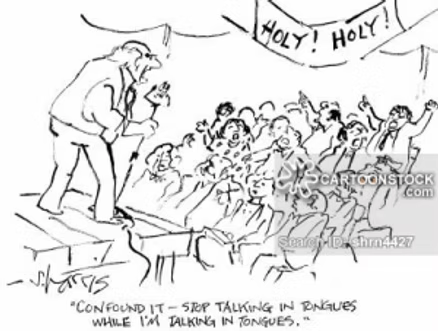
It cannot be imitated physically: through song (uplifting feelings of joy due to the vibrations of vocal chords) or dance (near ecstatic loss of bodily control through wildly moving, so fast, for so long, that sweat pours out of bodily pores and the depletion of salt makes one’s head spin). One cannot make unintelligible sounds (clucking, clicking, or otherwise making noises with one’s tongue) and allow others to think one is speaking what the Holy Spirit tells one to speak. Neither can one pretend to interpret the nonsensical noises made by someone uttering wild guttural noises, as if the gift of interpretation has been allowed by the Holy Spirit.
That does happen. Unfortunately, all that proves is there are people who want badly to be filled with the Holy Spirit; but no one like Paul has ever wandered into their midst to pass it onto them. Jesus has not whispered to them, “Receive the Spirit.”
For the most part, Christians today are gross pretenders (never do anything beyond filling out a government form that asks them to check their religious affiliation) and those who do follow Christian tenets are like the tax collector Jews of old, who hid their guilt while deeply regretting the sins the world forced upon them. Modern day Christians tend to do “odd jobs” for their church and faith, such that they openly proclaim God and Christ, they regularly attend a church service, and they pray. All of that is a good step in the right direction; but it has not reached the ultimate goal.
Like the Christians in Ephesus, they lean heavily on their baptism by water as proof. In some way this event took place at a point in their lives (sprinkled as a baby or dunked in a baptismal pool as a youth or adult), and since they have spent some time listening to sermons, maybe attended a Bible study class a few times, and maybe have actually opened a Holy Bible and read a few passages from time to time (without being commanded to do so by a pastor, during a Bible-pounding sermon). Still, none of them have ever been touched by someone with the Holy Spirit within. None of them have become transformed to the point of touching others and passing on the Holy Spirit.
Christians gather in sects because they fear the rejection of others. Those who force their young to go door-to-door are actually welcoming persecution, in order to feel holy. Still, for the majority of Christians that display their righteousness openly, it is done within the safety of the group. Organizers might point evangelists to places to go for practicing their faith; but few open the eyes of their fellow church-goers with explanations of what Scripture means, while welcoming the opinions and questions of those they know and strangers.
Paul asked “certain disciples” of Ephesus – which implies someone had told them to believe in Jesus as the Christ – “Did you receive the Holy Spirit when you became believers?” That question is a translation paraphrase of the actual Greek, such that it is broken into two segments. The first poses a scenario statement, beginning with a capitalized “If.” Thus, Paul said, “If Holy Spirit did you receive” was a question relative to the truth of their claim to be Christian. The second segment implies “then” (without stating that word) before concluding simply with, “having believed?” That means the conditional requirement of belief is having received the Holy Spirit.
Belief without personal experience is simply saying what someone else told you to believe.
Try to project that faith into ordinary beliefs human beings have. There once was a time when scholarly people believed the earth was flat. Prior to that, ancient cultures seemed to have full faith that the earth was a globe suspended in space, with other spherical planets and stars; but for some reason scholars had a change of faith, which was probably based on fears and illogical conclusions based on observations. If one was to wander up to some 14th century peasants in Europe and ask, “Is the earth flat or round?” the answer probably would have been “Flat.”
“Did you float above the earth to see for yourselves to believe this?” would be a logical question to ask in return. Of course, their answer would be an honest one, “Well no. We were told that by scholars, so we believe what we are told to believe.”
The same can be said of the people Paul encountered. Someone had dunked them in a water source (probably a river), in the “name of Jesus Christ,” by someone who had enough charisma to believe he knew what he was saying and doing. As a Jew (splinter disciple of John the Baptist) washing other Jews and some Gentiles, it was probably the blind leading the blind, all with good intentions in mind. Thus, Paul informed them, “John baptized with the baptism of repentance, telling the people to believe in the one who was to come after him, that is, in Jesus.”
That means the Christian Jews and Gentiles of Ephesus were sincerely repentant of their sins. As “certain disciples,” they were trying to do everything they could to not have to be baptized with water again (living separate from the unclean as much as possible). Probably, that meant they spent a lot of time discussing the Scriptures (the New Testament had not been written at that time), which included the oral stories of Jesus Christ. However, without the Holy Spirit to direct their understanding of holy words and stories, they were left to scratch their heads and make some stuff up … that made sense to them.
Still, that “Big Brain” approach did not fill them with the Holy Spirit, even though there were probably some events where the Holy Spirit manifested itself in a member every once in a while (like when Peter and Nathaniel spoke of things about Jesus that was beyond their normal mental capabilities). It is how God tests faith and gives gifts of reward for working towards understanding His needs. That was why they were “certain disciples” and not already full-bore Apostles.
You could say that their efforts had not gone unnoticed by God, which is why Paul “found some disciples” (“certain” was written, which means the ones Paul found were not just anyone’s followers, but those of Jesus as Christ). By Paul being filled with the Holy Spirit, he was led by God to go where he was needed, to advance the disciples from wantabe Christians to true Saints.
This is why “they were baptized in the name of the Lord Jesus,” through Paul laying hands upon them. That does not mean Paul shouted, “In the name of the Lord Jesus,” as much as it means the baptism of those certain Ephesians gave them the right to become Jesus. They were reborn from ordinary Joes to Christ Jesus.
In that verse that is translated above to say, “Paul had laid his hands on them,” the literal Greek states, “And having placed upon them the [One] Paul the hands.” While that does translate to the physical act of touching, the physical touching by hands is not necessarily the mode of Spiritual transfer. There are some physical tricks that can be accomplished by transferring natural electrical energy from one person to another. Evangelists like Oral Roberts know how to “lay hands on people” and cause them to mimic miraculous changes. Unfortunately, those physical changes are only temporary.
The Greek word “cheiras” (as the plural for of “cheir”) does mean “hands,” but the “figurative” use means, “the instruments a person uses to accomplish their purpose (intention, plan).” Therefore, the same verse can say that the presence of the LORD within Paul was then “placed upon” the Ephesian Christians, which was “the [One]” same in “Paul.” Thus, the Christians of Ephesus became “the hands” of God, just as was Paul. A Spiritual transfer does not require physical touching, as it does not really require hands. God cannot be limited in that way.
Here is what makes “believers” that have simply been made aware of sins, washed clean by the waters (symbolic of emotions) of repentance, be different from “believers” who have had “the Holy Spirit come upon them.” One group does nothing towards passing the Holy Spirit onto others, because they cannot. They wish they could, but one cannot give to others what one does not have to give. The other group does so by “speaking in tongues and prophesying.” That means telling others the truth that has been missed. That is a “laying on of words” that can clearly be understood. This means no gibberish and no false understanding of Scripture.
In Acts 2, when the eleven were filled with the Holy Spirit and began speaking in foreign tongues (aka languages), their newfound talent was utterances that were understandable by those who were fluent in known languages – those native to Jewish pilgrims who were present in Jerusalem and outside the upstairs room the Apostles exited. The topic of their divine utterances was the meaning of Scripture – meaning that all Jews sought, but none knew. Because Scripture is written prophecy, they spoke meaning to those words. This was astounding because the Hebrew text that had been memorized had been read in an Aramaic syntax, which missed the language (tongue) of God that was underlying it all. The meaning of prophecy was explained because they could then see (with their Christ Mind’s eye) what was always there, but never seen before.
The greatest value of this reading, during the season when individuals should seek a personal Christian Epiphany, where there is a sudden appearance of divine understanding of the Word, is to realize that there is so much more in the words of the Holy Bible than initially meets the eye. The “Big Brain” actually forbids one from seeing through to the underlying truth. If one has received the Holy Spirit, and then having believed” in God, Christ, and the Holy Spirit, then what is one doing to bring others to that same enlightenment?
The element of baptism by the Holy Spirit is the epiphany of seeing for oneself the truth that has always been there, but invisible to the physical eyes. It is the dawning of God’s love in one’s heart giving birth to the Mind of Christ that allows one to stand back and watch one’s body become the reincarnation of Jesus Christ. That is a huge “aha moment,” which cannot be kept to oneself.
Being a Saint is very rewarding work, but it is not rewarded by simply getting wet (taking a public bath) and saying, “I’m sorry for not knowing how to stop sinning forever.” Being a Saint means a 24/7/365 commitment to God, where one goes to where God sends His servants. It means finding certain disciples of faith and asking them, “What makes you think baptism by water means you are Christian?”
Apostles of Christ are looking for those who will hear that question and have a true Epiphany.
When the day of Pentecost had come, the disciples were all together in one place. And suddenly from heaven there came a sound like the rush of a violent wind, and it filled the entire house where they were sitting. Divided tongues, as of fire, appeared among them, and a tongue rested on each of them. All of them were filled with the Holy Spirit and began to speak in other languages, as the Spirit gave them ability.
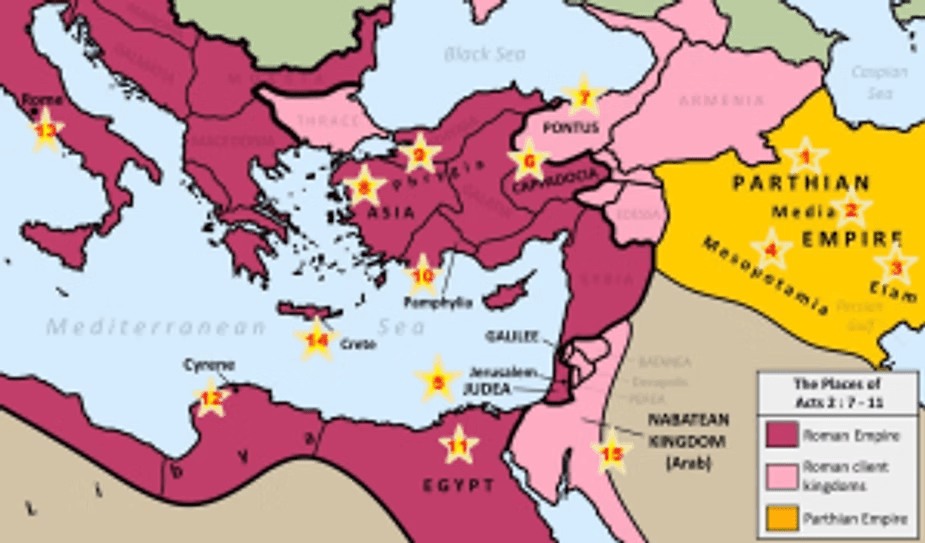
Now there were devout Jews from every nation under heaven living in Jerusalem. And at this sound the crowd gathered and was bewildered, because each one heard them speaking in the native language of each. Amazed and astonished, they asked, “Are not all these who are speaking Galileans? And how is it that we hear, each of us, in our own native language? Parthians, Medes, Elamites, and residents of Mesopotamia, Judea and Cappadocia, Pontus and Asia, Phrygia and Pamphylia, Egypt and the parts of Libya belonging to Cyrene, and visitors from Rome, both Jews and proselytes, Cretans and Arabs– in our own languages we hear them speaking about God’s deeds of power.” All were amazed and perplexed, saying to one another, “What does this mean?” But others sneered and said, “They are filled with new wine.”
But Peter, standing with the eleven, raised his voice and addressed them, “Men of Judea and all who live in Jerusalem, let this be known to you, and listen to what I say. Indeed, these are not drunk, as you suppose, for it is only nine o’clock in the morning. No, this is what was spoken through the prophet Joel:
`In the last days it will be, God declares,
that I will pour out my Spirit upon all flesh,
and your sons and your daughters shall prophesy,
and your young men shall see visions,
and your old men shall dream dreams.
Even upon my slaves, both men and women,
in those days I will pour out my Spirit;
and they shall prophesy.
And I will show portents in the heaven above
and signs on the earth below,
blood, and fire, and smoky mist.
The sun shall be turned to darkness
and the moon to blood,
before the coming of the Lord’s great and glorious day.
Then everyone who calls on the name of the Lord shall be saved.’ ”
——————————————————————————–
This is the fairly fixed reading that can be chosen as either the Old Testament selection or the Epistle selection for Pentecost Sunday, Year B 2018. The full reading is optional in Year A and Year C, making it a fixture reading for Pentecost Sunday. Either way it may be selected, it would next be read aloud in church by a reader on Sunday, May 20, 2018. It is important as it tells of the disciples’ transformation into Apostles and Saints, when the Holy Spirit flowed strongly through each of them on the first day of the week that was Pentecost (the Fiftieth Day), marking the Festival of Weeks (Shavuot). It is important because it tells how the Saints of Christ do not speak of their own accord, but by the Will of God. The truth spoken by an Apostle is then fulfilled by the prophecy made by Joel, where that prophecy needs closer examination.
I was raised (from nursery cradle to fifteen) in an Assemblies of God church. That denomination is under the general umbrella of Christianity that is called “Pentecostal.” I was into my fifties when I learned that “Pentecost” is Greek, meaning “Fiftieth Day.” My assumption prior to that (as I do not recall ever having “Pentecostal” defined to me) was that “Pentecost” meant “speaking in tongues,” as that was a tenet of the Pentecostal branches of Christianity.
Now, I see my assumption (from being told “Pentecostal” means the belief in “speaking in tongues”) was somewhat of an oxymoron. It must be, since one of the tongues not spoken appears, quite obviously, to be Greek. Otherwise, that branch of Christianity would be better named if there was no inference to being “Fiftieth Day related,” from “Pentecost-al.” A more suitable name would be “Glossaipyros-al” (from the Greek “glōssai“and “pyros“), meaning “Tongues of fire related.”
The very first verse in this reading states, “When the day of Pentecost had come.” That demands one understand what the “day of Pentecost” is, as its mere mention states it was a significant day. It demands that one know the Israelites were commanded to forever observe three holy days with feasts (festivals). The three are: Pesach (Passover), Shavuot (Weeks [a.k.a. Pentecost]), and Sukkot (Booths). Each festival attaches a number of days of recognition to each of those specified days.
The Hebrew word “Shavuot” means “Weeks,” such that there were seven full weeks that took place after the Israelites escaped Pharaoh, until Moses came down with the sacred tablets. Forty of those days were spent encamped at the base of Mount Horeb, while Moses was on the mount with God. The Covenant was then made on the fiftieth day (7X7=49, 49+1=50), after Moses came down with the sacred Tablets.
The festival that denoted the end of that counting of weeks was probably named Pentecost because of Greek rule over Jerusalem (following the Persians, prior to the Romans), as a translation of the statement of “fifty days” in Leviticus 23:16. If not, the Greek came after the Apostles spread into Greece and began writing Gospels and Epistles, where that became the translation for the Aramaic that spoke of the Feast of Fifty Days. Regardless of the etymology of “Pentecost,” there was nothing at all that would have predicted to Peter or the other eleven, “Pentecost is tomorrow, so get ready to start speaking in tongues guys.”
Realizing that, when we next read, “the disciples were all together in one place,” the only certainty of where that “place” was located was in Jerusalem, as stated in verse five (“eis Ierousalēm katoikountes” – “in Jerusalem dwelling”). We can assume that the specific place where they were all together was the same “upper room,” where they had shared the Passover Seder meal with Jesus.
This assumption comes from Acts 1:13, where the disciples had returned after the ascension of Jesus Christ. We read there, (“eisēlthon eis to hyperōon”) “they had entered into the upper room,” which is a statement of the same “upper room” prior. Due to the influx of pilgrims seeking rooms in and around Jerusalem, for Jesus (after his resurrection) to remain in the Essenes Quarter with his disciples for forty days (most likely in unrecognizable form), the room could be retained and he could teach his disciples the meaning of the future that was coming. As his Ascension was on a Sabbath, on the hill with olive trees (Mount Olivet) just outside the Essenes Gate, the disciples were within the limits on their walking distance (a Sabbath’s day walk – which is roughly a half-mile outside the city walls). That evidence implies the disciples went back in the same “house” (from Greek “oikon” in verse two) they had remained in for forty-nine days, then preparing for the Temple ceremony for Shavuot.
When we read, “Now there were devout Jews from every nation under heaven living in Jerusalem” (literally translated as, “in Jerusalem dwelling”), this is a statement of the importance of Shavuot. As a commanded event that was fifty days later than the Passover events (an eight day festival), those pilgrims in Jerusalem were not coming from the airport, having just flown into town. The distances stated by the naming of places the pilgrims had come from says they all came for the Passover and stayed some place near Jerusalem for about two months. After that stay, they could return home.
Fourteen places are named, but with twelve Apostles it is probable that a couple of nations shared a common language.
That distance means a traveler would have secured a place to stay (a “dwelling”) while near Jerusalem for two months. This could be “living” with relatives who still lived there, or it could mean staying in inns, or it could mean staying in “travel parks,” where groups of travelers all pitched tents and roped off donkeys and camels, within a reasonable distance from Jerusalem.
Keep in mind that Jesus fed a multitude of five thousand adult males (meaning perhaps a total of as many as eleven thousand, including men, women, and children). Those were largely pilgrims who were preparing for the Passover Festival (John 6:4 – “The Jewish Passover Festival was near.”). Matthew wrote of Jesus feeding the same five thousand (Matthew 14:13-21), but then wrote of Jesus later feeding four thousand (Matthew 15:29-39). The implication is the timing of the second miracle was prior to the Pentecost Festival. That means those “living in Jerusalem” were many, all of whom had been there since prior to the Passover; and this swell of people there took place every year (maybe not with the exact same people), because it was a commanded observance.
It is worthwhile to note that the ritual observances demanded by God, through Moses, as stated in the Torah (Exodus, Leviticus, Deuteronomy, and Numbers), were not maintained over the centuries. Once the Kingdom of Israel divided, the people were not led to understand the reasoning behind their Covenant, such that the fall of Israel and Judah was seen as rooted in this noncompliance. There was not always a Temple with priests to offer sacrifices, and some see the efforts begun while in captivity in Babylon was an attempt by the captive Jews to relearning what rituals had been forgotten. Because the Law had been forgotten, the exilic Jews (the Levitical priestly descendants) saw adherence to the Law as all important; and that included observing the commanded festivals.
In the reverse view, after the destruction of the Second Temple and the scattering of the Israelite people around the world (mirroring the spread of Christianity), there has again come a disconnect by Jews and Christians, relative to understanding the reasoning behind the Covenant and the new Covenant with Jesus Christ. Jews go through the motions of rituals without realizing the Messiah has come; and Christians have no grasp of the rituals that bring them into a Covenant with God. Everyone has changed the rules to fit their personal needs, rather than feeling the purpose of God demanding ritual feasts forever be maintained by ALL His chosen priests (thus a “New Covenant” that has been added to THE Covenant).
This lost sense of knowing why God wanted His people to observe the Passover and then fifty days later a festival of farmers taking their marked (with reeds) first fruits (grains) of harvest to the Temple for blessing, amid throngs of cheering Jews was the background setting to the story of Acts 2:1-21 (and 22-41). The people from all the nations listed were milling about during the morning of Pentecost, waiting for someone to finish a prayer and a rite, announcing the close of festivities so everyone could go home … finally.
Their devotion had led them there, seeking more; but so many Jews were looking for some greater reward, more than simply being God’s chosen people. They prayed for something to happen that would make their devotion be more than routine obligation. The scene of Acts 2 opens with that ripeness for receiving the Spirit. Rather than grains and fruits (and cheese blintzes) being the reward of the First Fruits, the pilgrims themselves were about to be blessed as a good harvest.
Knowing this setting, all of the streets in Jerusalem would have been packed. All the pilgrims would have flowed in through every gate, as their customary way of ceremoniously renewing their vows to serve Yahweh. Then, suddenly, “Came a sound like the rush of a violent wind.”
Imagine how people interviewed on the news after a trailer park has been destroyed by a tornado say, “It sounded like a freight train coming.” If they had freight trains back in ancient days, then maybe we would read here, “Came the sound like a freight train.” Not only did the ancients not have freight trains, but they had no machines that made loud noises that would be similar to any man-made noise. It must have sounded like a tornado, but those weather events are rare in the Middle East, including Israel. Such a loud noise was totally unexpected, because even rain is scarce in the area during May and June each year (the time between Passover and Pentecost).
Still, this was so loud it filled the entire house and the noise spread outside. It was so noticeable that it made the people in the streets stop and take notice. They all looked at the house where the disciples of Jesus were staying.
“What in the name of God could that loud noise be?” the pilgrims all asked.
Then, once they had stopped in their path, they looked hard and listened intently. They heard many men speaking loudly in many foreign languages (the real meaning of “speaking in tongues”); and everyone in the street heard some strange man speaking his own native language.
Then the men inside the house came outside. Some might have gone into the street, while some might have gone out on a rooftop-terrace. Once the men were seen – still speaking fluently in many different languages – they looked like Galileans. That means they looked somewhat foreign to the big city, as they probably were not in refined dress, not looking dapper. They might have had on funny hats or had their hair wild and un-braided. Whatever the case, they certainly were seen as not being men of the world and high culture.
Still, that source of sound coming from the least of Jews was not reason for the pilgrims to return to the din of street movement. We read that the pilgrims were all “Amazed and astonished.”
It is most important to realize that these foreign visitors to Jerusalem were not “amazed and astonished” because they heard rubes from Galilee saying things like, “Hello. Can you tell me where the hotel is? This is beautiful weather we are having, do you not agree?” as if they were automatically filled with the ability to speak a conversational language learned from Babble, Rosetta Stone, or The Idiot’s Guide to Mastering Foreign Languages.
The new Apostles were not babbling incoherently, using distinguishable languages recognized by the pilgrim Jews. They were preaching the meaning of Scripture (Torah, Psalms, and Prophets), which were lessons heard for the first time, leading the pilgrims to be “amazed and astonished.” The fact that each pilgrim heard those lessons in his native tongue means there was no language barrier to overcome – no struggles with Hebrew, no need for translation, no idioms, sayings, or slang terms to overcome – as the multinational visitors heard clearly what no rabbi or high priest had ever told them before.
And that was coming from Galileans!
When we read how some said, “In our own languages we hear them speaking about God’s deeds of power,” that speaks of the power of God flowing from the mouths of His servants, explaining the hidden meaning that had never been exposed. That is why they “all were amazed.” Still, they were also “perplexed.”
That state of wonder (amazement), followed by confusion and doubt (perplexity) means their hearts and minds had opened a crack, towards belief in the Apostles; but then their natural brain-driven reaction was to slam shut a protective shell of disbelief over the chance of human vulnerability. Something wasn’t right! They had to slam a harness around those hearts and minds.
We read how they began “saying to one another, ‘What does this mean?’”
Their brains began whirring, thinking about how Galilean fishermen, small town lawyers, former tax collectors, and general riff-raff Jews could be bedazzling and filling those international globetrotters with sudden wonder, speaking the truth so clearly … in foreign languages?
Then we read, “But others sneered and said, ‘They are filled with new wine.’”
This has to be seen as an explanation offered from the crowd, about how simple Jews could be speaking such deep levels of interpretation of Scripture. Being “filled with new wine” meant there were known past examples of how a drunken state could remove inhibitions in the brain, allowing people to utter thoughts freely, with surprising insight. The intent of such an explanation would be akin to thinking they might be speaking good ideas now, but wait until the influence of alcohol wears off and they return to being bumpkins, not remembering what they said while drunk.
Still, to have someone shout out, “They are filled with new wine” is the Holy Spirit already circulating around the crowd, influencing them to receive the messages spoken by Apostles.
Just fifty days earlier, Jesus had offered a prayer of thanks over the third ceremonious cup of Seder wine (the Redemption Cup), saying, “Drink from this, all of you. This is my blood of the covenant, which is poured out for many for the forgiveness of sins.” (Matthew 26:27-28) When Jesus then added, “I tell you, I will not drink from this fruit of the vine from now on until that day when I drink it new with you in my Father’s kingdom,” Jesus spoke prophecy that was then coming true. It was that day.Jesus Christ had been reborn within his disciples, so they spoke as if “drunk with the new wine” of the Holy Spirit and Jesus was there with them … in the kingdom of Sainthood.
In this regard, Peter did not deny that he and his eleven brothers in Christ were drunk. Instead, he said, “Indeed, these are not drunk, as you suppose.” They were drunk, but in a way that was not imagined by the pilgrims. They were drunk with the holy blood of Jesus Christ, through HOLY SPIRITS.
New wine (Greek “Gleukous”) is also called sweet wine, which is unfermented grape juice. It is a non-alcoholic beverage in that case, which might have been consumed by the disciples for breakfast. It would be a drink for the whole family to consume, and for adults to drink at any other time, when drinking spirits would be inappropriate. However, new wine can ferment unexpectedly and become alcoholic, causing one to drink it and unexpectedly get drunk. This is why Peter explained, “not … these are drunkards” (“methyousin”), where the denial was they were “not … intoxicated by wine.”
This was then spoken to the crowd by Peter, with the translation reading: “Peter, standing with the eleven, raised his voice and addressed them.” The better translation says, “Peter with the eleven , lifted up the voice of him , and spoke forth to them.” This says more than Peter just began speaking in a loud voice, as the loud sound that attracted the crowd had come from the wind-like roar of the Apostles speaking loudly in foreign languages.
The Greek word “epēren,” which is translated as “raised” or “lifted up,” should be seen on a deeper level. Peter and all the other Apostles were speaking loud enough to be clearly heard at some distance, but more importantly their voices were “exalted,” having been “raised” spiritually, as their words were “lifted up” divinely. This means that they all spoke from the Holy Spirit. With “raised voice” Peter and the other eleven were having the Spirit of the LORD poured out through them. Thus Peter used the example of prophecy, coming from Joel 2:28-32.
It is so important to see how Peter was not simply explaining intellectually, using words that explained what he and the other Apostles were doing. Peter was not speaking from his brain when he implied that he and the gang were fulfilling the prophecy of Joel. That would not be “with raised voice,” but human words of reason.
Instead, Peter quoted Joel because the Father spoke those words for him to recite. It was not rote memorization being accessed within his country-bumpkin brain that Peter (et al) was speaking. Everything Peter and the eleven spoke came from the Mind of Christ, brought upon them by the Holy Spirit, which included the quote from the Prophet Joel.
When Joel was led by the Holy Spirit to write, “In the last days it will be, God declares,” it must be realized that the Greek word “eschatais” (from the root word “eschatos”) means “last, at the last, till the end, and finally.” This is the root word for the theological word “eschatology,” which places focus on “the end of the world or of humankind.” As such, some can read Joel and project what he prophesied is still to come, at that fearsome, grizzly end of the world that always seems just around the corner of present time.
However, as Peter was quoting then, well into the future of Joel’s prophecy, as Peter spoke it was the last days, and God was declaring through ordinary folk.
God then spoke the words of Joel, through Peter: “I will pour out my Spirit upon all flesh, and your sons and your daughters shall prophesy, and your young men shall see visions, and your old men shall dream dreams. Even upon my slaves, both men and women, in those days I will pour out my Spirit; and they shall prophesy.”
Peter and the other eleven Apostles were sons prophesying. They were seeing the truth of Scripture – the visions of Joseph, Solomon, and Daniel, the dreams of Ezekiel and Isaiah, and the slaves that were Ruth and Ester and Amos and Joel. The prophecies of old stories had been fulfilled in the man known as Jesus of Nazareth. The Old Testament’s prophecies were at last revealed. They were exposed as clearly as the light of the day time hours makes seeing possible.
When God then proclaimed through Peter, “And I will show portents in the heaven above and signs on the earth below, blood, and fire, and smoky mist. The sun shall be turned to darkness and the moon to blood, before the coming of the Lord’s great and glorious day,” had not all that just recently been witnessed by those pilgrim who had been in and around Jerusalem, since the Passover Festival that began seven Sabbaths prior?
Had not Jesus produced “portends,” which means “miracles” and “wonders” for the Jews (and others) to witness?
Had the people not questioned if he had been sent from heaven as the Messiah?
Had Jesus not made clear that he had been sent only to the “blood” that was the remnant of the Israelites known as the Jews?
Had Jesus not set a fire under the Jews that both followed him and saw him as a threat?
Did Jesus not appear to be the human equivalent to the daytime pillar of smoke that guided the Israelites through the wilderness of the Sinai?
Was not Jesus the proclaimed Son of Man, as the representation of the sun – the light of truth; and had that light not been darkened by his crucifixion? Did the sky not go dark in the middle of the day for three hours, as Jesus of Nazareth hung on a cross dying? Did the ever waxing and waning moon – symbolic of emotions overrunning one’s personality – not stand before Pilate, screaming, “Crucify him” to bloodcurdling levels?
Peter reciting Joel’s line, “Before the coming of the Lord’s great and glorious day,” was God’s way of announcing, “Today is the Lord’s great and glorious day!” God was announcing the return of His Son, Jesus Christ, returned the day after his ascension in all of his followers.
For all who look for the End of the World, as far as Christian theology is concerned, it was delayed coming by the presence of Saints in the name of Jesus Christ on that day of Pentecost. It continues to be averted as long as Jesus Christ exists in the world, via Saints filled with God’s Holy Spirit.
As far as this reading selection goes, Peter ended the prophecy of Joel by God pouring out of his mouth, “Then everyone who calls on the name of the Lord shall be saved.” On a city of Jerusalem street that was filled mostly with Jews, but Roman converts (proselytes) and Arabs as well, the use of the word “everyone” (Greek “pas”) must be seen as the first sign that Saints were called to serve “all,” as messengers of Salvation.
Peter himself did not know he should welcome Gentiles until later; but in the reading that continues (but not read aloud today), we learn that three thousand souls were baptized by the Holy Spirit that Pentecost. Three thousand souls were then added to the number of Saints in the name of Jesus Christ. Those three thousand would return to their nations and begin a worldwide spread of Christianity. While not stated, all of the fourteen named nations of peoples had converts that day, all filled with the Holy Spirit, each calling upon the name Yahweh, as Jesus Christ reborn.
As the one reading in the Christian liturgy that is consistently read on Pentecost Sunday, it is vital to have one’s eyes opened to the realization that none of the twelve men speaking in foreign languages that day had any lessons or experiences in learning those languages prior. Likewise, Ezekiel had no prior experience prophesying to dried bones; but he did as God commanded. Thus, speaking in tongues, as a miracle of foreign languages, is not the lesson presented in Acts 2. Neither is the end of the world the lesson to be taken from Joel 2, as if babbling fools can point to some future date as when Jesus will return with vengeance. The lesson is God speaking universally so all can hear and understand.
There is absolutely no one who is going to have his or her soul baptized by the Holy Spirit and be saved, given eternal life, because they hear someone speaking nonsense, uttering noises that no one can understand. Salvation does not come by learning to fake speaking in foreign tongues or pretending to know what gibberish means. The brain plays no role in salvation, as it can only hinder that goal.
The miracle of Pentecost was speaking from the Spirit of truth, which Jesus prophesied in the Gospel reading from John 15-16.
The lesson of Pentecost is twofold. One, it is to hear the truth of the texts of the Holy Bible and understand them. Understanding comes from the Holy Spirit, not a book read, a course taken, or someone else’s interpretation that one is incapable of personally owning and defending. Two, it is the beginning of the end times of the old you. The selfish days of ignorance are over – ended forever.
Pentecost represents the end times of the release from bondage, when the Covenant with God is agreed on. It is when time spent learning has reached the point of teaching, such that one can only sit in a pew for so long, before realizing the Lord’s great and glorious day has dawned within oneself. Then it is time to go preach – prophesy to the breath – so that other can have the same chance for a personal experience with Salvation.
The lesson of Joel’s prophecy is not limited to the fulfillment that occurred the day after Jesus ascended into heaven. The experiences of Peter and brothers in Christ was the beginning of this prophecy’s fulfillment. It is fulfilled every time a disciple makes this transition. All of the trials and tribulations from one’s own denial of God, Christ, and the Holy Spirit within oneself points to a new last days, as the end of a sinner’s ways and the beginning of a Saint’s service to God, as Jesus Christ reborn.
In this way Peter was speaking to the readers who would eternally be called to God’s Word. Just as Joel wrote of all the coming sons and daughters of God, the spirit will always be poured out upon desiring flesh. Just as Peter passed along the flow of the Spirit of truth, so do all God’s Saints.
Blessed be the God and Father of our Lord Jesus Christ, who has blessed us in Christ with every spiritual blessing in the heavenly places, just as he chose us in Christ before the foundation of the world to be holy and blameless before him in love. He destined us for adoption as his children through Jesus Christ, according to the good pleasure of his will, to the praise of his glorious grace that he freely bestowed on us in the Beloved. In him we have redemption through his blood, the forgiveness of our trespasses, according to the riches of his grace that he lavished on us. With all wisdom and insight he has made known to us the mystery of his will, according to his good pleasure that he set forth in Christ, as a plan for the fullness of time, to gather up all things in him, things in heaven and things on earth. In Christ we have also obtained an inheritance, having been destined according to the purpose of him who accomplishes all things according to his counsel and will, so that we, who were the first to set our hope on Christ, might live for the praise of his glory. In him you also, when you had heard the word of truth, the gospel of your salvation, and had believed in him, were marked with the seal of the promised Holy Spirit; this is the pledge of our inheritance toward redemption as God’s own people, to the praise of his glory.
——————————————————————————–
This is the Epistle selection from Episcopal Lectionary for the Eighth Sunday after Pentecost, Year B 2018. In the numbering system that lists each Sunday in an ordinal fashion, this Sunday is referred to as Proper 10. It will next be read aloud in a church by a reader on Sunday July 15, 2018. This is important it touches on the predestination of Saints, where God released all human souls on the material plane with the instruction: “Come back. Don’t get lost in a physical body.”
When I was a young boy being raised in an Assemblies of God church, I remember there was a “prayer room.” It had folding chairs in it, at which people would kneel and pray.
As best as my young brain could discern (from what I saw happen in that room) was the room was a place to be trained in how to “speak in tongues.” According to the methods taught to me, as I knelt in front of one of those folding chairs, I was told to repeat the word “Glory,” over and over. I would do that until my tongue got so tied up it would stop saying “Glory” and start making unintelligible noises. I was told those unintelligible sounds was “speaking in tongues.” One traveling evangelists actually encouraged me to just make up any noises that I wanted. When I did, I was praised by the congregation for “speaking in tongues.”
Reading this greeting written by Paul to the Christians of Ephesus, it dawned on me how repetition being the key to leading one to speaking in tongues was the truth. Someone, somewhere along the line of the foundation of the Assemblies of God church mistook reading Scripture (the Glory of God in writing) over and over, until it begins to make deep, spiritual sense, as how one speaks in the tongues of God. What is unintelligible to those who have no time for repetition then becomes crystal clear to those who eyes and ears (and mouths) that God has opened.
Paul is a classic example (in all his writings) of how repetition is the key to understanding. The faster one reads Paul the more it sounds like babble. However, when it is read slowly, over and over, praying for the deeper truth to be exposed, it begins to amaze with how accurately detailed Paul’s words were. They are of divine origin.
With that short lesson about speaking in tongues complete, read this over and over and contemplate its deeper meaning: “Blessed be the God and Father of our Lord Jesus Christ.”
Ask yourself as you repeat those words, several of which are capitalized, showing importance, “Is this a simple church greeting, where important words are written ceremoniously, or formally, or ritually, rather than with the intent to express the truth?”
Ask yourself, “Is God truly Worthy of praise, such that God is the epitome of ones Blessings?”
Was Paul pointing out that God is the Father of all Creation, including himself, all the people breathing air in Ephesus, as well as every living being on earth? Or, was Paul making an important statement about God being exclusively the Father of himself – an Apostle – and those true Christians of Ephesus – also Apostles? Did Paul intend his use of Patēr (capitalized as “the Father,” versus “ancestor, elder, or senior” in the lower case) to be meaningless or meaningful?
Why did Paul further that by stating God is the “Father of the Lord,” going on to say “the Lord of us”? What does the word “Kyriou” mean, when it is the “Lord” and/or “Master of us”?
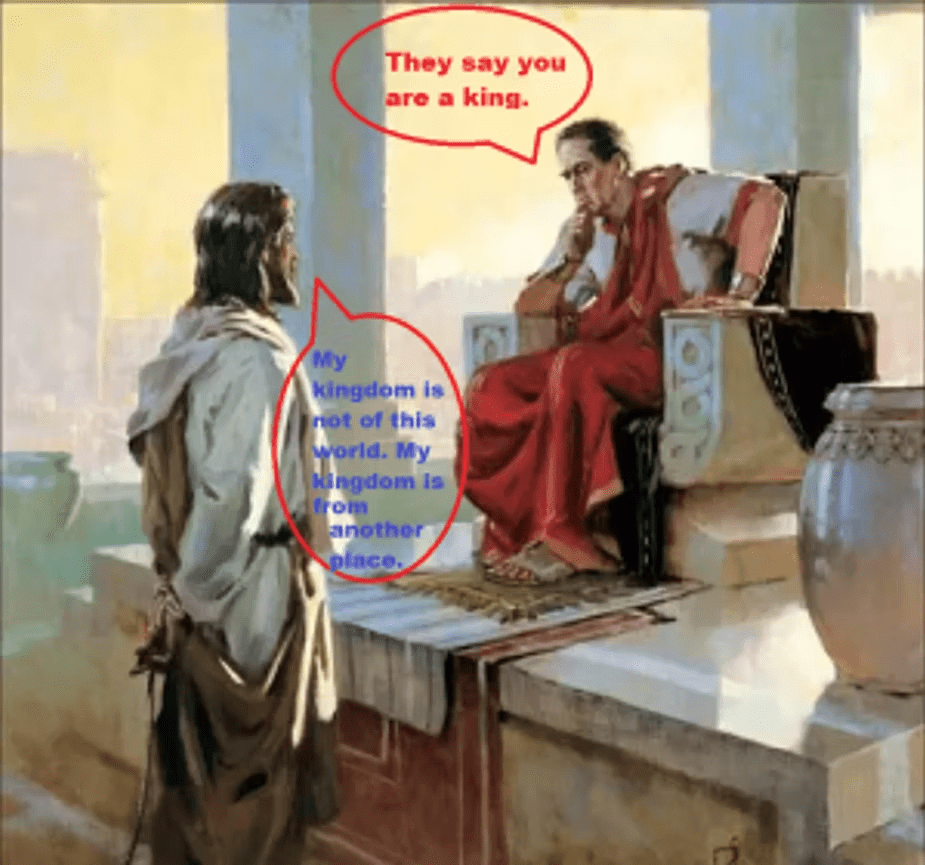
If God is King of Heaven and Jesus was not a king of a nation, where would he be Lord? Where could his kingdom be, if not within an Apostle?
When a comma is placed after “hēmōn” (“of us”), indicating a pause in this line of thought, how then does that mark in the text act to denote a separation between “us” and “Jesus Christ”?
When you read these ten words over and over … slowly … allowing the truth and full scope of intent to sink in … can you see Paul stating, “I praise the One God as do you praise the One God [“Blessed be the God”], for together we are blessed to know God as the Father [“and Father”] of new state of spiritual being, having been born of His love in His sending us our Master [“of our Lord”], the new Lord of our souls in our flesh, such that we each have become a kingdoms of Jesus Christ [“Jesus Christ”], each being the resurrection of Jesus Christ”?
When your eyes begin to open to Paul having just made a powerful statement that he was a member of the church of Ephesus, where “church” is defined by Jesus as being “where two or three gather in my name, I am there in their midst,” (Matthew 18:20), those to whom Paul wrote were just like him, in the sense they had each been “Blessed” by “God,” who then was the “Father” of their rebirth, where the “Lord” of their bodies, minds, and souls was “Jesus Christ.” They had each become Jesus Christ incarnate. When that becomes clear, then you can begin to do the same repetition of the rest of this reading.
To speak in the tongue of God, as Paul was writing “in tongues” using the Word of God spoken to him, each Apostle in Ephesus was then capable of “reading in tongues” (a.k.a. “speaking”) and reading the words of Paul on a divine level of understanding (above a human brain level). To an Apostle, there is not thought that goes into word selection, as some brain-powered trick of language. Words naturally come to one filled with the Holy Spirit. However, a disciple can be trained to begin proving the divinity in such tongues by following logical methods.
Like I am instructing, one has to practice reading slowly, repeating each word as it was meant to be read – using the full scope of each word’s usage, not just the standard or typical. That requires learning Greek (and Hebrew) as well as God knows Greek (and Hebrew), or using a tool to make up the difference (such as an online Interlinear translation of the foreign to the known. One has to know God’s Mind is so great it chooses the precise words necessary to convey depth beyond the standard and typical; but intelligence is elevated to inspiration when one proves to oneself how great God is to choose words with so much meaning unseen.
(I am now going off the script above and will be using the literal (interlinear) English translation of the Greek written. Feel free to see how English alters the ordering of words written, to satisfy syntactical differences from Greek.) By seeing that Paul said “Blessed [be] the [One] God,” as the source of Apostles having been reborn as Jesus Christ, next read:
“the [One] having blessed us with every blessing spiritual in the heavenly realms in Christ.”
God is “the [One] having blessed” Apostles. God has bestowed upon His servants “spiritual blessing,” rather than physical rewards. The spirit of a human being is the soul, so an Apostle’s soul has been made “worthy of praise,” due to it having been cleansed of sins by the Holy Spirit of God. They have been spiritually blessed so their souls can gain spiritual reward in the “heavenly realms.” The plural number of “realms” shows how heaven has become one with earth in an Apostle, of which there are many. They have been blessed with the knowledge of God that comes to them because they are in Christ. They have been blessed with the Christ Mind.
Then read:
“just as he chose us in him before foundation of world , to be for us blameless and holy before him ; in love.” [Notice the presence of punctuation marks, which are ‘road signs’ that say how to slow down more and shift gear.]
Again, “he” is God, who has Blessed them and they praise Him for those blessings. Paul is saying Apostles are predestined to become Saints. The Greek words “katabolēs kosmou” imply verbiage that says, “the foundation of the world,” but that is a limitation that plays on one’s brain. A brain thinks the only way that can be interpreted is from Creation, a long, long, time ago. It does not have to be that far-stretched. Each soul in “the world” is reincarnated into new flesh each earthly life. The word “katabolé” actually has a meaning that is relative to “conception,” so each human being’s “foundation” in “the world” is their birth. When rebirth is factored in, then being chosen “before being born as Jesus Christ” is the call to be a disciple. In Paul’s case, the spirit of Jesus Christ knocked Saul off his donkey and blinded him for three days before he took on the name Paul and began serving God as Jesus Christ reborn. The choice one makes that answers that call from God is completely and totally “to be blameless and holy before [God].” An Apostle is not forced to serve God; but one serves out of “love.” An Apostle falls “in love” with God. An Apostle becomes married to God [the cleansing of sin from the soul] and God’s love reigns in an Apostle’s heart.
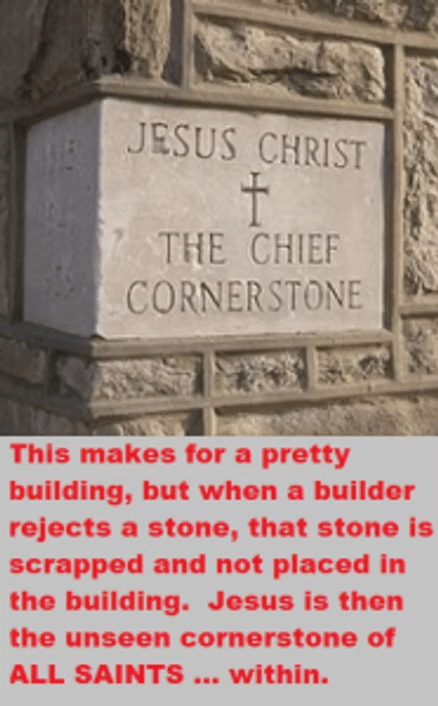
Jesus is the round stone that rolls away from the entrance to the tomb, freeing the soul for eternal life.
After absorbing that, then next read:
“having predestined us for divine adoption as sons through Jesus Christ , according to the good pleasure of the will of him.”
The Greek word “proorizó” means “I predetermine,” but it equally means “preordained” and “marked out beforehand.” By seeing how Paul said Apostles were “chosen at birth,” and that means being reborn “in him” – Jesus Christ – the view is now broadened to show one’s responding to God’s call is one’s “pre-ordination” towards becoming the Son of God. This is then a “divine adoption” by all human beings, of both sexes, those who answer the call, to be reborn as Jesus Christ. His Spirit is resurrected within one’s soul, so all who are so adopted divinely are transformed into “sons through Jesus Christ.” This Spiritual adoption goes beyond human gender because of the “love” of God, so accordingly all “sons” are everyone who is filled with the “happiness of the will of him,” which is the presence of the Holy Spirit – the same that surrounded Jesus of Nazareth.
That revelation then prepares one to read further:
“to praise of glory of the grace of him , which he has freely given us in the [One] beloved.”
This “good pleasure, happiness, and delight” that is brought on by God’s love, His Holy Spirit and the Mind of Christ is then the elation that instantly causes an Apostle to “praise the unspoken manifestation of God” inwardly. Such feelings of joy are due to the “favor” and “gift” of God, leading one to give in return “thanks” and “gratitude” to God. It means an Apostle acts as did Jesus of Nazareth, giving all “honor and glory to God.” This does not come by asking for favor. It comes “freely,” given by God to His ‘wives’, those who have subjected their will in marriage to God, accepting him into their hearts as “the [One] beloved.”
If that is difficult to grasp, keep repeating those words over and over, slowly. Understand that “praise” comes from inner delight that is beyond natural emotions, which are impossible to maintain by self-will. However, seeing “happiness” as a “gift of God” allows one to then read:
“in whom we have redemption through the blood of him , the forgiveness all of trespasses , according to the riches of the grace of him.”
Notice the repetition of the word “grace,” which in Greek is “charis.” The form written by Paul, “charitos,” is now being linked to “the blood of him,” where the Greek word “haimatos” means “blood” that has been spilled. This means that like Jesus of Nazareth spilled his “blood” in the act of crucifixion, where he willingly became a sacrificial lamb for a higher cause, so too are Apostles called to the same higher cause, through self-sacrifice.
By being reborn as Jesus Christ, one has been given the higher reward of “redemption,” where the sins of one’s life have been “ransomed” through a “blood” payment. Therefore, the “blood” of self no longer leads one’s body, because it has been replaced by the “blood of Christ.” The “blood” of Christ is the Holy Spirit that protects one from death. Achievement of that reward means “forgiveness of all sins” – the baptism of one’s soul by the Holy Spirit. That cleansing is “according to the abundance of the kindness of God” – through His “granting the favor of Jesus Christ” to one.
Keep repeating those words until they speak to you on a personal level, rather than as a bystander looking at an old letter written by an Apostle to a church in ancient Greece. See how Paul was not spreading the truth of some blanket promise of redemption and worldwide forgiveness of sins, given to anyone who did little more than profess belief in Jesus as the Son of God. One cannot believe in Jesus Christ without letting go of selfishness and actually living as Jesus of Nazareth lived. When one has a firm hold on that “grace of him,” then read:
“which he lavished upon us in all wisdom and understanding ; having made known to us the mystery , of the will of him , according to the pleasure of him , which he purposed in him.”
The Greek words that begin this series of segments, “hēs eperisseusen,” can equally translate as “that exceeded the ordinary” or “which abounded.” The use of “lavished” means the amount of the spirituality richly given by God to His Apostles is much more than they could ever possibly comprehend with a human brain. Those “riches” are now stated as “wisdom and understanding.” It is such divine insight that allows them to understand Scripture (“the mystery” is the hidden meaning in the words – such that I am expanding upon now) is made known instantly or with quick inspiration to know, not by the will of one’s intellect (a Big Brain) but by God’s whispers. God then delights in His servants finding enjoyment in seeing Scripture unfold before their eyes – meaning that astonishes – because everything was written with that deeper purpose intended. This is the knowledge of God being conveyed through the Mind of Christ, made available to an Apostle that has been reborn as Jesus Christ.
Then read the next series slowly and with repetition:
“for administration of the fullness the [one] of times ; to head up the all things in the Christ , the things in the heavens , and the things upon the earth.”
This series begins with the Greek words “eisoikonomian,” which can also state “for stewardship.” The translation read aloud in church states, “as a plan for.” The Christian view of “Stewardship” has been applied to the responsibility of Christians to take care of the earth. There is “a plan for” this type of “administration.” However, that view frequently turns into pleas for donations to the churches, so the burden will be taken on by Church, directing funds to outreach programs, allowing the individuals to have the comfort of knowing that doing little more than contributing money absolves them of this “administrative” duty.
The meaning here is different. It means Scripture is never to be read as a stagnant story of one time past. Apostles are given divine insight so Scripture is seen to always apply to current times, so there is a “full complement” of timely interpretations of meaning. The one who heads this organization is not a bishop or pope, but Christ – the head of the Church. Therefore, Stewardship can only come through Apostles who are enlightened as to the “administration” of all things that fit the requirements that bring one to God and project the Christ in the flesh. The “administration” is not for a body of people – an organization called a church – but that which ensures each soul can return to heaven. Those are the deeds one’s flesh does, through the Christ, as one in the name of Jesus Christ, while here on the earthly plane.
Being able to grasp that vital message, then slowly read and reread this:
“in him , in whom we also we have obtained an inheritance , having been predestined according to purpose of the case all things working , according to the counsel of the will of him.”
This begins with “in him,” which is a statement of being in Jesus Christ. The Greek words “enautō” state “in him,” but also can convey “with the same” or “in self.” This says an Apostle and Jesus Christ are one, not one on earth and the other in heaven. The Greek word “eklērōthēmen” expands on the root “kléroó,” where “inheritance” means an “allotment” or “a share.” When “inheritance” is understood to be defined as, “something, as a quality or characteristic, received from progenitors or predecessors,” then the share received is the resurrection of the Son, born of the Father, into the inheritors. That makes them also be (regardless of human gender) “sons of the Father.” Again, the “predestination” is less a birthright that comes from professing belief that Jesus was the Son of God, but more a statement about that period of devotion preceding one being filled with the Holy Spirit, married to God, and reborn as His Son. The Greek words “panta energountos” (“all things working”) means the “predestination” is “according to the purpose” of inheritance, where one does the works of the LORD – “of every kind.” This is how Saint James could truthfully argue: “Faith, without works, is dead.” (James 2:14-26)
Those “working” acts are then not led by brainstorming with a denomination of Christianity and its political agendas, where one is blindly led by the will of other human beings. Instead, one possesses a brain that functions, made fully cognizant of how what one does under the direction (“counsel of the will”) of the Christ Mind is works based on the gifts of the Holy Spirit. That subjection to the Will of God is how one inherits the resurrection of Jesus Christ within one’s being.
Allowing that vision to slowly appear makes one able to then progress to this series of words:
“for this to be us , to praise of glory of him ; those having first trusted in the Christ.”
Here we see Paul stating that doing the works of faith, directed by the presence of Jesus Christ within on, is the only way such works can be done. It means the self must be sacrificed to serve the Will of God. It is the self that becomes filled with doubts and fears and hesitates doing the works the whispers (conscience) tell one to do. “for Jesus Christ to be us,” following the counsel of his will, “all things working” are accomplished. That accomplishment is in no way attributed to the power of the self, but to the “glory of God.” As an Apostle watches him or herself doing the works of Jesus Christ – according to the talents given, listed by Paul elsewhere – “praise” is given to the Trinity having involved oneself: as Father, Son, and Holy Spirit converging in one’s flesh. That promise of accomplishment is then the “predestination,” where “one first trusted in Christ,” which is faith. Faith alone is not enough, but it is a “first” step in the direction of discipleship. To do the works of faith, one has to learn belief through study of Scripture, praying for the truth to be revealed. Until one sees that truth personally (not simply being told, like I am doing here), such that “all things working” become one’s personal acts of investigation, one will not be enabled by God to progress to Apostle status.
Seeing that insight of a search for the truth and the acts of faith coming from personal belief, read this next series of segments slowly, repeating until the meaning is clear:
“in whom also you , having heard the word these of truth , the gospel of the salvation of you , in whom also , having believed , you were seated with the Spirit this of promise , the Holy.”
Notice how the last segment ended with the word “Christ,” who offered one “hope” (another translation of “proelpizó,” which states “trust”) as one’s “first” step towards marriage with God and giving birth (resurrection) to Jesus Christ, Paul then stated “Christ” is “in whom also you,” where Paul was in the name of Jesus Christ and so were the true Christians of Ephesus. They have all been elevated to the status of Apostle, as completely devoted servants of the LORD, because their “works” involved study of Scripture, through divine insight. By “having heard the word these of truth” coming from whispers of enlightenment inside one’s head, one has been able to find a personal relationship with God that gives delight in His glory. That experience moves one spiritually (in one’s soul-being) to submit to the Will of God. When one has become the wife of God (males and females He weds them), the “love” child is Jesus Christ reborn into another Son of the Father. That presence of Christ in one becomes the “good news” of one’s personal soul’s salvation. The Holy Spirit has baptized the soul clean, with all sins forgiven, and “all things working” henceforth are the Will of God, through Jesus Christ reborn in flesh (“in whom also”). All comes from true belief, not just obedience to dogma and being told what one should say that one believes. One is then “seated” with salvation through having received the Holy Spirit of God.
Having grasped that last important series of segments, look now closely at this final series in this reading:
“that is guarantee of the inheritance of us , to redemption of the acquired possession , to praise the glory of him.”
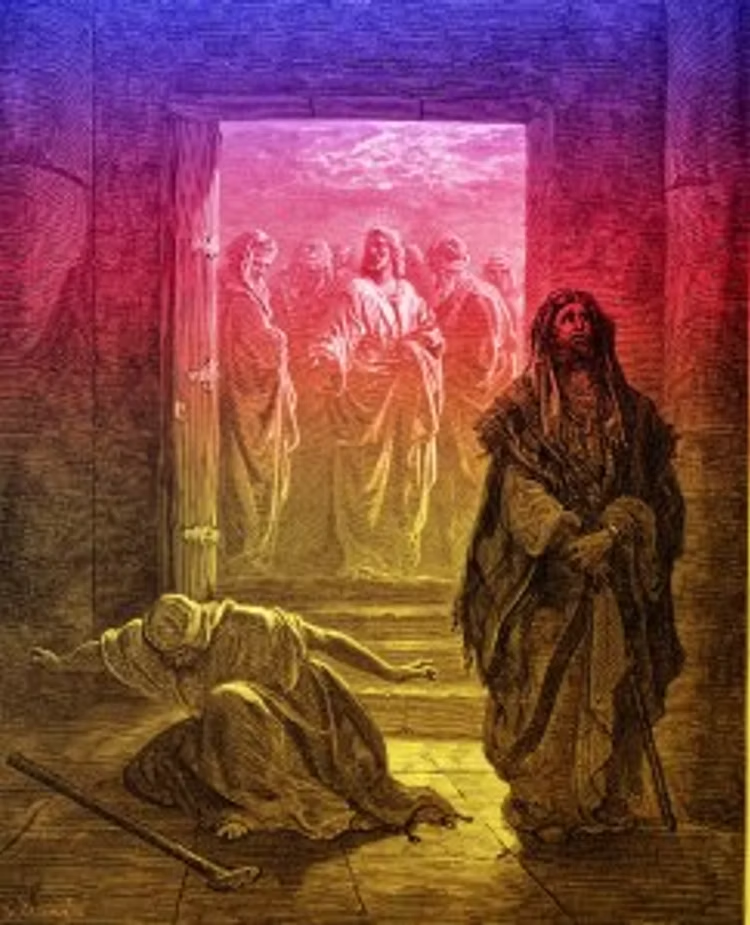
The Greek word “arrabōn” can be translated as “guarantee,” but the truest sense of the word “arrabón” is: “an earnest, earnest-money, a large part of the payment, given in advance as a security that the whole will be paid afterwards.” This means the receipt of the Holy Spirit must be seen as a pre-payment made in the worldly realm (while alive in the flesh) that then “guarantees the balance” that assures “the inheritance of us” in Heaven. This means one cannot sin an entire lifetime, doing nothing for anyone other than self (where all forms of altruism, without being led by the Christ Mind as one with a human being, is ultimately for selfish purposes) cannot find God on one’s death bed. Repentance must be pre-paid by selfless acts. Try borrowing money for a house in the same manner, where one has never worked to earn anything that would then act as a promise that more productive work will qualify one for total repayment. No house loans come to slackards, just as no heaven comes to those claiming faith, but without works. One has to become Jesus Christ reborn to insure entrance into the heavenly realm for eternity. In order to acquire that heavenly promise, one has to “deliver” on the promissory note of living a “Holy” life, once married to God. The act of “redemption” is payment in full for works done. Again, nothing is self-praiseworthy as no self-willed donations of time or possessions will cause one “to praise the glory of God” for one’s acts of faith. Self-acts of faith are then due to guilt or delusions of grandeur (the prayers of the Pharisee and the Publican), where neither is worthy of divine reward.
One is acquitted of his sins before God (a sheep of the flock) and one is condemned (a false shepherd blowhard), but neither can keep from further sins without the Holy Spirit’s assistance.
As a selected Epistle reading for the eighth Sunday after Pentecost, when one’s personal ministry to the LORD should be underway – like that of Paul and the true Christians of Ephesus – the lesson here is a personal relationship with God, one where oneself has become subjected totally to God’s Will. A minister supports other ministers, while being a light of truth to those “predestined” to also become ministers.
The words of Paul are written minister-to-minister. This means it requires one be led by the Holy Spirit to write in divine ways, so only those who are filled with the Mind of Christ can fully grasp the deeper meaning. In the story told in Acts 2, where Peter stood with the eleven other new Apostles and “spoke in foreign tongues,” the pilgrims in Jerusalem who heard them were amazed. It was not amazing how twelves ‘rubes’ from Galilee, who had no foreign travel experience or formal training in foreign languages, were speaking fluently in languages that were understood by those who recognized their tongue being spoken. Some wrote that marvel off as being drunk on new wine, where some slurring drunkards had been mistaken before as speaking in foreign languages. That notion was discounted because of the knowledge that came from each foreigner hearing the truth of Scripture in his or her own native tongue. Therefore, we learn that three thousand pilgrims were filled with the Holy Spirit that Pentecost morning, because their ears were opened to the truth of God’s Word for the first time.
The repetition of Scripture can be found in those three thousand pilgrims having lived a lifetime studying the Torah, Psalms, and the Prophets, so they recognized what the Apostles were speaking about in their language. They wanted to know the truth, so their hearts were opened to receive it. They were predestined to receive the truth through devotion to a religious doctrine; but they had never been told the deeper meaning of God’s Word before that time.
Decades after I left the Assemblies of God church, I heard someone say that one can speak in tongues that are not understandable, but confirmation is then required as proof. The confirmation requires one who can understand the tongue spoken. When this is guttural noises of meaningless origin being interpreted by someone who says what the meaning of meaningless is, I see that as wolves in sheep’s clothing leading lambs to the slaughter. However, that still makes sense as a valid test of one having a gift of the Holy Spirit, which prophesying and interpreting prophecy are two.
Paul wrote in the tongues of the LORD. This reading from Paul’s letter to the Ephesians has 255 words in it, with only six periods. That is an average of 24.5 words per “sentence.” Because the human brain is not accustomed to comprehending such long-winded statements, the “normal Christian” gets confused easily when reading Paul. This is because the sacred texts are not written to be read “normally.”
Paul’s letters, like all Scripture, requires the willingness to read them meditatively and then listen for insights. Those whispers come from the Mind of Christ. Thus, the reality of one speaking unintelligible words of divinity (Paul and the other Biblical writers) is indeed confirmed by others who interpret those unintelligible words (Apostles) as the truth. From what I have heard said to be a confirmation of one speaking in tongues, this could be what the Assemblies of God believes.
Still, when people stand and quote Scripture (such as a reader does in an Episcopal church each Sunday) and no one can understand what that Scripture means, it can seem as if it is double-talk or nonsense. But, if a priest can stand before a congregation and explain that meaning, so that everyone present is suddenly filled with the Holy Spirit and transformed into Jesus Christ reborn, then an Apostle has confirmed the meaning publicly. Both Paul and the Apostle-priest have spoken the truth as Jesus Christ. However, the purpose of understanding the unintelligible is not to make a living writing books of explanation or standing on the stage of a mega-church selling oneself as a prophet.
God chooses who can understand His words; and He does that for the purpose of transforming disciples into Apostles.
Somewhere, long ago, someone laid that truth before those who were not filled with the Holy Spirit, but they felt the power of the truth and believed. Speaking in tongues is not gained by repeating the word “Glory” over and over. But, it is seeing the “Glory” of God in Scripture that must be repeated over and over.
The true meaning of a church of Christ is everyone who is a member is an Apostle. When Scripture is read in that church, everyone understands, because everyone is a priest that can stand up and speak the truth to a chorus of “Amen’s.” Those churches were where Paul sent letters that were fully understood. Therefore, those churches were more like a ‘teacher’s break room’, where they gathered in the name of Jesus Christ, to rest before going to a synagogue here or a meeting place there (a classroom), where the truth could be taught to those “predestined” to receive the Holy Spirit.
This is the time to begin doing “all things working” towards one’s personal salvation and earning the down payment required for a loan for eternal happiness. A minister of the LORD makes him or herself available to those seekers of faith. A minister of the LORD teaches those how to believe with praise to the glory, glory, glory of God.














 Explaining the Readings