Tag Archives: Third Sunday after Pentecost

1 Samuel 15:34-16:13 – Being David anointed

Samuel went to Ramah; and Saul went up to his house in Gibeah of Saul. Samuel did not see Saul again until the day of his death, but Samuel grieved over Saul. And the Lord [Yahweh] was sorry that he had made Saul king over Israel.

The Lord [Yahweh] said to Samuel, “How long will you grieve over Saul? I have rejected him from being king over Israel. Fill your horn with oil and set out; I will send you to Jesse the Bethlehemite, for I have provided for myself a king among his sons.” Samuel said, “How can I go? If Saul hears of it, he will kill me.” And the Lord [Yahweh] said, “Take a heifer with you, and say, ‘I have come to sacrifice to the Lord [Yahweh].’ Invite Jesse to the sacrifice, and I will show you what you shall do; and you shall anoint for me the one whom I name to you.” Samuel did what the Lord commanded, and came to Bethlehem. The elders of the city came to meet him trembling, and said, “Do you come peaceably?” He said, “Peaceably; I have come to sacrifice to the Lord [Yahweh]; sanctify yourselves and come with me to the sacrifice.” And he sanctified Jesse and his sons and invited them to the sacrifice.

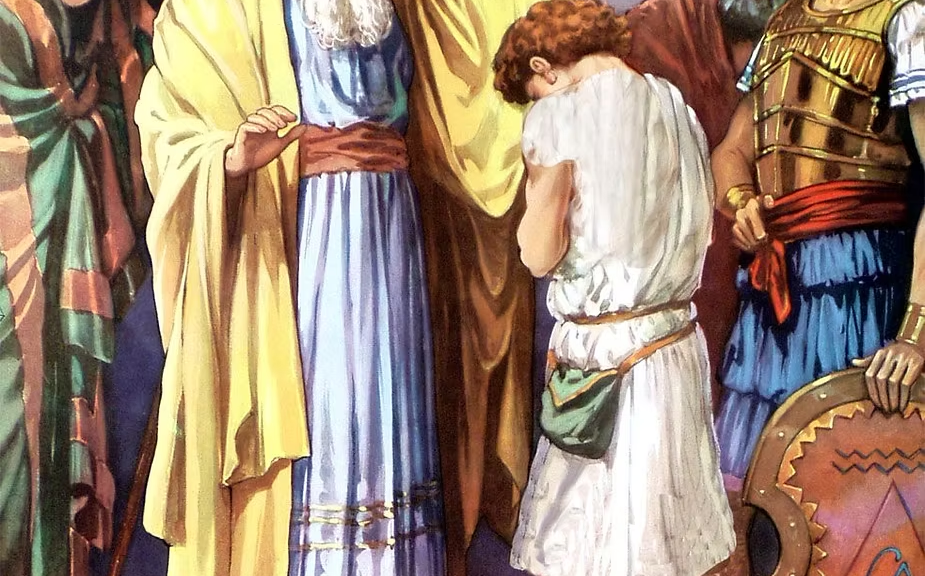
When they came, he looked on Eliab and thought, “Surely the Lord’s anointed is now before the Lord [Yahweh].” But the Lord [Yahweh] said to Samuel, “Do not look on his appearance or on the height of his stature, because I have rejected him; for the Lord [Yahweh] does not see as mortals see; they look on the outward appearance, but the Lord [Yahweh] looks on the heart.” Then Jesse called Abinadab, and made him pass before Samuel. He said, “Neither has the Lord [Yahweh] chosen this one.” Then Jesse made Shammah pass by. And he said, “Neither has the Lord chosen this one.” Jesse made seven of his sons pass before Samuel, and Samuel said to Jesse, “The Lord [Yahweh] has not chosen any of these.” Samuel said to Jesse, “Are all your sons here?” And he said, “There remains yet the youngest, but he is keeping the sheep.” And Samuel said to Jesse, “Send and bring him; for we will not sit down until he comes here.” He sent and brought him in. Now he was ruddy, and had beautiful eyes, and was handsome. The Lord [Yahweh] said, “Rise and anoint him; for this is the one.” Then Samuel took the horn of oil, and anointed him in the presence of his brothers; and the spirit of the Lord [Yahweh] came mightily upon David from that day forward. Samuel then set out and went to Ramah.

——————–

This is the track 1 Old Testament option to be read aloud on the third Sunday after Pentecost, Year B, according to the lectionary for the Episcopal Church. It will be paired with Psalm 20, which sings, “We will shout for joy at your victory and triumph in the Name of our God; may the Lord grant all your requests.” That will be followed by a reading from Paul’s second letter to the Christians of Corinth, where he wrote: “For all of us must appear before the judgment seat of Christ, so that each may receive recompense for what has been done in the body, whether good or evil.” All will precede the Gospel reading from Mark, where Jesus said: “The kingdom of God is as if someone would scatter seed on the ground … and the seed would sprout and grow, he does not know how.”

This seems to be a nice little history story, with little to do with modern Christians. The reality is David is a reflection of what a true Christian is supposed to be. Samuel is a reflection of a soul that has married Yahweh and become his obedient wife and servant should be. The other characters, from Saul to Jesse and his named sons, are a reflection of what most people who call themselves Christians really are.

Let me first point out that there are fourteen time “Yahweh” was written in these selected verses, with no times was “the Lord” written. While the translation into English shows zero times “Yahweh” is named, there are sixteen times this reading projects the word “Lord.” In these fourteen verses that bridge two chapters, there are thirteen proper names that are of people and places, which are all translated as written, rather than say, “This guy did that to that guy, over there in that place, before going to another place to see another guy and his sons.” This shows a respect for the specificity of that written, except when it comes to naming Yahweh as “Yahweh.” That is disrespect to one’s professed God.

This makes an analysis of those Hebrew words that have all been given the importance of capitalization, as names. In all Scripture, the names stated are intended to reflect the meaning behind the name, as that meaning assists one in finding the deeper message intended to be found in Scripture. This is a list of the proper names, as they appear in the text, along with the meaning each name carries (according to Abarim Publications):

  1. Samuel – Name Of God, Heard Of God
  2. Ramah – Lofty Place, Deceit, Established, Loose
  3. Saul – Asked For
  4. Gibeah – Hill
  5. Yahweh – I Am Who I Am; He Who Causes That-Which-Is To Be & He Who Causes That-Which-Can’t-Be To Fall
  6. Israel – He Retains God, God Is Upright
  7. Bethlehemite – [One Of] House Of Bread, House Of War
  8. Bethlehem – House Of Bread, House Of War
  9. Jesse – My Husband, Yah Exists
  10. Eliab – (My) God Is Father
  11. Abinadab – The Father Is Generous, My Father Is Noble, Father Of Liberality
  12. Shammah – Appalling Desolation
  13. David – Beloved, Weak, Flowing

In the storyline, Saul has been anointed as the King of Israel. He was not the choice of Yahweh. Instead, he was “Asked For” by the Israelites. Samuel was told by Yahweh to give the people what they “Asked For,” which was a king to lead them, like other nations had. Samuel, as a true prophet and judge of Israel, was in the “Name of God,” as one whose soul had married Yahweh, so he “Heard Of God.” Because Saul was not married to Yahweh, Yahweh gave Saul a test, which Samuel told him – step by step – what to do. Saul did not do that. Saul failed to do what Yahweh commanded, thus “Yahweh was sorry that he had made Saul king over Israel.”

Here, it is vital that one see the importance of Saul being a reflection of every soul that has animated dead flesh. Saul symbolizes all souls having “Asked For” the right to be the king over the kingdom that is their flesh. Every soul feels the power and strength that Saul felt, as he thought he could do no wrong. He did as he pleased. He broke the commandment and made up his own rules, thinking he was justified to do whatever he wanted. Everyone who is a reflection of Saul has turned away from Yahweh.

When one sees that Saul had been named King of “Israel,” it is important to realize that “Israel” was the changed name of Jacob. The “children of Israel,” who beget the Tribes of Israel, which became the nation of Israel under a king, are all supposed to be elevated from simple sinful souls inhabiting fleshy bodies, as priests on earth whose souls have married to Yahweh. Thus, as “Israel,” they are all expected to be spiritual wives who serve Yahweh, in the same way as did Samuel. Thus, one soul that has earned the right to claim to be an Israelite must then be one whose soul “He Retains God” or one where “God Is Upright” in the flesh [Yahweh incarnate on earth]. Yahweh is therefore the king who reigns over everyone of Israel; and, Saul was not a soul married to Yahweh, not being one who could possibly lead simple souls to become changed into “God Is Upright.”

This then applies to all Christians. Jesus is not a king over anything “of this world,” which means Jesus is not the king of all Christendom. Jesus’ soul is the king that resides over the kingdom of a soul-flesh being, after that soul-flesh being has become married to Yahweh. This then makes Jesus the King of Israel, when oneself has been transformed as was Jacob, from self-serving lowlife to a Son of Yahweh, as His wife. Anyone who claims to be a Christian, who is not “God Is Upright” through their soul’s marriage to Yahweh and His Son being sent to be King of one’s soul-flesh is a lying failure, just as was Saul. Whatever your lowlife soul Asks For, you will deserve to pay the price of that selfishness when your mortal flesh falls away from your soul and you face judgment from Yahweh.

Now, in this story, one cannot forget the lesson of the previous Sunday, where the elders of Israel went to Samuel, demanding he appoint them a king. If the elders of the Twelve Tribes were too lazy to each be a soul married to Yahweh, requiring Yahweh send them a judge who Heard Of God, all the lesser Israelites must be seen as led to ignorance, by the ignorant. From that ignorance, none had ever been taught the truth of being a child of Yahweh, so all did whatever the judge [Samuel] told them to do, none being married to Yahweh and able to hear His voice speaking to their souls. Thus, no one in all Israel was strong. All were weak. The people Asked For Saul, because he seemed willing to do vicious acts and not worry about what he left in his wake. Saul appeared to be strong, when in reality he was like everyone else in Israel – weak.

This is seen in the name David, which primarily means “Beloved.” That is a statement about the love that draws a soul to marry Yahweh, as mutual love shared between the two. Still, the name David also reflects his soul was “Weak” and thereby “Flowing,” meaning he was led to go wherever the Spirit took him. David should then be seen as selected by Yahweh because of that lack of self-ego that makes other souls be headstrong and selfish, like Saul. The sons of Jesse were named as selfish [as “My Father Is Noble” and (My) God Is Father”] or ruin bound to happen [“Appalling Desolation”]. Yahweh knew Jesse [“My Husband, Yah Exists”] was devoted to the Laws of Moses, but still self-concerned.

When we read that Yahweh instructed Samuel to go to Jesse the Bethlehemite because, “ I have provided for myself a king among his sons,” it is good to note that David was born in Bethlehem, just like Jesus. The name of that place means “House Of Bread” or “House Of War.” The Hebrew word “beth” means “house.” The possibilities of “bread” and “war” come from the vowels assumed, as “lahem” refers to “war” or “greedily gulping.” The Hebrew word “lechem” means “bread” or “food.” When this place is recognized as where Yahweh knows a “House Of Spiritual Bread” can come, that makes it be where Micah prophesied the Messiah would be born.

“But you, Bethlehem Ephrathah, though you are small among the clans of Judah, out of you will come for me one who will be ruler over Israel, whose origins are from of old, from ancient times.” [Micah 5:2]

When we read that Samuel went to Bethlehem and “the elders of the city came to meet him trembling,” it must be realized that Samuel was a known prophet of Yahweh, possessing all the powers of Yahweh wherever he went. The Hebrew word written is “way·ye·ḥer·ḏū,” from “charad,” meaning “to tremble, to be terrified.” Because the elders had gone to Samuel telling him, “You are old and your sons do not follow your ways,” it was not an overwhelming physical presence that made the elders of Bethlehem “tremble” with fear. This should be read in the same way that the elders of the Israelites feared the glow that came from Moses’ face, after he met with Yahweh in the tent of meeting. This fear says Samuel had the same glow about him [a halo?], which told those Israelites he came upon [by glow] that his soul and Yahweh were married, so be careful what you do and say before Yahweh.

This greeting of Samuel says the elders of Bethlehem feared God, which was a sign of reverence to Yahweh, even though they were not themselves also married to Him. The mistake in reading this is coming away thinking that Samuel was a priest, representing those who served Yahweh in His “Lofty Place,” which was the town of Samuel’s birth [Ramah]. While Samuel was raised in the School of Prophets, tutored by Eli, and Samuel was one of many priests who served as tabernacle servants, Samuel’s soul having married Yahweh’s Spirit brought him the presence of greatness, when Samuel did not take credit for this.

In our modern times, Christians bow down before people whose souls have not married Yahweh, but they wear the robes of priests, possessing titles that do not arouse fear, but delight in having come close to such false gods. Samuel the man was not feared, or no elder would have approached him with the bold demand for him to pass the torch to a human king. The only presence that demands reverence, as seen in fear, is one who comes near, lowly in stature, but Almighty in presence.

When we then read that Samuel “ sanctified Jesse and his sons and invited them to the sacrifice,” the Hebrew word “way·qad·dêš” is written, which [from “qadash”] means “to be set apart, be hallowed or consecrate.” This means Samuel announced a “sacrifice unto Yahweh,” which was an event only allowed for those made “holy.” When we read of Samuel instructing the elders of Bethlehem: “sanctify yourselves and come with me to the sacrifice,” this says the elders were the priests of Bethlehem, who knew rituals of service they needed to perform before such a sacred event. When it is then added that Samuel, “sanctified Jesse and his sons and invited them to the sacrifice,” that says Jesse and his sons were not members of the Bethlehem priests, as they were just common Israelites. Because they did not know the rituals of sanctification, Samuel guided them through this cleansing.

In those unspecified steps of purification, one can assume that Samuel had all the families of Bethlehem come to a mass sanctification, which included David. He would have been one of a sea of faces and bodies being blessed, although Yahweh would have spoken to Samuel, telling him to specifically invite Jesse and his sons to the sacrifice serving of holy barbeque. Samuel would not have singled anyone out as more special than another, as the eyes and ears of a king were throughout Israel and word would have reached the king, possibly endangering anyone singled out. Because Samuel had confirmed he came “peaceably,” the event was seen as a welcome change of pace, with only the best intentions bringing recognition to Bethlehem.

There should be understood that some time elapsed between the arrival of Samuel and the actual sacrifice, with subsequent anointing. It could mean a day or more, selecting the appropriate sacrificial animals and preparing an altar for the cookout. It would be during this preparation time that the people of Bethlehem would have returned to their normal activities, looking forward to the sacred event they were invited to attend. It is then this delay in time that David, who would have only been around nine years of age, was seen by Jesse as too young for this gathering; and, with flocks to tend, Jesse thought no one would miss a boy sent to watch over the sheep, while the adults did adult things.

When it came time to gather and the sacrifice had been made, with everyone seated at tables for the food to be passed out, it is possible that Samuel made an announcement that Yahweh knew one of the people present was worthy of special recognition [unspecified]. It is possible that he went from table to table, looking upon all the Bethlehemites who were present, knowing only the sons of Jesse were the intent of the whole sacrifice ruse. After all, we know Yahweh told Samuel it was a son of Jesse who needed to be anointed as the one of favor, but everything was still to be kept hush hush.

When we read that Samuel came to Jesse’s son Eliab, saying to himself, “Surely this is the one,” it is very important to remember that Yahweh told him, “Yahweh does not see as mortals see; they look on the outward appearance, but the Lord Yahweh looks on the heart.” In this, the Hebrew text simply says, “kî lō,” which literally states “that not,” whereas the NRSV translates this as “the Lord does not.” Later, when it translates, “the Lord looks on the heart,” the name “Yahweh” is written. There, the word translated as “heart” literally means “inner man,” which means the soul.

This is very important to grasp, because modern Christians will look upon someone wearing a robe and a collar and think special recognition is deserved. Christians look at the outer appearance, incapable of knowing the soul Samuel, whose name means “Heard Of God,” listened to the voice of Yahweh guide him. Christians do not possess this unity with Yahweh, so the become easy prey to wolves in sheep’s clothing. This falls in line with the worldly axiom that says, “Clothes make the man.” Politicians love to give big smiles and shake hands, wearing the most expensive suits; but the soul of a true holy person would never pander for such recognition.

When we read, “Then Jesse made Shammah pass by,” this is assumed to be the name of Jesse’s third oldest son. However, the name of that son is “Shimea,” whose name means: “He Has Heard, Hearing, Rumor.” The writing of “Shammah” must be seen as a form of “Shimea,” as if not the name is, “drawn from the verb שמם (shamem), meaning to be desolate or appalled.” This means the spelling here can be read as purposeful [not a mistake], placing important focus [capitalization] on the way Samuel was beginning to feel. As this was now the third of Jesse’s eight sons [only seven of eight present] and the three oldest had been rejected by Yahweh, “Shammah” sums up “and all the rest.” The fact that the next five are not named says they all fell under the heading of “Appalling, Desolation.” That despair then led Samuel to ask Jesse, “Are all your sons here?”

Jesse responded to Samuel, saying “There remains yet the youngest, but he is keeping the sheep.” In that, the Hebrew word “haq·qā·ṭān” is written, which [from “qatan”] means “small, young, unimportant.” This should be seen as a reflection on New Testament [Acts] Saul [the Jew who persecuted Christians], when he changed his name to Paul, which means “small.” This is also how the name David bears meaning that says “Weak.”

This is then a most important clue to those who aspire to rise to such lofty heights as popes, cardinals, archbishops and bishops, all puffing out their chests and pretending to be most high, hobnobbing with the rich and famous celebrities of the world. That pretense of piety is obscene, when Yahweh looks at the souls of the “small” and “weak.” It is they who gladly “Keep the sheep,” so others can enjoy barbecues. That makes one recall how Jesus told Peter three times to “feed the lambs of me,” “Shepherd the sheep of me,” and “feed the sheep of me” (John 21). The fact that David was watching the sheep says he took responsibility seriously, with a name that meant “Beloved.”

Knowing that some time had to have elapsed before David could be summoned and brought back, it is quite possible that Yahweh had planned this delay before the actual anointment. To keep this anointment less public, the delay would have been when the cooked meat was served and eaten. Afterwards, everyone would have thanked Samuel for the cookout and left, leaving Jesse and his sons alone with Samuel, when David arrived. Possibly, one the sons of Jesse had departed, taking David’s place in the field; or, one of Jesse’s two daughters took his position of responsibility.

When David is described as “ruddy” or “red,” this could mean his cheeks were flushed from running to his father, once he heard the call. Flushed cheeks could mean pale skin, easily reddened by the sun. Still, it could mean David had red hair.

In a prophetic trance that Edgar Cayce entered, when asked to describe the Last Supper, he said of Jesus: “The Master’s hair is ‘most red, inclined to be curly in portions, yet not feminine or weak – STRONG, with heavy piercing eyes that are blue or steel-gray.” Here, in the reading, David’s eyes are said to be “bright” or “fair, beautiful” [from “yapheh”].

It is common to find one with red hair having brown [hazel] or green eyes, with red hair and blue eyes being the most rare. With red hair being in itself unique [as a percentage] among people on earth, the combination with blue eyes makes a statement that the souls of both David and Jesus projected their purity through that rarity. Again, this is not some physical trait that can be looked upon as humans see things, but these descriptive terms should be seen as being what hidden traits one can look for, in order to see the soul. As the saying goes, the eyes are the window to the soul.
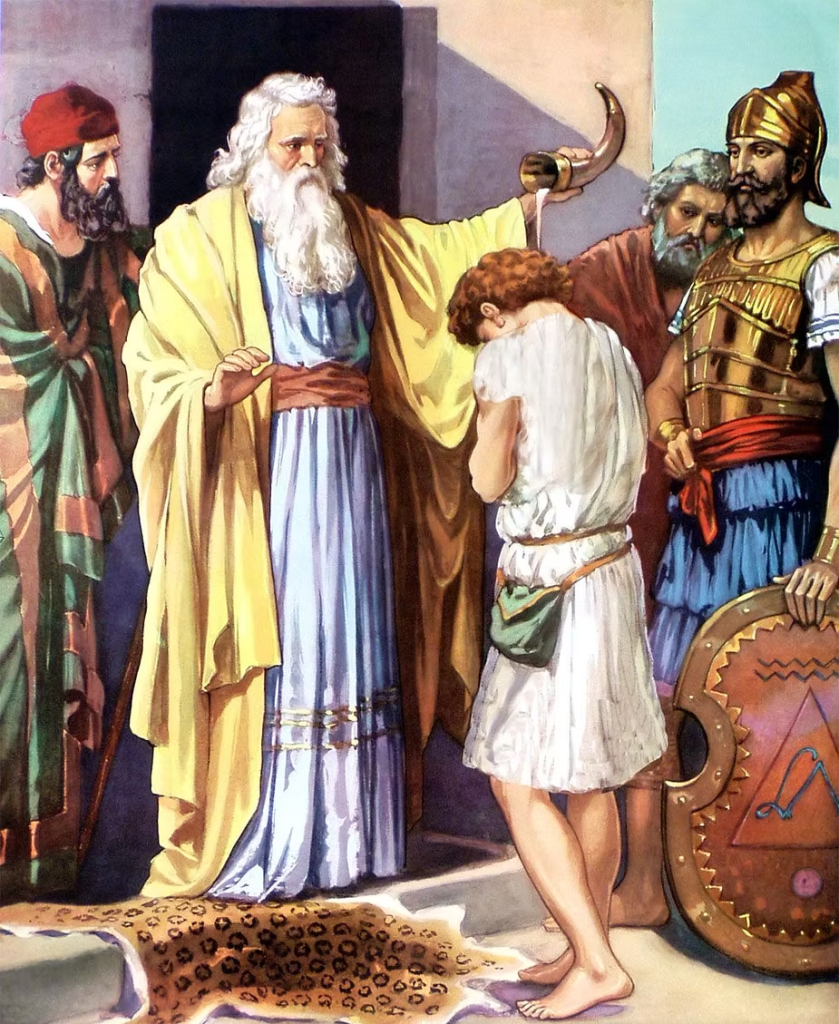
Finally, when we read, “the spirit of Yahweh came mightily upon David from that day forward,” this says the soul of David was sanctified by that Spirit [“rū·aḥ-Yah-weh”]. While all had been consecrated by Samuel beforehand, the Spirit of Yahweh possessed the soul of David when Samuel poured oil upon his head. This anointment would be akin to John baptizing with water, while Jesus would baptize with the Spirit that makes one Holy [Sacred, Set apart by Yahweh]. Thus, this is stating that David’s soul was a “Christ” [from the Greek “Christos,” meaning Messiah – Anointed one].

This needs to be seen as the missing link today, as so many Christians place full value on baptism by water, by ashes mixed with oil smudged on foreheads, wafers blessed by some man or woman, or wine consecrated in the same way. Nothing poured on or rubbed on or eaten physically can ever bring a union of soul spirit to Holy Spirit. All modern pretenses of being equals to Samuel, who was a true prophet of Yahweh and had his soul married to God Almighty, are lame excuses of consecration.

With that said, not even Samuel could become Yahweh’s Spirit and merge it with the soul of David, remaining there “from that day forward.” Just as Yahweh knew which soul of Jesse’s sons He planned to marry, Samuel was blind to the outcome, until it was done.

Christians today fall well short of being the brothers of David, who could look upon their younger sibling as being an Anointed one of Yahweh, sensing they were in the presence of Yahweh merged with their brother. As brothers of a Christ, I would expect David to receive resistance at first, from all his male siblings. David would have sensed little change; and, he probably would have had a spiritual affect on his family. We will never know; but being close to a true Saint has become lost in the worship of religion, one that is afraid to call Yahweh by name.

As the Old Testament track 1 optional Old Testament reading, during the third Sunday of the Ordinary season after Pentecost, this speaks loudly that all souls fall short in the eyes of Yahweh, until they turn to Him in marriage. The season after Pentecost is all about entering ministry; and, for that to take place one must become an Anointed one. That clearly means being a Christ, which comes from being in the name of Yahweh, as His wife. That marriage of soul to Spirit then gives birth to the soul of Jesus, which make the body of flesh he is resurrected within be a new Jesus reborn. This ministry comes from being able to hear the voice of Yahweh lead one through ministry. It is not a temporary assignment, as once it comes upon one, it remains forever. This is how one knows salvation has been obtained; and, it is the motivation to go into the world to save others for the Father.


Ezekiel 17:22-24 – Being the cedar tree

Thus says the Lord God [adonay Yahweh]:

I myself will take a sprig

from the lofty top of a cedar;

I will set it out.

I will break off a tender one

from the topmost of its young twigs;

I myself will plant it

on a high and lofty mountain.

On the mountain height of Israel

I will plant it,

in order that it may produce boughs and bear fruit,

and become a noble cedar.

Under it every kind of bird will live;

in the shade of its branches will nest

winged creatures of every kind.

All the trees of the field shall know

that I am the Lord.

I bring low the high tree,

I make high the low tree;

I dry up the green tree

and make the dry tree flourish.

I the Lord have spoken;

I will accomplish it.

——————–

This is the track 2 Old Testament option that could be read aloud on the third Sunday after Pentecost, Year B, according to the lectionary for the Episcopal Church. If chosen, it will be paired with Psalm 92, which sings: “The righteous shall flourish like a palm tree, and shall spread abroad like a cedar of Lebanon. Those who are planted in the house of the Lord shall flourish in the courts of our God.” They will be followed by an Epistle reading from Second Corinthians, where Paul wrote: “For all of us must appear before the judgment seat of Christ, so that each may receive recompense for what has been done in the body, whether good or evil.” The Gospel reading will then be read from Mark, where it is written: “It is like a mustard seed, which, when sown upon the ground, is the smallest of all the seeds on earth; yet when it is sown it grows up and becomes the greatest of all shrubs, and puts forth large branches, so that the birds of the air can make nests in its shade.”

In this reading selection, the Hebrew of these three verses includes the word “Yahweh,” written three times. In verse 22 is written “adonay Yahweh,”[1] which is translated as “the Lord God.” The two other places [verse 24] where “Yahweh” is written, the NRSV has translated it as “Lord.” The question to the ‘think tank’ translators is this: Which is it: “God” or “Lord,” when both “Yahweh” and “adonay” are two different words translated as “Lord,” yet when “Yahweh” is translated as both “God” and “Lord”?

To translate “adonay Yahweh” as “Lord God” is an error that believes God [Yahweh] tells His prophets to write about “two-word entities.” They do that with “Jesus Christ” [or “Christ Jesus”] and the “Holy Spirit” [or “Spirit Holy”]. That is thinking [always a deadly thing to do] Yahweh needs an additional title added to His name, when simply “Yahweh” says everything needed to be said. Saying Yahweh is a “Lord” is unnecessary redundancy. The same applies to a capitalized [a Greek capability] “Pneuma,” where that cannot come from anyone other than Yahweh, due to the capitalization. If it is accepted to be Spirit that comes from Yahweh, then it is accepted to be “Holy.” The same error applies to “Christ Jesus,” as it gives the impression that “Christ” was the last name of “Jesus,” so both words must be said together. That as if Mr. Christ” [Yahweh the Father?] will be offended if His name is not mentioned.

All of this is the absurdity of English translations, which are all designed to lessen the power of Yahweh [that is the name of a Jewish God], to make authors of divine books be opinion writers. Their translations of this nature remove all thought from simple-speakers-of-English’s minds, as to individual responsibility to serve Yahweh as Jesus reborn. No one is taught that Yahweh has the power to make anyone a “Christ,” because all power to Anoint Spiritually can only come from Yahweh.

This means that every time the two words appear in Old Testament Scripture, saying “adonay Yahweh,” “adonay” refers to the “lord” over the prophet’s soul-body. That follows the marriage of that soul to Yahweh’s Spirit. This means “adonay Yahweh” is reference here to Ezekiel, whose “lord” over his body of flesh was “Yahweh.” As such, every word written by Ezekiel came from Yahweh, his lord. Yahweh is only lord to those souls He has married and are His wives. Calling Yahweh “Lord” does little to make Him become one’s “lord.”

By seeing that, when Ezekiel wrote, “kōh ’ā·mar ’ă·ḏō·nāy Yah·weh” [“thus says lord Yahweh”], Ezekiel was announcing, “I now write as the voice of Yahweh, because He instructs the following words.” The following words become metaphor from Yahweh, with four references to Yahweh being “I” [“’ā·nî”].

In verse 22, the metaphor is placed on “a cedar tree.” This becomes symbolism that should be realized. According to a search of the Internet [Google], using the terms “symbolism of cedar trees,” the following was posted on the website Garden Guides:

“The branches of the cedar tree are wide and grow almost parallel to the ground, making the tree appear to be constructed of successively higher floors made of greenery. In the late 19th century, author John Worcester compared the structure of the cedar tree to the process of attaining successively higher natural and spiritual knowledge, writing, “The spiritual tree also must extend its branches, put forth leaves, and mature its fruit on successively interior planes of the mind.” Worcester further elaborated that the scent of cedar wood indicated the pleasure people find from discovering knowledge and truth.”

This becomes a perfect view of the growth pattern of the branches of a cedar tree. It makes the “highest branches” [“miṣ·ṣam·me·reṯ”] reflect upon those who had reached closest to Yahweh. This then becomes a statement of those who were like Ezekiel, as “adonay Yahweh.” It also is spoken through a prophet of Israel, even though his time as a prophet was served in the southern kingdom, Judah [including captivity in Babylon].

The name “Israel” is a reflection as the “highest branches,” as that is the name taken by Jacob, after his soul married Yahweh. His new name – the name “Israel” – means the soul of Jacob had become “God Is Upright” and “He Retains God.” [Abarim Publications] Thus, the “highest branches of a cedar tree” means those branches of one tree who have married the Spirit of Yahweh, being extensions of Yahweh, still on the physical plane.

As for the “cedar tree” [“hā·’e·rez”], that refers to the children of Israel, led to become a growth of Yahweh on earth, unlike any other “trees” of government or religion. Here, the “cedar tree” is said to symbolize “strength and eternity.” Still, as Ezekiel was a prophet of the mighty tree that was felled, it had once been Israel, but split by lightning and formed into Israel and Judah. That surviving “cedar tree” was then felled by the Babylonians.

This makes this become a prophecy of what Isaiah wrote about as well: “A shoot shall come out from the stump of Jesse, and a branch shall grow out of his roots.” The “stump of Jesse” was the “cedar tree” that had been Israel under David, such that from his being “the highest branches” [everything went downhill from then], the metaphor of the “tender sprig” [“yō·nə·qō·w·ṯāw raḵ”] would be Jesus, whose DNA was implanted in the womb of Mary.

When verse 23 sings, “On the mountain height of Israel I will plant it, in order that it may produce boughs and bear fruit,” here the name meaning of “Israel” [“yiś·rā·’êl”] must be understood. Because Ezekiel was a prophet of Judah, taken in the exile to Babylon, the meaning behind the name is the intent of Yahweh speaking. It has absolutely nothing to do with Yahweh promising to bring back to life a nation that failed, because it worshiped human kings, not Yahweh. Therefore, “the height of Israel” is the meaning that says, “God Strives” [Strong’s] or “He Retains God” – “God Is Upright” [Abarim Publications]. This speaks of all who would be like Ezekiel, married to Yahweh, so the “lord” of their souls would be His Spirit. The “fruit” [“p̄e·rî”] would be Jesus, which would give rise to the great new “cedar tree” called Christianity [still representative of “Israel” – not a nation run by humans, but individual soul married to God].

When verse 23 continues, singing “Under it every kind of bird will live; in the shade of its branches will nest winged creatures of every kind,” the metaphor of “birds” and “winged creatures” is that of angels. In Hebrew, the word “malak” is translated as “angel,” found written in Old Testament scripture a hundred ten times. The word actually means “messenger,” which [along with “ambassador” and “envoys”], so the same spelling shows up in Biblical translation a hundred three other times, with different translations than “angel.” This then leads one to see “apostles” [from the Greek “apostolos”] as having the same essence as “malak,” meaning “a messenger, envoy, delegate, one commissioned by another to represent him in some way, especially a man sent out by Jesus Christ Himself to preach the Gospel; an apostle.” (Strong’s usage)

When one realizes that the meaning of “Israel” implies a divine marriage between soul and Spirit, so one has become “Holy, Sacred, Set apart by God” [the meaning of “Hagion”], it is this union that makes one’s “lord” [“adonay”] be “Yahweh.” Another Old Testament way of making this union be stated is “elohim,” such that Genesis 2 – once the seventh day came and it was deemed “holy” [we live today still in the seventh day] – one finds “Yahweh elohim” written eleven times. An “elohim” of “Yahweh” is then a “god” [“el”] on earth, exactly as is an “adonay Yahweh.” Thus, “elohim” are “winged creatures” [a modification of “kāl- kā·nāp̄,” which literally states “all-winged”] or “birds” [“ṣip·pō·wr”], under the protection of the new “cedar tree” – Jesus [a name meaning “Yah[weh] Will Save].

In verse 24 Ezekiel wrote, “All the trees of the field shall know that I am [Yahweh].” When one realizes the “cedar tree” is the religion of the true priests of Yahweh [His wives in marriage], then “all the trees of the field” become every religion or denomination of a religion that believes in lesser gods. This includes all Christians who refuse to call upon the name Yahweh, preferring to generally state someone unknown [by name]. That lack of personal relationship is what lowers that religion to “all others of the field,” which make up the total scope of religion on earth. This is the difference in the “elohim” of those who worshiped Ba’al and the “elohim” who was himself one, Elijah. Those failed to light an altar fire through prayer alone were the “trees” of religion that had no direct contact to a true Spirit.

This relates to Yahweh saying through Ezekiel’s hand, “I bring low the high tree, I make high the low tree.” One needs to keep in mind here, how the “highest branches” of “Israel” now become the lowest tier of the tree. As such, the roots of the tree are the hidden union with Yahweh, where the Spirit is one with the soul of the tree, so the lowest branches were those of David’s reign, after the Saul branch was pruned and thrown into the fire. Saul was non-productive, producing no fruit. Conversely, the higher branches would be furthest from the roots and therefore less connected to the Spirit, although the highest. The higher branches are too young to produce fruit, but their “tender twigs” contain the code for becoming the Son of man. The wives of Yahweh are the soul produced by the tree of Israel [those in whom “God Is Upright”], not the other trees in the forest.

When the verse then sings, “I dry up the green tree and make the dry tree flourish,” this must be seen as precursor metaphor for Ezekiel’s dream of Yahweh taking his soul to a valley filled with dry bones. [Ezekiel 37] The statement “I dry up the green tree” speaks of the death of mortal existence in a body of flesh. The dead matter that is flesh is only made “green” [from “lāḥ” or “lach,” which actually means “moist, fresh, new”] when the “breath” [ruach] of life brings sinews, muscles and skin around the dryness of dead matter [bones]. This means reincarnation; and, it is the promise of mortality. That says the dream Ezekiel spoke of reincarnation, where now Yahweh says souls come back as “new trees,” after having been “trees” before. However, to make the “dry tree flourish” that means the promise of everlasting life. That was the lesson of Yahweh telling Ezekiel to prophesy to the breath, beyond prophesying to the dry bones.

The final segments of this song say, “I Yahweh have spoken and done.” This should not be read as some brag about the powers of Yahweh. Such truth needs no boasting come forth … from Yahweh. This then means “I Yahweh have spoken” is what we read having been written by Ezekiel. Yahweh speaks through the prophets; so, Ezekiel equates [minimally] to all who wrote divine text of Holy Scripture. Yahweh has spoken the truth every time. His Word becomes the physical roots from which a “cedar tree” grows. No religion claiming Yahweh as the “lord” of the souls who run an organization can use any other text. Even when those souls claim Yahweh is named “Allah” or “the Lord,” they cannot claim that “Yahweh has spoken” through themselves. Therefore, they are not the “cedar tree.” The “cedar tree” is only Jesus resurrected with a soul married to Yahweh and Yahweh alone.

The word translated as “and done” [or “I will accomplish it”] – “wə·‘ā·śî·ṯî” – says the proof is not to see prophecy fulfilled, as that is a lack of faith. The souls who grow from the “cedar tree” of eternal strength will marry Yahweh because they know what has been “done.” That knowledge can only come from personal experience of Yahweh, which means the soul [roots] have merged with the Spirit of Yahweh and the truth courses through one’s flesh. This faith of “done” is the truth of the “blood of Jesus,” whose soul allows one’s mind to know the truth of Yahweh and lead one into His service.

As an optional Old Testament selection to be read aloud on the third Sunday after Pentecost, one should readily see how the verbiage of Ezekiel becomes a match for the metaphor of Mark, where Jesus spoke of seeds growing and bearing fruit. It is vital, if this reading is chosen, to see Israel as a Spirit merged with a soul, creating one in whom “God Is Upright.” One needs to see how the “low” will be made high, not the other way around. Those who think [the deadly curse of mankind] they are high and mighty enough to stop calling Yahweh by His name will find their souls appearing on His doorstep, after their “green tree has been made dry,” only to hear YAHWEH say, “You did not know me, so I do not know you.”

——————–
[1] There are no capital letters in Hebrew. The word written is “יְהוִ֔ה.” Myself and BibleHub [and others, I assume] capitalize the transliteration as “Yahweh,” in the same way that proper names are capitalized. The intent implies capitalization, when in reality there is none. So, “adonay” translates as “lord.”

2 Corinthians 5:6-10,[11-13],14-17 – Opening the door to oneself, so the Lord can enter

We are always confident; even though we know that while we are at home in the body we are away from the Lord– for we walk by faith, not by sight. Yes, we do have confidence, and we would rather be away from the body and at home with the Lord. So whether we are at home or away, we make it our aim to please him. For all of us must appear before the judgment seat of Christ, so that each may receive recompense for what has been done in the body, whether good or evil.

[Therefore, knowing the fear of the Lord, we try to persuade others; but we ourselves are well known to God, and I hope that we are also well known to your consciences. We are not commending ourselves to you again, but giving you an opportunity to boast about us, so that you may be able to answer those who boast in outward appearance and not in the heart. For if we are beside ourselves, it is for God; if we are in our right mind, it is for you.] For the love of Christ urges us on, because we are convinced that one has died for all; therefore all have died. And he died for all, so that those who live might live no longer for themselves, but for him who died and was raised for them. From now on, therefore, we regard no one from a human point of view; even though we once knew Christ from a human point of view, we know him no longer in that way. So if anyone is in Christ, there is a new creation: everything old has passed away; see, everything has become new!

——————–

This is the Epistle reading that will be read aloud on the third Sunday after Pentecost [Proper 6], Year B, according to the lectionary for the Episcopal Church. This reading will follow either a track 1 or track 2 pairing of readings; such that if track 1 is chosen, a reading from 1 Samuel will say, “Samuel did not see Saul again until the day of his death, but Samuel grieved over Saul.” That reading will be paired with Psalm 20, which sings, “They collapse and fall down, but we will arise and stand upright.” If track 2 is chosen, then the Old Testament reading will come from Ezekiel, who wrote, “On the mountain height of Israel I will plant it, in order that it may produce boughs and bear fruit, and become a noble cedar.” That will be paired with Psalm 92, which sings, “They shall still bear fruit in old age; they shall be green and succulent.” All will accompany the Gospel reading from Mark, where Jesus said, “With what can we compare the kingdom of God, or what parable will we use for it? It is like a mustard seed, which, when sown upon the ground, is the smallest of all the seeds on earth; yet when it is sown it grows up and becomes the greatest of all shrubs, and puts forth large branches, so that the birds of the air can make nests in its shade.”

These selected verse begin by saying, “We are always confident; even though we know that while we are at home in the body we are away from the Lord– for we walk by faith, not by sight.” That is so much of a mouthful that it becomes difficult to follow what is said. It forces questions that are not answered, as the reader drones on, adding more to the complexity. What does “confident” mean? What does “at home in the body” mean? What does “away from the Lord” mean?

This confusion comes because Yahweh does not speak in ‘speed reading capable’ language. If the sole purpose of reading things aloud is to practice one’s public speaking skills, then a church is not the appropriate environment. If reading something as fast as possible is only to get a service over sooner, without any in-depth discussion [allowing hands to be raised with questions to ask], then there really is no point in reading anything in church. Just come in, wave some wands, pass out some human-deified material things [water, wafers, wine], adjourn and go home; and, then act like something good happened, when nothing happened to change anything from the way it was before.

What I just presented from the reading is ‘the first sentence’ that will be read by a reader. It is, in reality, two verses of text. Those two verses have pause marks, breaking them into five segments. Each word in those verses could become a sentence or more. Certainly, running on without pause makes it very difficult to understand any Epistle reading, Each verse needs to be understood, before one can go into the next verse. For that reason, here is what was stated in that first ‘sentence.’

Verse 6 begins with a capitalized “Tharrountes,” which divinely elevate the meaning to a Spiritual state of “Being” that brings about “Confidence, Courage, Happiness.” That first word states an Apostle is a soul married to Yahweh and thus in possession of an assurance that cannot be matched by a soul alone. It divinely indicates strength that surrounds one’s state of being, as a present participle level of “Confidence.”

A lion is a good symbol of strength and courage.

That one word leads to Paul saying that state of “Being” is not temporary, as it is “always and knowing” that state of being will always be. In that, a “kai” is written between “always” and “knowing,” signaling the importance of knowledge from personal experience, thus no doubts can diminish that state.

This then leads to a comma mark, indicating ‘take a breath of pause’ before going to the word “endēmountes,” which is another word in the present participle [“Being”]. That state is where “Confidence” is relative to “being at home” or “being in a place to live.” That “place” is then stated to be “in the body,” where “sōmati” can equally translate as “flesh.” From realizing the first word of this ‘sentence’ is capitalized, meaning a marriage with the Holy Spirit, one can then be aware that the Spirit has merged with one’s soul and is “known” to be “at home in the body of flesh.”

The third segment of words in verse 6 then begins with the word “ekdēmoumen,” which has been translated as “we are away.” The word means, “to be away from home, absent,” which shows the relationship to the home, which is one’s body of flesh. When this segment ends with the capitalized word “Kyriou,” one needs to see the divine elevation that comes from seeing that word as being the Spiritual “Lord” over one’s flesh. This represents a union of self [soul] and Spirit, where the self [soul] is “absent,” while still present, subservient to the presence of the “Lord.”

In the accompanying reading from Ezekiel [track 2 option], he wrote “adonay Yahweh,” where I explained the intent is to say the “lord” of Ezekiel was “Yahweh. That “lord” was God’s “Spirit,” so the same needs to be read here as “Lord.” When one’s soul is [present active indicative] “away from the Lord,” this needs to be seen as Paul indicating submission in marriage, as one’s soul has stepped aside, so Yahweh’s Spirit has becomes the “Lord” over one’s body of flesh.

While this can be read [equally right, which is the nature of divine language] to speak of the state of sin that humans always find themselves in, such that “to be away from the Lord,” while being “at home in the body,” says one is led by the desires of the flesh. That says one has turned away from the Lord and the soul has been sold into slavery, then possessed by the wants and desires of the body of flesh. The “flesh” becomes the “Lord” then. This way of reading says it is very easy to enslave oneself [self = soul] to a weakness, where no courage or confidence exists. In a world that panders to influencing souls to step away from self-controls that, in essence, makes Satan [or the Devil] become one’s “Lord” of the body. However, simply by seeing the first word of this three segment verse beginning with a capitalized word meaning a divine state of “Being” that brings “Confidence” and “Courage,” that says the present state is known from having married one’s soul to Yahweh. One has turned away from Satan, facing Yahweh.

Verse 7 then explains this transformation that comes from this Spiritual marriage, where the soul now lets Yahweh’s Spirit be the body’s “Lord.” Paul first wrote, “for we walk by faith,” where the literal Greek translates as “on account of faith indeed we walk.” Strong’s explains this usage of “walking” as meaning the way one conducts one’s life. HELPS Word-studies adds to the deeper meaning: “walk around, i.e. in a complete circuit (going “full circle”).” In that, one can see how a soul comes from Yahweh, as His “ruach” or “breath of spirit,” allowed to be free to do as one pleases; but after marriage to Yahweh’s Spirit, one then has returned to be with God.

Here, it is important to see the word “pisteōs” has been translated as “faith,” not simply “belief,” because the way one conducts one’s life – the true path one walks – always becomes a case of “do as I say, not as I do” contradiction, when the soul walks alone in the flesh. The translation of “faith” speaks of personal knowledge of Spiritual marriage and the presence of a higher “Lord” leading the direction in life one takes. Therefore, “we walk by faith” becomes a statement of the ministry true Apostles will always be found “walking.”

Verse 7 then adds a second segment of words that have been translated as “not by sight.” This element of “sight” must be seen as contrary to “faith,” as “seeing is believing,” while “faith” is trust in that which is physical unknown and unseen. A translation as “not by sight” is also what others see when one walks. That often becomes a failure to live up to beliefs, as what one sees cannot be expected to be the same as what one does.

In this, the Greek word “eidous” [translated as “sight”] truly means “appearance, fashion, shape, sight” (Strong’s Definition), and “visible form, shape, appearance, outward show, kind, species, class.” This makes it clearer to see that “faith” is not shown by what one wears: fancy robes, collars, crosses, high hats, fine suits, etc. This means one does not put on a display that becomes a statement of one’s “beliefs.” If one goes about in ministry feeling a need to announce by the clothes one wears, “Hey, look at me! I am holy and righteous!”

That becomes a projected false power that overcomes people, leading them to “believe” one wearing certain clothes is going to do all the work for them. Seen as having a special relationship with God says others should trust a priest knows what God wants lost souls to do. True “faith” walks the walk and talks the talk privately and without fanfare. This is because the power of ministry is a “Lord” that cannot be “seen” and one does not want to take credit for what that “Lord” does, while one has “stepped away” from the controls of one’s body of flesh.

By slowing down the reading process, incorporating a desire to understand divine text, rather than sit in a pew and dream about what one will do after the service is [predictably soon], one can see great depth arise from what is totally missed by the NRSV translation above. Two verses, broken into five segments of words, brings forth the value of divine insight.

All of the letters of Paul [and the other Apostles] are written in this way; and, all have greater depth of meaning than an English translation read aloud in a church can ever convey. All demand an accompanying explanation by one divinely married, like Paul [and the other Apostles]. The sole purpose of a priest is to provide that explanation, because a priest is like Paul just stated! The purpose of reading Scripture aloud [a practice adopted from the Jewish synagogue reading of the scrolls] is to discuss the meaning, so afterwards everyone “walks” as a priest in ministry – unseen as such to the eyes of others.

Verse 8 is translated above to state, “Yes, we do have confidence, and we would rather be away from the body and at home with the Lord,” which clearly repeats all that had been stated prior. This, however, is also begun by the capitalized word “Tharroumen,” which is the same root word as began verse 6, only now stated in the present active form. This capitalization becomes the same divinely elevated state of “Being” that says [collectively] “We are Confident” and “We are Courageous.”

What is missing from this translation is a second segment, introduced by the word “kai,” which places importance on one word, “eudokoumen,” which adds “kai we are pleased.” This is strongly stating that Paul knew all true Christians were “well-pleased, thought it good, were resolved” in that state of submission. That says their marriage was not forced upon them, but lovingly welcomed. Thus, by Paul saying, “we would rather be away from the body and at home with the Lord,” they had all found much preference from that submission to a divine “Lord.”

In verse 9, Paul is shown to have written: “So whether we are at home or away, we make it our aim to please him.” In reality, this misses another segment that begins with the world “kai.” That marker word is followed by “philotimoumetha,” which means “we love or seek after honor,” implying “ambition” or “self-motivation.” The root word implies [in usage], “I am zealous, strive eagerly, desire very strongly.” (Strong’s Usage) This strong drive to please, based on love intending to honor” their “Lord,” is not translated into the bland way the NRSV states this preference.

The “aim to please” [actually “well-pleasing”] is importantly based on this inner feeling the presence of the “Lord” brings; and, this presence is always present, whether it is giving commands or allowing the soul the freedom to retain and exercise some degree of control of the body it now coinhabits. The element of “pleasing” must be seen as sharing oneself through divine possession, like one would do “pleasing” things to make a guest feel welcome. It shows one is happy with the presence; and, one does not want that visitor to ever leave.

When verse 10 is then translated to say: “For all of us must appear before the judgment seat of Christ, so that each may receive recompense for what has been done in the body, whether good or evil,” this gives the erroneous impression that “Christ” is Yahweh. Most people professing to be Christian will read the word “Christ” and think it is the last name of Jesus; so, they will think Jesus Christ is the one who sits on a throne judging souls, not Yahweh. In reality, the Greek literally translates to state the following:

“these indeed all ourselves to be made known it is necessary before the face of that throne of judgment that of Anointed one , in order that might receive what had belonged to myself but had been lost each these because of that flesh , according to what done , whether good whether evil .

While the NRSV translation can be seen as a simplified version of what was written, the truth is exposed that Paul was making a statement [led by the “Lord” within his flesh to write] that says the souls of true Christians [where “ourselves” – “us” – means “our souls”] have found a gift from divine possession; and, they go into ministry because of that found, which is the promise of Salvation [“walking not by sight”]. Only a saved soul can stand before Yahweh, who sits high on a throne of judgment, as a saved soul come wearing the face of His Son. Only a saved soul stands before Yahweh as Anointed, one of His “Christs.”

Paul and the other true Christians went [and still are expected to go] into ministry with that message: Marry Yahweh and become a “Christ” – an “Anointed one” by the Spirit – so the soul of Jesus is resurrected within one’s flesh, becoming one’s “Lord.” Otherwise, play your time in the flesh all you please, and then suffer the consequences of one’s life. All souls will be held responsible to their life’s past acts of good and evil. Only those souls who “leave their body to the Lord” will wear the face of a Christ and be allowed into heaven.

Write that down and put the note in your wallet or purse; and, then read it each day. Going to church, believing in Jesus Christ [as one name], and trying to limit how many times one secretly does evil, while praying for forgiveness each time, will not allow one’s soul to enter heaven after death of one’s flesh. That is selfishness; and, marriage to Yahweh means the work of selflessness, in return for washing away the past sins. The only way to be redeemed is to marry Yahweh and become His Son reborn, which means getting off the pew and entering ministry, without any of the fancy clothing. Live that or live again [and again] as ‘go back and start over’ reincarnated souls.

This reasoning for ministry is explained by Paul in the bracketed verses, which many see as “whew, optional, let’s strike those out, thank god.” I will forego explaining them here, simply because so many verses of an Epistle reading becomes a dissertation too long for casual Christians to ever finish reading. It would be good practice to look at the text here [BibleHub Interlinear] and do your own work trying to see the truth for oneself.

That then leaps us to verse 14, which says literally: “this indeed that of love of Anointed one held fast ourselves , having decided this , because one on behalf of all has died .” Here, the word ”agape” is written, which means “love which centers in moral preference.” (HELPS Word-studies) That means not “love” based on a human state of emotions or feelings. It is a statement of the love that joins Yahweh’s Spirit to a soul, which comes from a moral desire, not any tinglings felt by the flesh.

Such mutual “love” marries a soul to Yahweh, who in turn “Anoints one” [makes one a “Christ”] out of “love.” This anointment is not temporary, as it “holds fast” to all “souls” [from “selves”] Yahweh merges within. Again, this is not forced, as the “decision” to enter this divine union is totally upon the soul to choose. The “one” who “on behalf of all has died” is Jesus of Nazareth. His human life in the flesh previewed the way all saved soul-flesh should “conduct a life,” with Jesus’ death planned. Only from his soul’s release from one body of flesh could it then be free to be resurrected alongside those souls married to Yahweh. The presence of the divine Spirit brings about this birth within, so Jesus brings one the Anointment that he had in the flesh, returning into a new body of flesh, as the “Lord” one’s soul steps aside for.

Verse 15 then literally says, “kai for the sake of all he died , in order that those living , no more to themselves should live , on the other hand then behalf of themselves having died kai having been raised again .” As can be seen, there are two uses of the word “kai,” which marks importance that must be noted.

First, Paul emphasized the importance of understanding the reason Jesus died, “for the sake of all.” The reason was not so everyone thereafter could sin and still go to heaven. Such a lifestyle means one is not “living,” but instead animating dead matter, heading to the dead end road of life that says, “repeat and try again.” The soul of Jesus is what makes one a “Christ,” which is the only way to become truly “living.”

When Paul then followed that statement by adding, “no more to themselves should live,” this states it is up to the soul to decide to marry Yahweh and be reborn as His Son. As such, “no more should live” is stating one’s own death of control over one’s flesh – dying of one’s ego and self-will. That is when a soul steps away from control of the body and allows the soul of Jesus to become “Lord” of the flesh. This is then stating “”having died,” with the great importance [“kai“] being “having been reborn.”

Verse 16 then literally states, “Therefore ourselves away from that of now nothing regard by way of flesh . forasmuch as kai we have regarded according to flesh Anointed one , but now no longer come to know .” Here, the capitalized word “Hōste” brings divine elevation to the meaning of “Therefore.” That stated prior referred to the conditional [shoulda, woulda, coulda] of making a decision. Paul is now beginning with the heavenly decision for marriage to Yahweh having been made. “Therefore our souls” have stepped “away from” control of one’s body of flesh.

This brings about an eternal “present” or “now,” where “nothing by way of the flesh” has any control over the soul. This is not a state of death, as the soul still occupies the flesh; but the flesh no longer influences the soul. The reason is the souls have allowed their flesh to be controlled by the “Anointed one,” or the “Christ,” which is the soul of Jesus.

The last segment of words can be confusing, but when read slowly they clearly say, “the exception that comes from the now and present is our souls are no longer dominant [instead submissive]. This says our souls have come to know Yahweh up close and personal, through marriage; and, the resurrection of His Son’s soul in one is known to be one’s “Lord.”

Finally [for this reading selection], verse 17 literally translates to state: “therefore if a certain one in Christ , new creation . that original have past away ; behold! , has come into being new .” Again, Paul repeated the word “therefore,” this time without capitalization. It simply states a reflection on that “come to be known.” While the Greek word “tis” can translate as “somebody” or “anybody,” in New Testament writings it refers to “a certain one,” which implies one who is known. While “anyone” [all souls] are invited to become wives of Yahweh [be known by Him], few will make that decision. This means Paul’s use of “tis” speaks only of those “certain” in the name of Yahweh [His Sons].

These will all be “Anointed ones” by the hand of Yahweh. All will become “new,” as having all past deeds of sin wiped clean. That past will “create” a “new” self or soul. The exclamation to be seen [“behold!”] is Jesus Christ has come again in a “fresh” body of flesh.

In this selected Epistle reading to be read aloud on the third Sunday after Pentecost, when each true Christian should have begun a personal ministry as Christ reborn, the true meaning of what Paul wrote is rarely addressed. This says those preaching the sermons either do not care or they do not themselves understand, meaning they have false ministries as false shepherds or wolves in sheep’s clothing. The truth of this reading selection clearly states what has to happen for Salvation to be gained. The totality of ministry is getting that message out, so everyone who hears the message can commit to marriage of their souls to Yahweh. Each has to wear the face of Yahweh, as His Anointed. Each has to have the soul of Jesus resurrected within him or her – all Sons of man – who leads one’s path of righteousness, while the self-soul stands aside to that “Lord.”

Mark 4:26-34 – The ministry of mustard plants (metaphorically speaking)

Jesus said, “The kingdom of God is as if someone would scatter seed on the ground, and would sleep and rise night and day, and the seed would sprout and grow, he does not know how. The earth produces of itself, first the stalk, then the head, then the full grain in the head. But when the grain is ripe, at once he goes in with his sickle, because the harvest has come.”

He also said, “With what can we compare the kingdom of God, or what parable will we use for it? It is like a mustard seed, which, when sown upon the ground, is the smallest of all the seeds on earth; yet when it is sown it grows up and becomes the greatest of all shrubs, and puts forth large branches, so that the birds of the air can make nests in its shade.”

With many such parables he spoke the word to them, as they were able to hear it; he did not speak to them except in parables, but he explained everything in private to his disciples.

——————–

This is the Gospel selection to be read aloud by a priest on the third Sunday after Pentecost [Proper 6], Year B, according to the lectionary for the Episcopal Church. Depending on whether track 1 or track 2 is chosen, there will be a pairing of Old Testament and Psalms also read aloud. If track 1 is chosen, the a reading from 1 Samuel will present: “And the Lord said, “Take a heifer with you, and say, ‘I have come to sacrifice to the Lord.’ Invite Jesse to the sacrifice, and I will show you what you shall do; and you shall anoint for me the one whom I name to you.” That will be paired with a reading from Psalm 20, which sings: “Some put their trust in chariots and some in horses, but we will call upon the Name of the Lord our God.” If track 2 is chosen, then there will be a reading from Ezekiel, saying “I myself will take a sprig from the lofty top of a cedar; I will set it out. I will break off a tender one from the topmost of its young twigs.” A singing of Psalm 92 will include the verse: “They shall still bear fruit in old age; they shall be green and succulent.” This Gospel reading will be preceded by a reading from Second Corinthians, where Paul wrote: “For the love of Christ urges us on, because we are convinced that one has died for all; therefore all have died. And he died for all, so that those who live might live no longer for themselves, but for him who died and was raised for them.”

It is important to grasp the timing of Mark’s fourth chapter. It meshes perfectly with Matthew’s fifth chapter, which is mistakenly called “the sermon on the mount.” Last Sunday, when the Gospel reading came from Mark’s third chapter, a large crowd had barged into Jesus’ home. Because Jesus was drawing such a following and because he had repeatedly healed on the Sabbath, in synagogues, Jesus was either kicked out of the synagogues or he volunteered to take his ministry to a place where large crowds could be accommodated. That was on the northeastern shores of the Sea of Galilee. The “sermon on the mount” was actually a series of sermons that Jesus preached, most likely on each Sabbath or possibly on the following Sunday. This means that Matthew’s fifth, sixth, and seventh chapters stretch over months of Sabbaths.

In verse 1 of Mark 4 is read [not aloud today]: “ Again Jesus began to teach beside the sea.” [NRSV] The Greek written there actually is: “Kai palin , ērxato didaskein para tēn thalassan,” which begins with a capitalized “Kai” showing great importance in the one word that follows: “again, once more, further.” (Strong’s) That importance says a routine had begun, with Mark 3:7-12 telling of the first time Jesus went to this area and a large crowd followed him. All of these gatherings were so large that Jesus at first preached from a boat he had the apostles have ready there for him. (Mark 4:1b) The water then separated the people from overwhelming Jesus with their adoration and needs. He would later move to the mountainside, where the acoustics were better and the crowd could hear him clearly, without clinging to him.

It should also be known that the practice of reading Scripture aloud is a Christian adaptation of the practice in Jewish synagogues. In Luke 4:21 Jesus stood after a reading from the scrolls and said, “Today this scripture has been fulfilled in your hearing.” [NRSV] The difference between the Jewish religious service and a Christian equivalent is the Jews allow for open discussion. The Christian service does not allow for such. The legitimate excuse for this denial is the first Christians preaching sermons [beginning with Jesus] were divinely knowledgeable of the meaning of all Scripture; so, they were there to explain what had been read aloud in a synagogue, but nobody explained and nobody had any answers as to the truth of meaning. Thus, every “sermon on the mount” was specifically addressing a reading from Scripture, which had never before been clearly explained.

In Mark 4:2a [again, not read aloud today], we readers are told, “He began to teach them many things in parables.” A parable takes something that is commonly known and accepted and then applies that to a reading from Scripture, so that the Spiritual becomes mirrored in common knowledge in the physical universe. By speaking to the crowd in parables, Jesus was not giving them a direct explanation of meaning, because human brains are quite capable of twisting the words they hear into words they want to hear or words that were not spoken [paraphrases, such as the English translations of Scripture]. Additionally, a parable makes one work to discern the meaning, based on a presentation of metaphor. One must take a hint and then see for oneself how that makes Scripture have meaning to each individual. Working to solve a parable shows Yahweh that one is willing to take personal steps towards Him [then He will help one find the answers sought].

In the accompanying readings today, both the Ezekiel reading and Psalm 92 speak of Yahweh planting things on the earth. In Ezekiel, a verse sings: “Under it every kind of bird will live; in the shade of its branches will nest winged creatures of every kind.” That is seen reflected in this sermon by Jesus, where he told the parable of the mustard seed, Jesus said it “puts forth large branches, so that the birds of the air can make nests in its shade.” This becomes metaphor that explains such a reading from Scripture the crowd of Jews would have heard, needing explanation.

In Psalm 92, David wrote: “Those who are planted in the house of the Lord shall flourish in the courts of our God; They shall still bear fruit in old age; they shall be green and succulent.” Therefore, when Jesus spoke “the harvest has come,” this could have been spurred by a reading such as that.

Just as Jesus spoke in parables as his way of making the faithful work to see the truth of Scripture for themselves, the parables told by Jesus, recorded by the Apostles, become the source of explanatory sermons necessary today. In that regard, Jesus asked his disciples [not read aloud today], “Do you not understand this parable? Then how will you understand all the parables?” (Mark 4:13) Jesus then explained the parable of the sower [again, not read today], which he had preached to the crowd. He explained to the disciples, “Satan immediately comes and takes away the word that is sown in them.” (Mark 4:15b)

The meaning of that is this: listening to someone tell the meaning will soon be forgotten, because it is impossible to absorb the brain of another as one’s own. Quoting some author of scriptural works of explanation [such as Bonhoeffer, but all others as well] makes double the problem of understanding Scripture; because, if one does not understand the Holy Bible, then hearing what someone else said just makes understand more complex. A parable is easier to recall; and, such a story forces one to do the work to bring meaning to the brain one possesses, the only brain that matters. As such, that what one has discerned for oneself will be owned thought; and, Satan cannot make that knowledge be erased.

This is why one must see the sermons preached by Jesus as being little bits at a time. Jesus would not sit for hours speaking one parable after another, or one gem of wisdom after another [like some mind control artist – cult leaders], because Satan would take away that which had been sown, as soon as each seed fell. A brain needs time to work on one small hint, before it can begin to work on another small hint. Therefore, this reading that tells of the growing of grain, until harvest, and then the planting of a mustard seed … they were two separate lessons. Mark’s Gospel simply states one before the other, making modern minds believe everything happened at one time. The similarity of gardening makes the two seem together adds to that conclusion.

Because of the metaphor of a seed being planted and growing and harvested, it is very easy to overlook how Jesus began a metaphorical explanation that was relative to “Thus is the kingdom that of God.” What does farming or gardening have to do with the “kingdom that of God”?

The reading from 1 Samuel is read by modern eyes and brains and thought to be little more than an ancient history lesson. Ho hum, yawn. Last Sunday we read from the same book, reading about the elders going to Samuel and demanding he appoint them a king, to be like other nations. They wanted a kingdom of their own, not the “kingdom that of God [Yahweh].” Today, we read that plan had failed, as “Yahweh was sorry that he had made Saul king over Israel.” That led to Yahweh telling Samuel to go to Bethlehem and anoint one of Jesse’ sons. As to which one, Yahweh would tell Samuel that when the son was in front of him.

What if that ‘ancient history’ had been read that Sabbath before Jesus taught this lesson about the growing of grain? What if that history, seen as having been written because it bore Spiritual meaning, gave rise to the question, “Would the kingdom of God be like that of David over Israel?”

That is a legitimate question that should be asked, whether or not someone like Jesus is around to tell a parable in response.

When Jesus began his parable, the translation that says, “as if someone would scatter seed on the ground,” the literal Greek states: “as a human being should cast seed upon the soil.” Rather than “someone,” Mark wrote “anthrōpos,” which is “a human being,” either male or female. Without regard to the actual physical expectations of who works a farm and who casts out seeds, men and women today should see themselves as a planter Jesus was making a parable about. Still, when “the kingdom that of God” is the preliminary given, Jesus himself can then be seen as the “human being,” as an extension of God on earth. Therefore, he was the “seed cast upon the fertile soil” that was Judaism; and, Christians today fill that same scenario, when reborn as Jesus.

Verse 27, is translated by the NRSV to say: “and would sleep and rise night and day, and the seed would sprout and grow, he does not know how.” The Greek from which that translation comes includes five uses of the word “kai.” Everyone of those uses were written by Mark to place important emphasis on the word[s] that followed and before the next presence of “kai.” Knowing that, this is how verse 27 should be read (according to a literal translation of the Greek text):

kai should sleep”

kai awaken night”

kai day ,

kai this seed should sprout”

kai grow ;

“as long as not beholds self .

By recognizing the power of a word that acts as a marker of importance, one can see how the intent of what Jesus said (which seemed to be talking about a farmer planting seeds) speaks in the hypothetical [Greek subjunctive mood], where “sleep” refers to the mortal state of being, which is bound to a realm of dead matter. This means “should sleep” is hypothesizing about ordinary life for human beings. It becomes a statement that Yahweh sends eternal souls into dead matter [dry bones], so a living soul enters a “sleep” state on purpose [“should”], meant to find its way back to eternal life with God.

That understood, the next two words go together (not easily recognized), as “awaken night.” That speaks of prophetic dreams or visions in the wake state, where a seed of truth has been planted in the fertile mind of a believer. In the death of “night” comes an “awakening.” This then is Jesus talking about one led to have an ‘aha moment,’ where an inkling of insight takes root.

This then leads to “day,” which is the light of truth shining forth. From that light of truth, the implanted seed breaks the surface and becomes an idea that cannot be kept down. Once an idea takes root and breaks the surface, drawn to the light of “day,” it will not reenter ‘the womb.’

This then leads to the “growth” of an idea that is relative to Yahweh and His kingdom within one’s being. The “kingdom that of God” is within, with one’s soul being married to Yahweh.
It is not somewhere unknown or in outer space.

These steps take place naturally, “as long as” the flesh [“earth”] does “not behold self” as greater than Yahweh. Here, the use of “autos,” which means “self,” must be recognized as meaning one’s soul; and, a soul that “does not behold” or “does not see” figuratively [from “oiden”] reason to question Scripture, nor desire to know God, is not a true believer.

From seeing this that is written, verse 28 then begins with the word “automatē,” which means “automatic.” This is then stating what comes naturally, as far as the earth bringing forth fruit. The word has been translated as “of itself,” where [once again] a self [“itself”] must be seen as a soul. Thus, verse 27 is saying the spiritual presence of a soul in the “earth” is that of life animating a body of flesh. A soul will naturally take a seed of thought planted in the brain and treat it in the same way as would a physical seed planted in the ground. This is an “automatic” process.

This then follows, where Jesus explained how the natural process of the earth is “first the stalk, then the head, then the full grain in the head.” That is metaphor for the same way ideas come forth. The “stalk” [from “chortos,” meaning “grass” or “herbage”] is then the “sprout” used earlier [“balsta”]. It is an inkling of thought, or an insight.

Then comes “an ear” or “head [of grain]” [from “stachyn”], which is the “growth” stated earlier [“mēkynētai”], also meaning “a lengthening” or “extension” of the “sprout” or “shoot.” This is then the automatic way a brain takes an idea as a problem to solve and processes it further, which can take place in dreams or visions [“night and day”]. Finally, when the “full grain in the head” or “ear” becomes that ‘aha moment,’ when something not understood before becomes clear “as day,” one has gained ownership of spiritual insight, which is kept as personal knowledge.

As such, when Jesus said that was when one “goes in with his sickle, because the harvest has come,” the metaphor of grains harvested means beginning the process that provides the grains for others to consume [including oneself]. When the “sickle” is applied to an idea that has come to fruition, it is one that can no longer be kept to oneself. It must be shared.

While that harvesting might mean the need to cut away the chaff, which is all the twists and turns one’s mind takes developing an inkling to a studied readiness for public presentation that work becomes how one receives a parable. It is an idea that is ready to be cut and given to those whose hunger will have then done the necessary work to make the same idea their own.

Verse 30 then begins with a capitalized “Kai,” showing the great importance of Jesus “bringing word, speaking, or commanding,” which does not need to mean he was simply adding to what he had said about planting and harvesting in what he said next about the mustard seed. The capitalization of “Kai” would be an indication [to me] that this was a subsequent lesson taught to his disciples, after he had given them time to reflect on what he had said prior. This means the Greek word “elegen” indicates more said on the same topic, but at another time past.

This concept is supported [in my mind] by Jesus using another parable that will explain “How shall we liken the kingdom that of God.” By posing that as a question, just as he did before using the prior parable, this says another reading has brought forth a question about the “kingdom that of God,” from another reading from Scripture.

It should be realized that Jesus and the disciples he taught were not ‘once a week’ followers of a religion. Just as Yahweh had Moses take His children away from the hustle and bustle of big city distractions, out into the wilderness, the point was to take them to a place where they could live their religion, day by day, hour by hour, minute by minute. Making one’s religion become one’s lifestyle takes a serious commitment [marriage to Yahweh]. So, the disciples reading Scripture might have taken place in synagogue on a Shabbat, but thought on that heard read aloud did not end there. This is a sorely missed devotion that Christianity fails to produce today.

Whereas the prior metaphor was a seed [“sporon”], here the new parable stated is of a “grain of mustard” [“kokkō sinapeōs”]. There a specific plant’s “seed” is indicated. Based on Jesus knowing he had already sown the parable seed that was of the “seed of thought,” that had led to the conclusion of a harvest, such that the new seeds would become the food of ministry. That idea having previously sown and gathered now needs to now be seen as a progression in development. The “mustard seed” becomes metaphor the repetition for that which was harvested, needing next to be planted.

Before, Jesus spoke of “a human being scattering seed on the ground,” which was a hint of himself have come from the “kingdom of God” to sow the seed of his ministry. Now, the “mustard seed” becomes the extension of Jesus’ ministry – after he has left the world physically – so the seeds become representative of the disciples. Jesus planted them, watched them grow to fruition, then harvested them [another metaphor here is the green figs from the House of Green Figs – Bethtphage]. The symbolism of the mustard seed says the apostles [once ripe – Pentecost] would be the smallest seeds of religion ever farmed.

In verse 32, Mark wrote “kai” three times, once each in the first three segments of words. Those are translated above to state: “when it is sown it grows up and becomes the greatest of all shrubs, and puts forth large branches.” A better way to see the truth exposed comes when the use of “kai” is seen as markers of importance that needs to be discerned. This is, as previously done above, now show here as:

kai whenever it has been sewn ,

“it ascends kai becomes greater than all those garden plants ,

kai it acts young tender shoots great ,

By realizing Jesus was speaking in parable, so the metaphor of a mustard plant was not the point intended, reading the usage of “kai” as markers of importance in the metaphor opens these three segments up [with a better literal translation of the actual words written] to a remarkable set of revelations.

First, the Greek word “hotan,” when translated as “whenever,” prophesies all times in the future [and the past, future to Jesus] when apostles would be planted into new ministry.

Second, by translating “anabainei” as “it ascends” [rather than “it grows up”], the truth of a word that says “to go up, ascend, mount, rise” comes out as an apostle not being a normal human follower of religion. Instead, it has become spiritually “raised.” This usage is different than the prior use of “mēkynētai,” as “grow, extend, lengthen,” showing it was stating a change greater than simple human growth.

Third, when it is said an apostle is “greater than all those garden plants,” the “tree of life” in the Garden of Eden is that elevated state of existence.

Finally, the use of “poiei” as “it acts,” rather than “it produces,” makes the “Acts of the Apostles” the production of the smallest having grown high and mighty.

When the word “kladous” is read appropriately as “young tender shoots,” this gives an impression of those who have become the resurrections of Jesus, reborn anew in bodies of flesh. Jesus is the vine, while the bodies of flesh of those souls married to Yahweh become the “branches” extending the presence of the Son of man on earth. Because Jesus was the Christ, so all reborn as him will also be Anointed by the Father, those “branches” become the ministers of Christianity [all a Christ in marriage, thereby “in the name of Christ”]. This is then defining the true Church, which is all who only consume the fruit of the tree of life, never the tree of knowledge of good and evil. A true “branch” of Yahweh knows no evil, thus true apostles do not question the authority of the Spirit that becomes their Lord.

Finally, the words translated as the “birds of the air” [“peteina tou ouranou”] can be read as “winged that of heaven.” This is an “angel,” where the Greek word “angelos” means “messenger. In Hebrew terms, such “angels” would be deemed “elohim,” where the “messengers” of Yahweh are His gods. In that use of the lower-g “gods,” the meaning speaks of a soul [a self spirit] having married the Spirit of Yahweh, thereby becoming Holy through that merger or union. The Church is thereby the gathering of all such “elohim” as a most holy assembly of the Sons of Yahweh, all reborn as Jesus Christ.

As a Gospel reading chosen to be read on the third Sunday after Pentecost, during the Ordinary season that symbolizes one’s need to enter personal ministry to Yahweh, as His Son reborn, it should be seen that understanding the metaphor of parables is the foremost trait possessed by an apostle. By seeing the differences (as subtle as they might be) in these two parables, each speaking of the metaphor of the “kingdom of God,” one can see multiple questions can come from the faithful. One addresses the natural progression of belief changing into faith. The other addresses the expectation of ministry; while both say nothing relative to the “kingdom of God” is from selfish motivations.

The metaphor of growth is easily seen. The same comparison of plants can be made to human beings, as a soul is a seed that is planted in the physical plane and naturally [automatically] grows. Just as naturally, a soul in the flesh learns about what is believed to be good and what is believed to be bad. Natural growth means being fertilized by the tree of knowledge, which includes religion. Once one learns what religions says, it naturally wants to know what that said means. This is natural growth that leads most often to a failure to have one’s soul marry Yahweh and be reborn as Jesus Christ. This demands there be those who are resurrections of Jesus to teach the truth of meaning, so others can be led to the same self [soul] conclusions [not told what to believe, without question]. That failure to marry one’s soul to Yahweh’s Spirit leads to reincarnation, so a soul gets replanted in the soil of the earth, season after season – life after life. The only way to escape that cycle of failure is to be harvested as good seed, then be planted into ministry so others can be produced as wives of Yahweh. Unfortunately, few priests today know that is the message all “elohim” should see and pass along.

Psalm 20 – Your day of trouble is coming. Now is the time to come to know Yahweh.

1 May [Yahweh] answer you in the day of trouble, *

the Name of the [elohim] of Jacob defend you;

2 Send you help from his holy place *

and strengthen you out of Zion;

3 Remember all your offerings *

and accept your burnt sacrifice;

4 Grant you your heart’s desire *

and prosper all your plans.

5 We will shout for joy at your victory

and triumph in the Name of our [elohim]; *

may [Yahweh] grant all your requests.

6 Now I know that [Yahweh] gives victory to his anointed; *

he will answer him out of his holy heaven,

with the victorious strength of his right hand.

7 Some put their trust in chariots and some in horses, *

but we will call upon the Name of [Yahweh] our [elohim].

8 They collapse and fall down, *

but we will arise and stand upright.

9 [Yahweh], give victory to the king *

and answer us when we call.

——————–

This is the psalm of David that is the track 1 accompaniment to the 1 Samuel reading for the third Sunday after Pentecost [Proper 6], Year B, according to the lectionary for the Episcopal Church. It will follow that Old Testament reading, which states: “When they came, [Samuel] looked on Eliab and thought, “Surely the Lord’s anointed is now before the Lord.” But the Lord said to Samuel, “Do not look on his appearance or on the height of his stature, because I have rejected him; for the Lord does not see as mortals see; they look on the outward appearance, but the Lord looks on the heart.” An Epistle reading from Second Corinthians will then follow, where Paul wrote: “We are always confident; even though we know that while we are at home in the body we are away from the Lord– for we walk by faith, not by sight.” All will be presented before the Gospel reading from Mark, where Jesus said, “With what can we compare the kingdom of God, or what parable will we use for it? It is like a mustard seed, which, when sown upon the ground, is the smallest of all the seeds on earth.”

In the presentation above [NRSV], I have edited [in brackets] all the places where “Yahweh” was written by David, but someone felt the need to reduce that specific name of God to “Lord.” In addition, this psalm includes three variations of the Hebrew word “elohim,” which is the plural form of “el,” meaning “gods.” I have amended those three, to the root spelling, as the NRSV has translated them all as “God,” as a capitalized word, making “elohim” out to be the equivalent to “Yahweh.” It is not so equivalent; and, as I discern these verses the truth of what “gods” means will come forth. Without displaying this reality as I have above, simple minds will get on their knees and worship the NRSV, thinking them [or it] to be “gods.”

In Luke’s thirteenth chapter [after he mentioned the parable of the mustard seed], he told of Jesus being asked, “Lord, are only a few people going to be saved?” (Luke 13:22) In the ensuing verses (24-30) Jesus told the parable of the narrow door, which is metaphor for the entrance into heaven [being “saved”]. Twice, the one answering the knock [I think this is Yahweh] said, “I don’t know you or where you come from.” That speaks loudly, in response to a question that asks, “How many will be allowed into heaven?” It says, “If you do not have a strong personal relationship with the one who opens that narrow door, then forget about ever being “saved.”

It might help one towards establishing such a strong relationship by knowing the name of the one opening the narrow door is “Yahweh,” not “Lord.” Knowing your neighbor casually does not mean he will open his door to you as a voice in the night asking to be let in, because you are not close family your neighbor can trust. Why would anyone open the door if you have to explain who you are: “I live a few doors over. We have waves at each other while working in the yard. Remember?” Jesus made a point in his answering a question by leading one to ask, “Why would getting into heaven be any different?”

In this translation by the NRSV is missing three Hebrew words written in the third person subjunctive [a Greek language term, not Hebrew], which all state “may he” before the root verb. In each of those translations by the BibleHub Interlinear presentation, the “He” is capitalized. Based on the first verse beginning with the subjunctive [sic] first person – “may answer you,” leading to “Yahweh,” the usage projects a hypothetical. Due to the absence of that shown above, the NRSV makes “may he” be intuited, when they begin verses 2, 3, and 4 with simply “send,” “remember,” and “grant.” All are not certainties for everyone, as the point made by David is a wish or a prayer, “may he” do those things mentioned.

It is vital to realize David did not pray to an unknown god, who he believed was the God of Israel. He prayed specifically to “Yahweh,” who was the “lord” of David’s soul. That special relationship made David’s soul be one of Yahweh’s “elohim.” Therefore, David wrote this song of praise for everyone whose soul would be exactly like his, as “elohim” means many souls will know the name “Yahweh” personally, through marriage.

In verses 1-5, it is important to see the hypothetical or conditional [the Greek subjunctive, the Hebrew perfect for imaginary actions]. What “may be” is relative to the condition having been met that “will be” allowed, if one has met the preconditions. Thus, when verse 1 begins by stating, “May Yahweh answer you in the day of trouble,” this states there will be a “day of trouble” [“bə·yō·wm ṣā·rāh”], at which time there will be pleas for help that will be sent to the divine, as no help will be present in the material world. In most lives there will be many of these troublesome times, with many prayers for divine assistance being offered up. In some instances, there may be help arriving. However, the most troublesome time for all mortal humans will be when death comes. That is when all souls will cry out to Yahweh [no other gods] for forgiveness from sins committed. David’s song, therefore, is for those souls who will have married Yahweh and become faithful wives, so death will no longer represent a a day [a reckoning] of trouble.

The answer to those souls will be [NRSV], “the Name of the [elohim] of Jacob defend you.” In this, it is important to know that Jacob was the given name of a second-born twin, who held onto the heel of his brother Esau at birth. Jacob was pretty much a gutter rat kind of human being, as his momma coaxed him into using deceit and deception to steal the birthright of the firstborn, leaving his brother with nothing by a curse from Isaac. Of course, all of this was planned, because Jacob would need to have an epiphany of conversion.

The story of Jacob wrestling all night long with an angel is true, as Genesis 32:1 states “mal·’ă·ḵê,” which means “the angels.” While that word is only written once in Genesis 32, it is immediately followed by the word “elohim,” a word written four times in that chapter. Because that word has been translated as a capitalized “God,” the false impression is given [and received] that Jacob wrestled with “God,” when Jacob was a soul-flesh entity and Yahweh is the divine that cannot wrestle anything made of flesh – simply because flesh born into the world is sinful. This means Jacob wrestled with “mal·’ă·ḵê ’ĕ·lō·hîm,” which were “messengers of souls married to Yahweh.” When Jacob pleaded to end the fight, as day had come, the symbolism of night [a soul in mortal flesh = death] and day [a soul no longer dead from sins] must be seen. At that dawn of day Jacob was told, [paraphrased] “you will not be called Jacob any more, but Israel, because you have struggled with elohim versus mankind and prevailed.” The meaning of the name “Israel” is “He Retains God,” so the soul of Jacob had married Yahweh’s Spirit, making Jacob’s sins be forever washed clean, so his soul was saved from his coming to know Yahweh personally.

By understanding that transformation that occurred within Jacob, where his physical flesh wrestled with himself [self = soul], over who would control his human actions, the night symbolism of death changed to the eternal life symbolism of day. That dawning meant his soul prevailed over the desires of his flesh. That means the “angels elohim” came to fight Jacob, who was struggling at a critical moment in his life [his “day of trouble”]. The angels elohim came when he cried out to Yahweh for help and he was taken kicking and screaming to the altar of spiritual marriage. The night was what his flesh was fighting to keep surrounding his soul; but when Jacob’s flesh became injured [hip displacement, leaving his body with a limp], he saw the light of day and submitted to a higher power.

By prevailing over his wicked ways and choosing to marry Yahweh, his name changed. Therefore, David wrote, “may defend you the name elohim of Jacob.” That “name” was Jacob taking on the “name” of Yahweh in marriage, which is the tradition of a wife to a husband. The giving away of a daughter to her husband means, “She is now your possession.” In that same tradition, Yahweh possesses a soul Spiritually, so the soul submits to His Will. Being “defended in the name” as a wife of Yahweh [an “elohim“] means all such soul become “Israel,” where the “name” means “He Retains God” or “God Is Upright.” Therefore, David presented all singers of his song of praise with the wish or prayer to likewise marry Yahweh [not some unknown lord], as the condition of having one’s prayers answered.

When verse 2 is translated to say, “may he you help from his holy place and strengthen you out of Zion,” the “holy place” is the “sanctuary” [from “qodesh”] of the altar. It is upon the altar that sacrifices were made to Yahweh [not some other god]. This says “help is sent” to that soul released from its flesh, in the same way that Jacob released his soul from his self-sacrificed worship of self-control over his flesh. The place known as “Zion” is the mountain where the City of David was erected, where the Tabernacle was set up that housed the Ark of the Covenant. The Covenant is one’s marriage agreement to Yahweh; so, one sacrifices one’s soul to Yahweh through a Spiritual marriage of a soul to His Spirit, agreeing to maintain His terms.

Verse 3 then says, “may he remember all your offerings and accept your burnt sacrifice,” which states the sacrifice of one’s flesh is the condition. Yahweh will forever remember the souls of each of His wives. That “acceptance” means His taking on the responsibility of guaranteeing eternal life for His wives’ souls. The “burnt sacrifice” is a holy state of matrimony, done upon the altar where only the flesh becomes charred, while the soul is released unharmed.

Verse 4 then says, “may he give you your heart’s desire and prosper all your plans,” where this becomes the wedding gift of salvation. The Hebrew word translating as “according to your hearts” [where “desire” is intuited, not written] draws on the word “lebab,” which means “heart.” In actuality, the word implies “inner man,” where the masculinity is totally relative to the positive essence of the spiritual, whereas the physical is negative or feminine. Because a soul penetrates the flesh, it is masculine essence; and, because the flesh receives the soul, it is feminine. The gender of a soul has nothing to do with human sex organs, as souls cannot reproduce and have no need to, being eternal.

Thus, the “gift” of Yahweh [if married to His Spirit] is eternal life, where that is when “all your counsel fulfills” [not “prosper all your plans”]. The Hebrew word “‘ă·ṣā·ṯə·ḵā” is a form of “etsah,” meaning “counsel, advice.” The Hebrew word “yə·mal·lê” is a form of “male,” which means “to be full, to fill.” This says the “gift” of eternal life means a soul hs been “filled” with a Spirit that leads one to live righteously in the flesh, by following “all advice” sent by one’s most Holy Husband.

Verse 5 then turns away from the hypothetical presentations of “may he,” as well-wishing all singers of his song of praise, to make the decision of Holy Matrimony. David then wrote “We will shout for joy at your victory and triumph in the Name of our [elohim].” That says David had made the decision to marry Yahweh [we read about that today, when Samuel anointed David and “the spirit of Yahweh came mightily upon David from that day forward”], so he personally knew that union was worth celebrating, not only for his soul but also when others tied that proverbial knot. Here, the repeating of “in the name of our elohim” [“ū·ḇə·šêm-’ĕ·lō·hê·nū,” from “shem-elohnu”] says another has become a wife of Yahweh, taking on His “name.” A wedding celebration then comes with “banners” of announcement.

Verse 5 then returns to the hypothetical, saying “may Yahweh grant all your requests.” In reality, that written literally translates to say, “may fulfill Yahweh all your petitions,” which is a two-way street. By stating the condition of “may fulfill,” the meaning repeats one’s soul being “filled” with the Spirit of “Yahweh.” This is not a partial filling, such that Yahweh is like a human spouse, where sexual needs make a wife or husband fill a sexual desire petition or a desire to have children petition. A marriage of a soul to Yahweh fills one wholly and completely. Therefore, “all petitions” work both ways: a soul does as Yahweh asks; and, Yahweh provides the soul with everything it needs.

The NRSV shows verse six beginning with: “ Now I know that [Yahweh] gives victory to his anointed.” In that, the Hebrew word translated as “victory” is “hō·wō·šî·a‘,” from “yesha,” actually means “saves, delivers.” The implication of “giving” is not actually written, as what David “knew” was a certain state of “deliverance” automatically led to the result of “his [being] anointed.” That comes from “mə·šî·ḥōw,” rooted in “mashiach,” where David’s knowledge comes from his having been so “anointed,” with the oil of Samuel’s horn accompanying the Spirit of Yahweh’s presence. Here, one needs to see how this word is duplicated in the Greek use of “Christos,” which means an “Anointed one” of Yahweh. As such, David was a “Christ” or a “Messiah,” a word rooted in “mashiach.” David is then saying all souls that have become “his anointed” [only something Yahweh can do] have had their souls “saved,” which is the ultimate meaning of a “Messiah” and/or a “Christ.”

David then followed that realization by adding [NRSV], “he will answer him out of his holy heaven, with the victorious strength of his right hand.” In this, Yahweh is “him” who “he will answer,” such that the third person “he” is the masculine essence of a “soul,” which has become a wife of Yahweh, while in a body of flesh. As one “anointed,” the expectation is then to be subservient to the Master’s call, thus “answering.” This makes “from heaven” [“miš·šə·mê”] be the soul [“heart” or “inner man”], such that ‘heaven is where the “heart” is.’ A spiritual presence of Yahweh is where “heaven” can be found. Thus, the body of flesh possessed by a married soul of Yahweh is “his holy” ground [from “qā·ḏə·šōw”], where “ground” means matter, thus “flesh.”

In the words that state “with the victorious strength of his right hand,” one again finds “victorious” is actually “deliverance,” from the root “yesha.” This then says the “delivered” soul has the “strength” of Yahweh’s Spirit to resist all the temptations of the world. Once “saved,” forever “saved,” with no regressions [divorces] possible. As such, “his anointed” become “his right hand” [“yə·mî·nōw”]. This means all who walk the earth with heaven in their souls, due to the presence of Yahweh’s Spirit [made holy through anointment] will naturally become the extensions of Yahweh into the material plane, as “his instruments of guidance” – shepherds and apostles – messengers sent to the flock.

Verse 7 then states [NRSV]: “Some put their trust in chariots and some in horses, but we will call upon the Name of [Yahweh] our [elohim].” In this, the Hebrew “’êl·leh ḇā·re·ḵeḇ” has caused intuition to find “put their trust in” as a way to make sense of what is written: “these chariots.” Thus, the ensuing “wə·’êl·leh ḇas·sū·sîm” [meaning literally “these horses”] gives the impression that “chariots” are pulled by “horses.” Because an inference from “בַסּוּסִ֑ים” [“cuwc”] can also be a “swallow or swift,” as a kind of “bird” [a winged creature], one can now imagine winged horses as the translation, which would presumably pull a chariot very fast.

The implication from the NRSV translation seems to be that of kings of nations, whose power is based on the ability to get into battle quickly and mightily, by overwhelming an enemy, depending on physical agility and strength to defeat enemies. That simply does not fit the flow of this song of praise, meaning the translation has been misread [imagine that!]. That demands one transform the confusion of the remaining words in this verse, so it becomes an exception [“but we”] that makes the wives of Yahweh better than kings with chariots and horses.

The remaining words literally state: “ourselves the name of Yahweh are elohim will remember.” In that, “ourselves” must be seen as a statement of the souls who have married Yahweh’s Spirit and become His wives in the flesh of their human bodies. By being both a soul and a divine Spirit in union, the wives of Yahweh are “elohim,” not simply souls. Their ability to “remember” does not say they will call upon Yahweh, remembering Him, as a source of power that defeats kings in battle. Instead, it says the souls married to Yahweh never forget who their Master is. That makes Yahweh their King, which makes His wives be His “chariots,” who He sends into the world as messengers. They appear as both “winged creatures” [angels on earth] and “horses” who deliver His messages, which are never forgotten by the messenger nor the one receiving the message.

Verse 8 then sings [NRSV], “They collapse and fall down, but we will arise and stand upright.” Here, the word translated as “collapse” actually says “have bowed down,” which relates to “they,” who are those who need to receive the messages of Yahweh. As such, “those who have bowed down” are the Israelites [and by osmosis Christians these days], all of whom “have bowed down” to the Law of Moses and profess belief in Yahweh. The Hebrew word “wə·nā·p̄ā·lū” adds those have fallen, which does not mean they have prostrated themselves before God. Instead, it says those souls have sinned [a normal expectation in a world where sin naturally exists – and no other realm]. This then returns one to the theme of verse 1, where “they have reached their day of trouble.” Thus, the reason Yahweh marries souls is not to simply to save one soul here and one soul there, like Him playing favorites who He saves [no Jews and no Christians, you cannot claim a right to heaven because you think you are favored]; but souls married are by purpose – to multiply those who can be sent out so Yahweh can save many others.

The meaning of “we will arise” is actually best stated as: “we elevated [in Spirit],” which is how the literal is written. That says the “elohim” of Yahweh are His right hand extensions on the earthly plane, as Sons of man who are Yahweh incarnate. It is their righteous presence that leads those who have “fallen” to likewise “return” to their faith, implying those who receive the message will arise from their laying down with sin [a symbol of sleeping with death] and be saved.

Verse 9 then literally says, “Yahweh save.” The Hebrew words here – “Yah-weh hō·wō·šî·‘āh” – become the name of “Jesus,” as “Yeshayahu.” This statement by David says he was the resurrection of Jesus, well before Jesus was known as the Son of man. This then led David to conclude, “the king may answer us day we call.” This also returns one’s focus back to verse 1, where the hypothetical was “may answer you Yahweh in the day of trouble.” The condition of salvation is then a soul’s marriage to Yahweh [not some generic “Lord”], as that proposition of marriage is always “the answer” that brings a soul the light of “day.” That means eternal life, without the failure of reincarnation.

As a companion Psalm to the 1 Samuel reading that tells of Yahweh sending Samuel to anoint David, this song of David’s praise says his anointment was Yahweh’s answer to the “day of trouble” that Saul had brought upon the Israelites. In that reading, the elders of Bethlehem were terrified when they saw Samuel arrive. Their terror says they felt the guilt of sin, from having forced Samuel to anoint Saul, who was their choice, not Yahweh’s. They knew Saul had failed them and feared Samuel had come with the power of Yahweh to bring them harm. Instead, Samuel came to answer their prayers of forgiveness.

The message all the “elohim” of the Scriptures is the same: Marry one’s soul to Yahweh, in order to be saved. The responsibility of one’s own soul’s judgment does not rest in the hands of someone outside one’s flesh, like some king [or president] is going to be righteous in one’s place. One’s soul will be judged by the actions one’s body of flesh does. To be righteous, one needs Yahweh’s Spirit to guide one along that path. There is no other way to salvation. No one will die in your place. So, it is up to you to decide to marry Yahweh and serve Him obediently, or accept the responsibility for your decision not to serve Him.

A marriage means making one’s ego be a “burnt offering” to Yahweh, on the altar of marriage. Once married, a soul takes on His name, as His wife; and, that spiritual union is total and complete, not a ‘pick and choose’ commitment.

Psalm 92:1-4,11-14 – Being the instruments of God

1 It is a good thing to give thanks to [Yahweh], *

and to sing praises to your Name, O Most High;

2 To tell of your loving-kindness early in the morning *

and of your faithfulness in the night season;

3 On the psaltery, and on the lyre, *

and to the melody of the harp.

4 For you have made me glad by your acts, [Yahweh]; *

and I shout for joy because of the works of your hands.

[12] The righteous shall flourish like a palm tree, *

and shall spread abroad like a cedar of Lebanon.

[13] Those who are planted in the house of [Yahweh] *

shall flourish in the courts of [elohim];

[14] They shall still bear fruit in old age; *

they shall be green and succulent;

[15] That they may show how upright [Yahweh] is, *

my Rock, in whom there is no fault.

——————–

This is the Psalm that will be read aloud in unison or sung by a cantor in accompaniment to the track 2 choice from Ezekiel on the third Sunday after Pentecost [Proper 6], Year B, according to the lectionary for the Episcopal Church. This will follow an Old Testament selection that says, “I myself will take a sprig from the lofty top of a cedar; I will set it out.” An Epistle reading from Second Corinthians will then follow, where Paul wrote: “knowing the fear of the Lord, we try to persuade others; but we ourselves are well known to God, and I hope that we are also well known to your consciences.” All will accompany the Gospel reading from Mark, where Jesus said: “The earth produces of itself, first the stalk, then the head, then the full grain in the head. But when the grain is ripe, at once he goes in with his sickle, because the harvest has come.”

In the presentation of these selected verses, you will notice I have bracketed my insertions of “Yahweh” and “elohim.” In the whole song [all fifteen verses], David wrote “Yahweh” seven times, with four of them in these selected eight verses. The NRSV has translated every one of the seven as “Lord,” which is an insult to Yahweh. Also, for some reason, the Episcopal Church shows verses 12-15 as numbered 11-14. The NRSV does not show that numbering and neither does my source for the Hebrew, as the NRSV and the BibleHub Interlinear, as both versions match the numbering I have amended by brackets. Finally, verse 13 finds a use of Yahweh and a use of “’ĕ·lō·hê·nū,” which is a possessive form of “elohim,” stating “us gods” or “our gods,” which I have noted above. A similar word is found in verse 1, which is “elyown,” meaning “high, upper.” The NRSV has capitalized this as “Most High,” as they obviously believe in the mental conditioning that “elohim” [“el” in the plural number] must translate as “God” [capitalized, in the singular number]. Both words state an elevated state of being that comes from a soul being married to Yahweh’s Spirit, so a soul is raised to a divine state of being [“most high”] and the collection of Yahweh’s wives on earth are referred to as “elohim.”

The NRSV shows verse 1 as singing, “It is a good thing to give thanks to the Lord,” when David sang “It is a good thing to give thanks to Yahweh.” It seems the NRSV has done the opposite by doing as it has done. Yahweh is a specific name for the One God over all – that which is spiritual. In the physical universe, there are many gods.

Genesis 1 repeated says “elohim” made this and “elohim” made that. It is wrong to change that, so it is changed to say: “God” made this and “God” made that.” It is wrong because Yahweh does not wade into the physical. He allowed it and ordered his “elohim” [which He made] to make everything Genesis 1 says was made.

Just as an architect does not physically make a building that has been designed, so too did Yahweh delegate the responsibility of “creating.” One must see that the physical realm is a lower state of being that is the spiritual realm; and, like the saying goes – “When in Rome, do as the Romans do” – Yahweh does not stoop so low as to wallow in the gutter with the physical. The physical is the realm of death and Yahweh is the realm of life. The only thing that brings the semblance of life into dead matter is the breaths of spirit [ruach] that comes from Yahweh, and those breaths are both “elohim” and souls.

The optional Old Testament reading for the second Sunday after Pentecost [last Sunday] told of the judgment given to “man,” “woman,” and “serpent,” as they were all banished from heaven. That story is a statement about the sending of “elohim” into the world, where only those of “man” and “woman” were allowed to return to the divine spiritual world. On the other hand, the “serpent” was forbidden from ever returning, due to its sins in heaven. That “serpent” becomes the precursor for Satan or the Devil. The realm of Satan is thus the physical, so Satan is a “Lord” that reigns happily over failed souls that have been breathed out by Yahweh into the physical of human flesh.

The “serpent” is then the “Seraphs” we read of in Isaiah’s dream, on Trinity Sunday. There are many who bow down and worship the Seraph as the highest angel, calling that “Lord.” The Jewish scholars recognize seraphim as being neither angel or divine, because the word means “fiery serpent.” It was the serpent that influenced Cain, who was influenced by the serpent to become the first priest for false religion in the world. Adam and Eve were the first priests to teach animal-mankind [male and female the elohim made them] about Yahweh and that He wants His souls back. The curse of knowing of good and evil means a soul must pick one over the other, not both. Calling “Yahweh” “Lord” is then a sign of worshiping Satan, the same error of reasoning that Cain made.

With that background stated, it is evil to give thanks to an unnamed “Lord.” I know that because the NRSV also deleted the words of David that said, “This is a song for singing on the Sabbath.” The Sabbath was the day blessed and made holy by Yahweh, when He said Creation [His design] was completed. Without making that distinction of divinity known specifically, every day becomes a wonderful time for heathens to run around giving thanks to every “Lord” those souls bow down before and worship as sinners. The Sabbath day is when Yahweh declared “This day is holy,” and the “seventh day” of Yahweh still exists today, until the end of the age. The only way to cut out the words David wrote as the introduction and be justified is to state the name of Yahweh as to whom thanks is good to give.

The second half of the first verse then adds, “to sing praises to your Name, O Most High.” Here is where the word “‘el·yō·wn” must be seen as connected to the statement “lə·šim·ḵā,” which is “in your name.” When a human being has taken on “the name” it has become married, as a wife takes the name of a husband. How can one professing to have religious faith ever take on “the name” of Yahweh, if that person cannot stomach saying that “name”?

To sing praises “in your name” means to be elevated Spiritually [the essence of making music, which cannot be seen] from a divine union. That union is then called “elyown,” because a soul has climbed “most high,” entering into an “upper” realm that is most holy.

Verse 2 then sings, “To tell of your loving-kindness early in the morning,” where that “declared” [“lə·hag·gîḏ,” or “nagad”] is the “speaking in tongues of divine language.” This is such that the “declarations” are bringing attention to that written in holy texts, unseen by normal eyes. By having one’s soul raised “most high,” the purpose is then to shout out the truth that represents the “dawning” of light. These revelations come from a soul being married to Yahweh, bringing forth “His loving kindness.”

The second half of verse two then adds, “of your faithfulness in the night season.” Here, the element of “night” [“bal·lê·lō·wṯ,” or “layil”] speaks of the state of death all mortals are born into – soul in flesh. The “night” brings out all temptations, as a time when the cover of “darkness” makes it seem easy to sin, without detection. Normal souls always fall prey to those lures and traps. It is the “faithfulness” of a soul married to Yahweh, who then submits to His Will while remaining as a soul in mortal flesh, so the light of truth becomes a beacon of “faith at night.” That ‘nightlight’ is so others can not only hear the words of truth, but they will see the works of truth too.

Verse 3 then sings: “On the psaltery, and on the lyre, and to the melody of the harp,” where it is obvious that musical instruments are used as metaphor for those “most high.” This becomes the way Yahweh plays His wives in ministry. They becomes His ministers who produce the music of Scripture in ways that makes the hearts [the inner souls] of others smile, dance and sing praises.

Verse 4 then follows by singing, “For you have made me glad by your acts, Yahweh; and I shout for joy because of the works of your hands.” In that, the words translated as “in your acts” are not written. They are paraphrase additions. The first half says, “you have made me glad Yahweh,” where the “rejoicing” comes from the touch of a soul to Yahweh. This is not physical emotions, such that “gladness” does not come from the flesh being emotionally tickled from something [anything] emanating from the world. This means the state of “gladness” has totally Spiritual origins.

The second half of this verse actually repeats the focus on “works.” The Hebrew “bə·p̄ā·‘o·le·ḵā” [from “poal”] says “through your works,” which becomes the minister or priest who does the “works, deeds, achievements” of Yahweh. These “works” are the playing of the instruments that send forth beautiful music. Next, David wrote “bə·ma·‘ă·śê” [from “masseh”], which says “in the works.” That reference then become those acts of the ministers and priests of Yahweh. As such, these “works” are done by “the hands” of Yahweh [“yā·ḏe·ḵā” = “your hands”], meaning souls married to Yahweh becomes His “elohim,” who are extensions of Yahweh on earth, as “His hands.” The “triumph” is actually “a ringing cry” [“’ă·ran·nên”] sounded by Yahweh’s instruments.

At this point, the Episcopal Church leaps forward to verse 12 [which they number as 11], singing, “The righteous shall flourish like a palm tree, and shall spread abroad like a cedar of Lebanon.” Here, the metaphor shifts from musical instruments to growths of plant life on earth, with “the righteous” [“ṣad·dîq,” from “tsaddiq”] must be understood to be those souls married to Yahweh. Since it is impossible for any single soul [one not married to Yahweh] to actually be “righteous” or “just” [although many pretend to be self-righteous], the skipped verses have developed the marriage of souls to Yahweh to this point of metaphorical development. That development is so that they have now become ready to spread like plants, through their seeds being a statement of their ability to bear fruit. This then prophesies Christianity. The aspect of a “cedar tree” makes this Psalm choice be a perfect match for the track 2 Ezekiel reading. The key phrase here is “he shall grow” [from “yiś·geh”], which means “increase” in number.

Verse 13 then sings, “Those who are planted in the house of Yahweh shall flourish in the courts of us elohim.” In this, the word “flourish” is repeated from verse 12 [“yip̄·rāḥ” and then “yap̄·rî·ḥū”], where the root meaning is to “bud” and “shoot.” The root word that translates as “those who are planted” [“shathal”] means “transplanted,” where a purposeful act of “planting” takes place. This is opposed to some wind-blown natural occurrence of the world. The “planter” is then Yahweh, as it is from His “house” [“bə·ḇêṯ” or “beth”] they are initially “grown” – the ‘greenhouse’ of true religion.

The word translated as “in the courts” [“bə·ḥaṣ·rō·wṯ,” from “chaster”] means “an enclosure,” which is the same meaning coming from the word used in Genesis 2 as “garden.” This has the effect of stating that those planted by Yahweh are sealed away or enclosed with the divinity of Yahweh, which cannot be penetrated by the weeds of the world. Thus, it is “us elohim” [“our souls made gods of Yahweh” through holy matrimony] that “will flourish” by taking root and producing good fruit.

Verse 14 then says, “They shall still bear fruit in old age; they shall be green and succulent.” Rather than translate the intent of “‘ō·wḏ” as “still,” the word has more impact as “continuing” or “a going around.” This says the fruit produced by the plants of Yahweh do not wilt and die, but have eternal lasting power. The typical degeneration of “old age” is when one becomes weak and non-productive, as the flowers cease and the plant dies. A minister or priest of Yahweh, however, is still able to give sage advice and explain the truth, so new fruit will always be the potential. Thus, the vine of truth is always kept “fat” [“də·šê·nîm,” from “dashen”] and “fresh” [“wə·ra·‘ă·nan·nîm,” from “raanan”]. This is now a third way David sang of “flourishing,” which is omitted from the translation.

Verse 15 the concludes, “That they may show how upright Yahweh is,” where David wrote “lə·hag·gîḏ” [from “nagad”], which returns the reader to verse 2, where the same word began that line of song. The word says, “to declare,” in a way that a minister or priest “is upright” [“yā·šār”], from having married Yahweh. It is ridiculous to think anyone would write lyrics to a song of praise that gives thanks to Yahweh, for Yahweh being upright. Yahweh is Yahweh, which has all, including every possible direction. For one to be “right” or “upright” is then a statement that one is so, because of Yahweh is merged within him or her. The use should be seen as one’s declaration being of righteousness, which is spoken less in words [the Law] and more in deeds and acts.

When David then said “Yahweh my rock,” the reality is “Yahweh” is a stand-alone name, which separately follows “upright.” That separation says those “upright” as not directly a part of Yahweh, such that His elohim reflect the influence His presence – the Spirit that makes one be Holy. This presence [the symbolism of the Leviathan David sang of in another song] is the only way one “declares righteousness.” Those “declarations” are more demonstrative than spoken.

Following “Yahweh” is the separate word that says “my rock” [“ṣū·rî”]. This should bring to mind how Jesus changed the name of Simon bar Jonah to “Petros” or “Peter,” meaning “Stone.” Such a claim says one is immovable in one’s faith. That is another statement that says the soul is married to Yahweh, whose Spirit is permanent. It also reflects on the Rolling Stone of Easter Sunday, such that Jesus becomes the “Rock” that allows one’s soul to escape the limitations of the grave, which is reincarnation.

The final statement translated as “in whom there is no fault,” which is another superfluous statement. Seeing Yahweh as having “no fault” is as pointless as saying Yahweh is “upright.” Duh!

In actuality, David placed brackets around “‘aw·lā·ṯāh” [“unrighteousness”] and parentheses around “bōw” [implied “him”], where the final words state the alternative to “not” having Yahweh as one’s “rock,” so one stands “upright” and “declares” the truth to the world is the absence of Yahweh. The only connection to Yahweh those souls have is He breathed life into the dead matter that became their bodies of flesh. The brackets then silently say [like the uses of elohim in Genesis 1] there can be nothing unrighteous in Yahweh, ever. Let the brackets be seen as a separation from eternal life for all single souls [those unwed to Yahweh].

As the accompanying Psalm that goes along with the Ezekiel reading, the metaphor of planted growths and fruit producing instruments of Yahweh must be seen amplified in the Gospel reading from Mark, where Jesus spoke similarly, in parables using seeds. Everything boils down to the marriage of a soul to Yahweh’s Spirit, as simply wanting to do good will not make one always do good. The world will break one’s soul down to a sniveling dog that does whatever the flesh says to do [a “Lord” over a soul], without that divine union.