Tag Archives: Thirteenth Sunday after Pentecost

1 Kings 2:10-12; 3:3-14 – The Wisdom of Solomon

David slept with his ancestors, and was buried in the city of David. The time that David reigned over Israel was forty years; he reigned seven years in Hebron, and thirty-three years in Jerusalem. So Solomon sat on the throne of his father David; and his kingdom was firmly established.

Solomon loved the Lord, walking in the statutes of his father David; only, he sacrificed and offered incense at the high places. The king went to Gibeon to sacrifice there, for that was the principal high place; Solomon used to offer a thousand burnt offerings on that altar. At Gibeon the Lord appeared to Solomon in a dream by night; and God said, “Ask what I should give you.” And Solomon said, “You have shown great and steadfast love to your servant my father David, because he walked before you in faithfulness, in righteousness, and in uprightness of heart toward you; and you have kept for him this great and steadfast love, and have given him a son to sit on his throne today. And now, O Lord my God, you have made your servant king in place of my father David, although I am only a little child; I do not know how to go out or come in. And your servant is in the midst of the people whom you have chosen, a great people, so numerous they cannot be numbered or counted. Give your servant therefore an understanding mind to govern your people, able to discern between good and evil; for who can govern this your great people?”

It pleased the Lord that Solomon had asked this. God said to him, “Because you have asked this, and have not asked for yourself long life or riches, or for the life of your enemies, but have asked for yourself understanding to discern what is right, I now do according to your word. Indeed I give you a wise and discerning mind; no one like you has been before you and no one like you shall arise after you. I give you also what you have not asked, both riches and honor all your life; no other king shall compare with you. If you will walk in my ways, keeping my statutes and my commandments, as your father David walked, then I will lengthen your life.”

———————————————————————————————————-

This is an optional Old Testament selection from the Episcopal Lectionary for the Thirteenth Sunday after Pentecost, Year B 2018. In the numbering system that lists each Sunday in an ordinal fashion, this Sunday is referred to as Proper 15. If chosen, it will next be read aloud in an Episcopal church by a reader on Sunday August 19, 2018. It is important because it tells of Solomon’s choice of wisdom as the best asset a child can have.

When David slew Goliath, he was not yet twelve years old. He was still a young boy when he led the troops out of Gilbeah and back in, after battle. He might have only been sixteen when Saul put David in command of a thousand soldiers. This youthful age of David did not make his son Solomon his equal in courage, when also just a young boy.

The story of David and Bathsheba took place when David was in the twilight of his life, probably occurring when he was around fifty-eight years of age, or twelve years before the end of his life. That means Solomon was conceived when David was around fifty-nine and born when David was close to sixty. When “David slept with his ancestors, and was buried in the city of David,” Solomon was then around ten years old. This means that when “Solomon sat on the throne of his father David,” at a time when David’s “kingdom was firmly established,” Solomon had done nothing to establish Israel. As a child king, Solomon became a “turn-key” ruler, with no threats to the Israelites because of the inexperience of their new king.

In the verses skipped over, one has to be aware that Solomon oversaw the executions of those who took advantage of David in his last years. David’s fourth son, Adoijah, tried to claim the throne, with the aid of Joab (a military general of David’s) and Shimei (who cursed David as disposed by Absalom). Solomon was advised by the priest Zadok and the prophet Nathan in these acts of retribution. Solomon did not shy away from those he would order killed at his young age.

Assuming those executions took a couple of years to administer; Solomon was still “only a little child” when “the Lord appeared to Solomon in a dream by night.” He was probably twelve years of age, before his bar matzah of thirteen. This young age can be overlooked when one reads how Solomon “sacrificed and offered incense at the high places. The king went to Gibeon to sacrifice there, for that was the principal high place; Solomon used to offer a thousand burnt offerings on that altar.”

It becomes important to see these sacrifices and burnt offerings to God were because Solomon was following the “statutes of his father David.” This means Solomon did what was required of him, led by wise men of God; but as a young boy he was still learning what was required of a king.

It makes sense to me that Solomon’s youth and his having experienced so much of the adult world so fast, led him to pray for God’s help.  In response, this would have been when God appeared to him in sleep and said, “Ask what I should give you,”

Solomon wanted the wisdom he had come to know in the adult servants to God, Zadok and Nathan. By telling God, “I do not know how to go out or come in,” young Solomon was saying that he was being told where to stand, what to say, and how to act kingly. Because Solomon knew so many people depended on an intelligent leader, he asked God, “Give your servant therefore an understanding mind to govern your people, able to discern between good and evil.”

The Hebrew word translated as “mind” is “lêḇ,” which also means “heart.” It can likewise mean the “inner man” or “will.” This word shows the link between the heart and the mind, where emotions of the heart stimulate the thought processes. By asking for an “understanding heart to judge” Israel, Solomon was asking for control of his emotions, so his judgments would not be rashly done.  One can imagine that ordering the executions of his father’s enemies was a learning experience, one which he might have been advised by a priest or prophet not to let fears cloud his judgment.

This element of “heart” is also relative to the statement that says, “Solomon loved the Lord.” The first step towards being filled with the Holy Spirit is to fall in love with God. One needs to sacrifice oneself to be the bride of God, where one’s heart opened for the LORD to enter and sit upon His throne, commanding over the kingdom that is His earthly servant.

David had loved the Lord in this manner and never once questioned if God would lead him astray. David gave up his mind so God could rule his actions from David’s heart. David made all his greatest decisions by saying, “As surely as God lives,” because God lived within David and David’s decisions were made by God. Solomon, however, did not love the Lord in that same way as his father had.

When we read how Solomon was “walking in the statutes of his father David,” David was not said to have been walking in the statutes of Jesse, his father. David was walking in the statutes of the Lord, because David loved the Lord. Solomon loved God because he had been told to love God, not because Solomon knew God as his husband. By following the rituals of David, Solomon was “showing his love of God,” a viable translation of “aheb.”  Solomon acted logically as how he understood “love” to be shown, by following the steps of the leader before him (his father). Therefore, Solomon loved God as an external presence worthy of praise as the God of Israel, but not as the God of Solomon.

When Solomon asked God for understanding of mind, rather than ask God to be his understanding of heart, we read, “It pleased the Lord that Solomon had asked this.” This  leads one to recall how God told David, “Out of your own household I am going to bring calamity on you.” (2 Samuel 12:11) Solomon was of David’s household, and was therefore not immune from playing a role in the distress that will befall the House of Israel. Solomon would cause a split in that house, based on how he would run his kingdom. Therefore, the pleasure God took from Solomon’s request is misleading, as the Hebrew word “way·yî·ṭaḇ” (from yatab“) can easily mean God “pleased” Solomon by granting him his request.

God then told Solomon, “Because you have asked this, and have not asked for yourself long life or riches, or for the life of your enemies, but have asked for yourself understanding to discern what is right, I now do according to your word. Indeed I give you a wise and discerning mind; no one like you has been before you and no one like you shall arise after you.”
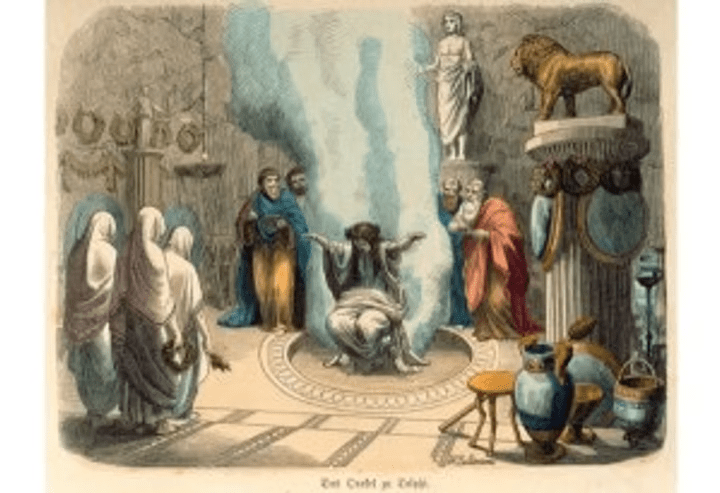
Pay a coin, ask one question, receive the truth … but it might not be what you want to hear.

This might sound good at first, but this falls under the old Chinese proverb that says, “Be careful what you wish for, you might just get it.” Because Solomon asked for (in essence) a Big Brain to judge the world with, God (in essences) said, “Since I cannot give you my Christ Mind [because you didn’t ask to marry me], I’ll give you more natural insight than anyone in the world has ever had and will ever have. There will never be a Bigger Brain that the one I will let you have.”

Then, with the wisdom of Solomon as the gift God gave, God added, “If you will walk in my ways, keeping my statutes and my commandments, as your father David walked, then I will lengthen your life.” Here the reading ends, but it is worthwhile to note that Solomon would die around age fifty-three, of natural causes, the wealthiest king Israel would ever know, failing to follow in the holy footsteps of his father. For all the wisdom Solomon had, it brought him only material rewards. When Solomon died, so too did Israel as one nation under God.

As an optional Old Testament reading selection for the thirteenth Sunday after Pentecost, when one’s personal ministry should be underway – asking not what God can do for one, but what one can do for God – the message here is to put more value in the heart center than the head. The head is where the ego lives. The heart is where one’s love of God resides.

Some people will read this set of verses in 1 Kings and think how wonderful God was to Solomon. The brand of Christianity that has spread across the Western World, in particular in the United States, sees how God blesses his people with riches and honor. It seems that the more bling one has, the more one can proclaim loudly, “Thank you Jesus! Thank you God!”

But, is that really the case?
When one sees the immaturity of young Solomon wanting to be as smart as an adult, rather than learn life’s lessons the hard way – the way the masses are forced to learn – he was asking for an easy way out. Solomon wanted to be his own man, rather than have to rely on advisors to tell him what to do.

Solomon did not once pause to think that God was his wisdom, as all he had to do was ask God, “What do I do, Lord?” God went to Solomon and prompted him to ask for help, saying, “Ask what I should give you.” When Solomon did not ask for God to give him His love, Solomon rejected God as his King, just as the elders of Israel had, when they first asked Samuel for a king, to be like other nations. Solomon, only a little child, wanted to be a king like those of other nations.

Because Solomon rejected God as his lover and husband, God gave Solomon what he did not ask for: wealth and honor. That reputation lasts till this day; but what good did wealth and honor do for Solomon? Wasn’t Israel worse off when Solomon died, than it was when David died?
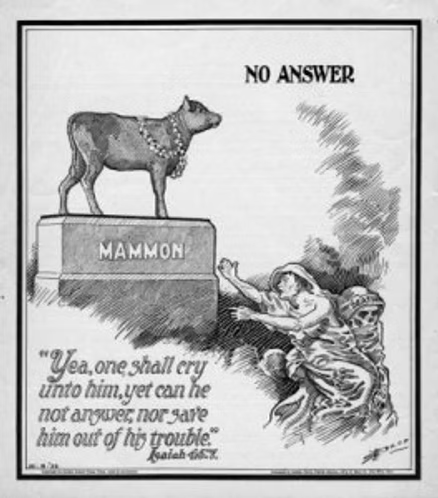
The same mirage is all around us today. We see wealth as a blessing. We are given honor by credit agencies, banks, and fraternal orders of secrecy. The richer and more powerful one gets, the more praises to God are little more than lip service.

All the wisdom of Solomon would have rejected Jesus, had Solomon asked Jesus to tell how he was assured of eternal life in heaven. Jesus would have told Solomon the same sacrifices that needed to be made he told the young rich Pharisee, and Solomon would have rejected Jesus as did the young rich Pharisee. The only difference might be Solomon offering some smart retort for Jesus (words of wisdom?), but he still would have walked away from any form of self-sacrifice.

A minister to the LORD knows the lures of money and power and has walked away from them. God provides in mysterious ways, as long as one is committed to serving the LORD. One does not need more than enough to feed oneself and one’s family – the same principle of the manna that fell from heaven and God’s orders given through Moses. Being given exceeding wealth and honor means having the problem to figure out how to sell everything and give the profits to the poor … doesn’t it?

That problem is best solved by being poor in material things, but rich in spiritual things. Then giving from the heart and teaching from the Christ Mind is more valuable than all the precious metals and gemstones the world has to offer.
Proverbs 9:1-6 – The temple of wisdom

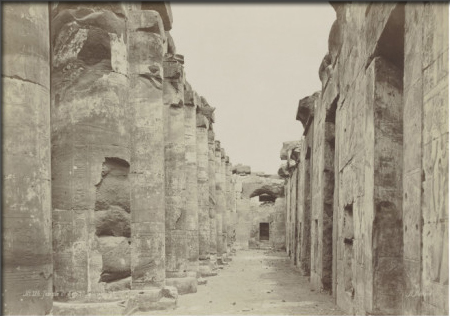
Wisdom has built her house,

she has hewn her seven pillars.

She has slaughtered her animals, she has mixed her wine,

she has also set her table.

She has sent out her servant-girls, she calls

from the highest places in the town,

“You that are simple, turn in here!”

To those without sense she says,

“Come, eat of my bread

and drink of the wine I have mixed.

Lay aside immaturity, and live,

and walk in the way of insight.”

———————————————————————————————————-

This is an optional Old Testament selection from the Episcopal Lectionary for the Thirteenth Sunday after Pentecost, Year B 2018. In the numbering system that lists each Sunday in an ordinal fashion, this Sunday is referred to as Proper 15. If chosen, it will next be read aloud in an Episcopal church by a reader on Sunday August 19, 2018. It is important because Solomon wrote of the wisdom he possessed and did not attribute it to the Father, but to a goddess.

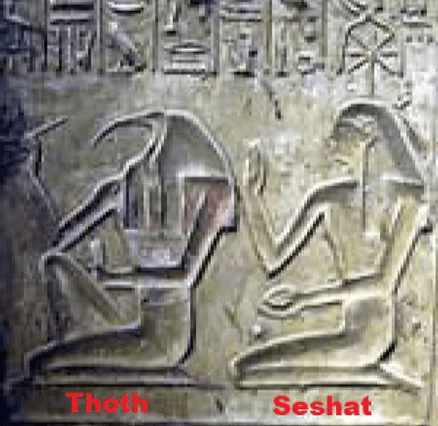
In Greek mythology, the goddess Athena was recognized as the deity who reigned over wisdom. Her Roman equivalent was called Minerva, also a goddess. In ancient Egyptian mythology, perhaps the religion most known by the philosophical minds of the Israelites, Seshat (the counterpart of the god Thoth and his wife Ma’at) was the goddess of wisdom, knowledge and writing.

Because all of these mythological deities are feminine (except Thoth), wisdom should be grasped as a talent that comes from the Earth mother, such that it is a talent of the brain and the powers of physical observation.

In this proverb that is attributed to the writings of Solomon, based on his wisdom possessed, he gives strong support towards that conclusion of wisdom being a feminine characteristic. Solomon wrote of “her house,” “her pillars,” “her animals,” “her wine,” “her table” and “her servant-girls.” That proliferation of feminine pronoun use (in addition to “she” used four other times) says Solomon had discerned (a talent of wisdom) that Yahweh was not the voice of reason he heard in his head.

Solomon’s references to a “house” “hewn” with “seven pillars,” where sacrificed animals spilled their blood upon a “table,” is clearly a statement of a goddess, whose temple was worldly.

The “servant-girls” were then priestesses of that temple. To read that they would “call out from the highest places” means they served the deity of wisdom, who is available to those who submit to that divine power.  The “highest places” were religious temples to gods foreign to Israel.

“You that are simple, turn in here,” says ordinary people do not possess wisdom. Solomon then proposed that the masses should follow the lead of those who serve the goddess of wisdom, as the judges blessed by the temple priests. The line that is translated to say, “To those without sense,” the Hebrew word “lêḇ” is used, which means “heart, mind, inner man, will, and understanding.” This is the word Solomon used when he asked God for a Big Brain, rather than prefer God’s presence within him.

Knowing that Solomon wrote his proverbs for the Israelites, who were sworn to serve God and remember the Passover via the ritual consumption of unleavened bread and cups of wine, it is not coincidence that Solomon wrote of “my bread” and “the wine I have mixed.” That physical food and drink would be filled with yeast, rising hot and fluffy and fermented to a highly intoxicating alcohol level. Solomon was telling his people to let him do all the work of rule, so they could turn their backs to God and enjoy the wealth and honor of Solomon’s realm.  In that scenario, the people were no longer subjected to finding God individually, so their unleavened bodies could become elevated (raised up) to righteousness and their plain blood be infused with the Holy Spirit.

For Solomon to say, “Lay aside immaturity and live,” proposing that the ignorant should “walk in the way of insight,” he was telling the children of Israel to follow him, his ways, and his knowledge.

Rather than asking the Israelites to put their faith in God, he was promoting himself as God’s chosen king, with the insight of a god. Solomon (whether he figured it out or not) was returning Israel to the royal deity worship of Egypt. No longer were the people of Yahweh asked to be priests in individual relationships with the Lord and walk in the ways of righteousness. They were told to let wisdom light their paths.

As an alternative Old Testament selection for the thirteenth Sunday after Pentecost, when one’s personal ministry to the LORD should be underway – as a different angle on Solomon’s wisdom – the message here is the danger of worshiping individuals as gods. When one sees another human being as holier than oneself, one ceases trying to be holy, submitting oneself to that other human.  Israelites did it for Solomon, saying, “No one can be wiser.”  Likewise, Christians do it for Jesus, saying, “There can only be one Son of God.”

This is the trap of Satan, which was set before Jesus, offering him the world if he would submit to the will of evil.  God set the world that Solomon had at his feet, to test his devotion to Him.

Power and wealth are intoxicating, as were the bread and wine of which Solomon wrote. The world is filled with simple folk, who have no sense for taking advantage of others. The mixed drink that comes from the slaughter of animals is the blood of the innocent spilled so that the elite can laugh at how easy it is to become rich off the ignorance of others. Those sacrificed are the people who bow down before those possessing Big Brains.

The aspect of “immaturity” is that of “foolishness,” where the Hebrew word “p̄ə·ṯā·yim” means “naivety.” It bears the same intent as does “foolish”: “Lacking or exhibiting a lack of good sense or judgment; silly.” (American Heritage Dictionary of the English Language)

This is the excuse of childhood ignorance, where simplicity is a natural state of learning from one’s mistakes. Those life lessons develop one’s maturity, and from life experience comes true wisdom. Solomon did not suffer the growth pains of normal people, as he laid aside his immaturity for a life led by reason, unclouded by childish emotions. Thus, his view of living was void of any possibility of eternal life.

A minister of the LORD has known the errors of thought and the failures that come from not having true insight. The only true source of wisdom comes from the Christ Mind, which demands a soul be blissfully ignorant to possess it. It is why prophets like Ezekiel answered questions from God by saying, “You know Lord.” A prophet never speaks for self as the Big Brain is never large enough to see all possibilities and answers at once … like God can.

Ephesians 5:15-20 – Being wise and singing songs of praise

Be careful then how you live, not as unwise people but as wise, making the most of the time, because the days are evil. So do not be foolish, but understand what the will of the Lord is. Do not get drunk with wine, for that is debauchery; but be filled with the Spirit, as you sing psalms and hymns and spiritual songs among yourselves, singing and making melody to the Lord in your hearts, giving thanks to God the Father at all times and for everything in the name of our Lord Jesus Christ.

———————————————————————————————————-

This is the Epistle selection from the Episcopal Lectionary for the Thirteenth Sunday after Pentecost, Year B 2018. In the numbering system that lists each Sunday in an ordinal fashion, this Sunday is referred to as Proper 15. It will next be read aloud in an Episcopal church by a reader on Sunday August 19, 2018. It is important because it tells of the need for divine wisdom to avoid the pitfalls of evil ways.

Keeping in line with the way I have been presenting Paul’s Epistles, in the literal translations from the Bible Hub interlinear page (Ephesians 5), following this lead-in is that translation. The translation above is fairly representative of the message this selection presents, but (as usual) it misses the point that makes it clear each Christian must be reborn as Jesus Christ. Without that occurrence happening to each individual first, Paul’s words here are much easier said than done. [Notice, again, the presence of capitalization as being meaningful, not simply because a new series of statements [sentences] have begun.]

15Take heed therefore carefully how you walk  ,” The word “peripateite” translates as “you walk,” but is used ethically to infer “you conduct your life.”

not as unwise  ,” The word “asophoi” translates as “unwise,” but also means “foolish or unskilled.”  It is used to imply rejecting God’s guidance (His Will).

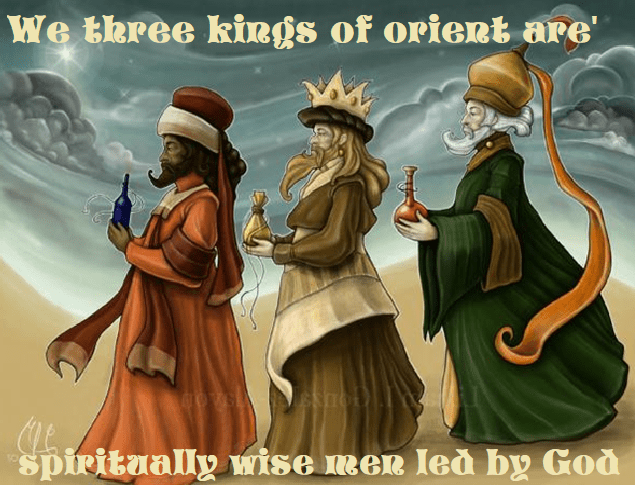
but as wise  ,” The word “sophos” means, “wise, learned, cultivated, skilled, clever.” This means to be “wise men,” where those who visited Jesus as a newborn were not smart enough to figure out where to go, what to find, and what to do on their own. They were led to Jesus by God’s guidance.

16redeeming the time  ,” The words “exagorazomenoiton kairon” are best translated as “use the opportunity” that comes from God’s guidance.

because the days evil are  .” The word “ponērai” means “evil, bad, malicious, wicked, slothful.” The meaning of “days” (“hēmerai” as “one’s time”) is more about the “years” or the “times,” being generally “always.” In another view, the light of truth (“days” versus nights) will attract those who are “evil” to one, because of the “lust of the times.” This requires one be able to shine light on that darkness.

17because of this  ,” The word “touto” (“this”) refers back to the state of evil that is always present, seen from the light of day. There is a cause (“because”) and effect challenge created that must be expected.

not be foolish  ,” One must not be “senseless” (from “aphrones”) to this evil presence, as one will be played the fool by the influences of Satan if not in possession of perspective and insight.

but understand what the will of the Lord [is]  .” The exception to foolishness comes from “perceiving” (from “syniete”) evil when it approaches, which is the will of the Lord for all His Apostles-Saints. This insight of “understanding” comes from the Christ Mind.

18and not to be drunk with wine  ,” The word “methyskesthe” means “become intoxicated,” where “intoxication” means, “overpowering exhilaration or excitement of the mind or emotions.” This is then a warning against the “poisoning” of evil, which possession of God’s Holy Spirit will protect one from.

in which is debauchery  .” The word “asōtia” means not to fall for “wantonness, profligacy, or wastefulness,” where “debauchery” means falling into a state that one cannot be saved from. It means, “spiritual wastefulness due to excessive behavior and the dire consequences it brings.” [HELPS Word-studies]

instead be filled with [the] Spirit  ,” The capitalization of “Pneumati” means the Holy Spirit, which is elevated above the spirit of a soul. This “Spirit” is the protection of God and the true source of wisdom and insight.

19speaking to each other [in] psalms  ,” As this follows a statement to be filled with God’s Holy Spirit, the least impact is “speaking to each other,” as the primary importance is God’s Holy Spirit speaking to them, those who are “themselves” (from “heautois” meaning “themselves” ) in touch with God’s Holy Spirit. It is the Holy Spirit that causes all Apostles and Saints to praise God in songs (“psalms”). Certainly all Apostles and Saints will join in with each other by singing the same songs of praise.

and hymns  ,” The word “hymnois” is much like “psalmois,” as both mean “songs of praise.” A “hymn,” however, is more specifically a “sacred son of praise,” one that “gives honor, praise, or thanksgiving.” In antiquity, a “hymn” was sung in celebration of a pagan god, hero, or conqueror. [HELPS Word-studies] The hero of all Apostles and Saints is Jesus Christ, whose entrance into a sinner means the defeat of Satan and his influences of evil.

and songs spiritual  ;” The word “ōdais” means “odes,” which are defined as: “A lyric poem of some length, usually of a serious or meditative nature and having an elevated style and formal stanzaic structure.” [American Heritage Dictionary of the English Language] This word is used in the New Testament to denote: “spontaneous, impromptu (unrehearsed) melodies of praise – not merely sung about (for) God but to God from a Spirit-filled heart.” [HELPS Word-studies] These songs are thus “spiritual,” stimulated automatically by the intense joy and happiness one feels from the Holy Spirit.

singing and making melody in the heart of you to the Lord  ;” This repeats the intent and purpose of “odes spiritual” and the source of one’s need to sing praises to the LORD.  It is most important to see the use of the word “kardia” as the Greek equivalent to the Hebrew “leb,” meaning “the heart; mind, character, inner self, will, intention, center.”  Because “singing and making melody” (“adontes kai psallontes“) are more acts of the emotional center leading the brain, for the the emotions of music to be heartfelt, this is a statement about God’s presence in one’s heart moving one to sing.

20giving thanks at all times  ,” The praises one sings are of thanks for having been saved by God. This is not simply a time rescued here and there, as being filled with the Holy Spirit means eternal salvation, where the word “pantote” means “ever.”

for all things  ,” There is nothing that comes into the lives of Apostles-Saints that is not to be praised as a benefit of God’s presence.

“All things come of thee of Lord, and of our own have we given thee.” This should not be associated with an offering to an institution. If one truly believes that all things come from God, then all things received are to be used for God.

in [the] name the Lord of us  ,” God’s presence within an Apostle-Saint comes with a name that one must identify as.

Jesus Christ  .” That name is Jesus Christ. One takes on that name as all Apostles-Saints must be reborn with the Holy Spirit of God’s presence in His Son, bringing with it the Christ Mind.

As an Epistle selection for the thirteenth Sunday after Pentecost, when one’s personal ministry to the LORD should be underway – one should be singing praises to the LORD – the message here follows the theme of the Old Testament selections that apply to wisdom.  The wisdom and understanding of which Paul wrote is different than that requested by Solomon, as it requires one sacrifice self-ego for the Christ Mind.

Paul began this series of segments by saying, “Take heed.”  Before one can walk in the ways of Jesus Christ, as a true Christian, one must be led by God, via His Christ Mind.  One must become a “wise man” (regardless of human gender) by being reborn as the Son of God, allowing one’s flesh to become the body of the resurrected Jesus Christ.  Anything short of that total commitment to serve the LORD will leave one foolish, overcome by the evil influences of the days.

The only way one can understand the will of the Lord is to stop giving credit to one’s Big Brain.  The Big Brain represents the drunken state of self-glorification.  Through ego, one wastes the advantages of spirituality.  One sings praises to God for what one has achieved, acting as if God rewards the selfish with wealth and power.  Wealth and power are payments that cease when one’s life on earth ends; and human beings are mortals that are born to die.  Material rewards leave nothing in the spiritual realm to reap.

A minister of the LORD knows the voice within which is a thrill to behold.  One sings constant songs of praise to God, when little can be detected of material gain surrounding oneself.  One’s life song, where an evil end was averted by sacrifice of self for the love of God is sung to others, like a recovering alcoholic sings praises to God for salvation.  One’s salvation came by submitting oneself to God and facing all the trials of commitment, so one can be reborn as Jesus Christ.  One cannot claim to be Jesus Christ, but the glory of that presence is known and it leads one to testify to God’s greatness, so others can come to find the same reward.

John 6:51-58 – Eating the flesh and drinking the blood of Jesus

Jesus said, “I am the living bread that came down from heaven. Whoever eats of this bread will live forever; and the bread that I will give for the life of the world is my flesh.”

The Jews then disputed among themselves, saying, “How can this man give us his flesh to eat?” So Jesus said to them, “Very truly, I tell you, unless you eat the flesh of the Son of Man and drink his blood, you have no life in you. Those who eat my flesh and drink my blood have eternal life, and I will raise them up on the last day; for my flesh is true food and my blood is true drink. Those who eat my flesh and drink my blood abide in me, and I in them. Just as the living Father sent me, and I live because of the Father, so whoever eats me will live because of me. This is the bread that came down from heaven, not like that which your ancestors ate, and they died. But the one who eats this bread will live forever.”

———————————————————————————————————-

This is the Gospel selection from the Episcopal Lectionary for the Thirteenth Sunday after Pentecost, Year B 2018. In the numbering system that lists each Sunday in an ordinal fashion, this Sunday is referred to as Proper 15. It will next be read aloud in an Episcopal church by a priest on Sunday August 19, 2018. It is important because one sees Jesus speaking metaphorically about his flesh and blood, which makes it impossible to associate this reading to the physical wafers and wine served at Communion. The body and blood of Jesus are wholly spiritual and in no way intended to be construed as material.

This reading is a continuation of the Proper 14 Gospel reading selection, with verse 51 appearing in both readings – ending last Sunday’s and beginning this Sunday’s. In my interpretation for August 12, 2018, I touched on Jesus being the yeast that gives rise to bread. That living body has to be consumed into the mixture that forms the dough, or one can only produce unleavened bread. This concept needs to be expanded here.

When Jesus said, “Very truly, I tell you, unless you eat the flesh of the Son of Man and drink his blood, you have no life in you,” he spoke the truth symbolically. The Jews speaking to Jesus (and the majority of Jews returned to Judea and Galilee) were unleavened bread.  They had no spiritual rise in them, which separated them from any other peoples on earth.  God had Moses instruct the Israelites to make unleavened bread the night of the Passover, and then remember that hurried escape from death each year for eternity, because they were to become priests of the LORD, spiritually elevated above all others. The Passover Seder ritual symbolized that they were chosen as souls without life, which God would add to them later. The Jews were totally without the rise of righteousness, by the time God sent His Son as the example of bread (body with yeast) that was risen and full. To eat of Jesus’ body was to add the rise that meant eternal life in them.

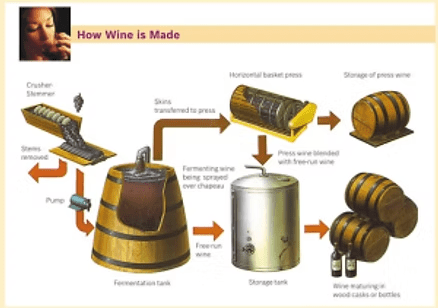
This metaphor continues to work when Jesus said, “drink [the Son of Man’s] blood.” Wine is fermented grape juice, where wild yeast on a grape’s skin has to be crushed so it can react with natural sugars, converting that into alcohol.

Jesus would raise the third ceremonial cup of wine at his final Seder meal and say, “This is my blood of the covenant, which is poured out for many for the forgiveness of sins.” (Matthew 26:28) So, “drink my blood” is no different than “drink my wine.”

The ceremonial cups of wine at a Seder meal (4) represent a progression of spirits being added into the bloodstream, adding to the individuality of the Israelite history lessons that are symbolized by the matzo.  All is a symbolic way to give thanks to God for saving them, through forgiveness and instilling them with holy blood (spiritual, not physical).

Still, one has to understand that “blood” is the fluid of life, which if lost means the threat of death. To put the blood of Jesus Christ within one’s body (only as a spiritual presence) means there is no danger of the soul perishing. That presence that is within – consumed through devotion to God – is what brings eternal life to the soul-body, as Jesus Christ reborn.

When Jesus said, “Those who eat my flesh and drink my blood have eternal life, and I will raise them up on the last day,” the confusion comes from “anastēsō auton tē eschatē hēmera” being translated to say “I will raise them up on the last day.” First of all, “Those” and “them” [the third person plural number] was not stated. Instead, Jesus said, “the [one]” (“ho”) and “him” (“auton”), which is a clearer indication of an individual’s actions towards “eating” and “drinking” Jesus. While the collective is a multiplication of the total number times “one,” without the “one” [as zero] there is no “them.”

Second, when one notices the important aspect of the individual’s responsibility, then one can see how “eschatēhēmera” (“last day”) can only be applied to a grand “end times” when the collective is read. This nebulosity then allows one to project a coming of Christ into a distant future, which may or may not be relevant to the individual’s commitment to God and Christ. However, when one sees the focus on “the [one]” and “him,” then “last day” is reflective of one’s own “end time,” which is assured, from being mortal.  The “last day” is always relevant to one’s assured “end time.”

The word “eschatē” actually can translate as, “last, at the last, finally, till the end.” The word “hēmera” can bear the meanings, “day, always, daily, time, year, or daybreak.” When those translation options show the statement as, “I will raise them up till the end daily,” or as “I will raise them up finally daybreak,” the focus turns away from some distant time in the future and points to when one actually “eats the flesh and drinks the blood of Christ.”  At that point in one’s life, one is then “raised up” spiritually forever more. The “end” of one’s darkness [sin] comes from the “daybreak” God brings to one, through His Son being resurrected again in flesh and blood, shining light where there was the absence of light.

When Jesus said, “for my flesh is true food and my blood is true drink,” the word “alēthēs” is repeated, meaning “true.” The Bible Hub Interlinear translation shows the word translated in all-caps, as “TRUE.” The basic word can mean, “unconcealed, true, true in fact, worthy of credit, or truthful.”

As a Christian, one knows that Jesus frequently began his statements with the words, “Verily,” or “Truly I say.” By saying his flesh and blood was the truth he meant the TRUTH of God was all that was capable of being said by one who has sacrificed self-ego in service to God. Therefore, all who (individually) eat his flesh and drink his blood will become the resurrection of that TRUTH – a voice of God incarnate.  Not only would those “partaking” of Jesus speak the TRUTH, but they could hear it as well [understanding].

As such, Jesus said, “Those who eat my flesh and drink my blood abide in me, and I in them.” This says, “The one who eats and drinks lives in me (the reborn Jesus Christ) and I in him” (“autō” as singular, the one), such that two spirits are in the same body of flesh and blood. One spirit is the one’s soul (cleansed by a Holy Baptism) and one is the Spirit of Jesus Christ, resurrected through the Holy Spirit of God. This says eating the flesh and drinking the blood of the Son of Man makes one unified with the Trinity, as one in three, the same as was Jesus of Nazareth.

Jesus then said, “Just as the living Father sent me, and I live because of the Father, so whoever eats me will live because of me.” The repeated word here is “zōn,” meaning “living, live, alive, or life.”

It is important to see the similarity in Jesus saying, “Just as the living Father” and David (and other prophets of God) regularly having said, “As God lives.” Those are statements of TRUTH spoken by souls that had been purified by God, so God could be one with them, residing in their hearts and leading their minds. Jesus then can be heard saying, “As surely as God sent me and because God is within me, then whoever consumes me also becomes one with God, forever saved.”

By returning to simply referencing the act of eating the flesh of Jesus, where that flesh is again the bread of life from heaven, Jesus differentiated the holy manna from what he represented. Jesus said, “This is the bread that came down from heaven, not like that which your ancestors ate, and they died.”

As I wrote in the interpretation for Proper 14, the “ancestors” of the Jews (the Israelites led into the wilderness by Moses) did not “die” because the manna did not “raise them up” spiritually. They did not “die” because they were mortal human beings of antiquity, such that all human beings face death.

The death experienced by those “ancestors” means Israel fell and collapsed in ruin because they stopped being raised spiritually. They needed to incorporate that holy bread into a race of priests that were the fruit of a holy vine, whose skins were emoting the natural yeast of God’s love. Physical deaths would have caused the breakdown of the natural sugars of their faith, fermenting their blood (lineage) with the elevation of eternal life for their souls. Because that did not happen due to the manna alone, and only served while in the wilderness of the Sinai, could not make the Israelites a multitude of Jesus Christs.

The manna fell before there was the blood of faith [the Son of God] to guide each individual Israelite. Without the blood of faith sustaining each and every one of those who were delivered into the Promised Land they continually stopped worshiping the One God, Yahweh, backsliding into a near-death state. Was it not for judges leading them (externally) to return to the right ways of God, they would have perished completely, before becoming a nation of people. Still, it was the lack of individual faith that led them to desire a king. When David led them towards individual responsibility to God, his sins released all the Israelites to do as they wished (not as God commanded). By the time the Jews stood before Jesus in Capernaum, all the glory of a state of Israel was dead.

It must be understood that without Jesus Christ having been sent into the world by the living God, there was no blood to add to the manna. The bread of the Torah, the Psalms, and the Prophets was all destined to point to the coming of that blood of life, which would be fulfilled by the Messiah of the Jews. It had been the manna that kept the embers of faith still alive at that time. However, Jesus was the bread of life that put new meaning into the words that had been memorized, but never fully understood; and, that flesh being eaten would give rise to a fresh desire to know more, which was the wine of God’s love filling one with desire to serve Him.

As this reading selection ends by Jesus stating the exception to mortal death, he said, “But the one who eats this bread will live forever.” It has to be understood that a body of flesh and physical blood cannot live forever. The body breaks down.

Jesus said to his sleeping disciples at Gethsemane, “The spirit is willing, but the flesh is weak.” (Matthew 26:41) In that same vein of thought, one can see how the spirit is eternal, but the physical body is not designed for everlasting life.

This is evidence for reincarnation, where the eternal soul passes from one temporal body of flesh to another, one life continued multiple times. Each new body of flesh brings about a blank slate of life, which has a soul start over, again and again, with the ultimate purpose being twofold: 1. Do not lose your God-given soul to Satan; and, 2. Gain eternal life with God, finally seeing the end of worldly incarnations and forever experiencing God’s presence as the eternal light of day (“eschatē hēmera”). To reach that gradation day, when one has been raised up to heaven, means all the work of righteousness has been done; and, that means one has eaten the flesh and drank the blood of Jesus Christ, reborn as him.

As the Gospel selection for the thirteenth Sunday after Pentecost, when one’s ministry for the LORD should be underway – one has eaten the flesh and drank the blood of Jesus – the message is to be transformed. One has to stop seeing the world through the eyes of a selfish sinner and see the light of truth.

Because this Gospel reading is scheduled with two other readings that address wisdom as a double-edged sword that can be all brain and little heart or all heart with the Christ Mind, one needs to see the Jews who followed Jesus to Capernaum as those who always represent mankind that is led by Big Brains and not in love with God. The majority of those who had been fed the spiritual food on the plain of Bethsaida (eating the bread and the fish and drinking in the faith of Jesus) – the miracle of Jesus feeding the five thousand (plus) – they had gone out into the world as Apostles. In Capernaum, Jesus was confronted by the twelve percent that followed Jesus there (those served by Judas Iscariot), as those who missed the opportunity others had received.

Those Jews were only looking for a material advantage, not a spiritually uplifting epiphany. Their hearts were closed to God, so this language spoken by Jesus (eat my flesh and drink my blood) could not sink into their Big Brains as metaphor. They were puzzled by the thought of “eating his flesh and drinking his blood.”  Their intellectual dependency meant they were those of little faith, full of doubt and denial, never able to understand the Word of God in that ego-driven state of being.

All Scripture read today, two thousand years after the fact and nearly that long since the first writings about Jesus surfaced, is easy to discern, simply because so many have put both Big Brains and heartfelt wisdom into interpreting Scripture. Christians always need to be wary of thinking, “I know where Jesus is going with this, because I have heard it read before.” The trap is to start thinking that you are one of Jesus’ disciples standing behind Jesus as he says “eat my flesh and drink my blood,” saying under your breath, “How stupid can these guys be?”

The trap is to not see oneself as just as dumbfounded at these words of Jesus as were those Jews to whom Jesus spoke. Many Christians fear discussing any Scripture outside of a Sunday school classroom. Few have any depth of knowledge, much less spiritual insight that comes from God, which is based on a continual thirst for the meaning of Scripture. A typical Christian today puts up with religious education, in the right environment, having learned religion and politics are topics not discussed in mixed company.  In reality, their lack of consuming Jesus on a daily basis means they have become like the Israelites after they entered the Promised Land … “Oh, manna?  No thanks, I used to eat that when I was little, but now I’m all grown up, so I don’t need that anymore.”

Christians who “eat the flesh and drink the blood of Christ” daily are called Apostles and Saints; and they love doing that because of the emotional reward it gives them.  They are given spiritual insights, one after another, each of which acts as yet another epiphany experience for them. It is the living bread come to life and the living waters gushing forth within.  It is a feeling that makes one want to share it with others.

No one teaches epiphany experiences in seminaries or theological institutions, and few pastors lead small groups of devotees to spiritual awakenings in Sunday schools.  The brief sermons that many men and women of the cloth offer up have little to do with the inspirational message of the readings, instead seeming to be lectures that boast of one’s educational acumen or pander as political advocacy. This means Christians today are just as dazed and confused by Scripture as were the Jews in Capernaum.  Atheists who read Jesus’ words cry out like them, saying, “Jesus advocated cannibalism!”

What Christians can ably defend Jesus’ words?

A minister of the LORD has no answers prepared for anyone who questions the meaning of Scripture. Most likely, Jesus was not putting the finishing touches on a sermon about eating his flesh and drinking his blood when the Jews came up to Jesus, asking, “Where did you go?” Jesus simply opened his mouth and the words of God flowed out. Words from God are often so difficult to catch hold of the whole meaning the first time heard that they have to be repeated (as Jesus did).  This challenges the one who hears the words to find the TRUTH, rather than reject it without reflection.

The whole time Jesus was speaking the TRUTH that came through him from God, Jesus delighted in knowing full-well what all those words meant. It tickled his heart to say them, especially knowing how they were like water on a duck’s back to the Jews listening. This is how God sends His Apostles out into the world – unprepared to speak the TRUTH, but speak the TRUTH they do.  That is the difference between believing (the flesh of Jesus) and faith (the blood of Jesus).

Ephesians 6:11-18 – Wearing the armor of God

Be strong in the Lord and in the strength of his power. Put on the whole armor of God, so that you may be able to stand against the wiles of the devil. For our struggle is not against enemies of blood and flesh, but against the rulers, against the authorities, against the cosmic powers of this present darkness, against the spiritual forces of evil in the heavenly places. Therefore take up the whole armor of God, so that you may be able to withstand on that evil day, and having done everything, to stand firm. Stand therefore, and fasten the belt of truth around your waist, and put on the breastplate of righteousness. As shoes for your feet put on whatever will make you ready to proclaim the gospel of peace. With all of these, take the shield of faith, with which you will be able to quench all the flaming arrows of the evil one. Take the helmet of salvation, and the sword of the Spirit, which is the word of God.

Pray in the Spirit at all times in every prayer and supplication. To that end keep alert and always persevere in supplication for all the saints. Pray also for me, so that when I speak, a message may be given to me to make known with boldness the mystery of the gospel, for which I am an ambassador in chains. Pray that I may declare it boldly, as I must speak.

——————–

This reading from Paul is scheduled for public presentation in Episcopal churches on the Sunday after Pentecost in years designated as B, known as Proper 16.  This will next occur on August 22, 2021, which will designate the Thirteenth Sunday after Pentecost in that year.  It was last read aloud on Sunday, August 26, 2018, then designated as the Fourteenth Sunday after Pentecost.

This reading is important as it is Paul clearly stating that each and every Christian must himself or herself be a priest to the temple of God.  The temple is one’s own body of flesh.  The soul within that flesh must become a priest that serves the high priest of the temple, who is the soul of Jesus.  The strength then comes from a marriage with Yahweh, the union of one’s soul with the Holy Spirit, which makes one wear the armor of the Christ.

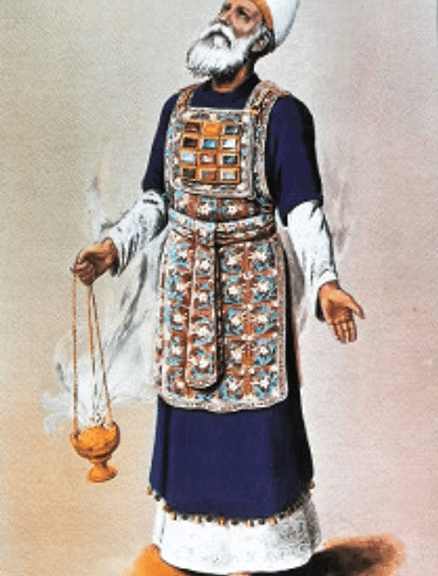
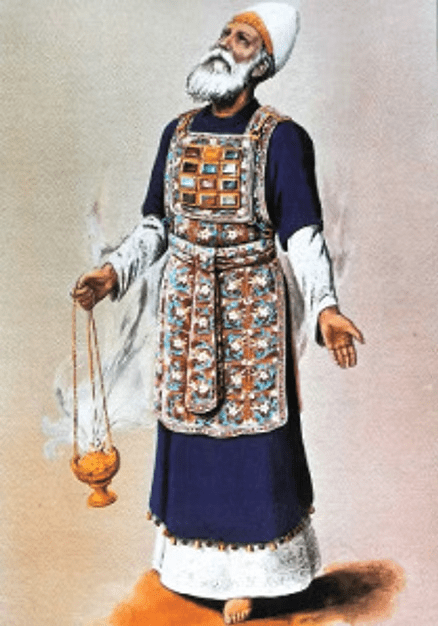
The metaphor of that comes from Paul writing to “fasten the belt of truth around your waist, and put on the breastplate of righteousness.”  This metaphor should be seen, along with the footwear [sandals or shoes] that gives one the expectation to walk the priestly path, as the clothing worn by a high priest of the Tabernacle.

When Paul wrote, “Put on the whole armor of God, so that you may be able to stand against the wiles of the devil,” the whole armor can only come through the marriage with God.  God is the completion that brings wholeness.  Without that presence within one’s being, then one is incomplete and all armor of God is based on knowledge that keeps God external.  The Holy Spirit has not been received and Jesus has not merged with one’s soul.  Without that inner strength, one easily becomes prey to Satan.

The Greek word “methodeia” is translated as “wiles,” but it can equally state “scheming, craftiness, deceit.”  This should be realized as being ever present, with the greatest times when one is vulnerable being when one feels within a safe environment.  For many Christians, a church building, or being amid church members, represents such a safe haven.  This is where the warning comes to beware false shepherds and hired hands, who appear to be there for one’s benefit but in reality they are there for their own benefit and no one else’s.  Without the full armor of God on – filled with the Holy Spirit as a stand-alone temple to the Lord – the devil sows the weeds of doubt, fear, and knowledge as a replacement for God.

This is seen supported in Paul writing, “For our struggle is not against enemies of blood and flesh, but against the rulers, against the authorities, against the cosmic powers of this present darkness, against the spiritual forces of evil in the heavenly places.”  The translation of “enemies” can be misleading, as the Greek word “palē” is written, which means “wrestling, a wrestling bout; hence: a struggle, fight, conflict, contest.” (Strong’s usage).  This says one’s struggle to avoid the influence of Satan is less about one’s heritage [“blood”] and one’s presence [“flesh”] – the inner self struggle as a Christian [or Jew] to commit to righteous living – and more about the powers over self that one gives freely to those who are external to one’s being – governments, philosophies, and influences advocating the denial of God.

The Greek words translated as “rulers” and  “authorities” are “archas” and “exousias.”  In the setting of Paul, who (as Saul) was both a Roman citizen and a Jew, his “rulers” were Roman, which included all that empire’s vassals (such as in Judea).  His “authorities,” however, were those who exerted influential powers over all who were Jews, being the Temple “authorities.”  It was those “authorities” who had fallen away from God, having turned instead to worship the profits they saw as obtainable in the earthly realm.  It is that realm where exists “the spiritual forces of evil in the heavenly places,” where “epouraniois” (“heavenly realm”) should be read as those who rule over one’s soul.

 This external danger is one that exists commonly and is prevalent in all people lacking true faith in Yahweh.  Paul wrote, “Therefore take up the whole armor of God, so that you may be able to withstand on that evil day, and having done everything, to stand firm.”  The Greek word “stēnai” translates as “to stand firm,” but also means one must become one with God in order “to be steadfast” in the ability to resist a most common attack.  The commonality of evil in the world cannot be avoided; without God’s help one will succumb to that power.  The meaning of “having done everything” is emphasized by the word “kai” preceding it, meaning everyone is born a sinner and knows sin all too well.  Thus, to “take up the whole armor of God” means one has to allow oneself to be “raised up” spiritually.

Paul then wrote these words of encouragement: “Stand therefore, and fasten the belt of truth around your waist, and put on the breastplate of righteousness. As shoes for your feet put on whatever will make you ready to proclaim the gospel of peace. With all of these, take the shield of faith, with which you will be able to quench all the flaming arrows of the evil one. Take the helmet of salvation, and the sword of the Spirit, which is the word of God.”  His words spoke of the visual armor worn by Roman soldiers that were prepared to do battle.  However, the metaphor speaks for one who is prepared to do battle against Satan and his realm of evil, as one filled with the Holy Spirit and enabled to “stand fast,” armed with the “truth” of God’s enlightenment, a heart filled with God’s love, an ability to walk the walk of righteousness, more than talk the talk of goodness, because one’s “faith” is an elevation that protects the soul, which comes from having sacrificed self-will for divine “salvation.”  The “sword” of God is the Christ, which comes out of one’s mouth and speaks double-edged words of truth.

When Paul then wrote, “Pray in the Spirit at all times in every prayer and supplication. To that end keep alert and always persevere in supplication for all the saints,” the purpose of prayer is to “at all times” remain in direct communication with God, through His Son’s Holy Spirit within one’s being (Jesus Christ reborn).  The use of “supplication” takes this communication beyond simple chitchat and makes it earnest, heartfelt direction.  When Paul used the term “hagiōn” (“saints”), this was not some measly designation of one who wears vestments and says he or she can call upon the name of the Lord to bless crackers and wine.  The designation of “saints” becomes a statement of truth: one has been made sacred by God as set apart from all influences of evil in the world.  To a saint, prayer and supplication is the conversation between Yahweh and His Son taking place as one’s soul listens and one’s flesh does as commanded.  It is less about self-preservation than it is about bringing others to the same presence within themselves.

As such, Paul then spoke to the saints of Ephesus, saying (per the translation): “Pray also for me, so that when I speak, a message may be given to me to make known with boldness the mystery of the gospel, for which I am an ambassador in chains. Pray that I may declare it boldly, as I must speak.”  In actuality, this is the Greek of what Paul wrote here:

kai hyper emou  ,  hina moi dothē logos en anoixei tou stomatos mou  ,  en parrēsia to mystērion tou euangeliou   ,  hyper hou presbeuō halysei  hina en autō parrēsiasōmai  hōs dei me lalēsai  .

This literally translates to state: “kai on behalf of me  ,  that of me may be given divine utterance in the opening of the mouth mine  ,  with freedom of speech to make known the mystery [revelation] of the coming of the Messiah [Christ]  ,  for which I am older in a chain  ,  that in it I may speak freely  as it is necessary to speak  .

Notice how there is no repeating of the word prayer.  That has been transposed from earlier in a translation effort to create a separate sentence of Paul, with the repetition meaning that has already been stated prior.  These segments of word build from Paul stating the word “saints.”  The word “kai” is then an indicator for the reader to take notice of how the creation and maintenance of “saints” was the purpose of Paul [and all like him – those also filled with God’s Holy Spirit].  Thus, saints are Paul’s “concern” (from “huper” meaning “over, beyond, on behalf of, for the sake of, concerning”), because making and maintaining saints is what saints do.

This then leads Paul to say that saints are made by his speaking divinely.  This does not mean his “divine utterances” (“logos“) are explaining Scripture so well that people’s brains swell with thoughts of devotion.  It means his presence, being joined with the presence of Jesus Christ, makes his words bear the same effect as did Jesus.  The souls readily willing to sacrifice of themselves for service to God will “hear” those words divinely and receive the Spirit.  

The saint is then speaking on such a higher level than physical words can ever bear [the reason Scripture needs explanation] that a seeker of truth’s soul will “hear” the truth in a “secret” or “mysterious” way, where “mystērion” means: “a mystery, secret, of which initiation is necessary; in the NT: the counsels of God, once hidden but now revealed in the Gospel or some fact thereof; the Christian revelation generally; particular truths or details of the Christian revelation.” (Strong’s usage)  That “secret” is the passing on of the Holy Spirit, which means “the coming of the Messiah [Christ]” into a new saint.

Paul then stated that he was “an elder” (“presbeuō“) in a “chain,” which means he married God before those who came after him, but as a chain (“halysei“) all are equal links, with the same strength coming into them as Jesus Christ reborn.  The purpose of his being a link in longer standing becomes meaningless, as his pending death would simply mean more equal links would be needed to replace him and keep the chain growing.

Everything is then dependent on all links in the chain freely speaking the Word of God, as Jesus Christ reborn.  This is the necessity of Christianity.  This does not come from years of having learned what to say from classes taken, books read or lectures heard.  All of that simply prepares one to seek for higher truth, with a history of learning being seen by God and known to be where one’s heart lies.  Where the heart leads the head will follow.  The Jesus Spirit replaces the brain with Mind of Christ.  Still, one needs to hear God speaking, in order to receive the Holy Spirt and become His Son reborn, becoming another link in a most divine chain, where all links are temples unto the Lord and each link is a priest that serves the High Priest Jesus Christ.  At that time the whole armor of God is surrounding one’s soul and one is prepared to battle evil.

1 Kings 8:[1, 6, 10-11], 22-30, 41-43 – Putting Yahweh in a tomb

[Solomon assembled the elders of Israel and all the heads of the tribes, the leaders of the ancestral houses of the Israelites, before King Solomon in Jerusalem, to bring up the ark of the covenant of Yahweh out of the city of David, which is Zion. Then the priests brought the ark of the covenant of Yahweh to its place, in the inner sanctuary of the house, in the most holy place, underneath the wings of the cherubim. And when the priests came out of the holy place, a cloud filled the house of Yahweh, so that the priests could not stand to minister because of the cloud; for the glory of Yahweh filled the house of Yahweh.]

Then Solomon stood before the altar of Yahweh in the presence of all the assembly of Israel, and spread out his hands to heaven. He said, “Yahweh elohe Israel, there is no elohim like you in heaven above or on earth beneath, keeping covenant and steadfast love for your servants who walk before you with all their heart, the covenant that you kept for your servant my father David as you declared to him; you promised with your mouth and have this day fulfilled with your hand. Therefore, Yahweh elohe Israel, keep for your servant my father David that which you promised him, saying, ‘There shall never fail you a successor before me to sit on the throne of Israel, if only your children look to their way, to walk before me as you have walked before me.’ Therefore, elohe Israel, let your word be confirmed, which you promised to your servant my father David.

“But will elohim indeed dwell on the earth? Even heaven and the highest heaven cannot contain you, much less this house that I have built! Regard your servant’s prayer and his plea, Yahweh elohay, heeding the cry and the prayer that your servant prays to you today; that your eyes may be open night and day toward this house, the place of which you said, ‘My name shall be there,’ that you may heed the prayer that your servant prays toward this place. Hear the plea of your servant and of your people Israel when they pray toward this place; O hear in heaven your dwelling place; heed and forgive.

“Likewise when a foreigner, who is not of your people Israel, comes from a distant land because of your name —for they shall hear of your great name, your mighty hand, and your outstretched arm—when a foreigner comes and prays toward this house, then hear in heaven your dwelling place, and do according to all that the foreigner calls to you, so that all the peoples of the earth may know your name and fear you, as do your people Israel, and so that they may know that your name has been invoked on this house that I have built.

——————–

This is the Track 1 optional Old Testament reading selection for the thirteenth Sunday after Pentecost [Proper 16], Year B, according to the lectionary for the Episcopal Church. If chosen, this reading will be partnered with a singing of Psalm 84, which sings, “Happy are they who dwell in your house! they will always be praising you.” Both will then precede a reading from Ephesians, where Paul wrote, “Put on the whole armor of God, so that you may be able to stand against the wiles of the devil.” All will accompany the Gospel selection from John, where Jesus said, “It is the spirit that gives life; the flesh is useless.”

I wrote about this reading selection in 2018 and published it on my website then. By searching this site it can be read. I stand behind my views then, as they are still relative today. I will point out that now, three years later, I correct the language of the English translation, so it shows the proper name “Yahweh,” which is used eight times [not “Lord”]. In addition, there are six variations of the word “elohim,” which do not translated to “God,” so I have restored them to the spellings as written. Because of those changes, I will address how that plays into my additional views today.

It is important to realize that Moses was instructed by Yahweh to build an ark for the covenant stones, as well as a tent [tabernacle] in which the ark would be placed, when Moses spent forty days on top of the mountain. In Exodus 40:34-38 is written:

“Then the cloud covered the tent of meeting, and the glory of the Lord filled the tabernacle. Moses could not enter the tent of meeting because the cloud had settled on it, and the glory of the Lord filled the tabernacle. In all the travels of the Israelites, whenever the cloud lifted from above the tabernacle, they would set out; but if the cloud did not lift, they did not set out—until the day it lifted. So the cloud of the Lord was over the tabernacle by day, and fire was in the cloud by night, in the sight of all the Israelites during all their travels.”

In Exodus 40:12-15, after Moses had set up the tabernacle for use, is written:

[Moses said] “Bring Aaron and his sons to the entrance to the tent of meeting and wash them with water. Then dress Aaron in the sacred garments, anoint him and consecrate him so he may serve me as priest. Bring his sons and dress them in tunics. Anoint them just as you anointed their father, so they may serve me as priests. Their anointing will be to a priesthood that will continue throughout their generations.”

On the “sacred garment,” Exodus 39:2 states, “They made the ephod of gold, and of blue, purple and scarlet yarn, and of finely twisted linen.” In 2 Samuel 6, when David brought the Ark into the City of David, we read: “Wearing a linen ephod, David was dancing before Yahweh with all his might, while he and all Israel were bringing up the ark of Yahweh with shouts and the sound of trumpets.” [2 Samuel 6:14-15]

“They brought the ark of Yahweh and set it in its place inside the tent that David had pitched for it, and David sacrificed burnt offerings and fellowship offerings before Yahweh. After he had finished sacrificing the burnt offerings and fellowship offerings, he blessed the people in the name of Yahweh of hosts.” [2 Samuel 6:17-18]

When David moved the Ark from the place it had been kept for fifty years [Kiriath-jearim], when they had moved it halfway the Ark seemed to slip on the cart it was moved on, which cause one of the house of Abinadab to touch it and die [Uzza]. That took place at Nachon’s threshing room (a winery), where the cart with Ark was left for about two months. The death made David give second thoughts about his moving it, seeing the death as a sign not to go further. That death probably played a role in David’s wild dancing before the Ark, as a display to Yahweh that his motives for moving the Ark were to marry Israel with the stronghold that had been Jebus.

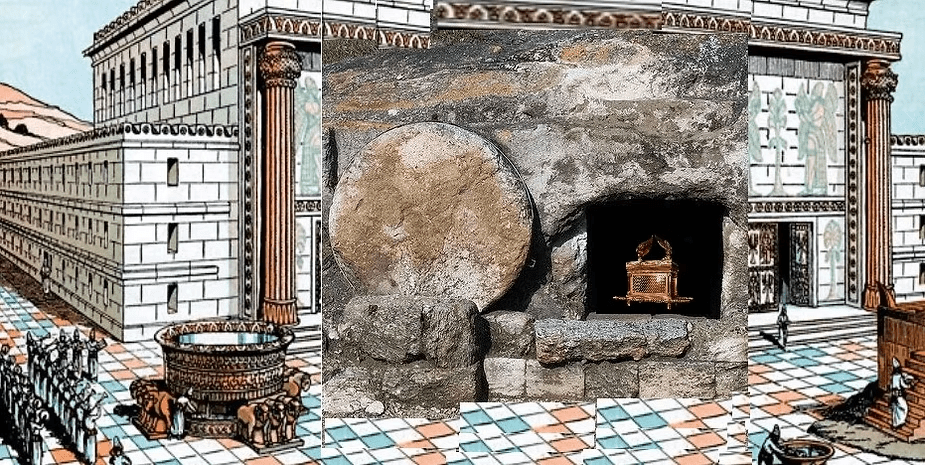
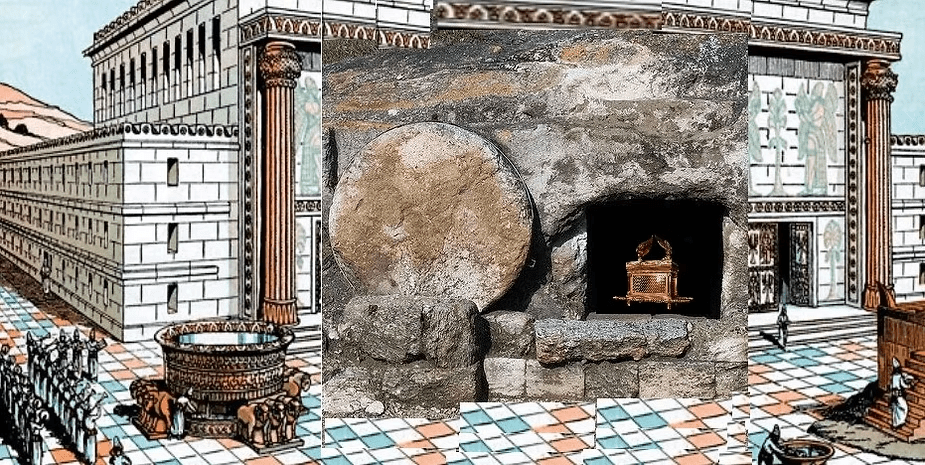
This respect for the Ark is mildly stated in this chapter from First Kings. The fact that the Ark was taken from a tent designed to be mobile and placed into a building of stone, the symbolism that must be seen is not a marriage celebration, but a funeral.

To put Yahweh in that mausoleum, the only “setting out” and “coming back” would be when an invader or occupier would destroy the temple, until someone else came to build it back. Of course, in that history there is not accounting for what happened to the Ark; so, in hindsight it was idiotic for Solomon to move the Ark from where it was. The Philistines [their main enemy] certainly wasn’t going to touch that again.

In the dedication of the grand temple, where Solomon stood prominently and “blessed all the assembly of Israel,” he said, “Blessed be Yahweh elohe Israel, who with his hand has fulfilled what he promised with his mouth to my father David.” In the use of the combination of words that say, “Yahweh elohe Israel,” the truth of those words says, “Yahweh’s gods in human form where each is He Retaining God.” That is the divine understanding, but Solomon, in all his wisdom, would have told the English translators, “Write the Lord God of Israel,” because the possessive form says I, as King of Israel, possess God, so He does what I want. Solomon, therefore, spoke the truth without understanding it, because his soul was not married to Yahweh.

Subconsciously, that is stated above in Solomon stating, “he [Yahweh] promised with his mouth [Yahweh’s voice] to my father David.“ Solomon was not even a figment in David’s corrupted imagination when Yahweh appeared in a dream to Nathan and told Nathan to tell David, “I have moved about with all the sons of Israel,” meaning David [a true son of Israel – one who retained God] was a tabernacle unto Yahweh, so wherever David moved, so too did Yahweh. Therefore, Solomon only knew what Nathan told him about that divine dream; and with all Solomon’s wisdom he could not discern the meaning of what Nathan said to him.

Solomon referenced “my father David,” while calling Yahweh blessed by his words. Solomon was not so blessed; and, because Solomon was not one of the “sons of God,” he could not bless the people, as had his father David. Four times in the speech made by Solomon he said, “my father David,” which took all the responsibility for a fixed building, instead of a tabernacle, away from Solomon and made it seem as if he were doing the plan of his father David. When Solomon then went into his prayer of dedication, three times he said, “your servant my father David,” not once implying he was also a servant of Yahweh [as “your servant and mind”].

In verse twenty-eight, where the NRSV has Solomon say, “Regard your servant’s prayer and his plea, O Lord my God, heeding the cry and the prayer that your servant prays to you today,” the reality is “Yahweh elohay” was written, which makes “my God” [“elohay”] need to be more closely examined.

The meaning of “elohay” is it expresses the possessive case that changes “elohim” [the plural of “god,” as “gods”] into a word stating “my gods” [not “God”]. By seeing the egotism of Solomon, who thinks he is as wise as Yahweh, from having eaten of the fruit of the tree of knowledge of good and evil – as the serpent suggested, an equal to God – him saying “Yahweh of my gods” means Solomon saw Yahweh as his personal servant god, with him an equal god, thus the two made “Yahweh gods.” Thus, all times that Solomon followed by saying “your servant,” this suggests more that Solomon was the one served by Yahweh, because Solomon only served himself.

In verse twenty-nine, when Solomon said, “that your eyes may be open night and day toward this house, the place of which you said, ‘My name shall be there,’ that you may heed the prayer that your servant prays toward this place,” that too requests that Yahweh follow the orders of Solomon and stay put in this place he has built. In the command given by Yahweh to Nathan, to pass on to David, Yahweh said of David’s “seed” “will build a house for my name.” That means the seed of David would be a soul who would make Yahweh a tabernacle that moves within his body of flesh. That “seed” would be minimally the prophets to come afterwards, but certainly Jesus, all of whom would be houses built righteously unto Yahweh. Again, Solomon’s wisdom misunderstood the words of Nathan; and, with David’s death removing the Spirit of Yahweh from nearness to Nathan, it is likely that Nathan could no longer talk to Yahweh to confirm things said.

When Solomon asked the question, “But will elohim indeed dwell on the earth?” [the NRSV translates “God”], the only possible meaning that can come from such a question asks, “Will human souls be married to Yahweh and become His temples?” It would be a clear statement that Solomon did not believe Yahweh truly existed, or the Ark was a tool available for his use. Solomon answered his question by saying [NRSV], “Even heaven and the highest heaven cannot contain you, much less this house that I have built!” This relates back to the dream Solomon had, when he spoke to both Yahweh and Satan. In the end, Solomon realized “it was a dream,” meaning his newfound wisdom said dreams are not real. As such, Solomon saw himself as a god on earth, as the reality of power, influence, and wisdom; so, there would be no problem burying Yahweh and His Ark in a mausoleum named after the god Solomon.

To add insult to injury [done by Solomon to his soul and the future of the Israelite people], Solomon prayed that Yahweh would bow down, roll over, and do tricks for foreigners coming to town. This, of course, was when the kingdom created by David was firmly set, with no major threats to its place from outsiders. That would change greatly after Solomon would welcome foreign influences within his Israel. He had married an Egyptian woman as a way to form an alliance with Egypt, which would help keep the Philistines appeased. In this prayer for foreigners, Solomon was taking a major step towards making Israel a nation like other nations [the lands of kings and royalty], no longer being a nation of people whose God was Yahweh.

As a reading selection for the thirteenth Sunday after Pentecost, when one’s own personal ministry to Yahweh should already be well underway, the lesson of the dedication to the Temple of Solomon is to beware all institutions that have the pretense of being a religion unto Yahweh [when they dare say His name, preferring to call Him “Lord”]. Solomon was the first to place Yahweh in a tomb, but all models of churches ever since are dedications and prayers to the entombed “Lord,” so that humans can assume all the powers of a god, in the name of the true God. It is a Satanic road to travel. So, beware how you walk this road.

Joshua 24:1-2a,14-18 – Dedicating your house to Yahweh

Joshua gathered all the tribes of Israel to Shechem, and summoned the elders, the heads, the judges, and the officers of Israel; and they presented themselves before haelohim. And Joshua said to all the people, “Thus says Yahweh elohe Israel:

“Now therefore revere Yahweh, and serve him in sincerity and in faithfulness; put away elohim that your ancestors served beyond the River and in Egypt, and serve Yahweh. Now if you are unwilling to serve Yahweh, choose this day whom you will serve, whether elohim your ancestors served in the region beyond the River or elohe of the Amorites in whose land you are living; but as for me and my household, we will serve Yahweh.”

Then the people answered, “Far be it from us that we should forsake Yahweh to serve other elohim; for it is Yahweh elohinu who brought us and our ancestors up from the land of Egypt, out of the house of slavery, and who did those great signs in our sight. He protected us along all the way that we went, and among all the peoples through whom we passed; and Yahweh drove out before us all the peoples, the Amorites who lived in the land. Therefore we also will serve Yahweh, for he is elohinu.”

——————–

This is the Track 2 optional Old Testament reading selection to be read aloud on the thirteenth Sunday after Pentecost [Proper 16], Year B, according to the lectionary for the Episcopal Church. If chosen, it will be accompanied by a singing of Psalm 34, which has the lyric, “The eyes of the Lord are upon the righteous, and his ears are open to their cry.” Those readings will precede the Epistle reading from Ephesians, where Paul wrote, “our struggle is not against enemies of blood and flesh, but against the rulers, against the authorities, against the cosmic powers of this present darkness, against the spiritual forces of evil in the heavenly places.” All will fall in line with the Gospel reading from John, where Jesus said to his disciples, “The words that I have spoken to you are spirit and life. But among you there are some who do not believe.”

I wrote about this reading selection and posted my views on my website, back in 2018. That was the last time these specific verses came up in the lectionary cycle. Those views can be found on this website by searching this site. I stand behind those views today, as the content has not changed; so, I welcome all to read what I wrote then and compare that to the new additional views I offer now.

It should be noted that in 2018 I was not focused on the errors of English translation that have had an effect on the minds of Christians to stay away from calling Yahweh by his ‘proper’ name. By calling His “Lord” one is always prone to think of Yahweh as some external entity, who one is so far below that one could never know Yahweh personally. It is vital to realize the prevalence of “Yahweh” in the Old Testament texts, which must be seen as the relationship all Christians must have in their lives, which is the same closeness the first Israelites of Moses and now Joshua had.

I also was not focused as much on making clear the mistranslation of “elohim,” which is routinely a transformation of the plural word stating “gods,” into an upper case presentation as “God.” This is not the truth and refusing to understand the concept of “gods” under Yahweh keeps Christians from becoming true saints. Again, seeing a ‘double name of God,’ as “Lord God,” reduces the truth to an externalization of Yahweh, making Jesus be non-existent in the Old Testament Scriptures. Jesus was the “Word” that has always been with Yahweh and the “Word” is what created an “elohim” in man. Joshua speaks loudly about that here, as he points out the difference between the “elohim” of dead “gods” worshipped by pagans and Gentiles. All external “gods” are dead. Only Yahweh lives; and, He lives in those who marry their souls to His Spirit. That is the true definition of an “elohim,” but that definition can never be realized when the truth is masked as some lie stating “God.”

First of all, one must see the parallel of Joshua convening a gathering of “all the tribes of Israel to Shechem, and summoned the elders, the heads, the judges, and the officers of Israel” to the shindig Solomon called to Jerusalem for the opening of his building of stone. Shechem was the first ‘capital’ of the people of Israel, in the hill country of the area assigned to the Tribe of Ephraim. After Solomon’s death, a meeting was held at Shechem, when ten tribes decided to secede from the kingdom that named Solomon’s son to take his throne. Shechem was where Yahweh confirmed His covenant with Abraham; and, it was considered the most sacred land in Joshua’s Israel. Conversely, David had taken Jebus, a stronghold of the Jebusites, who had never been conquered by Joshua and who held a treaty that was relative to the tomb of Abraham and Sarah [and Isaac and Jacob]. So, Shechem’s convention must be seen as an equal in importance to the one Solomon convened, if not much greater.

In the selected verses there are eight forms of “elohim” present. The first is “haelohim,” which actually translates as “these gods.” When this is seen to be preceded by the Hebrew word “lip̄·nê,” a form of “panim” or “faces,” the meaning relates to those who were true Israelites, as wearers of the “faces of elohim.” When the marriage vows [those inscribed on the stone tablets within the Ark] includes as the first agreement, “Thou shall wear no other face of a god before Yahweh,” that vow made all the true Israelites become elohim, as the wives of Yahweh that were made holy by His presence within their souls. Thus, Joshua called all who were indeed elohim to a meeting that discussed the resting of the tabernacle and the Ark in one central location, amid all the tribes. It was the Ark that they took with them to defeat all their enemies when they entered the land that was promised only to elohim.

When we read that Joshua said, “Thus says Yahweh elohe Israel,” that says Joshua was speaking as Yahweh, because like Jesus said, “The Father is within me and I in the Father,” Joshua was equally one with Yahweh. Just as Nathan spoke to David and told him what Yahweh said about building him a house, Nathan could have also said, “Thus says Yahweh elohe Israel.” The meaning of those three words says, “Yahweh’s wives Who Retain God [as elohim].” All humans, being souls entrapped in matter, are feminine in essence, making both males and females whose souls are married to Yahweh be His wives [a.k.a.: saints]. Thus, the “children of Yahweh” are the “Sons of God” [again, with no human gender reflected in “Sons”].

In verse fourteen stating [NRSV], “Now therefore revere Yahweh, and serve him in sincerity and in faithfulness,” the word translated as “revere” actually means “fear.” This is another agreement of divine marriage, such that the only fear one can possess is that of Yahweh, which is a focus on losing Yahweh after marriage. All fear should be motivations for commitment and fidelity. The service of a wife to Yahweh comes through sincerity and truth, which daily produces all the proof necessary for faithfulness. Thus, when Joshua stated that, he was like Paul making a personal statement of knowledge that he knew equally applied to all whose souls were possessed by Yahweh; and, that knowledge came from the sacrificing of all former “gods” [“elohim”] that ancestors served [those who originally left Egypt with Moses], which included themselves [self-egos].

It was then that Joshua said the placement of the Ark in Shechem demanded that everyone leave the Ark behind, in the care of Levitical priests [to whom Shechem would be made their city-state], which meant their souls would have to stop depending on the presence of Yahweh on the Ark as a visual motivation to stay true to one’s marriage vows [which they memorized]. The visual presence of a pillar of smoke outside the tabernacle would no longer make them feel the external presence of Yahweh close by. To that, Joshua told them [as Yahweh speaking through him ], “Now if you are unwilling to serve Yahweh, choose this day whom you will serve, whether elohim your ancestors served in the region beyond the River or elohe of the Amorites in whose land you are living.” That meant they would either remain a Yahweh elohim Israelite, through each’s individual marriage of their souls to Yahweh, or they would become Gentiles and wayward, no longer related to those who were elohim.

Joshua then added, “as for me and my household, we will serve Yahweh.” In that lies the truth of a “house of Yahweh.” Joshua was saying that the tabernacle was from then on to be a ceremonial place for Yahweh to assist the priests of Israel and the school of prophets. The presence of the tabernacle in Shechem was for guiding the whole of Israel, in the same way that a heart controls the blood flow throughout a whole body of flesh. Still, that body now extended to the reaches of the lands of the twelve tribes, because the Mind of Yahweh would be centered in the tabernacle, but the blood of Yahweh would be wherever His elohim wives flowed. Where there bodies of flesh had become mobile tabernacle of Yahweh, there too would be where Yahweh resided within. Thus, it did not matter if the Ark was kept in Shechem, or Kiriath-jearim, or the City of David, as long as it was readily portable, to be moved when Yahweh told His High Priest where to take it [when the smoke cleared]. What mattered was the people’s souls being married to Yahweh, so they were all houses of Yahweh wherever they went.

The true elohim of Yahweh heard Joshua state his commitment to serve Yahweh, regardless of where the Ark rested, so they replied to Yahweh’s voice from Joshua, saying “Far be it from us that we should forsake Yahweh to serve other elohim; for it is Yahweh elohinu who brought us and our ancestors up from the land of Egypt, out of the house of slavery, and who did those great signs in our sight.” In that, “Yahweh elihnu” means “Yahweh is ours as elohim.” That becomes a statement that they all had the fear of losing Yahweh within their souls, due to their souls having married Yahweh. The divine marriage of their ancestors had taught them to equally long for the same marriage of soul to Spirit.

When the people spoke to Yahweh about “the house of slavery” that was the life of a soul in Egypt, it is important to realize that the “other elohim” of their ancestors meant they left behind souls that were married to lesser gods, such as all the addictions to a world that is very sinful. The “gods” of lust, greed, gluttony, sloth, pride, wrath and envy were the foci of the marriage vows to Yahweh. Worship to those “gods” must be left behind, because Yahweh said, “I am a jealous God,” who will not accept infidelity. Thus, the “house” built by Solomon was one dedicated to his addiction to the lesser gods like those the Egyptian pharaohs built houses for. The servitude of a soul married to Yahweh also makes one a slave, through willful submission to Yahweh’s Will. However, the difference is a willing sacrifice that makes slavery come with the promise of eternal life after death, versus the slavery that comes with the wish it would all end, only to find death brings on the repeating of sinful addiction through reincarnation.

When the Israelites told Joshua, “We also will serve Yahweh, for he is elohinu,” the meaning here is “Yahweh is our marriage partner that makes us elohim.” Because of leaders like Moses, Aaron, and Joshua, the people had been shown the miracles of those empowered by self-sacrifice in service to Yahweh. Seeing those signs made them fearful of losing that presence, so they willingly submitted their lives to service to the marriage vows. Such due diligence brings about the proposal of marriage to those who serve Yahweh as His bridesmaids; and, those who always keep their lamps filled with the oil of truth will find their souls also married to Yahweh and able to produce miracles of their own. Therefore, the words of Yahweh through Joshua made all the Israelites present reconfirm their wedding vows with Yahweh. He was their Husband in divine marriage.

As an optional reading that is opposite the reading of Solomon’s grandiose meeting to dedicate the monument he constructed for his own kingship, as a place to bury the Ark and forever turn the Israelites away from Yahweh, it is important to grasp the necessity of one’s soul making a personal commitment to marry Yahweh and die of self-ego and self-will. Solomon is the anthesis of that commitment, as Solomon reflects the “elohe of the Amorites,” with his Egyptian wife [one of many, many to come, plus concubines] advising him of other elohim to bring into his new temple. Jesus said, “You cannot serve two masters,” and Yahweh is the only master that counts, when a soul’s eternal life is at stake.

As a reading selection to be read aloud on the thirteenth Sunday after Pentecost, when one’s own personal ministry to Yahweh should already be well underway, the lesson here is to put up or shut up. Yahweh said through Joshua, as I paraphrase, “Nobody tells you to marry Yahweh. Yahweh did not tell Solomon his wish for the fruit that took Adam and Eve away from Eden was a bad idea. One’s soul has been given to one’s body of dead flesh, free to have and to hold until death do you part. Once that marriage has been consummated when the umbilical cord to one’s mother has been cut, one is free to find whatever and whoever one’s soul wants to marry, be it the deadly sins, the Satan who offers wisdom and riches, or to Yahweh, who offers a soul eternal life. The choice is yours, and Joshua said that clearly. Ministry with some pretend god, one of the elohim who are not Yahweh, makes one nothing more than a hired hand [a slave to some boss that one is afraid to piss off and get fired] or a false shepherd [a thief who leads souls away from Yahweh]. Solomon was a wolf in sheep’s clothing, like so many who dress regularly in priestly garb, only to sell lies as truth. Joshua was a true priest of Yahweh, who becomes the icon that those who wish to marry Yahweh must become. That icon is Jesus resurrected in one’s fleshy body.

Ephesians 6:10-20 – Wearing the robes of the High Priest

Be strong in the Lord and in the strength of his power. Put on the whole armor of God, so that you may be able to stand against the wiles of the devil. For our struggle is not against enemies of blood and flesh, but against the rulers, against the authorities, against the cosmic powers of this present darkness, against the spiritual forces of evil in the heavenly places. Therefore take up the whole armor of God, so that you may be able to withstand on that evil day, and having done everything, to stand firm. Stand therefore, and fasten the belt of truth around your waist, and put on the breastplate of righteousness. As shoes for your feet put on whatever will make you ready to proclaim the gospel of peace. With all of these, take the shield of faith, with which you will be able to quench all the flaming arrows of the evil one. Take the helmet of salvation, and the sword of the Spirit, which is the word of God.

Pray in the Spirit at all times in every prayer and supplication. To that end keep alert and always persevere in supplication for all the saints. Pray also for me, so that when I speak, a message may be given to me to make known with boldness the mystery of the gospel, for which I am an ambassador in chains. Pray that I may declare it boldly, as I must speak.

——————–

This is the Epistle reading selection for the thirteenth Sunday after Pentecost [Proper 16], Year B, according to the lectionary for the Episcopal Church. Its reading will follow either a Track 1 or a Track 2 pairing of Old Testament and Psalm readings. The first places focus on Solomon dedicating his new temple and the second places focus on Joshua telling the Israelites it was up to each individual to choose what gods they would serve, from that point onward. Both Psalms are songs of praise, with Psalm 84 singing about the happiness of Yahweh’s dwelling and Psalm 34 sings about the abilities of the righteous. All will accompany the Gospel reading from John, where Jesus told his disciples, “For this reason I have told you that no one can come to me unless it is granted by the Father.”

The last time this reading came up in the lectionary cycle (2018), I wrote my opinions and published them on my website. That commentary can be read by searching this site. I welcome all to read those views and compare them to the views I will now add. I also welcome comments and suggestions, questions and correction via the website’s contact format.

In 2018 I was focused on interpreting this reading as the intent behind Paul’s words to true Christians of Ephesus. Certainly, that meaning still fully applies to all Christians today. Therefore, the views I expressed in 2018 are still quite applicable today; but I now want to address this reading in the context of the Old Testament readings, which both took place well before the advent of Christianity.

This reading begins with the appearance that Paul just blurted out, “Be strong in the Lord and in the strength of his power.” As this reading begins at verse ten, it should be realized that there is context written before, which led to this statement. In actuality, the first word in verse ten is a capitalized “Tou,” which takes on a divine level of importance that has been erased in the presentation of this reading. That capitalized word means “of This,” which is the genitive case [possessive form “of”], meaning “That” previously said. The segment of words that finished verse nine said [I summarize] there was “no partiality” given by Yahweh to those “masters” that have become His “Anointed ones” [i.e.: “Christs”] and allowed His Son Jesus to become the “Lord” [“Kyriō”] of their flesh. It is then “of This” that prompted Paul to add, “be empowered by the Lord , kai in this strength of this power oneself”.

That becomes the theme statement for this set of verses. The focus taken by Paul, in a letter written to people who had done just as he had done and understood what he meant, is the empowerment [from “endynamousthe”] that comes within one’s body of flesh after a soul has divinely wed Yahweh’s Spirit and given birth within one’s soul to the merger with the soul of Jesus, as a most divine possession that becomes the “Lord” over one’s flesh. The placement of the word “kai” [following a comma mark] says it is most important to grasp that it is one’s “soul” [from “autou” meaning “of self,” with “self” equating to a “soul”] that has become “in this strength of this power.” It is vital to understand that everything Paul followed this theme statement with – the armor of God – is metaphor for the power and strength that comes from the Spirit and the Christ being one with one’s soul.

When Paul then wrote “put on the whole armor of God,” the Greek word “endysasthe” is better translated as saying “be clothed” [rather than “put on”]. This means the clothing that can be called “the full armor of God” is the priestly garb of the High Priest of the Tabernacle. According to Exodus 28, these garments were the ephod, a breastpiece, tassels with bells, a turban with a seal, and linen undergarments worn from the waist to the thighs. All of this was to be worn “whenever they enter the tent of meeting or approach the altar to minister in the Holy Place, so that they will not incur guilt and die.” (Exodus 28:43)

All of this elaborate priestly clothing is only physically required for Aaron and his Levite descendants, which were those who physically attended to the tabernacle and the Ark and altar, et al, that was moved with the children of Israel. In the Old Testament readings that accompany this reading from Ephesians, the Tabernacle had been set in a central place (Shechem) and that place was given over to the Levites as their property to possess. In Solomon’s dedication of his Temple in Jerusalem, the Ark and alter, et al, was moved into that fixed place. However, the point of Paul’s words say the presence of the resurrected soul of Jesus, within one’s soul-body, his soul comes garbed with everything necessary for a High Priest. His presence within means one’s body of flesh has become the Tabernacle, where Yahweh resides between the Cherubim atop the Ark, which has been placed in one’s heart [where the word for “heart” means “soul” or “inner man”].

This means the “full armor of God” is His Son reborn within one’s being. This must then be seen as a divine possession of one’s soul-body, such that one’s soul has lowered its ‘head’ in submission to a higher power. The metaphor of “armor” then means oneself [self always means soul] has knelt before the King and been ‘knighted’ as a fully devoted servant that will fight all enemies to the throne. Paul then stated that enemy when he said, “so that you may be able to stand against the wiles of the devil.”

In 2018, I had not come to the realization of possession, although I was aware of the need for divine marriage, so a soul became one with Yahweh’s Spirit. The aspect of Jesus’ soul becoming a twin soul merged with one’s physical life soul was still beyond my mental conceptions. Since then, I have come to realize that possession of a soul is least common as divine, where the soul of Jesus comes in to control one’s bodily actions. What is most common is demonic possession, which are less the extremes of Hollywood movies and horror books and more the commonality of drug addiction, sex addictions, and any other worldly lust that can and will overtake a soul-body entity. It is this demonic possession that becomes the reason a soul needs to “be clothed in the whole armor of God.” One needs divine possession to fight [“take a stand”] against the schemes [“methodeias” means “crafts, deceits”] of Satan [“diabolou,” “slanderer, false accuser”].

The point that I have been making for quite some time now is the mistranslation of the Hebrew word “elohim” as “God.” The Hebrew word “el” is the singular form of “god,” but there is no reason to capitalize that into English. The plural form, “elohim,” means “gods,” again with no need to capitalize that into English. The mistranslation, such that Genesis 1 has been mistranslated to say “God created this” and “God created that” is truly a series of statements about Creation, from which the first creation was Yahweh creating “elohim,” who were the “gods” He assigned to make everything. Yahweh is the architect of the Creation, who drew up the plans, but never got his hands dirty building his designs. That was left up to the lower “g” gods. In Genesis 2 we find Yahweh busy creating His Son and then Adam’s mate. In that there is no mention of “elohim” alone, after verse four. Still, because Yahweh created Adam [not the males and females of Genesis 1], Adam must be seen as the first divine “elohim” (a “Yahweh elohim“) who would be sent [along with wifey] to be the first High Priests on earth [outside Eden].

From that story in Genesis 2, by the time we reach Genesis 4, we find that the “elohim” are not limited to being only divine possessions, where the descendants of Adam and Eve were not always possessed by Yahweh’s Spirit. Cain becomes the first example of a demonic possession. Cain would become a reflection of the powers of the earth, which will quickly take possession of a soul, if the soul is not careful and seeking Yahweh in marriage. The books of the Old Testament tell of the lineage of divinely possessed souls, who become opposed by the demonically possessed souls of king, queens, and false prophets and priests. This is a common problem that Paul warned the true Christians of Ephesus about.

Paul said the stance that must be taken by those ‘knights’ wearing the armor of Christ Jesus is “against the rulers, against the authorities, against the cosmic powers of this present darkness, against the spiritual forces of evil in the heavenly places.” This says Satan has less need for possessing the minions of the world, because he knows possessing the leaders of the minions will force them to do their will. This then states the purpose of Yahweh marrying souls and having His Son resurrected into divine elohim is ministry. Those knights do not hide at home, only venturing out to a church pew for others to marvel at their piety [like the hired hands and false shepherds do]. Knights of Yahweh challenge the liars and cheats of the world with the truth. The true Christians Paul was writing to were the front lines in a war of exposure, where the point was to transform the many who sought redemption into divine elohim, who served Yahweh as Jesus reborn. Paul was at the forefront of a major movement back then; a movement that has since been reduced to a slow drip.

The paradox of the First Kings reading, with all the pomp and circumstance of Solomon’s self-aggrandizement, must be seen as his soul having become a demonic elohim, promised the world by the serpent offering him more wisdom than anyone ever, before or after. Solomon was then an agent of Satan, who had a mausoleum built, in which to entomb Yahweh and His Ark. The servants of that temple would slowly cease to attend to the needs of the people; and, with the king no longer an agent of Yahweh [as was David], they would stop being divinely possessed and fall prey to the “schemes of the devil.”

When that reading is set up with Joshua 24 being the counter-reading, it must be realized how often Joshua spoke the word “elohim” to the Israelites he summoned to gather at Shechem, where the Tabernacle and Ark were to be set permanently [although still mobile, when needed]. Because the presence of Yahweh was no longer going to be visible [as a cloud outside the tent of meeting], Joshua told all those who were committed as “Yahweh elohim” to make the decision what “gods” their souls would merge with next. Joshua mentioned the options of the “elohim” of Egypt and the “elohim” of the Amorites, who were those “gods” from which Abraham came, himself believing in Yahweh alone. The lesson of Joshua, verses the lesson of Solomon, says it is up to the individual to become the “god” of their choice. That means there will never be a demand by Yahweh to follow any of His Commandments. Those are the marriage vows that can only be taken by a soul in love with Yahweh, who is willing to submit fully to His Will. All who choose to retain some of himself or herself as a “god” [the demonic elohim], they will be made promises by the devil, all of which will end when the soul is separated from its body of flesh at death.

This choice must be realized from this reading from Ephesians. To make this choice – to become a ‘knight’ in service of the King and fight for truth and justice against the leaders who corrupt souls – Paul said what all true Christians must also say and know. Paul wrote, “Pray that I may declare it boldly, as I must speak.” In that, the Greek word translated as “must” is better translated as “it is necessary.” This is “necessary” because the soul of Paul seeks redemption for his own past sins, and speaking the truth will bring his soul what it seeks. Still, it is “necessary” because the truth has to be heard, so other souls can be freed of their slavery to demonic spirits.

In the Gospels and in Acts are stories of those souls who have been divinely possessed [Jesus and his Apostles] going and touching the souls of others, healing them from deformities, illness, and even death; but many others were found to be possessed by demonic spirits, which were cast out by the words spoken by the Apostles. Only those who had become the elohim of Yahweh, with Jesus resurrected within their soul-flesh, could cast out the Satanic spirits possessing very evil people. It must be realized that “elohim” can be both good and bad. It must be understood that it is much easier to be possessed by a demonic spirit than it is to be married to Yahweh and give birth to His Son once more.

For more on this concept, called Eudaimonia, I recommend reading the Wikipedia article under that name. This is a concept that has been recognized for many centuries. It is not something I have made up. Modern psychology addresses people with “Multiple Personality Disorder,” as some scientific way or renaming an age-old phenomena. The Roman Catholic Church still employs exorcists, because they firmly believe in demonic possession. It is a topic worth becoming familiar with, because it is the root meaning of “elohim,” which scholars will quickly mislead one away from understanding [including the Jews who assist the translators of Hebrew, also seeing the plural as the singular, pronounced].

As the Epistle selection for the thirteenth Sunday after Pentecost, when one’s own personal ministry for Yahweh should already be well underway, the lesson here is to realize the need to become one with Yahweh and be truly reborn as His Son. No ministry will have any lasting positive effects that promote self-worth and act as a minister only to bring one the riches of the world. The organizations of religions must be seen today in the same light they were seen by Paul, as corrupted by evil influences. The Jews of Jerusalem – those of Herod’s Temple – were the ruined remnants of the Israelites of Solomon – those of his temple – all of whom were “the rulers, the authorities, the cosmic powers of an ever-present darkness, as the spiritual forces of evil in the heavenly places.” The “heavenly places” are souls possessed by Satanic promises. The ministry of a true Christian is necessary, so the truth is spoken by Yahweh, as Jesus resurrected in new flesh.

John 6:56-69 – Absorbing the words of eternal life

Jesus said, “Those who eat my flesh and drink my blood abide in me, and I in them. Just as the living Father sent me, and I live because of the Father, so whoever eats me will live because of me. This is the bread that came down from heaven, not like that which your ancestors ate, and they died. But the one who eats this bread will live forever.” He said these things while he was teaching in the synagogue at Capernaum.

When many of his disciples heard it, they said, “This teaching is difficult; who can accept it?” But Jesus, being aware that his disciples were complaining about it, said to them, “Does this offend you? Then what if you were to see the Son of Man ascending to where he was before? It is the spirit that gives life; the flesh is useless. The words that I have spoken to you are spirit and life. But among you there are some who do not believe.” For Jesus knew from the first who were the ones that did not believe, and who was the one that would betray him. And he said, “For this reason I have told you that no one can come to me unless it is granted by the Father.”

Because of this many of his disciples turned back and no longer went about with him. So Jesus asked the twelve, “Do you also wish to go away?” Simon Peter answered him, “Lord, to whom can we go? You have the words of eternal life. We have come to believe and know that you are the Holy One of God.”

——————–

This is the Gospel selection to be read aloud by a priest on the thirteenth Sunday after Pentecost [Proper 16], Year B, according to the lectionary for the Episcopal Church. This reading will be preceded by one of two pairs of Old Testament and Psalm readings, where the reading from First Kings tells of Solomon dedicating his temple in Jerusalem. The alternate reading comes from Joshua, when the Tabernacle was established in Shechem and all the Israelite leaders were told to choose what elohim they would serve afterwards. Joshua said he would be a Yahweh elohim and the rest of the leaders said they would do the same. The Psalms are songs of praise to the dwelling place of Yahweh and the protection the righteous have. The Epistle reading that will accompany them all comes from Ephesians, when Paul told the true Christians of Ephesus to wear the full armor of God.

The last time this reading came up in the lectionary cycle (2018), I wrote my comments and published them on my website. That article can be viewed by searching this site. I stand behind what I wrote then and I welcome all to read that commentary and compare that to this production of additional views. Because the text has not changed, the same things I saw three years ago are pertinent today.

In my observations of 2018, I made it clear that when the Jews in the synagogue in Capernaum heard Jesus talking about eating his flesh and drinking his blood, their saying, “This teaching is difficult; who can accept it?” was a sign that they were not inspired by the Spirit of Yahweh to understand divine language. Thus, Jesus said, “The words that I have spoken to you are spirit and life,” as an affirmation of that his words of the Father were indeed divine language.

For the past twenty years I have been learning to speak divine language. I was led to understand it by first realizing Nostradamus was a modern prophet of Yahweh, whose work The Prophecies [Les Propheties] was in fact divine language. No one has been able to read Nostradamus and make sense of it, because to understand divine language one has to be assisted by the divine. I did not solve how to make sense of what Nostradamus wrote. I was divinely guided to see the truth; and, just as the followers of Jesus to the synagogue in Capernaum said, “This teaching is difficult; who can accept it?” the Christians I have encountered over the past fifteen years have said the same thing to me [as they pick up the stones of destruction, preparing to smash my head for thinking such things].

By spending several years of my life being totally devoted to following the voice of Yahweh as He led me further and further towards understanding divine language, I produced a book I entitled “The Systems of Nostradamus: Instructions for Making Sense of The Prophecies.” I was led to write a book that lists the syntax of divine language, which could be applied to what Nostradamus wrote. But then, I began going to an Episcopal Church and reading the selected readings they printed on a handout, listening to the public reading of those Scriptural verses; and, my mind was opened to understanding those words, because I had been led to understand Nostradamus.

The same methods for understanding Nostradamus made understanding Holy Scripture clear. I read and understood, to the point of investigating insights and asking questions about meaning. However, no priest I ever heard give a sermon presented the truth of the meaning I saw, meaning no priests I ever heard had a clue about understanding divine language.

Christians today have been led away from a personal commitment to Yahweh [they do not even know the name of their God, taught to call Him “Lord”], because of being fed spiritual food by the likes of Judas Iscariot reincarnated in Christian vestments. The priests I have heard have been little more than hired hands. When I have attended Bible Studies led by priests and church deacons, I have had Bible Studies suddenly go on hiatus and teachers tell me to stop raising question that no one can answer [other than scholars making hypotheses]. Because of this false teaching model, Christians gleefully memorize Bible quotes that are English mistranslations, when few can explain what their memorizations mean [they sure do sound pretty, however].

Because I did an acceptable job explaining this message in this reading, back in 2018, I will not beat that bush any further today. What I will do is give a syntactical explanation of what John wrote, about what Jesus said. It should be noted that John wrote his Gospel many years after the fact; but faith says John did not write from memory, as he wrote by divine guidance, which he willingly followed. Thus, every stroke of John’s pen [in Greek] must be seen as divinely chosen by Yahweh and given to John to write, because each specific word bears the meaning Yahweh intended. At no point did John offer opinions that were not divinely led. At no point did he stray from the truth.

In verse 56, the Greek text written [transliterated] is this: “Ho trōgōn mou tēn sarka kai pinōn mou to haima , en emoi menei , kagō en autō .” This verse has been translated into English by the NRSV [New Revised Standard Version] to say, “Those who eat my flesh and drink my blood abide in me, and I in them.”

The standard translation of the Greek into English must be realized as being according to the rules of language [syntax], such that the differences in Greek and English are resolved, so the intent stated in Greek is transposed into a statement of the same intent in English. This result becomes a paraphrase, which should be seen as a step away from the truth. Realizing there is problem with this means one then comes with the task of grasping how Jesus most likely was not speaking Greek, as he was most probably speaking Aramaic. John heard and understood the Aramaic, but did not write his Gospel [as did none of the New Testament writers] in Aramaic.

This makes Greek be a language chosen by Yahweh, both because John was fluent in that language and John understood the intent behind Yahweh selecting exact replacement words in Greek, which would divinely reflect what was said in Aramaic. Anyone who does not have faith that Scripture is the Word of Yahweh [call Him “God” if you want], written by a devoted vehicle [a servant in ministry], needs not read here any further, because such people will always say, “This teaching is difficult; who can accept it?”

In that regard, I once made a comment in a lectionary class, one that was reading the account of Pentecost Sunday, from Acts 2. At that time I said the English translation of “raised,” where Peter stood and with a “raised voice” spoke, that English translation should not be understood simply as meaning, “Peter yelled out to the crowd.” I said the word written in Greek means he spoke in an “uplifted” manner, better meaning that Peter spoke divinely [perhaps even while yelling]. After I made that [in my opinion basic] clarification, one woman blurted out angrily, “Then why doesn’t it say that?!?!” – as if the English translation saying “raised voice” could not be understood any way other than “Peter shouted.” I mention this as one example [of others], where it is much easier for Christians [those calling themselves that] to say, “This teaching is difficult; who can accept it?”

As for the Greek written by John that I have posted above, a literal translation can state, “He partaking of a meal of me this body kai imbibing of me this blood , in me waits , kai ego
in soul .” In this there are four words that place focus on the ego, where “mou” is the genitive or possessive statement of “egṓ,” such that “of me” is a possession relative to “I.” The Greek word “emoi” is the Dative singular form of “egṓ,” such that “me” is again a statement about “I.” Finally, the contracted words “kai and egṓ” create “kagō,” where the use of “kai” is always a marker word denoting importance to follow, with that importance then being placed directly on the state of being that is “I.” That repetition must not be seen so much as the ego of Jesus being stated; but instead, the repetition of “I” must be seen as Yahweh speaking through the Son to all who would forevermore read the words of John and realize “I” becomes a statement of each individual who is resurrected as the Son.

Relative to “trōgōn” being “partaking of a meal,” rather than “eating” [or “eater”], this has to be seen in the context of Jesus having set this up by saying, “I am the bread of life,” followed by his saying, “I am the bread that came down from heaven.” This says Jesus is not a man, as much as Jesus is a soul that has been sent by Yahweh in the form of a man. While Jesus appears to be a man of flesh and blood, he had just told those in a Jewish synagogue that the reality was he stood before them as bread from heaven, which offers life. That makes Jesus be spiritual food; and, spiritual food is as unseen as are words spoken and Greek written with deeper than surface meanings.

The scary word that is so hard to take is “flesh.” Hearing Jesus say “eat my flesh” turns one’s mind away from the truth. The Greek word written by John, “sarka,” can mean “flesh, body, human nature, materiality; kindred.” (Strong’s Usage) According to HELPS Word-studies, the word implies “of human origin or empowerment,” such that the “body” of Jesus, which came down from heaven, was the Spirit of Yahweh within his being [his “I”]. The “body” of Jesus that we know comes from the four written accounts of his life on earth, which is what needs to be “consumed,” in order for one to even begin to think “I am a Christian.”

In the first series of words in verse 56 is the presence of the word “kai,” which [again] marks importance that follows. That marker word follows the use of “body” [“sarka”], which means the consumption of the body of Christ is the preliminary step towards the greater transformation which is [marked by “kai”] “imbibing this blood.” Here, the use of “imbibe” brings about the essence of the definition that is “to absorb or assimilate (ideas or knowledge).” [Google, Oxford Languages] Following the consumption of a body of knowledge, to absorb that knowledge into one’s own self being [a reborn “I”] means to have the same flow of “life” as did Jesus. When “life” equates to the presence of a “soul” in a body of flesh, then to have absorbed the “bread of life” means one has had one’s soul joined by the soul of Jesus. This equates to a divine possession.

The acceptance of that meaning means the “blood” of Jesus is one’s own “blood,” which becomes grounds for claiming a relationship, through divine lineage. The assimilation of the “blood of Jesus” means one has also become the Son of Yahweh, in the flesh of a human. It is the foundation block of true Christianity, where all who truthfully make that claim have become resurrections of the soul of Jesus, so each has married their souls to Yahweh, so He has brought about that divine rebirth. This becomes the truth of “in me waits [or abides]

, kai I upon soul.”

The element of followers of Jesus no longer being able to follow him, is seen through John writing, “Jesus knew from the first who were the ones that did not believe” and “many of his disciples turned back and no longer went about with him.” This prophesied people like that woman who angrily challenged a simple explanation of language as something her belief system cannot survive. By being told, “You must be in Jesus and Jesus one with you,” the fair weather Christians will leave in droves. They have all been promised the moon for doing nothing, with all sins washed away by the rhetoric of hired hands. They have been told, “Jesus died for your sins,” which refuses to explain that Jesus died in the flesh to release his soul to join with yours; so now, the addition has to say [but isn’t preached], “You have to die of self ego and be reborn as Jesus, because of your sins.”

The aspect of Jesus saying, “no one can come to me unless it is granted by the Father” means the first step to receiving the bread from heaven to consume is for one’s soul to accept the marriage proposal from Yahweh [you need to learn His name in order to marry His Spirit] and become a bride of Yahweh. If one’s soul does not marry Yahweh, one cannot “eat the flesh of Jesus and drink his blood,” becoming his brother in Christ [regardless of human gender]. The problem so many denominations of Christianity have is they sweep aside Yahweh, going straight to the Son, seeing Jesus as an equal to God, which forbids them from ever gaining eternal life. The marriage vows [the Covenant, or Commandments] are between the soul and Yahweh. One has to commit to serving Yahweh eternally, before the idea of Jesus comes. There are no shortcuts here.

In regards to the truth that was said by the followers of Jesus being, “This teaching is difficult; who can accept it?” there is nothing about Holy Scripture [All Testaments] that can be understood by 2-hour a week believers. Before there was any written texts to memorize, the children of Yahweh – the true Israelites, who all “Retained God” – were taken away from the glare of the big city, into the wilderness, where for forty years they lived being children of Yahweh. Anyone who does not have the time to look up the Hebrew and Greek texts and figure out the depth of meaning the words written contain, that soul does not want to submit to Yahweh and be His wife. Scripture is meant to be hard to interpret, because the only ones who can accept it are those brides whose lamps never run out of oil.

As the Gospel reading selection to be read aloud by a priest on the thirteenth Sunday after Pentecost, when one’s own personal ministry to Yahweh should already be well underway, the lesson is clear. Either you are a pretender or you are a contender. Pretenders run away from the hard work. They want everything handed to them on a silver platter. The souls who are willing to submit to the Will of God and do all the servitude He demands – willingly, out of love and devotion – they will find all the work that servitude demands will become a joy to behold. Ministry can only be truth when a soul has married Yahweh and then consumed His spiritual bread, which means being His Jesus reborn.

Psalm 84 – Being a house of God

1 How dear to me is your dwelling, Yahweh of hosts! *

[2] My soul has a desire and longing for the courts of Yahweh;

my heart and my flesh rejoice in the living el.

2 [3] The sparrow has found her a house

and the swallow a nest where she may lay her young; *

by the side of your altars, Yahweh of hosts,

my King and welohay.

3 [4] Happy are they who dwell in your house! *

they will always be praising you. Selah

4 [5] Happy are the people whose strength is in you! *

whose hearts are set on the pilgrims’ way.

5 [6] Those who go through the desolate valley will find it a place of springs, *

for the early rains have covered it with pools of water.

6 [7] They will climb from height to height, *

and el-elohim will reveal himself in Zion.

7 [8] Yahweh elohim of hosts, hear my prayer; *

hearken, elohim of Jacob. Selah

8 [9] Behold our defender elohim; *

and look upon the face of your Anointed.

9 [10] For one day in your courts is better than a thousand in my own room, *

and to stand at the threshold of the house of elohay

than to dwell in the tents of the wicked.

10 [11] For the Yahweh elohim is both sun and shield; *

he will give grace and glory;

11 [11] No good thing will Yahweh withhold *

from those who walk with integrity.

12 Yahweh of hosts, *

happy are they who put their trust in you!

——————–

This is the accompanying Psalm for the Track I option from First Kings, which tells the story of Solomon’s dedication of his new temple. If chosen, that pair will be read aloud before the Epistle from Ephesians, where Paul wrote, “take up the whole armor of God, so that you may be able to withstand on that evil day, and having done everything, to stand firm.” All will precede the Gosple selection from John, where the disciples told Jesus, “This teaching is difficult; who can accept it?”

This is another Psalm identified as “of the Sons of Korah,” who were the descendants of the cousin of Moses, who staged a rebellion against Aaron and Moses. As punishment, Yahweh opened the earth and swallowed Korah, which indicates he was sent underground. His descendants [Kohahites] became the “porters” of the Tabernacle and Ark [they maintained the baking pans for meat-offerings]. We last read another of the Psalms dedicated to the Sons of Korah, when Psalm 48 was sung aloud on Proper 9 [sixth Sunday after Pentecost]. That song accompanied the Old Testament reading from Second Samuel, which told about David taking Jebus and building his city there. Because the Old Testament reading this Sunday is associated with also involved a change that is relative to the Tabernacle and Jerusalem [Jebus], this psalm must be viewed in that light and seen as a song of praise to Yahweh and to those who honor His holy ground.

In the translation presented above, I have amended the NRSV-Episcopal Church translation so that every place the translation had been “Lord,” it has now been restored to “Yahweh” [what was written]. In addition to those changes, every place where “God” has been translated, I have restored the Hebrew transliteration, with the singular “el” and the plural forms of “elohim” are found. This becomes important to realize, when one notices “of hosts” [from “ṣə·ḇā·’ō·wṯ” or “tsaba”] must be understood as the angels [minimally], which are “elohim” [“gods”]. Additionally, in two places the Hebrew word “Selah” is written at the end of a verse. Those had been erased in translation, seen as some musical instruction; but I have reinstated those also. Finally, the numbering of the Episcopal Church is wrong, for no understandable reason. Their numbering does not match that of the NRSV, meaning they have presented some paraphrase, as if they are holy enough to do that. I have noted the truth of the verse numbers; and, they will be how I address the analysis by verse.

In verse one, the literal translation says, “a song how beloved your tabernacle , Yahweh of hosts.” In that, the Hebrew word translated as “tabernacle” [from “mishkan”] can also translate as “dwelling place.” This alternate translation makes it clearer that David was speaking of the “beloved” presence of Yahweh within his soul, more than his seeing a tent and altar configuration as a site of beauty. This leads one to be more apt to see “Yahweh of hosts” in the light of David’s soul not being the only one married to Yahweh, because all of Israel under David felt the same inner presence. This use of “of hosts” then allows one to see such devotees as “elohim.”

Verse two then begins with this: “My soul has a desire and longing for the courts of Yahweh.” This is literally stated as, “longs and yes also faints for the courts of Yahweh.” In that, the word translating as “courts” [“lə·ḥaṣ·rō·wṯ,” from “chaster”] means “enclosure.” When one realizes that one’s “soul” can only “long and yes even faint” within the “enclosure” of its body of flesh, the use of “courts” becomes metaphor for the tabernacle of Yahweh being one’s body of flesh. The key is to see the presences of Yahweh, atop the Ark of the Covenant of marriage, as being within one’s heart [and “soul”], where love is the bond.

The second half of verse two then literally sings, “my heart and my flesh cry out for the living God.” Here, the Hebrew word “lib·bî” [from “leb”] translates as “heart,” which affirms the condition of love; but the same word also means “inner man, mind, will,” which are elements of a soul, more than the “flesh.” By then adding the word “flesh,” the outer and inner being is the result, such that “heart and soul” equate to “soul and body.” The use of “el” states the singular was indeed possible, making the writing of “elohim” become upheld as meaning “gods,” which are the divine creations of the “living God.” The focus on living says there are lesser “gods” that are dead, which means those gods only last in the physical realm, having no lasting effect on an eternal soul. The dead gods only serve a body through external delights, while Yahweh delights both the body and soul, the only God offering the promise of eternal life.

Verse three then starts by singing, “The sparrow has found her a house and the swallow a nest where she may lay her young.” The missing word that begins this verse is “even,” which makes this be a comparison to birds that are winged creatures. That makes the comparison to a soul suggest the soul has wings in comparison, which makes one become angelic. The focus on a “house” [“bayith”] and a “nest” [“qen”] is then the place built to provide self-security, from which new growth can come. This makes the body of the soul become a sanctuary, where one is then able to bring forth new life within one’s body of flesh, under the protection of Yahweh. This then reflects as the parable Jesus told, about the mustard seed growing into the mustard shrub, which becomes synonymous with Yahweh providing a home for such nesting angels.

When the conclusion of verse three sings, “by the side of your altars , Yahweh of hosts , my King and welohay,” the bird comparisons to a soul, in a home built within a bush that is Yahweh, the “altars” are then symbolic for self-sacrifice. The sanctuary that is a metaphoric tree, where trust in the protective branches that allows for a bird to lose all inhibitions about entering the tree or shrub. The “altars” [from “mizbeach”] reflect the sacrifice of self-presence, knowing rest and protection means a need for sacrificing individuality to advance one’s life. A shrub, such as the mustard plant provides, becomes the home of many birds, so there are multiple sacrifices within the same sanctuary. When we read “Yahweh of hosts,” the “hosts” are the many angels of God, such that the possessive “my” says one’s soul has submitted to Yahweh, becoming one of His angels, with Him as one’s King to whom a soul submits fully. The use of “welohay” sings of marriage, where each of the soul sacrifices have become married to Yahweh, so His name has been taken and a state of possession exists between His Spirit and one’s soul.

Verse four then sings, “Happy are they who dwell in your house! they will always be praising you. Selah” In this, the word translated as “happy” can equally mean “blessed.” By using “blessed,” the picture becomes more evident that the soul is that “blessed” and “happy.” When this then leads to “those who dwell in your house,” this again relates back to the “hosts” aspect of “elohim.” The “house” is not an external structure, such as a tabernacle or tent of meeting, but the body of flesh that is the “house” [temple] of the soul. This then says the state of “blessedness” and “happiness” is because Yahweh now resides within one’s body, having become one with one’s soul. Because this reflects the “blessed” event of permanent marriage [therefore salvation from past errors of life], the soul “will always be praising” the presence of Yahweh with one’s soul. As noted before, the first appearance of “Selah” comes at the end of this fourth verse, with “selah” meaning “to lift up, exalt.” As a musical direction, it follows the soul’s “praising always,” where the praise is because one’s soul has been “lifted up” to eternal life, from the imprisonment of a corporal body that offers only death.

As a way of continuing this theme of “uplifted praise,” verse five then repeats the first word that began verse four, as singing, “blessed is the man whose strength is in you ; on highway whose soul .” This continues to sing praises of thanks to Yahweh being one with one’s soul, as that union makes one a Son of man. A Son of man is an elohim, because Yahweh is one with one’s soul. In the Hebrew word for “man” written – “’ā·ḏām” – this has to be recognized as the name Christians believe Yahweh gave to His first priestly elohim. One who knows the presence of Yahweh becomes the resurrection of that Yahweh-made “man,” whose “strength” comes from having been made by the One God. The second half of this verse then sings praises to the ministry that comes on the “highway” [from “mesillah”] that is a pilgrim’s path of righteousness. Again, it is not the flesh that leads one on this path, but the “soul,” which has married Yahweh and become His elohim.

In verse six there is a vertical bar following the first word, which acts as a musical direction to pause [I assume], as a long note held, more than a separation from the words that follow. By seeing that marker, the literal translation becomes, “pass through ׀ the valley of weeping a fountain they make it ; moreover with pools , it envelops oneself the rain”. This translation shows a verse that reflects life without Yahweh having married one’s soul. It shows the true cause of self-sacrifice in marriage to His Spirit. The metaphor of a “valley” [from “emeq”] is an erosion of self-worth into despair, where “weeping” [the meaning of “bakah”] is the misery that leads one’s soul to seek Yahweh. Life is a soul “passing through” from one body of flesh to another, in a long series of reincarnations, each finding the deep rut that comes from refusing to marry Yahweh, life after life. It is the “pools” of hope [where the word translated as “pools” is “berakah,” meaning “blessings”] that leads one to pray for forgiveness sincerely, so one’s soul become immersed in the “rain” of Yahweh’s love.

Verse seven then follows by literally singing, “they walk from strength to efficiency , sees before elohim in Zion”. This says the presence of Yahweh within a soul is how it gains the ability to walk a path of righteousness, in a way that is regimented. The words “mê·ḥa·yil ’el-ḥā·yil” pulls in the word “chayil” twice, where the multiplicity of translation allows this to translate as “from strength to efficiency.” Still, the word also means “wealth, army,” where the walking becomes the training and exercises that are demanded to be successful. It is not the strength of self but the strength of many learning the same tactics from a central instructor. The second half of this verse then explains that source, as all the soldiers in this “army” are “seeing” how to “walk,” because they all wear the face of Yahweh as the “elohim” of “Zion.” The word “zion” can mean “dry place,” where the dampness of self-pity and weeping has been removed, so one relies on the deep pools of strength that is Yahweh’s presence. The pre-Israelite meaning of “zion” is “fortress,” meaning becoming an elohim puts a soul within the “fortress” of Yahweh.

Verse eight then begins with the confirmation of this face of Yahweh being that worn by His elohim, as it begins with “Yahweh elohim of hosts.” In that, the use of “hosts” can also have a military-like essence, as it is another word meaning “army,” as an “army of angels.” It is they who have asked Yahweh to marry them, as David sang, “hear my prayer.” That says they have accepted the proposal for marriage and submitted themselves before Yahweh, praying for forgiveness. The second half of the verse then sings, “listens the elohim of Jacob.” Here, it is important to realize that the elohim of Jacob was his elevation from a worldly name [a name that means “Supplanter”] to a divine name – Israel – a name meaning “He Retains God.” Those who “listen” to the commands of Yahweh do so because they have learned to follow orders and march to the instructions of Yahweh.

This verse is the second which ends with the word “Selah,” which means another point of being uplifted is recognized. Hearing the voice of Yahweh giving insight to action is then worthy of praise. One does not feel forced to do anything unwanted. One is amazed at the ease of the work, no matter how difficult, because one’s soul is assured of eternal life.

Verse nine then literally sings about “our shield,” where the “army” [“hosts”] of Yahweh’s elohim are together as one group, where Yahweh is their “shield” against all challengers and obstacles. Whereas the Greeks and Romans were known militarily for tactics, where phalanxes were formed by holding shields forward, along with spears protruding outward, it is similar how the Israelites [and true Christians] are “beheld as elohim.” In that, their personal “shield” of Yahweh gives them no fear in their hearts, regardless of how strong those they face seem. When David sang, “those who look upon the face of your anointed, the “face” [from “paneh”] worn by all Yahweh’s wives [servants] is His “face.” To be “anointed” [from “mə·šî·ḥe·ḵā” or “mashiach”], that says one’s soul has had Yahweh’s Spirit poured onto it, making all become His “messiahs.” This is a holy presence that will be recognized from one’s actions, in the name of God.

Verse ten then sings [NRSV], “For one day in your courts is better than a thousand in my own room, and to stand at the threshold of the house of elohay than to dwell in the tents of the wicked.” Again, the Hebrew word “chatser” is used, which alternatively means “enclosure.” The aspect of “a day” [“yō·wm”] means the light of truth has become eternal, such that one day of Yahweh’s presence is equal to “a thousand” years or physical time. While nothing is written that states “in my own room,” the words literally state, “I choose to be a doorkeeper in the house of my elohim,” such that “elohay” is a statement of possession, as Yahweh’s elohim. To be the doorkeeper becomes synonymous with Jesus saying, “I am the gate” to the sheepfold. The preference is to be the Son of Yahweh, rather than be outside His protection and forced by the world to sleep [metaphor for death] in the “tents of the wicked.”

Verse eleven then includes another bar denoting to hold a note, so it literally sings, “for the sun ׀ and shield Yahweh elohim grace and glory will give Yahweh , not will he withhold good from those who walk uprightly”. The note hold makes the light of truth, which is dwelling in the “sun” of Yahweh’s truth, become the light of truth that is the shield protecting all of Yahweh’s elohim. That, in turn, will have all of Yahweh’s elohim always give full credit to Yahweh for His saving their souls from oblivion. That credit will give all praise for salvation to Yahweh; and, He will never darken His light that shines the path of righteousness before His wives in marriage.

Verse twelve then simply sings, “Yahweh of hosts , blessed is the man who trusts in you.” Once more, Yahweh of hosts says Yahweh is the source of all elohim, which is the army of angels and divine servants in human flesh who serve Yahweh’s needs in the material plane. All who place their souls in the trust of their God will be rewarded with eternal life with Yahweh in heaven, after their mortal flesh has been destroyed.

As the accompanying Psalm that goes along with the First Kings story of Solomon dedicating his glorious Temple in Jerusalem, and his moving the Ark and the Covenant into that enclosure, no longer in a portable tabernacle, the paradox needs to be seen. David sang a song dedicated to the Sons of Korah, which were the spiritual descendants given the task of watching after the holy place [as themselves elohim]. The fact that Solomon constructed a building of stone, against the wishes of Yahweh, as told to David through Nathan, says Solomon was not an elohim. Solomon could not understand the divine language that said the “seed of David” would become a tabernacle of flesh, as a true elohim, in whom the truth of Yahweh would reside. This song of praise sings about the truth of commitment to Yahweh, as Solomon reflects the lie of self-worth. Solomon would lead generations of Israelites and Judeans into the valley of weeping, never again to feels the pools of hope presented by their God, much less be enveloped in the rain of His love.

As a Psalm that stands alone for public reading on the thirteenth Sunday after Pentecost, when one’s own personal ministry for Yahweh should already be well underway, the lesson here is devotion to Yahweh. Oneself [a self is always equal to a soul] must come to the realization that Yahweh does not stay in some distant house, as an external deity who watches down on mere humans from above. Yahweh lives within, and that life comes from a soul marrying Yahweh and feeling the eternal presence of His life in one’s being. One must know Yahweh, not believe in Him. Ministry can only be walking in His light of truth, so that others can be led away from the darkness of death that covers an unwed soul.