These are my notes on the Episcopal Lectionary readings for February 26, 2017, Year A. Due to the option of two psalms, there are no notes on either in this report. However, the option of Psalm 99 offers these verses that fit well with the Old Testament, Epistle and Gospel readings that do follow:
6 Moses and Aaron among his priests,
and Samuel among those who call upon his Name, *
they called upon the Lord, and he answered them.
7 He spoke to them out of the pillar of cloud; *
they kept his testimonies and the decree that he gave them.
A most general summation for this Sunday – the last one in the Epiphany season – is “Transfiguration Sunday.”
Exodus 24:12-18
The Lord said to Moses, “Come up to me on the mountain, and wait there; and I will give you the tablets of stone, with the law and the commandment, which I have written for their instruction.” So Moses set out with his assistant Joshua, and Moses went up into the mountain of God. To the elders he had said, “Wait here for us, until we come to you again; for Aaron and Hur are with you; whoever has a dispute may go to them.”
Then Moses went up on the mountain, and the cloud covered the mountain. The glory of the Lord settled on Mount Sinai, and the cloud covered it for six days; on the seventh day he called to Moses out of the cloud. Now the appearance of the glory of the Lord was like a devouring fire on the top of the mountain in the sight of the people of Israel. Moses entered the cloud, and went up on the mountain. Moses was on the mountain for forty days and forty nights.
———————————————————————————————————-
Realizing that the Lord was speaking, and understanding that God never makes small talk, one should be able to see that the command, “Come up to me on the mountain, and wait there” is more than Him saying, “You know where my office is Moses. Just make yourself comfortable there and I’ll be able to meet you when my other business is taken care of.” There is meaning to the command to Moses, just as there is meaning to everyone who reads those words.
“Come” is a commandment to “Approach” God. It is not up to God to come to us. Instead, it is up to us to demonstrate our desire to act in ways that put us closer and in touch with God. Realizing that, the Hebrew word written is “‘ă-lêh,” which is fully translated as “Come up.” The root verb “alah” means “to go up; approach; arise, ascend, climb and went.” The essence of “up” and “climb” is to take actions that elevate one’s soul, as opposed to those that lower it, which is how one goes about “Coming” to the Lord (“Come up to me”).
When we read the word “mountain,” it is easy to see the majesty of high, snow-covered peaks, and imagine Zeus on Mount Olympus, as if God actually lives on a mountain somewhere (the Sinai?). That is not the meaning we should grasp. Near where I grew up was a well-known mountain – Stone Mountain. As kids we were taken there on outings, where climbing the mountain was part of the fun. There was a hiking trail that made the trek mostly a casual stroll. Then, as one neared the top, one had to basically crawl upward on one’s hands and knees, until the top leveled out and standing erect was possible. The climb up was fun, as long as one was young enough to handle the stress of making the final yards of elevation. As a tourist attraction, where people too old came to see the view from atop the mountain, there was installed a sky lift; but that had been a modern luxury, which afforded owners to haul up the building materials to erect a building of shops and meeting rooms, to which the sky lift would end and tourists could enjoy without all the physical demands of climbing up a mountain. The point then, which was made to Moses, is that God will meet with him after he has gone through the struggles of climbing up to God.
When God then said to Moses, “Wait there” – at the top of the mountain – the command was to not do something for God simply because you want God to give you what you want in return. To wait at the ascent means to enjoy the presence of that elevation – see the vista and feel the breeze. One needs to love satisfying God, as realizing how much self-sacrifice (from “climbing up to the Lord”) leaves one in awe from that elevated state, as looking down and seeing just how minuscule human life appears from your perspective makes it more special to know that God has a plan for those who serve Him.
The Hebrew word “weh-yêh” (from the root “hayah“) has been translated as “and wait” or “and remain,” but it is a modification of the root verb “hayah,” which means, “to fall out, come to pass, become, or be.” From this realization, the view of “waiting” after “coming up on the mountain” is now a statement to “ascend to new heights and be.” The following word says to “be there,” where “there” is in that state of elevated spirit. It says that “come up” is a command to face the task of a “mountain” of obstacles, so that once overcome one has “come there.”
For this effort to elevate one’s being, God promised a gift, saying: “I will give you the tablets of stone, with the law and the commandment, which I have written for their instruction.” In this promise to Moses (which is a promise to all who will become Saints and Apostles of Christ – then and today), the Hebrew words “lu-ḥōṯ hā-’e-ḇen” are translated as “tablets of stone.” This has given the impression of granite tablets, in which God had etched Hebraic words.
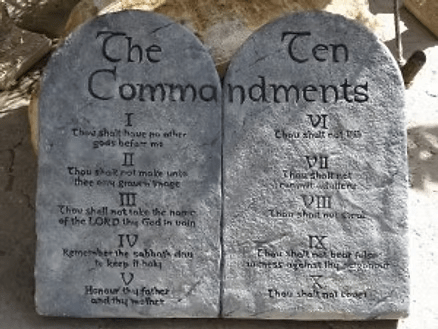
In actuality, the Hebrew word “eben” (which means “a stone”) is also found used in the Old Testament to denote both “cornerstones” and “gemstones.” In this regard, Strong’s lists the possibility of the specific gemstone, “lapis lazuli” (“blue stone”) as a translation of “eben.” This makes sense because a gemstone is a receptor of energy (and even granite with quartz and marble are similarly energy receptors), which makes tablets prepared by God reflect a greater value than simply as rock tablets. In addition, Exodus 24, prior to verse 12, tells of God giving the laws to Moses, which Moses wrote down, before making a blood sacrifice upon the altar, as a commitment by the Israelites to honor those laws. Therefore, going to the top of the mountain, as an ascension of the leader of the Israelites, was to receive a special gift of very deep powers. A stone like lapis luzuli then becomes a more apt image of this gift from God to Moses, for the people below him.

According to the website Crystal Vaults, and which prompts from a Google search of “lapis lazuli meaning,” one finds: “Lapis Laluzi is one of the most sought after stones in use since man’s history began. Its deep, celestial blue remains the symbol of royalty and honor, gods and power, spirit and vision. It is a universal symbol of wisdom and truth. … Its name comes from the Latin lapis, “stone,” and the Persian lazhuward, “blue.”’
Without any confirmation of God having presented Moses with tablets of precious stone, the website Healing Crystals for you says, “Lapis Lazuli stones resonate with the vibration of truth and enlightenment, and are powerful intense blue stones for opening the third eye and stimulating the pineal gland.”
That site goes on to state, “Lapis Lazuli is a useful stone to wear as it is said to relieve anger and negative thoughts, as well as easing frustrations causing the anger. They resonate with the energy of the inner king or queen, and are historically stones of royalty, and this crystal also helps to balance the male and female aspects of your personality.”
It is this value that is seen in crystal stones (which were also placed in the high priest of the tabernacle’s breastplate) that become an unseen power that surrounds a human being, just as God’s presence does the same. Still, such a gift does not manifest within and around one, until one has reached heights of spirit and has then remained in that state. Therefore, to see the “tablets of stone, with the law and the commandment, which [God had] written for [the priests of God’s] instruction,” can be read as two separate items – Stone symbols and the written Law.
Since God had already recited “the law and the commandments” to Moses, and since Moses and the people had already ritually sacrificed a bull to seal their covenant with the Lord, to now read that “God had written for their instruction” can mean both the words written by Moses (from God’s dictation) AND a less discernible form of “writing” that is contained within the esoteric properties of crystal stone.
In Exodus 31:18 one reads, “When [God] had finished speaking with [Moses] upon Mount Sinai, [God] gave Moses the two tablets of the testimony, tablets of stone, written by the finger of God,” one needs to understand a human’s need to use anthropomorphic descriptions for God. The “finger of God” would not mean a physical etching into stone by a cloud touching gemstone, as much as it would be a direction commanded by God. God figuratively pointed to the stone and caused its formation in the rock of Mount Sinai to have marks of significance in them. Naturally formed stones (supernaturally inscribed) might well have been produced long before Moses reached the top of Mt. Sinai, as an All-Knowing God would not wait for Moses to arrive to make tablets of stone. This means Moses might have had to break them free and rub them to a polished smoothness.
This means it could be possible that one simple mark (among many other simple marks) could have been found in the stone, which acted as a symbol for one law dictated to Moses that he had written. All marks equally applied to those laws written, with the origin of Hebraic script connected to those marks (a scholastic theory not of my origin). From pondering the stones, the deeper meanings of the law would then fill one’s mind, from the Holy Spirit. Such a projection would leave the stones with the capability of being like modern computer chips: able to store vast amounts of words in each stone given to Moses, rather than limit God to ten commandments and a promise to honor God as His priests.
To see this intent then makes it easy to see how God would tell Ezekiel, “And I will put my Spirit in you and move you to follow my decrees and be careful to keep my laws.” (Ezekiel 36:27) It shows how God told Jeremiah, “This is the covenant I will make with the people of Israel after that time,” declares the LORD. “I will put my law in their minds and write it on their hearts. I will be their God, and they will be my people.” (Jeremiah 31:33) It is also how Isaiah was told by God, “As for me, this is my covenant with them,” says the LORD. “My Spirit, who is on you, will not depart from you, and my words that I have put in your mouth will always be on your lips, on the lips of your children and on the lips of their descendants–from this time on and forever,” says the LORD.” (Isaiah 59:21) Because the “tablets of stone” were to be placed inside the Ark of the Covenant the intent was less to read the stones, and more to feel the spirit of the stones being among the people.
Such a view means that aspiring to great heights in service to the Lord AND remaining in that state of subservience will bring about the presence of the Holy Spirit as the reward for that service. That gift of understanding the laws will then be passed along to those who have yet to climb up the mountain to God and wait there. The Holy Spirit makes explaining that which is written “for their instruction” possible to be passed on … by Saints and Apostles, those empowered by God’s gifts.
In respect of God telling His prophets that understanding the laws will be written within the priests of YAHWEH, instead of in some external form where brevity would be demanded, the aspect of “stone” must be seen as the physical presence of the laws. Rather than some granite monument in the courtyard of a local courthouse, the “stones” that will become the source of those laws are indeed the priests themselves [Jesus telling Peter he would be the Rock of his Church, with “peter” meaning “stone”]. Living Stones inspired by the Holy Spirit. This makes the “tablets of stone” be the physical presence of God in his servants (via the Holy Spirit), which was the Covenant between God and the Israelites, spoken through Moses. Thus, “the law and the commandment, which I have written for their instruction,” was initially Moses, Aaron, Joshua, and Hur (et al), but would become every judge and prophet of Israel to later come, as well as Jesus Christ and all of his Apostles and Saints.
This means that one verse (Exodus 24:12), which seems so mundane and little more than a simple statement of Jewish history, is as deep and broad in meaning as is everything coming from the voice of God. This relates the power of the spiritual law, which then is contrasted with the remainder of the reading, which points to the common law of men arguing amongst themselves.
Prior to this reading, Exodus 24:9-10 states, “Then Moses went up with Aaron, Nadab and Abihu, and seventy of the elders of Israel, and they saw the God of Israel; and under His feet there appeared to be a pavement of sapphire, as clear as the sky itself.” Verse 11 then goes on to explain how none of them were stricken dead for having glimpsed God, with a celebratory feast taking place instead. The point of that says the elders and the named men were dedicated servants of God, meaning they would teach their tribe members to honor God and the Covenant. From the names mentioned: Nadab’s name means, “Willing, Volunteer, or Generous.” Abihu’s name means “Father is He.” Joshua’s name means “YAHWEH is Salvation.” Aaron’s name means “Bright” or “Very High.” Hur’s name means, “White” or “Splendor,” all are indicators of devotion, purity, and subservience.
When the translation says, “under His feet there appeared to be a pavement of sapphire, as clear as the sky itself,” the Hebrew words “kə-ma-‘ă-śêh liḇ-naṯ has-sap-pîr” can also state, “[was] a work of transparent lapis lazuli,” where the word “has-sap-pîr” seems to imply a blue sapphire. This then can also indicate (by translation options), “bones of heaven transparent,” more than “as clear of the sky itself.” The meaning of “bones” (which Bible Hub translates as “the essence”) is then an indication of the framework that represents the foundation upon which God stands (in heaven). Those “bones” represent the “body” that is God’s laws. When one is in touch with God, then the meanings of the laws become transparent and clearly understood.
The eating and drinking (“and they ate and drank” – Exodus 24:11b) is then no different than the sacraments consumed in celebration of having come in touch with God, through His Holy Spirit. Therefore, the judges left in the encampment below, after Moses and Joshua went up the mountain to meet God, were quite capable of fairly ruling in matters of dispute, based on their names reflecting the nature of their spirit. That was a reassuring message left by Moses, as he would be gone for an extended period of time.
Still, it should be seen that “legal matters” (the alternate translation of “disputes”) are only found on the low level of life, which are at the base of the mountain of God. Those “disputes” were based on the written law God had dictated to Moses, so sins could be identified; but identification of sins is only a first step, intended to elicit guilt and begging for pardon from God – the ultimate Judge. That self-judgment is more valuable than any profit gained from pointing out the sins of others.
When we then read, “Then Moses went up on the mountain, and the cloud covered the mountain. The glory of the Lord settled on Mount Sinai, and the cloud covered it for six days; on the seventh day he called to Moses out of the cloud.” The “cloud” is a “heavy mist,” as a fog around elevated ground. It should be easily recognizable how a “fog” or “cloud” is an indication of obscurity and nebulousness. A “cloud” points to conditions where clarity is sought. This cloud is then called “kə-ḇō-wḏ-Yah-weh,” meaning “glorious YAHWEH.” That means the confusion about the written law is “the glory of the LORD.” It is written from the mind of God, such that what seems simple and shallow is actually boundlessly deep and most meaningful.
The element of “six days” is then relative to the number of days that God created the world, so six days is symbolic of a week of work. For humans, the rise and fall of the sun six times means 144 hours applying the laws of God in a worldly existence. The “seventh day” is then the day YAHWEH made holy, when He made Adam holy, as the first priest to serve God on earth. Moses was called on the seventh day because he was made holy. Therefore, when we read, “[God] called to Moses out of the cloud,” this is no different that God speaking to Jesus when he was in the Jordan River, saying “You are my Son, whom I love; with you I am well pleased.” All who apply the laws of God daily are filled with the Holy Spirit and recognized as Sons and Daughters of God … those humans who please Him.
In the ancient world there were seen four basic elements: earth, water, air and fire. Every time there is a mention of something that fits one of these four elemental states, there is a deeper symbolic meaning to consider. When we read, “Now the appearance of the glory of the Lord was like a devouring fire on the top of the mountain in the sight of the people of Israel,” this makes a statement that sees “fire” as a burning and harmful element. That view of “fire” was at the base of the mountain, far away from a perspective of understanding. Remember how Moses first encountered the Lord when he saw a burning bush that was not consumed by the fire. This is the symbolic fire of inspiration.
Inspiration is dangerous because it causes people to act, often with a lack of experience or knowledge. Having acted and been burned means people fear the heat that comes from being inspired. However, Moses entered into this cloud of inspiration and remained there for forty days and forty nights. This is a statement that Moses was being filled with the knowledge of God, which is so obscure to lesser human beings. This was Moses receiving the Mind of Christ, only it became the Mind of Moses then, with both linking equally to the Godhead.
The forty days and forty nights is then the symbolic time one spends in the wilderness, learning to be tested by the Almighty. Numerologically (relative to the divinity of numbers), 40 is equal to a 4, as 4+0=4. The number 4 is relative to foundations. The day is when the light of the sun abounds. Likewise, night is when the light of the sun is absent from the earth. Thus, Moses spent time understanding the foundation of light, and an equal time understanding the foundation of darkness. That equates to a full understanding of right (light) and wrong (darkness), which is the purpose of laws.
***
2 Peter 1:16-21
We did not follow cleverly devised myths when we made known to you the power and coming of our Lord Jesus Christ, but we had been eyewitnesses of his majesty. For he received honor and glory from God the Father when that voice was conveyed to him by the Majestic Glory, saying, “This is my Son, my Beloved, with whom I am well pleased.” We ourselves heard this voice come from heaven, while we were with him on the holy mountain.
So we have the prophetic message more fully confirmed. You will do well to be attentive to this as to a lamp shining in a dark place, until the day dawns and the morning star rises in your hearts. First of all you must understand this, that no prophecy of scripture is a matter of one’s own interpretation, because no prophecy ever came by human will, but men and women moved by the Holy Spirit spoke from God.
———————————————————————————————————-
When Peter stated, “We did not follow cleverly devised myths when we made known to you the power and coming of our Lord Jesus Christ,” it must be understood that a “myth” is a tale from antiquity that can never be proved. Thus, Peter was saying that everything about Jesus Christ is the truth and not made up or memories passed along with embellishments. To avow that his story was “not cleverly devised” is to say that there is nothing about the story of Jesus Christ that will profit him or the other Apostles in a worldly manner. There were religious scam artists back then, which is a problem more so today. Churches with leaders who promote a “get rich with Jesus” agenda (available to all congregation members at a cost) are those that have been “cleverly devised.” Neither Peter nor his fellow Apostles and Saints had the latest, greatest clothes, cars, nor homes that projected to potential lambs just how well God had treated them, because of their ‘Jesus story’.

For Peter to say, “We had been eyewitnesses of his majesty,” this personal testimony would only be possible for one like Peter, who was a disciple of Jesus and aided him in his ministry. Because he was there with Jesus in the flesh, Peter and fellows were “eyewitnesses” to many of the miracles that Jesus performed in their presence. His use of “majesty” can also be read as “divine glory” and “divine greatness,” which is a term often applied to kingly rulers. The term is used to denote that presence of God within that leader, rather than to be a statement of landholdings or wealth. Thus, Jesus is referred to as Christ the King, because of his “majesty.”
Peter’s writing, “For he received honor and glory from God the Father when that voice was conveyed to him by the Majestic Glory, saying, “This is my Son, my Beloved, with whom I am well pleased,”’ this is a testimony about Jesus’ receipt of that divinity (via the Holy Spirit). Peter witnessed this divine glory with his own eyes and ears on Mount Hermon (along with James and John of Zebedee). Matthew wrote of hearing God say the same thing (Matthew 3:17), after Jesus was baptized by John the Baptist in the Jordan. Luke also recounted this voice of God saying the same thing (Luke 3:22). Peter was also present at that baptism of the Holy Spirit, but he might not have heard that voice of God then. It could have been like when Jesus foretold of his coming death, of which John wrote (John 12:28-30): “Father, glorify Your name.” Then a voice came out of heaven: “I have both glorified it, and will glorify it again.” So the crowd of people who stood by and heard it were saying that it had thundered; others were saying, “An angel has spoken to Him.” Jesus answered and said, “This voice has not come for My sake, but for your sakes.”
Those who hear the voice of God speaking are close to receiving the Holy Spirit. When Peter was on the “holy mountain” and God spoke after Peter’s eyes led him to see the bright white and ghostly images of Moses and Elijah with Jesus, God then commanded, “Listen to him!” Listening to Jesus means advancing to the point of receiving the Spirit, which brings one the Christ mind of understanding. Therefore, Peter wrote, “So we have the prophetic message more fully confirmed.” An Apostle, like Jesus, is able to confirm all that had been written in the holy books as coming directly from God to prophets. With the Christ mind comes full understanding.
This is then what led Peter to state, “You will do well to be attentive to this as to a lamp shining in a dark place, until the day dawns and the morning star rises in your hearts.” To know the text of the Torah, or to know the children’s Sunday school stories, leaves one in a dark place – as far as being able to defend one’s religious beliefs to one who doubts them. Even more dark is the constant influences to sin that overtake one who has not “fully confirmed” the meaning of God’s Word. A “lamp shining in a dark place” is the teaching of an Apostle, just as Peter learned from Jesus.
When “the day dawns and the morning star rises in your hearts,” then the disciple has received the Holy Spirit and the Christ mind, to become that lamp in the darkness for others. Further, the “morning star” is actually the planet Venus, which symbolizes love, beauty and aesthetics. Therefore, we should focus on the flame of truth until we are fully enlightened and the love of God fills our hearts.
This then led Peter to shine some light from the lamp that he was, saying “First of all you must understand this, that no prophecy of scripture is a matter of one’s own interpretation, because no prophecy ever came by human will, but men and women moved by the Holy Spirit spoke from God.” This says that those who bend the meaning of Scripture to meet the modern wants and desires (“one’s own interpretation”) will be wrong. This is what I call “the Big Brain Syndrome,” where scholars research and look for relics and historic documentation that proves the occurrence of a scene and storyline, while repeating the brainiac thoughts of those past as proper reason in discernment. No matter how profound their conclusions may be, if done alone – without the assistance of God’s mind – then “no prophecy ever came by human will.” This means the topics of abortion, death penalties, and human sexuality are most often passed off as “myth,” using Jesus as the reason their brains come to support sinful existence (which is ever present and cannot be justified simply because it has always existed).
The truth can only be known when “men and women moved by the Holy Spirit spoke from God.” That does not seek to justify personal views of the earthly realm and life amidst both beauty and sin. That only seeks to serve God as Christ reborn, which makes one a lamp in the darkness of a sinful world. An Apostle cannot remove the darkness and fill it with light alone. Only the Holy Spirit can do that.
***
Matthew 17:1-9
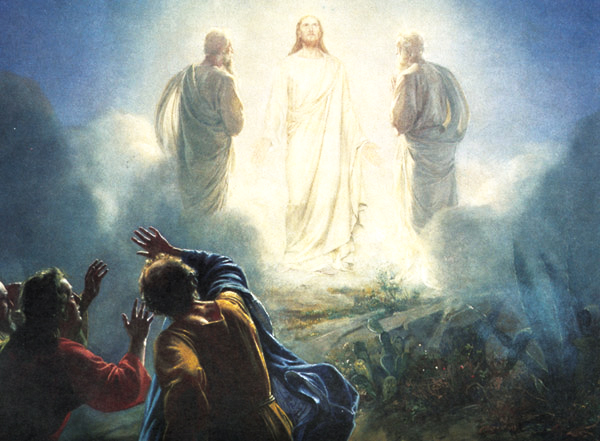
Six days later, Jesus took with him Peter and James and his brother John and led them up a high mountain, by themselves. And he was transfigured before them, and his face shone like the sun, and his clothes became dazzling white. Suddenly there appeared to them Moses and Elijah, talking with him. Then Peter said to Jesus, “Lord, it is good for us to be here; if you wish, I will make three dwellings here, one for you, one for Moses, and one for Elijah.” While he was still speaking, suddenly a bright cloud overshadowed them, and from the cloud a voice said, “This is my Son, the Beloved; with him I am well pleased; listen to him!” When the disciples heard this, they fell to the ground and were overcome by fear. But Jesus came and touched them, saying, “Get up and do not be afraid.” And when they looked up, they saw no one except Jesus himself alone.
As they were coming down the mountain, Jesus ordered them, “Tell no one about the vision until after the Son of Man has been raised from the dead.”
———————————————————————————————————-
From having read Exodus and Moses with Joshua working for six days in the cloud of God to reach the top of the mountain, we see the same number of days related to Jesus’ ascent on the holy (“high”) mountain. After six days Jesus was “transfigured before them.” This is the same as Moses being called by God into the cloud on the seventh day – the day recognized as holy. One can now make the assumption that Jesus was transfigured on a Sabbath, as was Moses. God does not do things haphazardly or by happenstance. Everything has purpose.
The Greek word “metamorphoó,” which is the root of the word written (“metemorphōthē”), means “to transform.” Strong’s adds this helpful analysis of the word: “3339 metamorphóō (from 3326 /metá, “change after being with” and 3445 /morphóō, “changing form in keeping with inner reality”) – properly, transformed after being with; transfigured.” [My highlights and underline.] This means that on the seventh day of the ascent upon the high mountain – after six days of effort – Jesus was in the cloud, with God. In that transformed condition, he reflected godliness: “his face shone like the sun, and his clothes became dazzling white.”
When we then read, “Suddenly there appeared to them Moses and Elijah, talking with him,” the point is a projection into heaven, where time on a linear plane dissolves. The soul that was within the body named Jesus (of Nazareth, born of a woman in Bethlehem) was the same soul as filled the bodies known as Moses and Elijah. This glimpse can only be seen when one realizes the holy thread throughout the books of the Holy Bible is souls reincarnated and those born of a holy line that loves God deeply and serves Him with all their souls.
When Christians believe the ‘three-in-one’ concept of Father-Son-Holy Spirit, one misses the Trinity of the Christ mind being in Moses-Elijah-Jesus. Each of those three figures was transfigured by the presence of God after being with Him, just as each was separately a ‘three-in-one’. Still, there can be no limit to how many human beings can become the Son, in whom God is very pleased, as all Apostles and Saints are likewise transformed by the Father’s extension of His Holy Spirit to a reborn Son. That resurrection always brings with it the Christ mind, as well as a brightly shining face and gleaming white clothes of purity.
When Matthew quoted God as what Peter said he had heard, the element of “Listen to him!” must be known to be a command from God to YOU. Because we cannot be an eyewitness to Jesus, as were Peter and Matthew, we can still listen to the voice of God, which was what Jesus was preaching. From the text of the holy scriptures God speaks to us through the words Jesus was remembered to have said. Too often we look to others to tell us what the meaning is; and if another is a Saint, they will guide up correctly. However, there are far more wolves in sheep’s clothing (bad shepherds) who will lead us the wrong way; and that is why we each are responsible to listening to our hearts, which will lead our brains. It takes practice hearing what physical ears miss.
We then read Matthew recount the reaction of the disciples after hearing God’s voice commanding them: “When the disciples heard this, they fell to the ground and were overcome by fear.” It is a scary thought to have – that we need to pay attention and hear, then act too. Our legs get rubbery when the idea is to learn, because you are expected to do this soon. We fall to the ground and cry like babies; but Jesus says, “Get up and do not be afraid.” Listen to that and believe you are not alone. Do not be afraid to serve God. That is why, after the disciples looked up, only Jesus was there. All the ghostly images and loud heavenly voices were gone. With the Christ mind, there will only be Jesus there with the devoted disciple, at all times and places, after one has seen and heard the divine.
When the group was leaving Mount Hermon to rejoin the others, Jesus told them to be silent about what they had experienced on the high mountain, until Jesus has died and been resurrected. While Jesus had spoken about his having to face death, the concept of being raised from the dead would have flown completely over the heads of any normal Jews (or Romans or Greeks, et al). Peter had rebuked Jesus for speaking of being punished to death, at which point Jesus said, “Satan, get behind me!” (Matthew 16:21-23) However, as the saying goes, “Seeing is believing.” Peter, James and his brother John saw Moses and Elijah raised from the dead, as real as Jesus. Still, without the Christ mind within them to fully understand their vision, Jesus was telling them to be silent until they had the wisdom of the Holy Spirit to speak about what they had seen.
***
#Exodus241218 #MosesElijahandJesus #TransfigurationofJesus #2Peter11621 #Matthew1719 #highholymountain #LastSundayofEpiphany




 Explaining the Readings