Since we are justified by faith, we have peace with God through our Lord Jesus Christ, through whom we have obtained access to this grace in which we stand; and we boast in our hope of sharing the glory of God. And not only that, but we also boast in our sufferings, knowing that suffering produces endurance, and endurance produces character, and character produces hope, and hope does not disappoint us, because God’s love has been poured into our hearts through the Holy Spirit that has been given to us.
——————–
This is the Epistle selection that will be read aloud on Trinity Sunday, Year C, according to the lectionary for the Episcopal Church. It will follow a reading from Proverbs 8, where Solomon wrote: “when he marked out the foundations of the earth, then I was beside him, like a master worker; and I was daily his delight, rejoicing before him always”. That will precede either a singing of Psalm 8 or Canticle 13. If Psalm 8 is chosen, then the words of David will be heard, which sing: “What is man that you should be mindful of him? the son of man that you should seek him out? You have made him but little lower than the angels; you adorn him with glory and honor”. If Canticle 13 is selected for singing, then we will hear sung, “Glory to you, Father, Son, and Holy Spirit; we will praise you and highly exalt you forever.” All will accompany the Gospel selection from John, where Jesus told his disciples, “All that the Father has is mine. For this reason I said that he will take what is mine and declare it to you.”
In the above NRSV translation, confusing words are found. Words like “justified,” “peace,” “grace” and “hope” are all nebulous and can mean different things to different people. The translation becomes so generalized that is sounds like a dream that can never be real or personally realized so the words are fully understood. I find this is due to the above translation being a paraphrase that focuses on making Paul seem like he was writing about some agenda that Jesus was the ‘cat’s meow’ for all to go along with. Such words become things nicely marked in a Bible or printed on cards, placed in one’s wallet or purse, to be pulled out and read for momentary comfort. These words, however, are well chosen for reading on Trinity Sunday because they speak of the divine possession that makes a soul be a personal witness to the Father, Son, and Spirit, where Spirit needs to be understood as synonymous with the word “Christ.” That is the Baptismal purification that must take place, before the Father and the Son can be enthroned within one’s soul.
Rather than simply read the beauty of the NRSV translation (and oooh and aaah like a schoolgirl), I have literally translated these five verses, using English terms that make the mind be opened to the reality of what Paul wrote. In his words, the Genitive case is used several times, where the possession that says “of” is regularly omitted from the translations read aloud in churches. Please reread these verses above and compare them to those translations below. To assist the reader, as to where the Genitive case should be seen, I have placed an underline to those words.
1. “Righteous us having been made therefore from out of of faith , wholeness we possess advantageous for this God , on account of of this of Lord of our souls of Jesus of Christ ,”
2. “on account of of whom kai this access we possess to this to faith into this kindness this within to whom we make a stand ; kai we boast on the basis of to expectation of this of honor of this of God .”
3. “Not alone now , on the other hand kai we boast within to these to persecutions , remembering that this tribulation , endurance brings out ;”
4. “this now steadfastness , tried ; this now approved character , expectation .”
5. “this now expectation not to bring to shame , becausethis love of God has been poured out within to these to inner selves of our souls because of of Spirit of Sacred , of this of having been placed to our souls .”
On Trinity Sunday, where the importance of this must be understood to be known personally, where divine possession makes a soul be a witness to this divine presence within, rather than to think one can see the spiritual with physical eyes or figure the spiritual out with a fleshy brain, the Genitive case is placing the foundation of divine possession in the words written by Paul. To discard them is to miss the truth that he told.
As to verse one, it begins with a capitalized “Dikaiōthentes,” which means it bears a divinely elevated meaning that must be examined closely. The NRSV over simplifies (incorrectly) this as “Since we are justified,” with the capitalization placed on “Since.” The form written states the Aorist Participle, such that it makes a statement of a past event in the present tense, where “having been” is a part of the translation into English. Then, the root verb (“dikaioó”) is the Nominative Masculine Plural, where the plural number applies to many Roman Christians (“us” or “we”), to whom Paul addressed with this word. The verb means, “to show to be righteous, declare righteous,” implying in usage “I make righteous, defend the cause of, plead for the righteousness (innocence) of, acquit, justify; hence: I regard as righteous.” (Strong’s) When all this is considered, the divinely elevated meaning of this word says, “Righteous us having been made,” where the divine elevation says this was not self-made or self-willed ‘good living.’ The source of “Righteousness” is Yahweh. This must be grasped firmly.
The Greek words “oun ek” translate as “therefore from out of,” with the same words also capable of being translated as saying, “then from.” In that regard, “ek” implies “from” as movement “from the interior outwards.” (Strong’s) This movement is then spiritual in nature (of Yahweh’s doing), therefore related to the souls of those to whom Paul wrote. This leads to the word “pisteōs,” which is the Genitive form of “pistis,” meaning “of faith” or “of faithfulness.” (Strong’s) Therefore, the initial purpose of Paul’s words address a state of divine “Righteousness” that all true Christians know, which has come from within outwards, such that the true source of “Righteousness” is personal knowledge within one’s soul, where the truth of “faith” is founded. Because “pisteōs” is in the Genitive form, the possession of Yahweh is what transforms “trust, belief, and confidence” (that which is outwardly motivated) into the true personal experience within one’s being. That makes “faith” become a knowledge “of Yahweh” [from His possession].
The second segment of verse one begins with the Greek word “eirēnēn,” which is routinely translated as “peace.” While “peace” is one of those words (like “grace, love” and “glory”) that demands a layperson enroll into some theological program that trains one in paragraphs of definition for those simple words, the truth of the meaning is this: The word means, “one, peace, quietness, rest,” implying in usage “peace, peace of mind; invocation of peace a common Jewish farewell, in the Hebraistic sense of the health (welfare) of an individual.” (Strong’s) HELPS Word-studies explains the proper meaning as: “wholeness, i.e. when all essential parts are joined together.” For as little as Christians know “peace,” they have a much better ability to grasp “wholeness,” especially when readings leading up to the Ordinary after Pentecost season point to the resurrection of Jesus’ soul within one’s soul being the definition of what “wholeness” is. Seeing that, that same presence is then the truth of “peace,” where “peace” is a statement of Jesus’ soul resurrected within one’s own soul (bringing “peace” within).
To confirm that meaning of “eirēnēn,” Paul next wrote the Greek words “pros ton Theon,” which translate into English as, “advantageous for” or “towards this God.” That says the “wholeness” that had been missing prior to “us having been made Righteous” was that which took a soul “towards this God.” This makes it an “advantage” for the unsaved soul, when it has become saved by coming “towards this God,” with “this God towards” one’s soul in return. The two had been separated, so the “advantage” for a soul comes from a return “towards this God.” In contrast, away from this God would be lives of sinners, not those “having been made Righteous.”
In the third segment of words in verse one, five of six words are written in the Genitive case, meaning Paul delved deeply into explaining the divine possession that is the source “of faith,” which brings a soul to a state of “wholeness.” Here, he wrote “dia,” which says, “through, on account of, or because of,” where HELPS Word-studies explains this word’s intent is to mean, “across (to the other side), back-and-forth to go all the way through, “successfully across” (“thoroughly”).” Thus, the reason (“because of”) one make it “advantageous for” one’s soul, as stated prior, is “on account of of this of Lord of our souls of Jesus of Christ.” That says “of this” (“tou”) is that stated prior – “made Righteous of faith” – now is “of Lord.” Here, the lower-case spelling of “kyriou” is a statement of a soul being its own ”lord” over its body of flesh (and soul); but the divine elevation “of Lord” means the presence of a Yahweh-sent soul of His Son, who comes “advantageously” for the feminine soul-wife to become its new “Lord.”
To ensure one knows the meaning “of Lord” is that, Paul then wrote “of our souls,” where the Greek word written is “hēmōn,” which is written in the first-person plural – matching the plural of “Dikaiōthentes” and “echomen.” The word typically translates as “of us,” but can equally say “of ourselves.” In that case, “ourselves” becomes a statement about “our souls,” as the only thing bringing life to flesh (a “self”) is its soul. More than being a “Lord” over one’s flesh, where arguments could ensue about the self-soul not liking the restrictions of a “Lord” soul, the “Lord” must have complete authority over both self-soul and its body of flesh. So, by it being in possession “of Lord of our souls,” the soul of Jesus is the “Master” in charge of “making one Righteous,” making one become “whole.”
Paul the named who this “of Lord” is, as it is being in the possession “of Jesus,” where one’s soul becomes Jesus reborn … in his name. That name is applied to the soul-flesh possessed, in a similar way that a soul takes on the name of the Husband – Yahweh – becoming one “Who Retains Yahweh (as one of His elohim)” [“Israel”]. To become “of Jesus” means one has become an Apostle reborn in that name. In order to become that – a possession “of Jesus” – one’s soul must also have become totally cleansed of all past sins. This is the marriage of a soul to Yahweh, which brings about the cleansed state “of Christ,” which is the possession of Yahweh, Baptized by His Spirit. To become “of Christ” means a soul is made into a Virgin womb (the feminine essence of a soul in the flesh), into which the soul “of Jesus” is implanted. Thus, the whole of verse one is Paul reminding his fellow Christians in Rome of their transformations into “Righteous” Apostles, made “of faith.” That transformation did not by Paul handing out instructions to believe, as being “of faith” means being “of personal experience.” That means each of their souls had been made “whole” by divine marriage to Yahweh (through His “Spirit”), making them possess “of Lord of their souls Jesus, of Christ.”
Following a comma at the end of verse one, verse two then repeats the Greek word “dia,” such that the “through, on account of, or because of” stated in verse two as “on account of of this of Lord of our souls of Jesus of Christ” is further stated in verse two. Here, the reason (“because of”) is relative to the “of whom” that are involved (from “hou” being the Genitive masculine singular form of “who, which, what, that”) in this divine possession. This focus is then stated to be important (from the word “kai” written) to denote the feminine gender usage of words saying “this access” or “this coming to,” which says the divine possession enters (or penetrates) the soul, not the other way around. It is then said to be “we are possessed to this to faith into.” Here, Paul is laying the groundwork for explaining “faith” is “brought to” one’s soul, such that it becomes “faith” once “into” one’s soul. This says “faith” is importantly a result of divine possession, meaning “beliefs” fall short of that personal experience.
Here, Paul wrote “this favor,” where he wrote the word “charin,” a word normally translated as “grace.” The feminine gender of “charin” says it is the soul that receives such a state, with the root word meaning “favor” and “kindness.” This must be seen as a gift that “comes into” a soul, resulting in “faith.” Paul then wrote, “this within to whom we make a stand.” In this, the Greek word “hestēkamen” is another in the series of first-person plural verbs, where Paul says all true Christians are made to “stand firm” or be “steadfast” in their “faith.” The positioning of “standing” is opposed to lying down, which mimics sleep; and sleep is metaphor for death. By saying “we make a stand,” Paul said “we have been raised from the dead.” By seeing this presence as a “favor” “brought into” them, there is nothing that can ever weaken that “faith brought.” The “kindness” bestowed to a soul is knowing Yahweh’s Spirit personally; and, that allows one to know Salvation of a soul means defeating death.
Following a semi-colon that divides verse two into two separate statements, Paul again wrote a “kai” which introduces this second relative statement as being important to grasp. The first word following that marker word is another in the first-person plural, which now places focus on “boasting.” Paul then said, “we boast on the basis of to expectation.” In that, the Greek word “elpidi” is written, which is normally translated [in the Dative] as “to hope.” Because “hope” is another of those vague terms that people often misunderstand, to see the truth be expressed as “to expectation,” this takes away the weakness of “to hope” and lays this importance on the realization that divine possession is not some ‘iffy’ sense of being, but instead a fixed set of “expectations” that one knowingly faces, when divinely possessed.
The ”expectation” that comes “to” one’s soul is then stated to be “of this of honor of this of God.” Here, again, the Genitive case points out the possession involved, where one’s soul-body is given the ‘expectation” that divine possession means a state “of honor” has come. In that, the Greek word “doxēs” is written, which ordinarily would be translated (properly) as stating “of glory.” Once again, such a word brings a sense of nebulosity that is difficult for laypeople to define. I have posted in prior commentaries that the truth of “glory” is the love of Yahweh that fills the soul of Jesus. One cannot possibly begin to define that love of Yahweh; but one can experience that love as the “glory” of divine possession. As such, the word also means “renown,” which means one takes on “the name of Jesus,” above and beyond one’s own name. The word also means “honor,” such that it is easier to grasp the importance of maintaining the “honor” bestowed upon a soul, by the presence within “of Jesus.” This is the truth “of glory.”
When Paul then finished verse two by saying “of honor” was “of this of God,” that says Adam-Jesus is His Son, who was made by His hands. That “Yahweh elohim” made in Genesis 2 was made for the purpose of being sent onto the earth plane as the first Apostle in the name of Yahweh. The purpose was to save lost souls, so the name told to Mary by the angel Gabriel said, His name will be “Jesus.” That “renown” says “Yahweh Saves.” Thus, this coming “of glory of God” is His Son, in whom the love of Yahweh is permanently affixed.
Verse three follows a period mark that ends verse two, beginning with the capitalized Greek word “Ou,” which means “Not.” This negative word is divinely elevated to the spiritual level, so when the words that follow it say, “alone now,” this highlights “alone” as a soul by itself in a body of flesh. That is “Not” the makeup of an Apostle. The soul is possessed by this “of glory [Jesus] of God [Yahweh], so a Trinity exists along with the host soul, which is “No longer alone now.”
Following a comma mark of separation, the next segment make a one-word statement that often is translated as “but,” from the Greek “alla.” Because “but” has no meaning as a one-word statement, the word is found to also mean, “on the other hand,” which indicates multiplicity (of hands), which becomes “the other” that possesses a lone soul. This is then followed by the word “kai,” which says it is important to place focus on the Greek verb (once more) that is stated in the first-person plural, meaning “we boast.“ This is the multiple Christians of Rome that Paul addressed, repeating his prior usage (in verse two), where Paul also importantly introduced “we boast on the basis of to expectation of this of honor of this of God.” Now, Paul importantly adds: “we boast within these persecutions.”
When Paul was named Saul, he persecuted those Jews who claimed to do feats in the name of Jesus of Christ, without understanding what that meant. As Paul, he regularly faced persecutions; and, the true Christians of Rome were persecuted just like was Paul. [See in the history book where it talks about Christians being fed to the lions in the arena.] The importance says “we are able to hold our heads up high within these persecutions [or “tribulations”], because their souls are “Not alone,” but “on the other hand” they had the strength of Jesus reborn within each of their souls.
Following a comma mark of separation, the next segment says, “we are knowing that this affliction [of “persecution” or “tribulation”] , steadfastness produces”. This says that the presence of Jesus within gives a soul the strength to “endure” all pains and sufferings that come because one has been transformed into Jesus in a new body of flesh. This says that “perseverance” is “produced,” which means anyone who says “Jesus died on the cross for your sins; so, you don’t have to suffer” is full of complete ignorance. Paul set forth the “expectation of faith” that being made “Righteous” – as Jesus reborn – means Jesus will be persecuted to death countless times over again, involving many different bodies of flesh in which his soul is resurrected. Every Christian killed in Roman arenas, for the delight of Roman entertainment, was Jesus killed all over again. When a soul has a soul that has ‘been there, done that’ to count on for strength, then all punishments short of death are just ‘practice runs.’
Paul then followed a semi-colon at the end of verse three to change to a new direction in verse four, while remaining on the theme of “persecution.” There, Paul wrote, “this now perseverance , character ; this now character ; expectation”. In this, Paul referred to the “steadfastness” that comes from “perseverance.” Each event of “persecution” is a test, just like a school class regularly tests the students for what they have learned. The test that are not the final exams are what build the truth of one’s “character.” The Greek word translated as “character” is “dokimé,” which means “(the process or result of) trial, proving, approval,” implying in usage “trial, proof; tried, approved character.” (Strong’s) Once one has been “tested,” one knows what “to expect,” therefore one’s “faith” is “tested” regularly; and, that becomes the “expectation.” To get a passing grade (an “approved character”), then one must be “tested” or ‘thrown into the fire,’ so one’s metal is proved.
Again, the typical translation of “elpis” is as “hope.” The word “hope” is too weak to be “tested.” The link of “hope” can only be to “belief.” When one “believes” in a school and one “believes” in “tests,” that is because one has seen such external to oneself, while not actually being a student enrolled in a school. To suddenly be cast into an educational setting, when one is not prepared to do the work that is necessary (to be “tested”), then it does not matter how much “belief” in “tests” one has, or how much “hope” one has of not failing. To “hope” for miracles, without doing any work, is useless. Thus, James wrote, “Faith without works is dead” [where “dead” is about the missing Trinity of salvation, ensuring “death” will come]. When one is in over one’s head (a soul alone with a Big Brain), then “hopes” will be dashed; and, when that happens, “beliefs” are shattered. Therefore, “faith” is the personal experience of readiness, where “testing” is the “expectation;” and, when that is the “expectation,” then the “character” will respond to the demands of the “persecution” and succeed (with help, “knowing one is Not alone”).
Following a period mark at the end of verse four, Paul then began verse five by advancing this notion that separates “belief” from “faith.” His first segment says, “this now expectation not we bring to shame”. In that, rather than the first-person plural, Paul wrote “kataischynei” in the third-person singular, where each individual knew the personal “expectation” that he or she (collectively a “we” as those true Christians) “not to bring shame.” This is “not” about “shame” to the Trinity possessing everyone individually, but “shame” on self, which is the state of being that is sinful, including full of doubts. When the word “elpis” is translated as “hope,” rather than “expectation,” then the “not” (“ou”) becomes linked to “hope,” where a lack of “faith” (wishful thinking only) will always lead to a state of “shame.” It is Paul writing that “beliefs” leading to “hope” are useless, as “shame” becomes one’s way of life. Only when one has the personal experience within can the collective know that “not we bring to shame” our souls.
In the next segment, Paul identified that the soul of Jesus is why “not we bring to shame.” He was created by Yahweh for the purpose of saving souls. In that creation, His personal touch passed into flesh (immortal hero-like when made) the love of Yahweh into the “Yahweh elohim” that became the soul of Adam-Jesus. Whenever that soul has been resurrected within a previously lost soul, Paul wrote: “because this love of God has been poured out within these inner selves of our souls through Spirit Holy”. This explains how one’s previously lost soul – which knows nothing but “shame brought upon self” – will “not” repeat that misery, “because” of Yahweh’s “love” having been “poured out within each soul”. This is the divine marriage of a soul to Yahweh, with His “Spirit” being a soul’s Baptism that removes all past “shames.” The “inner selves” or “hearts” (from “kardias”) connect to the Greek word “hēmōn” (again), where the Genitive case, first-person possessive pronoun normally translates simply as “us” or “we.” However, as I explained before, the word also means “ourselves,” where “selves” relates to “souls,” meaning “we” or “us” is a statement of the life that animates dead flesh; and, that is what truly is one’s “inner self” or “heart.”
The ”outpouring of love” must be seen as the necessary connection from which all marriages are formed. Without “love” for Yahweh – shown by acts of submission to His Will and efforts to maintain the oil in one’s lamp that leads one’s life lawfully (willing self not to sin, because of knowing the Law) . Without one’s love poured out to Yahweh, there will be no “outpouring of His love” in return, when the time for divine the marriage should take place. The “outpouring” from Yahweh is first the “Spirit” that Baptizes a soul, removing all past “shames.” That prepares a new wife-soul to be penetrated ‘on the wedding night’ with the seed of Yahweh’s true “love,” which is His Son. This is a love of God that cannot be compared to any physically led emotions. Being purely Spiritual, this becomes the difference between “belief” and “faith.” The “love of God” is too deep to explain in words, to fully teach others what that “expectation” is like. It must be experienced. It must come from the divine union of a soul with “God, Spirit, and Son” – the Trinity of “God’s love” in one’s soul.
The two words ending the second segment are both capitalized: “Pneumatos Hagiou.” It is wrong to read that as one word, as “Holy Spirit.” The Genitive case shows both equally as possessing a soul, such that “of Spirit” means the marriage of a soul to Yahweh. It is His “Spirit” that is outpoured in divine Baptism. The capitalization of each word means they are each divinely elevated in meaning, as from Yahweh … individually and separately. The purpose of Yahweh’s Baptism (which must come first) is to make a soul become “Holy” or “Sacred” or “Set apart by God.” It is not the “Spirit” that is “Holy,” as that becomes a lowly imbecile (soul-flesh peon) judging Yahweh, when its nose should always be touching the ground, in submission to Yahweh, knowing it is too lowly to look up and show its face. “Hagiou” is a statement about one’s soul having been forever changed. It is the return to a pure state of existence, as when one was breathed as life into dead matter (at birth), so one can return to Yahweh in the same state one was in when one departed Yahweh. It is in this “Saintly” state of being that Yahweh has prepared one’s soul-flesh to be reborn as His Son, who will walk in new bodies of flesh as the “Saint” he was made to be. Thus, the truth of the Trinity is it is the threesome, Father, Son and Spirit, with the fourth being the soul-body that has been transformed into a “Saint.”
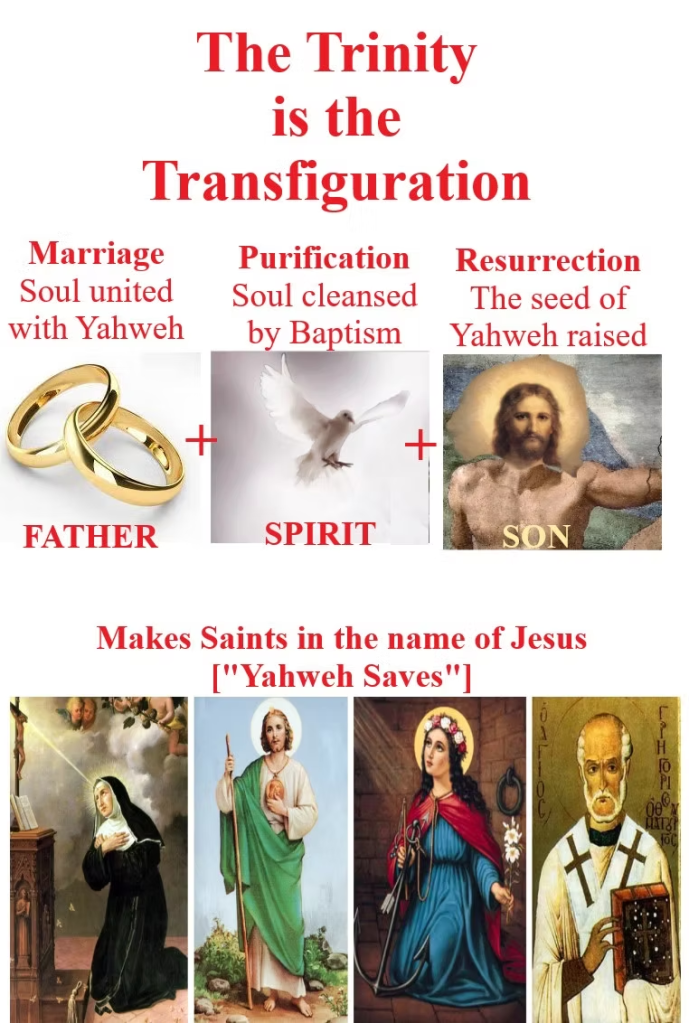
Paul then ended verse five by writing, “of this of having been placed to our souls.” Here, the Genitive case states (as that stated prior) there being a divine possession of one’s soul-body. The word “of this” (“tou”) refers back to “love of God” entering a soul “through of Spirit of Sacred”. When the Greek word “dothentos” is seen as the singular, becoming a statement of each individual soul of the ‘Christian’ collective (“we” or “us”), the word’s meaning as “to give,” is better read as the implication in usage of “I offer, put, place.” Each soul has not been “given” the right to be deemed “Set apart by God,” but all have been “offered” that opportunity, because Yahweh has sent His “Saint Spirit” into the world, so His Son can teach seekers the truth of Salvation. That “offering” must then be acted upon. Knowing there exist schools in the world does nothing for one’s education, if one does not enroll in a school, for the purpose of becoming educated. Thus, the registration requirements say one must first apply to Yahweh. Once one has been accepted, then He will “place” His Trinity into one’s soul; so, the end result will always be His Son Jesus reborn into ministry in the material realm.
As an Epistle selection to be read aloud on Trinity Sunday, which is the first Sunday after Pentecost, signaling when priests of Yahweh are sent out into ministry as His Son reborn, that cannot happen without a soul-body having had “placed” the Trinity of Father, Sun, Spirit, making one be a Saint, Set apart by God. Paul wrote to the true Christians of Rome, knowing they were ALL exactly in the same state of Salvation as he was. Going out into ministry is hard work. That is why so many who call themselves ‘Christians’ laze about in pews for a lifetime, rarely doing anything to show a love of Yahweh [a name they do not know]. Instead, they wallow in the idolatry [a shameful existence] that loves a church building, a church denomination, or the priests therein – all for the wrong reasons. None of that will ever save one soul. Only the Trinity brings Salvation of a soul; so, sitting in the same pew for ninety years – having done none of the works of a Saint – means getting this wasted life over with, so you can receive your failing grade (or less than passing) in Judgment and return in new baby flesh, to start all over again. Hopefully, one will find a true priest of Yahweh to lead you to do the acts of faith, rather than the works of shame.
 Explaining the Readings