The Gospel reading for October 2, 2016 (Twentieth Sunday after Pentecost, Proper 22) was from Luke (17:5-10). The reading stated:
“The apostles said to the Lord, “Increase our faith!” The Lord replied, “If you had faith the size of a mustard seed, you could say to this mulberry tree, `Be uprooted and planted in the sea,’ and it would obey you.
“Who among you would say to your slave who has just come in from plowing or tending sheep in the field, `Come here at once and take your place at the table’? Would you not rather say to him, `Prepare supper for me, put on your apron and serve me while I eat and drink; later you may eat and drink’? Do you thank the slave for doing what was commanded? So you also, when you have done all that you were ordered to do, say, `We are worthless slaves; we have done only what we ought to have done!’”
While many people hear or read the words “mustard seed” and think in terms of itty-bitty small, they confuse this reading with Matthew 13:33. There, Jesus was quoted as saying, “Though it [a mustard seed] is the smallest of all seeds, yet when it grows, it is the largest of garden plants and becomes a tree, so that the birds come and perch in its branches.” The mistaken thought comes from applying that growth of a physical seed into a large tree, as if Jesus implied that in the reading from Luke. Therefore, when people hear or read this reference to a mustard seed by Luke, people imagine a seed that needs to grow, in order to fulfill the statement, “You could say to this mulberry tree, `Be uprooted and planted in the sea,’ and it would obey you.”
That is wrong to think.
One cannot go to the garden store and buy a bag of faith seeds. In Luke’s verses, Jesus was stating that faith cannot be grown or increased in size. The use of mustard seeds is metaphoric, such that the reference is to say, “If you had but one iota of faith, you could work miracles.”
The disciples had told Jesus, “Increase our faith!”, which must be seen as a braggart saying, “I have faith, but I want more!” Jesus replied, in essence, “You have no faith. Not even one iota. Not even the amount that would match the minuscule size of a mustard seed.”
When Jesus said, “If you had faith the size of a mustard seed, you could say to this mulberry tree, `Be uprooted and planted in the sea,’ and it would obey you.’” then remember when Jesus saw a fig tree that did not produce fruit. Jesus said to the tree, “May you never bear fruit again!” (Matthew 21:19b) He was also remember to have said, “May no one ever eat fruit from you again,” by Mark’s Gospel (Mark 11:14b). Immediately, the tree withered before the disciples, prompting them to ask, “How did the fig tree wither so quickly?” (Matthew 21:20b)
Matthew then wrote, “Jesus replied, “Truly I tell you, if you have faith and do not doubt, not only can you do what was done to the fig tree, but also you can say to this mountain, ‘Go, throw yourself into the sea,’ and it will be done.’” That is the same thing as Jesus saying, “If you had faith the size of a mustard seed, you could say to this mulberry tree, `Be uprooted and planted in the sea,’ and it would obey you.” Therefore, “faith the size of a mustard seed” is equal to “faith without doubt.”
The disciples who followed Jesus had doubts, thus they had no true faith. All Jews who believed in the Law of Moses had doubts, because they sinned. Because the Jews had produced the fruit of maintaining an education system for religious principles, they were not ordered, “May no one ever eat fruit from you again,” such that Judaism would wither and die. Still, they had no real faith, simply from memorizing what they were told to memorize. Therefore, when Peter jumped out of the boat and attempted to walk on water, because he saw Jesus walking on water, he sank because he doubted, prompting Jesus to say, “Oh you of little faith, why did you doubt?” (Matthew 14:31b)
Jesus told his disciples, “You of little faith, why are you talking among yourselves about having no bread?” (Matthew 16:6) He further said to them, “You of little faith, why are you so afraid?” (Matthew 8:26) when they were on the Sea of Galilee and a storm came up, threatening to sink them. The point is clear: Jesus was one who did have a mustard seed’s worth of faith, such that he had faith in God with no doubt and no fear. The disciples, who called themselves the followers of Jesus – his disciples – they had zero faith, because they still doubted and feared, regardless of how many rules they followed.
As Christians today, we are no better than the disciples were then. We follow Jesus because we feel safe with him around. We think it will make Jesus happy if we do a few things that make it seem as if we have faith, to the point that we think we actually have faith. But, then we feel bad because we cannot heal the sick or cast out demons, so we demand of Jesus, “Increase our faith!”
We fail to see how Jesus did “Jesus-type” things when he only needed a mustard seed size amount of faith in God to do them. In actuality, faith with no doubt in God means a human with a soul is all God needs for God to work miracles through one of faith. If Jesus had demanded that God increase his faith, Jesus would have asked to be God. To ask to be God is to admit one is full of doubt and fear. To simply have faith, as small as one iota, that is all one needs to be God, as a servant through whom God works.
This is then the purpose of the story Jesus told the disciples, about a master and a slave. Jesus asked who among the disciples would treat a slave as an equal, if they were the slave’s master. A slave can never aspire to anything more than to meet a master’s expectations. Therefore, the disciples had asked Jesus to make them the equal of God, their master, when they were unworthy of taking a seat at that table of privilege. Jesus said, “When you have done all that you were ordered to do, say, `We are worthless slaves; we have done only what we ought to have done!’” That is an admission of service to God, which is true faith.
By understanding that seeking more faith is an admission of no faith, telling those whose faith is full of doubts and fears, “If you only have a mustard seed’s worth of faith, then planting it in good soil will make that faith grow as big as a tree that birds and squirrels can find a home in” is misleading. It leads those of “little faith” away from gaining “one iota of true faith.” To serve God as an Apostle, whose mind is led by Christ – full of faith without doubt – then the message should be to tell people to gain the fundamentals from which true faith comes.
The Greek word for “faith” is “pistis.” The word stems from “peithô” meaning, “persuade, be persuaded,” with “pistis” properly meaning, “persuasion (be persuaded, come to trust); faith.” One does not have faith in anything without knowledge of that thing first taught to one. Thus, knowledge of God is what faith in God comes from.
The knowledge of God the Jews had was the Law of Moses, the psalms of praise, and the warnings of the prophets. Still, that knowledge had brought forth only a few who had true faith (those who are referenced in the books we read in the Old Testament). Jesus was sent by God to make that prior knowledge reach maturity and fulfillment, so the stories of Jesus would elicit more who would come forth and have true faith. However, no one gets to sit at the table with the master as a reward for being a slave on earth, as Jesus was sent to show the world how to become a slave for God. All reward comes from attaining heaven, which is why the Kingdom of Jesus was never meant to be of this world; and we are asked to be reborn as Jesus the slave to God.
If you are a slave to God, then you spend 24/7 in contact with the Lord. You read Scripture and ponder its meaning daily, through prayer. You hear the whispers of Jesus telling you the answers you need for the enrichment of faith, as your mustard seed’s amount of faith that makes you Jesus reborn. You then go out and plow the fields and tend the sheep, by letting that awareness given to you be known by others seeking to find faith. Then, when that work is done, you prepare a meal for the Lord, which is the bread of your body and the wine of your blood, as a duplication of Jesus Christ. When God has been fed by your servitude, then you may find your needs met – salvation.
At no time are you able to maintain that iota of faith, if you go asking, “Please, sir, may I have some more?” That is when there are too many chiefs and not enough Indians.
Moses said to the Lord, “See, you have said to me, ‘Bring up this people’; but you have not let me know whom you will send with me. Yet you have said, ‘I know you by name, and you have also found favor in my sight.’ Now if I have found favor in your sight, show me your ways, so that I may know you and find favor in your sight. Consider too that this nation is your people.” He said, “My presence will go with you, and I will give you rest.” And he said to him, “If your presence will not go, do not carry us up from here. For how shall it be known that I have found favor in your sight, I and your people, unless you go with us? In this way, we shall be distinct, I and your people, from every people on the face of the earth.”
The Lord said to Moses, “I will do the very thing that you have asked; for you have found favor in my sight, and I know you by name.” Moses said, “Show me your glory, I pray.” And he said, “I will make all my goodness pass before you, and will proclaim before you the name, ‘The Lord’; and I will be gracious to whom I will be gracious, and will show mercy on whom I will show mercy. But,” he said, “you cannot see my face; for no one shall see me and live.” And the Lord continued, “See, there is a place by me where you shall stand on the rock; and while my glory passes by I will put you in a cleft of the rock, and I will cover you with my hand until I have passed by; then I will take away my hand, and you shall see my back; but my face shall not be seen.”
———————————————————————————————————-
This is the Old Testament selection from the Episcopal Lectionary for Year A, Proper 24, the twentieth Sunday after Pentecost. It will next be read aloud in church on Sunday, October 22, 2017. It is important as God tells Moses His presence will go with Moses, with Moses able to be shown the way of the LORD to God’s chosen people. The glory of the LORD will rest on Moses.
This reading continues the dream sequence that Exodus 31 presented, about the golden calf. In between that dream and this selection are other elements that are best seen as prophecy. We find that YHWH directed Moses to record a second version of the Covenant, after getting so angry he smashed the first tablets of stone, which can then be seen as prophesying the coming of Jesus and the New Covenant. Rather than the stone tablets being broken in anger by Moses, it was the Israelites (over a millennia) who broke the Law and lost their lands. The second story is then pertinent to the second phase of the agreement to abide by the Law, while the Jews were in Babylon.
I am fed up with you people continually dragging my name through the mud for centuries.
I recommend every Christian re-read Exodus and Deuteronomy, paying close attention to the stories told that are repeated, but told differently. Simply be aware of the possibility that the differences are due to a prophetic dream being the purpose, which would later be fulfilled, well into the future from then. See the purpose of two versions of the tablet story and the agreements made, and the other duplicate stories that complete Exodus (and repeat in Deuteronomy), as God looking to see who pauses and begins to look deeper, looking for truth, rather than excuse to disbelieve.
In regards to this reading, the text above suffers greatly from the Hebrew text. The reality of the Hebrew exposes more insight into the dream powers that Moses possessed. This makes the prophecy of Joel worth remembering, when he prophesied as the voice of God:
“And afterward, I will pour out my Spirit on all people. Your sons and daughters will prophesy, your old men will dream dreams, your young men will see visions.” (Joel 2:28)
One needs to see Moses as an “old man,” since he was neither young nor a child when on Mount Horeb. We regularly read of Moses going to have a talk with God; but the question now becomes, “Just how did Moses have those conversations?”
In the Tent of Meeting? “Your old men shall dream dreams.” Joel 2:28
That prophecy written by Joel, which Peter quoted to the pilgrims in Jerusalem on Pentecost, was fulfilled on that Pentecost morning; but it was not the only fulfillment. Prophecy by the pouring out of Spirit is repeatedly seen fulfilled every time God’s Spirit comes upon men of God. Moses was one of those men who spoke to YHWH in a dream state. Samuel answered the call of God as a child when asleep. Joseph interpreted the dreams of Pharaoh, and Daniel did the same for Nebuchadnezzar. Therefore, the tent of meeting might well have been the place where Moses went to find solitude (outside the camp of Israelites), so that there he could drift into a prophetic dream state.
To grasp this Exodus 33 reading, I recommend the readers here visit this Interlinear page on BibleHub.com. It shows the Hebrew text for all of Exodus 33, so scroll down to verse 12; and the remainder of the page is this reading. The page lists the Hebrew root word and an English translation. The written words have links to a page that offers examples of other uses and their translations, with the root word (above the actual text word) having a link to a page that details the root meaning and translations, based on their possible usage. The English translation is then literal, as it maintains the order of the written text. Reading literally is a great way to realize the Hebrew text before it becomes mutated in English translation.
When the literal is compared to the English translation that will be read in churches (the New International Version), it is eye-opening how much meaning is lost. Seeing the words that were actually written, thus representative of the language of the LORD, means one is freed (somewhat) of translations that act as paraphrases of what God told a prophet to write. Looking at the root language is a good beginning, from which God will see an effort made to learn. Understanding the words of Scripture (at all times) requires the Holy Spirit’s assistance, so one can be fluent in that holy tongue.
The word count for the selected reading is 319 words. Beginning where the first verse says, “See,” the focus is strongly placed on vision. We have “my sight,” “your sight,” “show me,” “show mercy,” and “see” written multiple (14) times. Additionally, we find “the face” and “my face” three more times, with “face” an omitted part (in English translation) of the First Commandment, and the “face” is where the eyes are located. This is not coincidence, as this reading (entitled “Moses and the Glory of God” on some translation sites) is about Moses seeing, in a special way, as one filled with God’s Holy Spirit. Therefore, everything is metaphor for being led by the Mind of Christ.
Yahweh: “Samuel!” All like Samuel: “Here I am!”
Here are some notes I made, from looking at the Hebrew translated into literal English translations. If you open a separate window by clicking the link to BibleHub.com, you can see what I am taking notes from, as well as check the links to word meanings.
“See” = “rə·’êh” = “Vision, View, Understanding.” The meaning is to have access to visions of prophecy and hearing what YHWH wants a prophet to “See.”
“Bring up” = “ha·‘al” = “Ascend, Raise.” This indicates that it was Moses’ role, as the leader of the Israelites and who was in touch with YHWH, to elevate the Israelites Spiritually. That helps explain 40 years in the wilderness – they were slow learners?
“you have not let me know whom you will send with me.” This means that Moses has not yet seen (through dream insight) what powers of elevation God will send to him, which can then be passed on to the Israelite followers.
“I may know you by name” = “yə·ḏa‘·tî·ḵā bə·šêm” = “I know you by name.” By Moses having the presence of YHWH, he knows what YHWH knows, as if Moses were YHWH. This does not mean God knew Moses was named Moses. It means a union of God and Moses, so Moses can know what needs to be known “in the name” of God.
“in My sight” = “bə·‘ê·nāy” = “in My eyes.” God has shown favor to Moses, where “favor” means with God’s blessing. Moses was “accepted” [translation possibility for “favor”] by God, known by His showing Moses visions to guide him. The word for “favor” (“ḥên”) also means “grace.”
“Consider” = “ū·rə·’êh” = same as “See” [see above – “rə·’êh”]. Moses was shown that the Israelites (“‘am·me·ḵā” – “your people”) are a “nation” or “community of people.” They too are to be “this,” or the “same,” as was Moses … able to “See.”
“My presence” = “pā·nāy” = “My face.” This means that Moses will wear the face of YHWH, as the presence of God within him.
“I will give rest” = “wa·hă·ni·ḥō·ṯî”. “I will give calm or rest” means God will allow Moses to have daydreams and night dreams of prophecy and guidance.
“If your presence will not go, do not carry us up from here.” This means that without the presence of YHWH on Moses, the Israelites will not be raised or elevated. They cannot progress as servants of the LORD without that spiritual elevation.
“For how shall it” = “ū·ḇam·meh” = “Wherein” or “How many?” This asks the question “How many will know the grace of God’s Sight, [besides] I [Moses] and your people [the Israelites].” The question then applies to all who will be allowed the Sight of YHWH. If they ever become separated from that presence [face of YHWH], then they will go nowhere, nor will anyone else in the world. The “face of the world” will not be that of God, if the Israelites and Moses are separated from the “face of God.” Separated mean wearing “the face of the world.” This is a statement of importance placed on Moses and the Israelites. It is a prophecy that the world is that which needs to be saved by “the people” (of God), so they must not be separated from that service to the LORD.
“show me your glory” = “har·’ê·nî nā , ’êṯ kə·ḇō·ḏe·ḵā” = “show me now” or “show me I beg, pray, saying please” [pause of separation comma implied] “your abundance, riches, honor, glory” This says Moses asked God to give him the gifts of the Holy Spirit, so he could See for the LORD, recognizing that “glory” was not his own, but that only of God.
“I will make all my goodness pass before you” = “’ă·nî ’a·‘ă·ḇîr kāl- ṭū·ḇî ‘al- pā·ne·ḵā” = “I will pass over all My goodness over your face.” This says Moses was to shine with the face of the LORD upon him.
“and will proclaim before you the name, ‘The Lord’” = “I will proclaim the name of Yahweh on your face [which projects before your head].” This says the people will know Moses has the face of the LORD, because of the glow on his face.”
“and I will be gracious to whom I will be gracious, and will show mercy on whom I will show mercy.” = “and will show blessing to whom I favor, and will show compassion to whom I am compassionate.” This means God’s face will shine upon only those who, like Moses, are compassionate for the LORD [compassionate means, “from suffering,” meaning drawn to the LORD through suffering AND willing to suffer to serve the LORD].
“you cannot see my face” = “lō tū·ḵal lir·’ō·wṯ pā·nāy” = “not are you able to See my face [upon your face].” This means one with the Holy Spirit upon him or her will See what the LORD allows to be seen, but will still look like the human being they are [look like themselves].
“for no one shall see me and live” = “for not can See me [“hā·’ā·ḏām , wā·ḥay”] man , and be alive [live].” This means to know the image of God is impossible for human bodies of flesh, as YHWH is unfathomable to such little brains. Only through death, when the soul is released from the narrowmindedness of a physical brain, can the soul See God as He is.
“See, there is a place by me where you shall stand on the rock” = “the LORD behold! , wherever [a space, any physical place] near me , a pillar over of strength [or a cliff, a rock].” This says that wherever one Sees through the face of God, that person will stand like a pillar of strength for others.
“while my glory passes by I will put you in a cleft of the rock” = “And it will come to pass over , the pass over of my favor [glory] , and you will be set [or placed, or granted] in a cleft [or fissure, or cavern] of my strength [that rock].” This means that one filled with the Holy Spirit of God is within an encasement of the LORD’s covering.
“I will cover you with my hand until I have passed by” = “I will cover you with my power [or my branches] , will cover through the pass over.” This means the powers of the Holy Spirit, and all talents given by the LORD, surround the one wearing the face of God, for as long as God’s presence is within one.
“then I will take away my hand, and you shall see my back” = “And will turn aside with my power [my branches] , and you shall Know my back side [or hind part].” This means that the result of God’s power will be all that is Seen, as none of the power will be explainable. This is how Jesus routinely said, “Go. Your faith has healed you.” He did nothing that could be Seen, but the result (“the back side”) was the power of the LORD.
“but my face shall not be seen.” This means the face of God cannot be seen as the one who wears the face of God. One cannot say, “I am the Son of God. See? I look just like Him.”
When Jesus made insinuations, proclamations or affirmations that his Father was God, Jesus only looked like a man. Thus, Jesus did not appear to have the face of God. God’s face shall not be seen, but it is present in all who become reproductions of His Son, shining through inner powers of strength.
Hopefully, these notes will make my point clear, which is this story of Moses talking to God was a prophecy that says all who are chosen to follow God need to be elevated spiritually. If you look closely at the Greek text of Acts 2:14, where a standard translation states:
“Then Peter stood up with the Eleven, raised his voice and addressed the crowd: “Fellow Jews and all of you who live in Jerusalem, let me explain this to you; listen carefully to what I say,”
You will see that what is written more importantly says that Peter spoke, “with an elevated voice.” Maybe he yelled, or maybe elevated voices carry to ears without screaming? The meaning is that after having been given the gift of speaking in foreign languages (without formal training or education), his voice was elevated to speak interpretation of Scripture. All Apostles were, are, and will always be elevated spiritually.
Christians today are called to become Moses in this prophecy. We are to converse with God, asking Him to guide us as we take on the task of “bringing up these people” that look at us for spiritual guidance. We need to be able to wear the face of God, so He knows us by name … Jesus Christ reborn.
Peter became Christ Peter when he stood in a cleft of rock and let the Holy Spirit send words out of his mouth. He certainly lived up to his nickname (given by Jesus), as Peter the Rock of Jesus Christ. Peter was encased by the strength and power of God’s Holy Spirit.
Three thousand pilgrims did as Peter instructed that day and listened carefully to what he and the other Apostles said. Those listening also were filled by the Holy Spirit, from being told the meaning of Scripture in ways they had never been taught. That was the pass over of God; but no one saw His face. Only the back side of God was seen in the conversion of Jews, to faith in Jesus as their true Messiah.
This reading prophesied that event, and all other conversions since and still to come.
Paul, Silvanus, and Timothy, To the church of the Thessalonians in God the Father and the Lord Jesus Christ:
Grace to you and peace.
We always give thanks to God for all of you and mention you in our prayers, constantly remembering before our God and Father your work of faith and labor of love and steadfastness of hope in our Lord Jesus Christ. For we know, brothers and sisters beloved by God, that he has chosen you, because our message of the gospel came to you not in word only, but also in power and in the Holy Spirit and with full conviction; just as you know what kind of persons we proved to be among you for your sake. And you became imitators of us and of the Lord, for in spite of persecution you received the word with joy inspired by the Holy Spirit, so that you became an example to all the believers in Macedonia and in Achaia. For the word of the Lord has sounded forth from you not only in Macedonia and Achaia, but in every place your faith in God has become known, so that we have no need to speak about it. For the people of those regions report about us what kind of welcome we had among you, and how you turned to God from idols, to serve a living and true God, and to wait for his Son from heaven, whom he raised from the dead– Jesus, who rescues us from the wrath that is coming.
———————————————————————————————————-
This is the Epistle selection from the Episcopal Lectionary for Year A, Proper 24, the twentieth Sunday after Pentecost. It will next be read aloud in church on Sunday, October 22, 2017. This is important as Paul addressed the Christians of Thessaly as all true Christians must recognize – as being beloveds of God, chosen to become imitators of Christ the Lord, sharing their love of God and Christ to all they live among and come in contact with.
As the introduction chapter to a new letter, it is worthwhile to note how Paul includes his Christian travel companions as equally supporting the contents of this letter. One should not see Paul adding those names as though it was some cordial inclusion of his helpers or underlings. The Greek text says, “Paul, and Silvanus, and Timothy,” where the conjunction “kai” can be translated as “also, even, indeed, again, same,” and (among many other possibilities) “together.” When this equality is seen, those three men (each filled with the Holy Spirit) become representative of a holy Trinity, or a triple Trinity, as each were Father, Son, and Holy Spirit, just with different travel names.
That multiplicity being stated at the beginning of this letter (chapter) can then be seen as a governing factor for the rest of this reading.
The salutation above is missing a comma (which was written or implied), as it is “To the church of the Thessalonians.” The Greek word “ekklēsia” also states “To the assembly,” where that meant “the whole body of Christian believers” who lived in Thessaly. Following the comma, the address states: “in God [the] Father and [the] Lord Jesus Christ.” The separation of the comma allows for this segment of words to say that Paul, Silvanus, and Timothy, along with the assembly of Christians in Thessaly are all related “in God,” the “Father.” The use of “kai” here then adds that the relationship all have, through the Father, is they all have become reborn versions of Jesus, with the Christ Mind. This is the deepest meaning that was written with intention and thus it was received by the Thessalonians with understanding.
It is not a greeting without deep and sincere meaning attached, regardless of how many times others will read that greeting and miss that intent.
When Paul then continued with his salutation (following the colon – a mark of clarification about the intent of “in God Father and Jesus Christ”), writing, “Grace to you and peace,” please understand that Paul is not attempting to give “Grace and peace” to anyone. Such use of flowery language today is a sign of how people throw about good wishes, with no idea how grace and peace ever comes to be. The Greek word “Charis” means “Grace,” but the usage states, “a gift or blessing brought to man by Jesus Christ,” as well as “the Lord’s favor” and refers “to God freely extending Himself, reaching to people because He is disposed to bless (be near) them.” Thus, Paul (and his co-equals) were stating a known fact about the Christians of Thessaly: They had been given Grace by the Father and that comes with peace of mind and general good health and welfare.
To further clarify (which has been omitted above [NIV], but is in the KJV), Paul followed another comma and stated that Grace and peace had come “from God our Father and Lord Jesus Christ.” He made it clearly stated that he was not making some kind of papal decree of holiness bestowed, as Paul sending his blessings out to people he once spent time with.
After the greeting, this letter demonstrates how difficult it can be to read the epistles of Paul. He appears long-winded as his sentences seem to go on and on, with few period marks. In this regard, I have found the same characteristic of writing in the two letters that Nostradamus wrote (a Preface and a letter to King Henry II of France), which have become fixtures to the publications entitled The Prophecies. The same long-windedness and scarcity of period marks are repeated there; and this means both Paul and Nostradamus wrote in the same manner, without attempts to copy this style. The commonality of the two says they were both filled with God’s Holy Spirit (by their own admission), which makes this style of writing that which can be termed the language of God – Holy Scripture.
It is important, therefore, to not attempt to read Paul as one would read the latest (fill in the name of your favorite fiction author here) novel, as if you can’t wait to see what is written several pages away, because the excitement builds so rapidly. Prophets of God write in ways that demand one pull up a chair at a table, get out the paper and pen, and make some notes. Reading must then be done slowly, rather than as a graduate of some speed reading program.
This makes all internal punctuation become the stepping stones (or speed bumps), from which pause and reflection are demanded. Because one’s brain is trained to read quickly, it becomes an automatic process where “auto-correct” occurs … with the same inabilities one sees a cell phone make. Errors of understanding are commonplace, and the more they occur the more they are accepted as correct. Therefore, reading slowly allows the full impact of what has been written to appear, so the words of prophets can amazingly become specific in choice, yielding detailed and meaningful text.
This is God at work.
In regard to reading in this manner, keep in mind that God has set apart the seventh day as holy. It is to be a day of rest – the peace of the Lord upon one. No ordinary or daily work is to be done on the Sabbath. So, what better way to spend eight hours on a Saturday can there be, other than letting the Holy Spirit enlighten one and increase one’s faith through understanding?
On the other hand, what better way is there to make the cornerstone of one’s religion erode and crumble into nothing meaningful, when one does not take dedicated time to explore the Word of the Lord? This is why God commanded attention be paid to holy matters.
With that said, consider the statement made in verse two, which begins by saying, “We always give thanks to God for all of you and mention you in our prayers.” This is how true Apostles and Saints go about their daily business: “We give thanks to God always.” Being filled with the Holy Spirit is a gift that keeps on giving. Therefore, the thank-yous to God keep on coming. This is not something only Paul, Silvanus and Timothy did, as “concerning all of you [the Christians of Thessaly],” for they too continuously gave thanks to God.
Following the comma (not recognized in the text above), verse two goes on to state, “mention you in our prayers.” The actual text becomes more accurately stated as a separate segment (following a comma), beginning with “remembrance,” which is more a follow-up on the prior statement of “giving thanks to God.” Therefore, one gives thanks to God through their “remembrances made in the prayers of everyone” Christian.
Certainly, thanks would be made to God, through prayers, for having been found, led, and made associated with others who likewise became rebirths of Jesus Christ. This means Paul’s (et al) prayers were not pleas that God would keep the Thessalonian Christians remembered (as God knows all hearts and minds that are His), but that all Christians remembered other Christians through prayers of thanksgiving.
In verse three, the above statement is likewise missing quite a few commas (each either written or implied), as we read, “constantly remembering before our God and Father your work of faith and labor of love and steadfastness of hope in our Lord Jesus Christ.” The literal Greek text breaks this into a series of segments, where each part stands alone as meaningful, before joining with the other segments. The series states: “unceasingly remembering your work of faith,” followed by “and the labor of love,” followed by “and the endurance of hope of the Lord of us,” followed by “Jesus Christ,” and finally followed by “before the God and Father of us.” As one needs to be able to see, reading slowly, segment by segment, allows a much deeper and meaningful letter to unfold.
After one has been thankful to God’s presence within one, thankful through remembrance in prayer, one is then constantly praying. The prayers of thanks are not like those of a child, on one’s knees at the bedside before sleep. One is “constantly recalling one’s work of faith” in prayer. One is thankful because those works are “labors of love,” where the love is a relationship with God, and God’s direction of that work.
So often people speak highly of “hope,” when “hope” becomes an “enduring desire to maintain the presence of the Lord” within one. One’s “hope” is to forever act as “Jesus Christ,” whose Mind has been the product of one’s love of God (baby Jesus born within one, as the consummation of one’s love with God). It is through that rebirth of “Jesus Christ” within one that allows all Christians to truly stand “before God,” knowing He is the “Father of us all,” as each true Christian is a reproduction of the Son of God.
Verse four then states above, “For we know, brothers and sisters beloved by God, that he has chosen you.” The translation “For we know” comes from one Greek word, which is “eidotes.” With that one word set apart by period before and comma after, it bears more importance than simply a statement of what Paul “knew.”
The word implies “perception” and “understanding,” as “a gateway to grasp spiritual truth (reality) from a physical plane.” (Word Studies reference) Therefore, this “knowing” comes in the same way it came to Paul (et al), as all were “brothers [and sisters]” due to the consummation of God’s love (“beloved by God”).” This is not a casual spreading of God’s seed, as would occur in human nature through unmarried and unprotected sex [fornication, like animals]; but , instead, all Christians are brothers [and sisters] because they have all been “chosen by God.” God chooses His brides; thus being chosen by God is metaphor for being married to God.
Marriage begets baby Jesuses.
Aaaahhh. I think he looks just like you!
Verse five then begins by stating (as shown above): “because our message of the gospel came to you not in word only.” The Greek word translated as “message” is “euangelion,” which means, “The good news of the coming of the Messiah, the gospel,” but implies “the human transmitter (an apostle).” This then explains the “hope in our Lord Jesus Christ.” An Apostle spreads this “hope” to others; but this “hope” did not come to the Saint simply by reading or hearing “words only.” Therefore, being an Apostles means more than telling people about Jesus as the Christ.
Hope that comes only from words means that which is hoped for is always beyond one’s reach. We hope for things to materialize in this realm, when hope is only truly answered “in our Lord” being our Lord within. A true Christian’s hope is to become Jesus Christ.
The second segment of verse five then states (as above): “but also in power and in the Holy Spirit and with full conviction.” This means that an Apostle gives others the keys to fulfilled “hope,” by explaining the intent of the “word” so that others can see the “power” those words contain. That power illuminates the presence of the Holy Spirit, in the writer of the words, in the Apostle explaining those words, and in the abilities within one being enlightened. Only from one being exposed to the light of truth can one personally feel the power within and realize the “full assurance” and “conviction” that the Word is indeed Holy.
Only from that personal relationship can one have “full confidence” in God and His Christ. This is how “hope” is “assured.”
Verse five concludes by stating (as above): “just as you know what kind of persons we proved to be among you for your sake.” This says that the personal experience then allows each new believer to “know” and “appreciate” that a Saint has come to him or her, in order for him or her to be enlightened personally. That personal connection to God is what leads one to choose to be “that kind of person” who likewise seeks others to enlighten. It is a light that opens one’s eyes to helping others, more than self.
Verse six begins by simply stating, “And you,” where the focus of the letter changes from the wonders that all Apostles and Saints feel, to specifically address the accomplishments of the Thessalonian Christians. Paul pointed out that, by stating that they “became imitators of us and of the Lord.” Paul, Silvanus, and Timothy had been welcomed by them in their travels, but that presence had the effect of passing on the Holy Spirit to all.
As “imitators,” the Thessalonians had become “followers,” in the way that Jesus meant when he said, “follow me.” The Greek word here is “mimētai,” which was only used by Paul in his letters and means, “imitators” or “followers,” but more properly: “the positive imitation that arises by admiring the pattern set by someone worthy of emulation.” There was nothing artificial – no pretense – in their following holy men into sainthood.
This is an example of an imitator, who never is who he acts to be. This is a reflection of idol worship.
To clarify that this was a statement of the Thessalonians being “followers” in Christ, following a comma (not shown above) Paul then wrote, “and of the Lord.” This means all were “imitators” of Jesus Christ, just as were Paul, Silvanus, and Timothy. By Paul stating “the Lord,” using the Greek word “Kyriou,” he meant it was understood that Jesus becomes “the Master” of one’s physical body (his kingdom), and that “Lord” is whose commands a “follower” or “subject” obeys.
When is read, “for in spite of persecution you received the word with joy inspired by the Holy Spirit,” this is split in two by a comma not brought into the translation above. By Paul separating this into a segment that stated the Thessalonians “had received the word amid much tribulation,” this says the Thessalonian Christians primarily were Jewish. They were then outcast by Jews who rejected the “word” that the Christ had come. Similarly, as had occurred in Jerusalem and Galilee, attempts had been made to harm them or force them to recant their beliefs. Still, they believed Jesus of Nazareth was the promised Messiah because of more than simply words having been spoken.
They maintained their faith in Jesus Christ because they “received the word.” The Thessalonians had “welcomed” and “accepted” the Good News, but they had also breathed in the Spirit that news brought. Therefore, that receipt came “with the “joy” and “gladness of the Holy Spirit.”
Verse seven then continues the thought line on the Thessalonian Christians being imitators of Paul, Silvanus, and Timothy, through the joyful presence of the Holy Spirit and the Christ Mind, as they too have evangelized to others. Rather than just become “couch potato Christians” and stay at home, doing nothing, some “became examples” of Jesus Christ reborn, bringing forth “all the believers in Macedonia.” Some of them spread the Gospel “in Achaia,” which is stated separately via comma. Those two places represent distances traveled to the southwest and northeast, in mainland Greece, from Thessaly.
In verse eight, Paul stated his certainty (from personal experience) that the Christians of Thessaly were in no way limited to how far and to whom their “words” of Christ Jesus were announced, with joy motivating them to speak that truth wherever they traveled and wherever they lived. This means they were not limited to telling Jews only, in Macedonia and in Achaia. That meant it was unnecessary for Paul to list every place in the world where Greeks had access, as places where they might consider going. Just as Paul (et al) was driven by the Holy Spirit to evangelize, he and his travel companions knew the same motivation was present in the Christians of Thessaly.
In verse nine, Paul informed the Christians of Thessaly that he and his companions, in their travels, were meeting other Christians who had been affected by those Thessalonians. The Greek word that has been translated as “welcomed” (“eisodon”) actually translates as “reception,” implying an “entering” or “entrance into.” As such, these reports Paul (et al) were hearing were more than the Christians of Thessaly saying how happy they were to meet Paul and his traveling companions; but the same Spirit had entered them.
When Paul wrote, “and how you turned to God from idols,” this clarified how they had been filled with the Holy Spirit of the LORD. The Greek word “eidolon” means “idols,” but denotes an “image (for worship),” thus “false gods.” While the history of the Greeks is known to be polytheistic, as their mythology had them erecting many statues to the gods (including one to “the unknown god”), the “false gods” that the Jewish converts to Christianity had turned away from were the leaders who condemned Christianity (as a belief in the Messiah having come as Jesus of Nazareth). Evidence of this can be seen reflected in the story of Jesus and the young, wealthy ruler (Pharisee), who proved he served a material master. The “idols” worshipped by many leading Jews were representative of things possessed (land, coins, clothing, and the rest), where those “idols” were proof to them of their God.
From grasping this connection to Judaism, which believed in the God of Moses (ancient history, thus perhaps a dead God – after their ancestors lost their land?), they served themselves as the special ones whom God rewards with things. All of the Greeks of paganism worshipped dead gods (stone monuments) out of fear, more than belief. They offered sacrifices out of ritual, with few expectations beyond the uncertainty of Mother Nature. Still, those pagan Greeks were not persecuted for “mailing in” their “faith card,” so they did not “turn to God from idols” because someone told them about Jesus dying, resurrecting, and ascending to heaven, before witnesses. The Jews had belief in such things in their history (Elijah for one), but they had reverted (once again, in a history of many times) to idolatry.
This is why Paul then wrote about that turn away from idols as being “to serve a living and true God.” The Greek text presents a comma (written or implied) between “God living , and true.” The separation is important, as “a living God” (“Theō zōnti”) placed focus on God being alive in the servant (or “slave, devotee, subject” – from “douleuein”). It is not a statement that God is Alive, but one that says one lives as God incarnate.
This is the story of Jesus of Nazareth, who walked the earth as the living presence of God. ALL subsequent Apostles and Saints are then reproductions of Jesus of Nazareth, as the Son of God still living on the earthly plane. Those who worship idols are as dead as the stone images they stand before, or as dead as the rabbis who cannot teach one to be filled with God’s Holy Spirit and make God be Alive on earth. Therefore, the separate statement, “and true,” means one is “genuine,” “real,” and literally “made of truth.”
The Greek word “alēthinō” means “true,” while “emphasizing the organic connection (authentic unity) between what is true and its source or origin.” Every time Jesus said “verily,” he said, “I only speak the truth.” The truth is certain. God becomes alive and present through those who speak His truth.
When Paul began to wind down this introductory page of his letter to the Christians of Thessaly, he continued by stating, “and to wait for his Son from heaven.” This has to be seen as adding meaning to the use of “to serve God living,” where “truth” is all important. By Paul adding the need “to wait for the Son of him of the heavens,” the reason one calls a “waiter” in a restaurant by that name, is the customer decides what the waiter will bring forth; and until that time an order is determined, it is the place of that servant “to await” that order. For Paul to say “to wait for his Son” or “await the Son,” this is confirmation that each true Christian is indeed a body of flesh that is the attendant of the Son, as the rebirth of Jesus Christ.
That presence in a human body is then not physical, but spiritual, being “from heaven” or “of the heavens,” which is the Holy Spirit.
This too is confirmed when Paul next wrote, “whom he raised from the dead.” Each and every true Christian is the one “to wait for his Son,” as the one (one of many) “whom God raised from the dead.” All human beings are born of death, as mortal creatures housing living souls. Death means reincarnation; whereas Life means the release of the soul to eternal life, without the restraints of mortal death.
Jesus of Nazareth was one “whom God raised from the dead,” but all true Christians are likewise raised from the dead by the rebirth of Jesus Christ within them. Therefore, Paul stated “Jesus” between two commas, standing alone as that statement of rebirth.
The presence of “Jesus” within a servant waiting on that Son is the only way one becomes “rescued from the wrath” that is mortal death, as repeating the life of a soul imprisoned in another body of flesh. Becoming a servant to the LORD means dying of self and being reborn with the Mind of Christ, which makes one like Paul, Silvanus, Timothy, and the Christians of Thessaly – those who await the Son sent to them from heaven, and go to others so they too can be “rescued from the wrath.”
The Greek word that has been translated as “rescues” is “rhyomenon.” The word actually says, “delivering.” The servant who makes deliveries is always seeking the one who will receive. Thus, salvation is more than the words one takes out to the world. It is about finding those who will be receiving them spiritually.
From this detailed interpretation of the 256 words Paul wrote here, in his first letter to the Thessalonians, one should come away with either a headache or the “wow effect.” There is so much contained in so few words that to listen to them be read aloud in a church requires amazing abilities of grasping meaning and retention of that meaning, for Paul to be understood fully. I have written over four thousand words in explanation of 256 written by Paul.
The same depth of meaning comes from the writings of Nostradamus; but then God purposefully had Nostradamus write in more confusing text than did he tell Paul. Nostradamus clearly entitled his work The Prophecies, as a statement that the future was only knowable by God. Something only knowable by God requires God to understand. Paul also wrote of the future, with the confusion being in a letter addressed to people long gone. To not see that fixed in the past state of 1 Thessalonians 1, one likewise needs God to see Paul wrote a prophecy of the future – now – always now.
The point here is that Paul was not simply rubber stamping a “thank you” letter to the Thessalonians. He wrote words that only one filled by the Holy Spirit could fully comprehend, after happily spending hours poring over each word written. Each of Paul’s letters should be seen as written to every true Christian who will ever read or listen to his words.
They are written to me and to you, because that is the power of God and His Word. If you read Paul and are thinking “Yada, yada, yada” (which is actually Hebrew, stating, “I know, I know, I know”), then you might want to look around and see if you spend more time worshiping things (idols) and much less time having fun letting the Holy Spirit enlighten you about Scripture. Hopefully, you read my words here and said, “YADA! YADA! YADA!, because you saw the same things, but felt you had no one to tell.
If that is the case, consider this interpretation of a letter of Paul my congratulations to you. Thank you for being Christian.
The Pharisees went and plotted to entrap Jesus in what he said. So they sent their disciples to him, along with the Herodians, saying, “Teacher, we know that you are sincere, and teach the way of God in accordance with truth, and show deference to no one; for you do not regard people with partiality. Tell us, then, what you think. Is it lawful to pay taxes to the emperor, or not?” But Jesus, aware of their malice, said, “Why are you putting me to the test, you hypocrites? Show me the coin used for the tax.” And they brought him a denarius. Then he said to them, “Whose head is this, and whose title?” They answered, “The emperor’s.” Then he said to them, “Give therefore to the emperor the things that are the emperor’s, and to God the things that are God’s.” When they heard this, they were amazed; and they left him and went away.
———————————————————————————————————-
This is the Gospel selection from the Episcopal Lectionary for Year A, Proper 24, the twentieth Sunday after Pentecost. It will next be read aloud by a priest on Sunday, October 22, 2017. It is important as Jesus saw through the trick of the Pharisees and told them worldly debt is owed to worldly rulers, but spiritual debt is owed to God.
When this reading is compared to the deeply metaphysical dream state of Moses speaking with God (Exodus 33) and Paul’s letter thanking the Thessalonians for helping spread the message of Christ (1 Thessalonians 1), a confrontation between Jesus and those planning to trap him in his teachings seems quite plain and simple. Certainly, many a priest will take this easy out and prepare a sermon about paying dues money, omitting the Moses and Paul connections.
After all, October is when those pledge cards are needed to be turned in and this Gospel reading is about sending in money. Right?
There are deeper issues involved in this reading, one of which is that few people today fully understand the financial responsibilities first century Jews bore. Another little grasped aspect is the different coins that were legal tender in the New Testament writings; and that ignorance makes it is easy to read this Gospel selection and think ALL coins bore the image of the emperor. That was not the case.
A Gospel reading every Sunday needs to relate that aspect of Jesus’ life with the lives Christians face in a modern world. Every reading must be applied in that manner, as if each person listening is personally involved in the story unfolding from the text. This leads one to question today, “How does this message apply to the American greenbacks (paper money or digital numbers) I own? How do I tithe, pay bills and taxes, help those in need, and still have enough for my family, including my retirement?”
To begin to address such monetary issues, here is a quick ancient history lesson first:
The coinage of Jesus’ day were either coined by the descendants of Herod the Great – shekels of silver mostly (but some of brass) – or those coined by the Romans, of which the denarius was one. The denarius and the assarius both had the Emperor’s image on them, but a lesser coin did not, as the Romans knew the Jews had complaints about graven images.
Still, the civil tax Rome demanded of all its subjects (including those in Judea and Galilee) had to be paid in denarius coins only. The Temple Tax, which was a financial burden on the Jews for the remodeling of Herod’s Temple, was to be paid in Tyrian Shekels, which were minted in Jerusalem. Those had the image of a plant on them.
The Tyrian Shekel was originally a Greek monetary unit (minted in Tyre), which was adopted by Herod the Great. Herod’s survivors (Archelaus, Antipas, Herod II, and Philip the Tetrarch) each eventually minted coins with their names, for circulation in the provinces they ruled for Rome.
The Herod family had Jewish roots, but little devotion or personal attention to tradition. They mostly did as Rome said, while honoring the Jewish people’s presence in a lost land, due to their willingness to accept foreign rule, as long as they could freely worship their God. Jerusalem had become something like Vatican City is to Italy, as special allowances were permitted within its walls. The Herodians were Jewish partisans of Herod Antipas, who had a palace in Jerusalem, although his area of official control was Galilee and the land beyond the Jordan.
With this brief background established, one can then read, “The Pharisees went and plotted to entrap Jesus in what he said. So they sent their disciples to him, along with the Herodians” and realize two important elements are stated in that. One is the Pharisees involvement and the other is the involvement of their underlings.
First, the Pharisees were those who got personal wealth from knowing the Law. They were the first of a LONG line of Jewish lawyers, which is a profession Jews still excel in today. They learned lawyers never make any money simply by knowing the law. Obedience to the law means no one needs a lawyer. Lawyers only make money when legal questions stir up unrest, which then demands a lawyer help straighten things out … legally. Therefore, the Pharisees hatched a plan to entrap Jesus so his words could be used legally against him.
Second, the lawyers can never be the ones seen stirring up legal messes, which would void their rights to be part of the legal proceeding that follow. This means it is important to see how they sent their followers, or the disciples of the Law, as those underlings were not fully versed in all the intricate details of the Law. They were learning the practice that later would be applied before the judicial body of the Temple.
The Herodians were those who favored the Temple Tax, knowing that the Roman Civil Tax (a poll tax) lessened the amount Herod’s Temple could assess on Jews. The Pharisees, who held vast amounts of Jewish wealth, were not exempt from the Roman taxes, so their disciples were sent to stir the hornet’s nest that was the tax burdens placed on the Jewish people. Then, as today and commonly throughout history, taxation rubs a sore spot on taxpayers.
To then read these law students said to Jesus, “Teacher, we know that you are sincere, and teach the way of God in accordance with truth, and show deference to no one; for you do not regard people with partiality,” this is standard classroom training of lawyers-to-be, where the pleasantries have little to do with proving Jesus was a Rabbi, was a sincere Law teacher, was trained to know the Law, and was unbiased in his application of the Law. Their smooth talk was a tactic of wooing the jury and courtroom watchers (the crowd surrounding Jesus on the Temple steps) with their complete lack of bias, as they set Jesus up for the kill question.
All that “buttering up” was designed to make a statement that Pharisees were fine and upstanding figures in Jewish society; and if Jesus wants to be speaking his mind on the Temple steps, then he needs to be a fair and balanced lawyer … like the Pharisees. His answer would be something like an unofficial bar exam.
In this regard, remember how three years earlier, following Jesus’ first Passover as a Rabbi on the Temple steps in Jerusalem, Nicodemus (probably the young, rich ruler unnamed later) came by night to recruit Jesus to the ranks of the Pharisees. The charisma they saw in Jesus would have been an excellent addition to their fund-raising abilities; so they wanted that fresh new face on their team. Jesus, however, rhetorically asked Nicodemus, “You call yourself a teacher of spiritual matters, when you do not know anything about spiritual matters?” That encounter meant that the Pharisees only stood for financial gain, through knowledge (a Big Brain power) of legal words.
The zinger question that was designed to be the trap Jesus was then, “Is it lawful to pay taxes to the emperor, or not?” To paraphrase that question a little, they could have said, “Did Moses say the children of God should send silver to the Roman Empire?”
The obvious answer was, “No.” Moses never knew about the Temple of Jerusalem, nor the Romans. However, law is purposefully written in black and white, so that everything in between the lines of written text becomes the gray matter that Big Brained lawyers love to argue.
The trap was to have Jesus speak wordsthat could then be used against him, as a Jew preaching rebellion against Roman taxation. A simple answer (the obvious answer) would have been enough to convict Jesus in a Roman court of law, as a seditionist. However, Jesus (led by the wisdom of the Holy Spirit and the Christ Mind) saw through the trap and went on the offensive.
Jesus asked, “Why are you putting me to the test, you hypocrites?” The operative word in that question was “hypocrites.”
The Greek word, “hypokritai,” actually means, “A stage-player,” as a “pretender.” The hypocrisy was those young lawyers-to-be knew the answer to their question, but pretended not to. They were “two-faced” in that regard. The use here, as a stand-alone statement in one word, says Jesus said they were those “whose profession does not match their practice.” They acted like they were seeking teaching (as disciples), when they were trying to get Jesus to perjure himself, as guilty of preaching revolution.
When Jesus then said, “Show me the coin used for the tax,” we are then told “they brought him a denarius.” By knowing that the denarius was the only currency accepted for payment of the Roman tax, which was required of all registered property owners and based on the value of that property, this explains why the Jews inside the Temple grounds would bring out that specific coin.
That says the Pharisees knew full well that an “income tax” on their wealth demanded they have a supply of denarii readily available; so they charged their Jewish clients in Roman coins or Tyrian Shekels, whichever they had on hand. Those silver coins would then be sold by weight (minas or talents) to Roman moneychangers, getting back only denarii when tax time was due.
The purpose of asking for an example of that coin then leads to a logical question in return (not asked), for the Pharisees disciples to answer: “What did Moses say the children of God owed in taxes to the Temple, so tax-exempt priests, scribes, and their legal advisers could have beautified office space there at the expense of the ordinary Jews, with no costs passed onto them?”
It was hypocritical to ask about the Law of Moses being applied to any worldly tax or material cost.
We then read that Jesus asked, after receiving a Roman denarius, “Whose head is this, and whose title?” That was not simply a question about who Tiberius was (or Augustus, if a coin that had been left over from the previous emperor’s minting). It was a jab at the rules of the very people who oversaw the Temple, and sent their disciples to ask an asinine question. The Temple of Jerusalem was deemed a sacred place that Romans needed to be very careful about how they acted when within those walls. If Romans had to tread lightly, the Jews were most certainly expected to be reverent there.
The first ruler of Judea, after Herod the Great’s death, was Herod Archelaus. He killed over 40 Jews who took down and chopped to pieces a golden eagle that had been placed over the Temple entrance. It had been ordered placed there by Herod the Great, just before his death. In response to that action by a mob of Jews, Archelaus ordered troops kill two Rabbis and 40 zealots. Their actions were because they saw that foreign image as blasphemous. Archelaus even cancelled Passover and dismissed a high priest, due to the sedition that arose over his actions.
Rome would remove this son of Herod the Great and send him into retirement exile in southern France. His replacement was a Roman governor (which Pontius Pilate was later to be one), who were ordered not to make the natives restless. Therefore, Jesus was pointing out that history of Jewish sedition in the past; and now here was a blasphemous coin with the graven image of a Roman ruler, on the same sacred grounds.
The simple answer given to Jesus was, “[Um. That is] The emperor’s [graven image].”
<cue the sound of crickets chirping>
The emperor? Of Rome? Wasn’t he the one who had standards with golden eagles on them? A graven image of a Roman emperor is on this coin … here?
No one was up in arms over that sacrilege. The Jews there that day were cool with the idea of Roman emperors.
So, what was the big deal about paying a tax to the Roman owner of their land?
When Jesus saw no outburst of unrest caused by the presence of an image of the ruler of the land previously possessed by Israelites (centuries prior), the unspoken answer to the question about the lawfulness of taxes paid to the empereur-du-jour of Rome was: “Moses did not receive any Laws from God about tributes made to kings, emperors, or any other kind of custodian of the physical world.”
God was not concerned with how many things one should have, or how much one should charge for legal advice. I doubt God would even send His blessing to modern Israel, even if that theft of land is said to be stolen in the name of God.
God’s only reason for choosing a groups of descendants of Abraham (a truly righteous dude), a lineage passed on through Isaac and Jacob, was to groom those descendants to serve only God. All the laws were then designed to slap the hands of any who tried to have more than God allowed, based on need alone.
The sole responsibility of God’s servants was (eventually, through Jesus of Nazareth and the Holy Spirit) to lead disciples away from a dependency on human rulers and to God as their only King. This, obviously, was why Jesus then told the crowd, “Give therefore to the emperor the things that are the emperor’s, and to God the things that are God’s.”
Within a week, Jesus would be dead, nailed to a tree by Roman hands. At the time of his death, an earthquake would split open the rock that entombed buried Saints, and the curtain that kept the Holy of Holies private, for God to live in that chamber, it was split in two, from top to bottom. A few decades later, the Roman tore down the Second Temple.
God has no use for material things. He left that building forever. Let the Romans have the property. Let the Jews pay them as their debt to the One God they serve.
The souls, on the other hand, no physical body can hold onto one for longer than a matter of decades. Ashes to ashes, dust to dust is all about paying the earth its due. The soul is forever the possession of God, whether it turns away from God for things, or faces God in servitude. Thus, the “amazing” effect Jesus had on legal beagles was his words resonated within them as if God Himself touched their hearts and they knew the truth had been spoken to them, saying “Give … to God the things that are God’s.”
As always, Christians today need to be more than disciples of Pharisees, who “left [Jesus] and went away.” The Big Brain of the Twenty-first century says, “You told them Jesus, ole boy! Hooray for us!” Unfortunately, anyone who sees him or herself as separate from Jesus can never speak as Jesus. God wants more who will be Jesus and speak words like Jesus spoke. Christ wants more who will be led like Jesus.
The problem is so many people ARE THE PHARISEES. People calling themselves “Christian” are little more than the disciples of the Pharisees, hypocritically pretending to do good things for God and Christ, while keeping things to themselves. People today want to keep as much precious metals as they can get their hands on, so they try to entrap Jesus’ words.
Christians look for Scriptural justifications for cheating on their income tax returns. Some so-called ministers [those in concrete buildings with neon lights on the outside and stadium seating on the inside, with cup holders on chair arms rather than places for prayer books on pew backs, and a stage with a dancing choir and a live band playing while clapping audiences follow-the-bouncing-ball big screen monitors is the scene, rather an altar, organ, and song books] they preach that what Jesus said means he wants to make you cash rich!
Even the priest who preaches a sermon that places guilt on the shoulders of a congregation to give one’s fair share to the church, rather than everyone in the congregation already being all in … that is a remodeling of the Second Temple, in the Twenty-first century. Tithing becomes a Temple Tax that never goes away. It places more value on material things than on an honored pledge of spiritual ministry. That was what was wrong then; and that is what is wrong still.
Every Christian should be amazed reading or hearing read, “Give therefore to the emperor the things that are the emperor’s, and to God the things that are God’s.” To paraphrase that: “Give therefore to the world the things that are of the world, and to God your whole heart and soul.”
Some Pharisees came, and to test Jesus they asked, “Is it lawful for a man to divorce his wife?” He answered them, “What did Moses command you?” They said, “Moses allowed a man to write a certificate of dismissal and to divorce her.” But Jesus said to them, “Because of your hardness of heart he wrote this commandment for you. But from the beginning of creation, ‘God made them male and female.’ ‘For this reason a man shall leave his father and mother and be joined to his wife, and the two shall become one flesh.’ So they are no longer two, but one flesh. Therefore what God has joined together, let no one separate.”
Then in the house the disciples asked him again about this matter. He said to them, “Whoever divorces his wife and marries another commits adultery against her; and if she divorces her husband and marries another, she commits adultery.”
People were bringing little children to him in order that he might touch them; and the disciples spoke sternly to them. But when Jesus saw this, he was indignant and said to them, “Let the little children come to me; do not stop them; for it is to such as these that the kingdom of God belongs. Truly I tell you, whoever does not receive the kingdom of God as a little child will never enter it.” And he took them up in his arms, laid his hands on them, and blessed them.
———————————————————————————————————-
This is the Gospel selection from the Episcopal Lectionary for the Twentieth Sunday after Pentecost, Year B 2018. In the numbering system that lists each Sunday in an ordinal fashion, this Sunday is referred to as Proper 22. It will next be read aloud in an Episcopal church by a priest on Sunday October 7, 2018. It is important because Jesus used the door opened about the legality of divorce to explain the purpose of marriage as being to have children. Thus, both parents are responsible for the safety and care of children produced, as well as raising their children to be in the name of Jesus Christ.
The setting for this reading is established in verse one, which is not read aloud. Jesus has gone to the region beyond the Jordan. He would remain there until it was time for his final return to Jerusalem for the Passover. Jesus’ departure to the land to the east of the Jordan River took him to the region of Perea, which was ruled by Herod Antipas, the same son of Herod the Great that ruled over Galilee. Jesus was safe from the reach of the leaders of Jerusalem’s Temple, who had influence on the Roman governor, Pontius Pilate.
In John’s Gospel, he told of Jesus going to Jerusalem for the Feast of Dedication (also called the Festival of Lights or Hanukkah), stating “it was winter.” (John 10:22) Jesus had a confrontation with the “Jews” at the Colonnade, who demanded Jesus make a clear claim that he was the Messiah. He said, “The Father and I are one,” which led the Jews to attempt to stone Jesus for blasphemy. However, he escaped their grasp when they tried to seize him, going “back across the Jordan to the place where John had been baptizing in the early days. There he stayed,” (John 10:40)
[Note: The fact that neither Matthew nor Mark wrote of that event in Jerusalem acts as evidence that the God-commanded holy observances that were convened in Jerusalem were family centered, not educational or institutional. Participation was based on one’s commitment to the commands of God, through Moses, meaning Jesus did not make religious feasts a ‘business trip’. While the disciples would have also been in Jerusalem at that time, they would have been with their families, voluntarily.]
Jesus would stay in that region of Perea until the time when the Passover would come, two weeks after the advent of spring (early April). Still, in the safety of Perea, Jesus did not lay low. Verse one of Mark 10 concludes by telling us, “again he was teaching them.” That means Jesus was in a synagogue of Jews, as a ‘guest rabbi’ reading the scrolls and leading the discussion about the meaning of that read.
This means that when we read, “Some Pharisees came, and to test Jesus,” this was based on the anger that the Temple had for Jesus. They were not trying to test his faith or learn to understand the meaning of Scripture; they were attempting to find reason to make formal charges against Jesus. Because one understands this took place in a synagogue or place of gathering by Jews on a Shabbat, where holy scrolls were stored or brought, it can be assumed this line of questioning was then based on the reading of that Sabbath.
The Greek word translated as “they asked” is “epērōtōn,” which means “interrogate,” in a “demanding” manner. The Greek word translated as “testing” (“peirazontes”) equally means they were “tempting” Jesus, such that their questioning was supposed to be a trap.
Jews that regularly attend synagogue worship will know that certain readings are read at certain times of the year. Since Jesus had gone beyond the Jordan in the equivalent month as December (the Hebrew month of Tevet), it could be that a Psalm, a reading from one of the Prophets, or from part of the Torah led to some mention of marriage. I welcome Jews to ponder which reading ignited the conversation about marriage and divorce.
It is worthwhile to know that Jews write a physical contract of marriage, with it understood that there is a spiritual marriage and a physical marriage that contractually binds two together. In that contract are also the grounds for a possible divorce. Jesus referred to this when he said, “Moses allowed a man to write a certificate of dismissal and to divorce her.” When a divorce actually occurs, based on the grounds stated in the marriage contract, the marriage is dissolved and the written contract is burned (read here), as a sign that the contract was fulfilled and holds no further merit.
The question designed to entrap Jesus was then, “Is it lawful for a man to divorce his wife?” The key word in that question is “lawful,” coming from the Greek word “exestin.” The same word means “possible” or “permissible,” such that the question focused on asking, “Does a marriage contract permit divorce?”
Jesus then responded, beyond saying the Law was obvious on the subject, by adding, “Because of your hardness of heart he wrote this commandment for you.” Jesus repeated a form of the word “you” (“hymōn” and “hymin”), in the second person rather than the general, which directly called out the questioning Pharisees as the reason Moses allowed divorce to be written into a marriage contract. A “hardened heart” (from “sklērokardian”) means it was known that loveless marriages would be arranged and there would be males with “perverseness” and “obstinacy” in their character that would lead them to marry, simply because it was a way of appearing to be obedient to the Law of Moses.
Lawyers would not attract many clients if single and always ready to mingle. With a wife, however, the money comes flying in. Since wealth corrupts, having too much means there is enough money hidden away from the spouse to buy some sexual fun on the side [Ref.: The number of politicians in Washington D. C. that have law diplomas.]
Jesus said that marriage between males and females [hold on … all you freakazoids that are screaming, “Gay marriage!!!”] had to have a “get out of responsibility free” clause because “From the beginning of creation, ‘God made them male and female.’” Way back at the beginning of humanity, the only reason God made two complimentary sexes [in most creatures, and all mammals] was so they would have to come together and have sex, so the species could repopulate. Marriage means reproduction, not sexual playtime.
Besides, everyone knows the true reason dinosaurs went extinct was they all had Big Brains and figured out that homosexuality was the way to go – “No more need to share with anyone!” [Sorry. I jest. I was trying to make the freakazoids feel at ease.]
It is hard to believe someone else thought of this before me!
When we read that Jesus then said, “‘For this reason a man shall leave his father and mother,” the translation of “man” is misleading. The Greek word “anthrōpos” refers to anyone in the human race, which (believe it or not) includes both men and women. When that is understood, one can then easily grasp that “leave his father and mother” is a statement of being born.
If this were not to be directed at humans giving birth to children, there would be no need to use “father” and “mother,” as some word more general would work (such as “family”). The words “patera” and “mētera” are written and they are words ‘invented’ to show the change between “men” and “woman,” and between “husband” and “wife,” although “husband” and “wife” are words ‘invented’ to denote the expectation of babies, coming from parents.
Pause and take as long as you need to grasp that “leaving” of one who has matured sexually, so both sons and daughters will leave the nest to make their own nest. This is not for the purpose of being sexual without mom and dad watching [thank God], but to have their own babies, as themselves becoming “father” and “mother.” Adults become responsible when they have children, so they stop being children that are cared for and start caring for their own children. Therefore, after leaving, adults will “be joined” in opposite sex pairs.
The phrase, “to his wife,” then becomes a statement of opposite sex being a requirement for babies to be made. This means “his” is the masculine pronoun that says a “male husband,” who seeks a “wife.” The use of “wife” is a statement about the necessity of one of the two, the one who will carry the baby to be born of two adults. Still, opposite sex parents have to mate for this to happen.
Please take another deep breath, count to ten, and ponder the real meaning of joining together. It has very little to do with the honeymoon exercise of sexual intercourse (or the pre-marriage squirming together in the splendor of nakedness), and everything to do with the squirting of urine on a pregnancy test strip.
If sex did not come with the possibility of pregnancy, there is no need for the pretense of marriage, where two people often “join” in intercourse, but no baby results. This occurs when a woman (or a man) uses some form of birth control, most prominently “the pill.” This occurs every time two human beings of the same sex use non-reproductive organs in the manipulation of orgasm. This is the result whenever two teens engage in erotic stimulation that does not result in a male copulating inside a female’s vagina, such that no sperm has a chance of swimming to an egg.
THAT is where the true joining that matters takes place – a man’s semen inside a female vagina. That automatically transforms a female into a “wife,” once that one little sperm rascal gets inside an egg and all kinds of splitting and replication takes place.
That is the truth of marriage. It is not a contract. It is not non-reproductive sex. It is when an egg receives a sperm and the DNA of two parents are joined. It is as Jesus said: “The two shall become one flesh.” That means two will become reproduced in their child. With EVERY child, the marriage of two parents is formed in “one flesh.”
Up until that point, Jesus had matter-of-factly been telling the Pharisees what was written in the Book of Genesis. Nothing he had said could be argued against. Nothing Jesus had said was found at the bottom of the pit, as the trap set by their ploy. With that truth understood (although they did not really grasp what Jesus meant), Jesus said, “So they are no longer two, but one flesh. Therefore what God has joined together, let no one separate.” That was Jesus saying, “You can quote me on this.”
That’s my opinion and I’m sticking with it!
Because the Pharisees did not really understand all the innuendo Jesus had just said (like the whole Christian world to this day doesn’t), it appeared that Jesus was drawing a philosophical conclusion, based on the premise of Genesis being accepted as truth (a feat of logic). Because the Pharisees had asked a question about divorce being legal, Jesus seemed to be having the opinion that divorce, while contractually possible, should never be, because it was the will of God for two human beings (opposite sex then, but hey … same sex today too, if two roll in the hay with warm, soft hearts, not cold, rock-hard hearts) to be joined in blessed matrimony.
Jesus did not offer that opinion.
As far as what Mark wrote about this trap set by the Pharisees and Jesus side-stepping it, Matthew wrote “Why then,” they asked, “did Moses command that a man give his wife a certificate of divorce and send her away?”
Good question. Still, it should be realized that this question was not asked by the Pharisees. They had absolutely no interest in pursuing what Jesus thought about the issue of divorce, beyond his answer that it is legal, according to the Law of Moses. Thus, what Matthew wrote was asked was a question posed by the disciples, as a later question. Relative to what Matthew wrote, Mark wrote, “Then in the house the disciples asked him again about this matter.”
The answer Jesus gave to his disciples, once they were out of the synagogue and away from the Pharisees trying to test Jesus was: “Whoever divorces his wife and marries another commits adultery against her; and if she divorces her husband and marries another, she commits adultery.”
The implication here is that a wife has already given birth to one child (minimum), because the man and the woman are “married” by that definition. Unless a wife that is a mother willingly cheats on her husband with another man, there is no good excuse for divorce. Divorce, in all cases, boils down to adultery: adultery is the validity of divorce; and, adultery is the illegitimacy of divorce.
The illegitimate is then all about the selfishness of physical lust, disregarding the commitments and responsibilities of a spouse with children to raise. This includes the illegitimacy of children born and left for mothers to raise, while the father is off giving the world more bastard children. Those children are torn asunder by their being raised by single parents that get paid by the government to be birth machines.
[Aside: That is why people clamor for pro-choice for abortions. That is government sponsored genocide of the lower classes, under the philosophy that it is not good for children to be raised by gangs, while the momma is off buying crack with welfare checks. Abortion clinics are the spawn of Satan, as legal genocide is as evil as are gangs and crack use. To kill the babies means the residual effect will be to lessen the money used to buy drugs.]
In Matthew’s Gospel, he recalled Jesus repeating the aspect of hardened hearts, again referring to any loveless marriage between two mature adults.
One can then, knowing Jesus had just said God created two sexes in Man for the purpose of creating children, assume a bad marriage, where one or both have hearts that refuse to have sexual intercourse, means the allowance by Moses. It would be for arranged couplings where a mismatch meant two who would not produce children. Divorce is then necessary for adults to fulfill their reproductive purpose in life.
There is evidence in Genesis that supports this concept, in an unspoken manner. Three times Abram traveled with Sarai, when Abram introduced Sarai as his father’s daughter, leading important men to think that meant Abram traveled with his sister. Because of Sarai’s beauty (she was sexually arousing to men), three important men each planned to take Sarai as his wife. They did not plan to have a marriage ceremony. They planned to have sex with her and get her pregnant. Because Abram and Sarai had no children (so none traveled with them), Sarai’s purpose as a female was seen as unfulfilled.
Since Abram and Sarai had no children together (at those three points in time), their contract together meant they could go their separate ways ‘legally’. Abram loved Sarai so much, he would allow another man to test the possibility that Abram was the impotent one of the two. However, each time a man planned to take Sarai as his wife, someone urged Abram to speak up and say Sarai was indeed his wife, but barren.
Abram would follow that advice each time, causing the important men to apologize and back away from their marriage plans. This was how Abram was given Hagar to be Sarai’s handmaiden and bear Abram’s first son, Ishmael.
In Matthew’s Gospel, he recalled that the disciples remarked that it would be better not to marry, causing Jesus to add, “Not everyone can accept this word, but only those to whom it has been given.”
The “Ah-ha” moment of truth being revealed.
That meant that only those led by the wisdom of the Holy Spirit (especially at a time when no one on earth could grasp DNA and see inside a womb) could “accept this word,” meanings “receive divine speech” into a human brain. Jesus was so filled, understanding Scripture through the Christ Mind. Therefore, Jesus said marriage is most definitely the best thing one can do in the eyes of God; but there certainly were caveats to realize.
Matthew then recounted how Jesus said, “There are eunuchs who were born that way, and there are eunuchs who have been made eunuchs by others—and there are those who choose to live like eunuchs for the sake of the kingdom of heaven.” This clearly stated the one who could not shine brightly in the eyes of God, through their children, were those who were sterile.
Some human beings are born sterile. ALL of the barren wives of the Old and New Testaments were born incapable of having children, meaning their conception was due to a miracle happening within their bodies. Still, anyone who claims to be born into the wrong body today, as lacking interest in mating with the opposite sex, can be deemed “eunuchs who were born that way.”
A baby should not be raised by such freaks of nature.
Some were purposefully made sterile as slaves, so they could watch over the wives of important people and not be aroused. Still, then and now, children have accidents that keep them from having children naturally. As a form of birth control, women who take the pill (and other contraceptives) make themselves “eunuchs,” as do men who have vasectomies. This is then both willful and accidental life-changing decisions, where not having children is one’s outlook in life.
When Jesus said, “There are those who choose to live like eunuchs for the sake of the kingdom of heaven,” this does not mean they had not had children, because there was nothing keeping one from reproducing. For one to “choose to live like eunuchs,” one has been fruitful and multiplied, been a dedicated parent and spouse, but from a perspective of divine wisdom, one has chosen the point of celibacy for the remainder of one’s life.
My wife and I discussed my ministry and since the children are grown, she understood I had to be married to God. She married God as well.
For a Roman Catholic priest to be ordained out of seminary, having never been married and be under forty years of age, this is someone who has absolutely no experience in being a husband and parent (the R.C.C. still shuns women in ordination, so no reason to say a woman has no experience to counsel couples in the commitment of marriage, when unwed and childless). Having been there and done that was the point Jesus was making about those who chose a life of celibacy.
Paul would be a perfect example of who would meet this classification of willing eunuch. He wrote about how ideal it would be for all Apostles to give up sex, because it causes as many (if not more) problems as does a love of money in human beings. Jesus is viewed as a celibate Jewish male, which is a slap in the face of God. What one does not know does not mean one has to right to make an ass out of you and me (the meaning of ass*u*me). Jesus had fulfilled his human duty, but it is not written of in the Gospels. We know nothing of Paul’s life outside of ministry for God. However, for devout Jews, in that period of history, one can logically deduce that because the Pharisees were not condemning Jesus for not having been fruitful and multiplied, he had been.
Puberty is not a biological function that God wants to overcome via the Holy Spirit. There were no Jews, except those firstborn of Levite descent, who would be given to the Temple, without having first married and had babies. One could imagine that a Temple priest would have been ordered by a superior – a teacher of God’s Word – to be married, have at least one baby, name it after God, and then raise it for forty years, when one would then be old enough to be a wise leader of Jews. Not marrying and not having children was breaking God’s command to be fruitful and multiply.
When we then read, “People were bringing little children to him in order that he might touch them,” there is nothing that would transition Jesus and the disciples outside of the house in which they were staying, the one beyond the Jordan. Most likely, the house was owned by a relative of Jesus or someone whom he had come to know earlier in his life. The person who owned the house welcomed Jesus to stay with him and his family at any time, much like the man who would gladly let Jesus use his donkey colt, or the man who would let Jesus have an upstairs room in the Essenes Quarter for the Passover week. Jesus’ ministry did not depend on Jesus begging strangers for money to support him and his entourage. Jesus’ ministry stretched far beyond the words that were written of him. The people Jesus knew, he knew well and they knew Jesus well, from soft, warm and loving heartfelt desires to share.
As I have mentioned prior, when Jesus was in his house in Capernaum and an unnamed child came and jumped into his arms, while the disciples were surrounding Jesus. Children were natural elements in a home environment. A Jewish household would ordinarily have children in it, due to multiple families living under the same root, all related by birth and marriage. In this house where Jesus was welcomed, “people were bringing little children to him in order that he might touch them,” which means (according to Matthew) for Jesus “to pray for them.” This is not a separate lesson, where the message is “Jesus loves the little children, all the children in the world.” It is a continuation of the “Marriage is children” message.
The disciples saw this as a bother to Jesus and spoke sternly to the people whose children were being brought to Jesus. Jesus, in turn, told his disciples to leave them alone. Jesus saw this rebuke by his disciples as if they thought Jesus was like a royal figure, who owned everything in his kingdom, so everyone owed him their respect and Jesus owed nobody anything in return. Jesus’ sharing with those he loved and who loved him was his touch of prayer and healing. The people who lived in the house shared the house, which came with the children, with Jesus. Jesus shared God with those he touched. The disciples could not see this yet; but in time they would write epistles to those they came to love, as their having learned the lesson of sharing.
Jesus told the disciples, “Let the little children come to me; do not stop them; for it is to such as these that the kingdom of God belongs.” This was not Jesus speaking about little children, which would be classified as not yet matured sexually, so somewhere under the age of thirteen. Children grow into adults. This means Jesus was welcoming those with the soft, warm, trusting hearts of children.
Jesus called his disciples “little children,” such that they were the ones who answered the call to “Follow me.” That is the meaning of letting the children go to Jesus; and those who would be reborn as Jesus Christ would be those who were not stopped and were due the kingdom of heaven.
This is not what Jesus meant.
It is always important to realize that Jesus was not talking as the earthly man named Jesus, but as the divine being that spoke only what the Lord God had him say. Speaking for God, Jesus could say who would be granted entrance into heaven. When Jesus then said (as God speaking through him), “Truly I tell you, whoever does not receive the kingdom of God as a little child will never enter it,” he meant only those who married God and “received a little child” born into them would be given a share of God’s realm.
This means that all adults have to give up their self-egos and become as submissive as little Sons before the Father – in the name of Jesus Christ, reborn as little children – or they would not reach that goal. Jesus, speaking for God, said, “If one does not receive this ‘second childhood’, then one gets reincarnated back into a body of flesh (try, try, and try again) or one’s soul gets the eternal punishment of hell’s flames.” Jesus had already told Nicodemus how ignorant he was for thinking being reborn meant returning to the mother’s womb. Therefore, you “receive the kingdom of God as a little child,” when your soul is reborn as baby Jesus.
When this reading ends by Mark writing, “And [Jesus] took [the children] up in his arms, laid his hands on them, and blessed them,” this is a scene that is designed to portray the truth for as long as this verse was, is, and will be read. We are the children that have been brought to Jesus. We are filthy with the illness of sin, but the arms of Jesus Christ around us means the Holy Spirit has washed that past filth away. That says that an Apostle will be the child in “his hands,” by being reborn with him. This is a blessing of God the Father, to be made a child again, with a loving heart of the Son that seeks that parental comfort.
It is very important that one see clearly this “marriage-children” lesson. This is why Jesus told the Pharisees that what God has joined together, let no one separate. This speaks out against abortion, certainly. It is God that has His hands on the one sperm that will be allowed in the egg that God also has His hands on. The whole reproductive process inside a woman’s womb is not because a woman is smart enough to think what needs to be duplicated next, and when to develop the eyes and lungs, hairs and fingernails. All that takes place within a human being is God’s work.
As much as Women’s Rights advocates love to shout, “It’s a woman’s body,” let one woman demonstrate the power to keep that body from aging and dying. The soul has no power but to direct the body to the most favorable maintenance, with the most favorable coming from prayer to God. The body’s workings are enabled wholly by God and a woman’s womb is God’s laboratory for new life. There is where God splits the DNA of two parents and splices the split halves together as one. No human brain should make the mistake of ripping a fetus apart in the womb, just because one has developed a case of hardened-heartitis.
Laughing as he said, “Oh I aborted some that were big enough to walk down to the bus stop and catch a bus.”
The most important message is to a soul that has married with God’s Holy Spirit and become pregnant with baby Jesus Christ in the womb. Woe be it to the person who tears that person asunder. If your mother and father gave birth to a baby that was promised to God, through baptism by water and holy oil, then let that little child become Jesus Christ. Do not stop him or her.
As the Gospel selection for the twentieth Sunday after Pentecost, when one’s personal ministry for the LORD should be underway – one has married God and given birth to His Son – the message here is the commitment that can only be lived up to with a heart full of love, to and from God. When one’s heart is filled with love, then the brain has no time to spend calculating contractual agreement language, trying to test God as to just how far one can go and still be within the legal limits.
In every lesson that is read each Sunday, it is up to the individual whose ears are hearing the words spoken to grasp them with divine inspiration. The test is placed on Christians, to see how the bad guys match parts of their lives. Here, each Christian should ask themselves, “Am I testing Jesus like the Pharisees? Do I try to find ways to divorce myself from certain responsibilities that I don’t like?”
We should consider, “Am I like the disciples, who could not understand what Jesus was saying? And, do I keep the children from developing a deeper spiritual understanding of God and Christ, because I know less than I pretend to know?”
As the saying goes, “The first step in solving a problem is to recognize that it does exist.”
In this modern world, all of the issues of this reading are prevalent. Divorce is rampant. The institution of marriage has been disgraced; and the desire to have children has dwindled. We in the United States of America have been conditioned by influence (media propaganda and political agenda) to accept the institution of marriage as an outdated tradition. As a result, the children are brought into a world that does not care about them and does not bring them to Jesus, as him reborn in new Apostles.
I have personal experience as a child of divorce, when it was a social stigma to be raised without a father. I have experience as a husband to a wife that bore two children in our likeness, only to see the lives of those children be torn asunder by the divorce my wife and I went through, due to hardened hearts towards each other. I married my wife, largely due to her having aborted a pregnancy that occurred when we were just dating. After we married, we experienced three miscarriages because of the prior abortion.
I was young and stupid and my wife was also. We did not know to trust God. I only knew that abortion was the whispers I overheard, spoken by others my age, who were too young to be “tied down by marriage.” I was to ignorant to see myself as one selfish fool. I do not see myself as unique, in that respect.
I was influenced by an opinion that people should be given the right to choose how and when it is okay to kill a fetus. In those days, the Church was dwindling in its influence and refusing to allow Catholic women to take the pill with its blessing. Today, the failures of that Church (and others) have been magnified. So many have turned against religion (Christianity specifically) that they would love to see any positive values brought forth by religious beliefs be destroyed. Many would love to see America sterilized and doomed for extinction.
This then goes beyond the destruction of the institution of marriage as that bringing two adults together to give birth to children and raise them to maturity, having instilled in those children the morals of Christianity. We have become a nation led by eunuchs that have been elevated into positions of power; and although the eunuchs number in the minority, their sterile ways are forced upon the majority as a standard acceptance. That makes the children of today hear that influence and then be conditioned to think, “It must be okay.”
The eunuch leaders of today depend on the ignorance of children. The Communists learned this long ago: If you want to erase religion from the hearts of millions of people, you have to work on the minds of their children. Over time, the old ways dissolve into the new. Just as I thought abortion was a viable solution to my grown up problem, through subtle indoctrination, I acted the way I was programmed to act.
America is laughed at by powerful nations that hate the strength that the U.S. of A. has represented since the Twentieth century began. Those other countries openly abuse those among them that try to act like the American way is the holy way, when there is nothing holy about a nation that allows itself (by new laws) to be drug through the gutter because of minority will. America’s will to fight for what is right has been weakened; and all attempts to correct the wrongs at home are being loudly protested, by paid, professional trouble-makers and foreign billionaires who are loving every moment.
While not read in Mark’s account of this event in the life of Jesus, this is how Matthew’s words are so important to understand. When Jesus said to his disciples, “Not all receive the word of this [Scriptural lesson], but only those to whom the truth has been given,” (Matthew 19:11) that explanation says to understand the truth of Scripture, one has to be led by the Holy Spirit. For America to wake up and return to true religious values, it first needs to prove it can grasp spiritual meaning and live by that truth, while promoting understanding in others.
I have my doubts that more than a handful of Americas can do this. That means we are doomed to fail; most likely gleefully running to that end with our proverbial hands down our pants (or some doctor’s scapel tearing asunder a fetus within our wombs). Adultery is anyone who says he or she is a Christian, pretending to be married to Jesus, while sneaking off to wallow in the sins of all the gods of a lustful world.
America has been divorced by God. By Mosaic Law, we cannot remarry God after divorce. It is a valid divorce, because American Christians have lain with other lovers (seriously … too many to name). All of our children are born of adultery, with none being led to Jesus the true way.
Long ago God spoke to our ancestors in many and various ways by the prophets, but in these last days he has spoken to us by a Son, whom he appointed heir of all things, through whom he also created the worlds. He is the reflection of God’s glory and the exact imprint of God’s very being, and he sustains all things by his powerful word. When he had made purification for sins, he sat down at the right hand of the Majesty on high, having become as much superior to angels as the name he has inherited is more excellent than theirs.
Now God did not subject the coming world, about which we are speaking, to angels. But someone has testified somewhere,
“What are human beings that you are mindful of them, or mortals, that you care for them?
You have made them for a little while lower than the angels; you have crowned them with glory and honor, subjecting all things under their feet.”
Now in subjecting all things to them, God left nothing outside their control. As it is, we do not yet see everything in subjection to them, but we do see Jesus, who for a little while was made lower than the angels, now crowned with glory and honor because of the suffering of death, so that by the grace of God he might taste death for everyone.
It was fitting that God, for whom and through whom all things exist, in bringing many children to glory, should make the pioneer of their salvation perfect through sufferings. For the one who sanctifies and those who are sanctified all have one Father. For this reason Jesus is not ashamed to call them brothers and sisters, saying,
“I will proclaim your name to my brothers and sisters, in the midst of the congregation I will praise you.”
———————————————————————————————————-
This is the Epistle selection from the Episcopal Lectionary for the Twentieth Sunday after Pentecost, Year B 2018. In the numbering system that lists each Sunday in an ordinal fashion, this Sunday is referred to as Proper 22. It will next be read aloud in an Episcopal church by a reader on Sunday October 7, 2018. It is important because it has Paul speaking of subjection to God (marriage to God through the sacrifice of self-ego) and being reborn as the Son, Jesus Christ. Unfortunately, this translation (like the translations of all of the Epistles) is poor and is from a preconception of Jesus worship, as an idol in heaven, not real, not within each and every Apostle who bears his name.
As has been my lengthy process (and boring to most readers), to break down the writings of Paul (primarily), based on the Greek text as it shows in a literal (and viable) translation, I do this segment of words by segment of words. I break the segments at points of punctuation (implied or written). I have done so here, yet again.
I recall the words of Jesus, as remembered by Matthew and relative to the event of the accompanying Gospel of Mark, about the Pharisees questioning Jesus about the legality of divorce. Matthew recalled how Jesus told the disciples who did not understand Jesus’ interpretation of a man’s written right for divorce: “Not all receive the word [of] this.” (Matthew 19:11)
That means that what Jesus said, and what the Apostles recorded that Jesus said, is easily misunderstood. The Pharisees thought they understood Jesus’ words and walked away satisfied. The disciples still had questions, as what they thought Jesus had said was against marriage completely.
This is exactly the way all readers of Holy Scripture are [dazed and confused], unless they are guided to understanding by the Holy Spirit. Unfortunately, the Holy Spirit does not write a version of the Holy Bible that skips over the difficult to understand and gets right to the meat of the meaning. Alas, when I write long explanations, it amounts to just a smidgen of the total meaning. In that way, I always leave some sinew and flesh on the bone for others to bite into and chew hardily.
Mortal, can this wet bone live?
The whole reason Apostles and Prophets spoke in unclear terms was they were speaking the Word of God. When people say “Speaking in tongues,” that means speaking the Word of God, with those words only understandable by those fluent in the language of God. To understand the Word of God you have to be married to God; and, that means having all your filthy sins washed clean by the baptism of the Holy Spirit (no water is harmed in that process). Once squeaky clean, one is able to be reborn as the Son of God – Jesus Christ. Once possessing the accompanying Mind of Christ, one is then capable of understanding clearly what was written.
All of the above needs to be broken down by actually looking at the Greek (as stated in this reading from the Epistle to the Hebrews of Rome), which takes more effort than simply sitting and reading (or being read to) an English translation. Belief that Paul wrote in English (or any other language of translation) needs to be eliminated. Effort to look deeper means showing God you care and want to get to the truth.
If you don’t care about doing all the hard work that I am doing for you here, then do you really think God cares about filling you in on all of His meaning? The truth is more than ‘postcard religion.’ The truth is what makes true faithpossible.
Now, here is this week’s Paul breakdown. You will notice that the reading begins with chapter one, and then it hops and skips to chapter two, making it seem to be a natural fit because “angels” is a word that appears in both chapters, appearing to be a link between the two. Keep in mind there is God reasoning behind two chapters having been written; but such cut and paste, focused on a repeated word, still bears divine intent.
Hebrews 1 1. In many portions and in many ways , long ago the [one] God having spoken to the fathers in the prophets , 2. in last some days these having spoken us in Son , whom he appointed inheritor of all , by reason of that he also made the ages , 3. that being a flashing light forth suitable renown and exact expression the [one] reality of him , upholding then all things by the word of the power through himself , purification the [one] of sins having made , sat down at right hand the [one] Majesty on high . 4. by so much superior having become to the angels , as much as more excellent beyond theirs , he has inherited a name .
Hebrews 2 5. Not for to angels did he subject the world that is coming , of which we are speaking . 6. has testified however somewhere someone , saying , What is man , That you are mindful of him , or son of man , that you care for him ? 7. You made lower him a little some than angels , with glory and honor you crowned him , ( and have appointed him over the works of the hands of you ) 8. all you have put in subjection under the feet of him . in what for subjecting to him the whole , nothing he forgave to him not subject to rule . at present however , not yet do we see him the whole having been subjected . 9. who even though a little one alongside angels , having been made lower , we see , Jesus , because of the suffering that of death , with glory and honor having been crowned , so that by grace of God in behalf of all he might taste death . 10. It was fitting for him , for whom what all and on account of whom all things , many sons to glory have brought , the archetype case salvation of them , through sufferings to be made perfect . 11. those both for sanctifying , and those being sanctified , of one all ; for which reason , not he is ashamed brothers them to call . 12. saying : I will declare the name of you to the brothers of me , in the middle of the congregation I will sing praises of you .
In the translation that will be read aloud in churches, the icon of Jesus is stated in the introduction of this letter, as: “[God] has spoken to us by a Son”; “[Jesus] is the reflection of God’s glory and the exact imprint of God’s very being”; and “he sat down at the right hand of the Majesty on high.” That evokes the image of Jesus having left the earth [the Ascension] and will be God’s ‘right-hand man’ until his return [the Apocalypse].
God: “So, Son, when do you plan on leaving home and getting your own place?” Jesus: “Father, You know.”
The literal translation from the Greek begins by saying that God has always spoken to the faithful through prophets. Prior to the current day of Paul, God had not just done this a few times, but “in many portions” [by one, two, and many human voices] and “in many ways” [prophecies, healings, and miraculous feats, etc.]. This means that God speaking to His faithful had long been expected and realized. The same could not be said of those who believed in lesser gods.
With that background stated, Paul then referred to the present day and the recent past, which was long after Jesus of Nazareth had been executed, returned to life, and ascended into heaven … the day before he returned in Spirit and became the voice of twelve disciples. Paul did not even meet the living Jesus of Nazareth. He met the Spirit of Jesus Christ and was converted from disbeliever into fervent believer. Soon after that encounter, Paul began speaking as Jesus Christ, as one of “us in the Son.” The word “us” means there were others in the same way. Thus, the reason Paul established a background of many prophets past, over thousands of years, all appointed by God, was because with the coming of Jesus and his ascension to the Christ God had appointed many prophets in the name of His Son, who inherited everything Jesus of Nazareth represented.
When we hear, “Jesus sat down at the right hand of God,” the meaning is Jesus has become God’s right hand. The Greek word “ekathisen” means, “sat down,” but also “was appointed” or “had taken the seat of.” The Greek word “dexia” was used to denote “the right side,” which is symbolic of the “right way” or the path to God. “Right” is the direction of “righteousness.” As such, Paul was stating that rather than God speaking through the prophets, judges, and kings, as of old times, the voices of God would become the resurrections of God’s right hand in the flesh, as was Jesus of Nazareth.
More than hearing God speak and then passing important messages along to others, the voice of God would be that of His Son, sent into the souls of human believers. Believers who would have accepted God into their hearts and allowed the hand of God to work through them. Paul, as an Apostle in the name of Jesus Christ, was one example of the right hand of God having been reborn into the earthly plane.
In verse four of chapter one, Paul said that Jesus “[had] become so much superior to angels.” This superiority is from becoming the right hand of God, thus an extension of God. The angels are eternal spirits created from God, but separate. The angels have been ordered to serve Man (males and females), and Jesus also serves Man as God’s Son. That name given to Jesus, as the Son of God, is only partially the inheritance of Jesus of Nazareth. His greatest title is the Christ (or the Messiah).
The linkage that has chapter one attach to chapter two is “angels.” In chapter two’s verse five, Paul wrote that it was not God’s Will to have angels speak for Him, through human beings. Angels serve God by standing with human beings, whispering good advice, letting their souls choose what a body will do. Angels lead human beings to other human beings in distress, so human beings can help one another. However, the Christ-led Apostles go beyond this “synchronicity,” which cannot be clearly attributed to God’s power.
The questions posed in the translation that will be read aloud is confusing, when the aspect of “angels” is seen, but not understood as a Spiritual entity that has no physical control over any human beings. It is difficult to see that Paul is speaking from personal understanding that is beyond that possible by a human brain alone. Thus, we hear, “What are human beings that you are mindful of them, or mortals, that you care for them? You have made them for a little while lower than the angels; you have crowned them with glory and honor, subjecting all things under their feet.” We miss the points that are struck in the slowly read literal.
The questions focus on the influence of “man,” which asks one to understand “what is man,” before one can realize that the Pharisees, Temple scribes, and high priests were nothing more than human beings, like all human beings. One has to grasp that.
One then has to ask oneself, why should a man be mindful of another man, where the Greek word “mimnēskē” says, “You are mindful.” That is rooted in “mimnéskó,” meaning “to remember, call to mind, recall, and mention.” This asks why someone else’s brain makes your brain remember or recall the meaning of things important. It asks one to answer why one cannot understand on one’s own, needing to be reminded of important matters by others. The implication is the honor and glory paid to other human beings, as opposed to giving ALL praise to God alone.
This even applies to the “son of man,” where Jesus of Nazareth was a human being, born of a woman. If one’s brain is too weak to be connected to God, because one’s heart is too hard to love Him, then to project one’s understanding onto the lessons of Jesus of Nazareth, what is the difference? Does not obeying the minds of Pharisees, who speaking meaningless words about Scripture, equate to obeying the words spoken by Jesus, simply because he spoke in ways that made the true, deeper understanding impossible? What is the difference in the blind following the blind, and the blind being blindly led by a cane of ignorance?
Just in case Moses does not make it back ….
If you care for Jesus because someone told you, “Jesus is the ticket to heaven,” then is that not being mindful of man, not God?
When the statement says, “You have made them for a little while lower than the angels,” [translation read aloud] this points a finger at the elevation of idolatry, when a man has been set upon a pedestal and given human status that is higher than other human beings, but lower than angels. When the statement is seen to literally state, “You made lower him a little some than angels,” this refers to a little Jesus statue on the dashboard of one’s car … a man idolized. It reduces the Son of God to an idol.
In either way, the crown of holiness (like a pope or a cross on a wall in a church building) has been placed on the material and the physical, and not the spiritual and Godly. Just like the Israelites who demanded Samuel appoint them a king, when God was their King, human beings refuse to give God His rightful due.
Through surrogates, either religious leaders or the icons of Christianity, the works become those of interpretations of Scripture, which are external and human. Christians go about their daily lives with absolutely zero need to feel responsible for their own souls, because they willingly see themselves as too small to ever be as righteous as Jesus of Nazareth. They feel they are too lowly to ever be able to hear the voice of God [if they really believe anyone has], and they bow down to the feet of Jesus the Messiah as an idol of worship, equal to God in being all powerful.
Forgive me Jesus for not being able to become you, so I can’t stop sinning and asking for forgiveness.
In verse eight, the words “subjection,” “subjecting,” “not subject” (or “unsubject”), and “subjected” are written. This is referencing submission to Jesus, not God. Instead of the submission of one’s self-ego (the death of self, to be reborn as Jesus Christ), so God can marry one’s soul with His Holy Spirit, the soul maintains separation from God. It does that by laying at the feet of Jesus of Nazareth, as the one-of-a-kind Messiah.
When one segment reads as, “nothing he forgave to him not subject to rule,” this means that those that do not subject to the rule of God over one’s soul are not forgiven of sins, due to the lack of baptism by the Holy Spirit. Total subjection to God must occur for forgiveness to be achieved.
While there can be compliance to external rules, as a disciple that is devoted to serving Jesus Christ, Paul wrote, “not yet do we see him the whole having been subjected.” That was at the present time, when the spread of Christianity was totally based on every member being reborn as Jesus Christ. Christians are those whose souls have been forgiven by God; but like Jesus’ disciples, prior to them speaking in tongues on Pentecost day, they had not yet been wholly subjected to the rule of the Holy Spirit. This is why they hid after Jesus was taken prisoner and trembled in the upstairs room after he was crucified and buried.
In verse nine, one needs to read the segments slowly and see how Paul said that even though man is a little one alongside guardian angels, man has to lower in a position of subjection. This means willingly being placed in a bowed down position, one of submission to God. Three Greek words make three segmented statements, all separated by commas. Those words are “ēlattōmenon,blepomen ,Iēsoun,” which say “having been made lower , we see , Jesus.”
This is a progression of steps, where each step is important in its own right. Disciples must lower their self-will and submit to God’s will. It is no longer good enough to depend on one’s instinct, as far as listening to the good angel that whispers what not to do, resisting the evil angel that whispers “Go ahead and do it. God will forgive you.” It means dying of self. Once one has died of self-ego, in a completely humbled state before God, then one is not listening for intuited guidance, but seeing the truth unfold before one’s mind’s eye.
The truth of a Nazi sacrifice of ego is no different than a Communist demand for self-sacrifice for the State. The truth is no philosophy of man asks for self-sacrifice for God, to have self replace by the Holy Spirit, as Jesus Christ reborn.
When one can see the truth, one then acts upon that light of truth and this is when one is reborn as Jesus. Just as Jesus died so his spirit could be multiplied many times over [endlessly] in Apostles, each disciple must also suffer death of self to crown Jesus as the Christ, whose kingdom is then one’s body. The Christ Mind can rule over countless kingdoms, each individually ruled by the Son of God, with all collectively joined as One Church of Jesus Christ.
Verse ten then confirms that all of this is a necessary pattern that leads to salvation. Jesus Christ is the archetype (from the Greek “archēgon”) of that metamorphosis from disciple to Apostle. Salvation depends on the “originator, author, founder, prince, or leader” that was modeled by Jesus of Nazareth. Jesus died to show us how death of the self-ego is only a temporary lowering, because once one has received the Holy Spirit of God within one’s soul, the rebirth of Jesus Christ as one’s new self raises one to divine levels.
When the verse ends by stating the segment of words, “through sufferings to be made perfect,” this is why a self-centered soul cannot lead a body to righteousness. Man cannot become perfect without giving up the self and letting God guide one’s actions completely. This was the model of Jesus of Nazareth; but then Jesus of Nazareth was born having received the Holy Spirit of God, as His Son, the Messiah.
Jesus of Nazareth modeled how all who would follow him and walk the path of righteousness had to be reborn as him. His life included sufferings, much of which was not written in the books of the New Testament. However, all Apostles have to be reborn as Jesus Christ to withstand the persecution that would come to them, just as it came to Jesus of Nazareth.
Spoken by a Big Brain that can never follow the model he sees no other human beings have demonstrated their capability to model.
Verse eleven confirms the holiness of this union, where “sanctifying” and “sanctified” are forms of the Greek word “hagiazó,” meaning “to make holy, treat as holy, set apart as holy, sanctify, hallow, and purify.” This is why an Apostle is a Saint. They have the same powers of God at their disposal as did Jesus of Nazareth. They earn the right to be called Saints because they are all in the name of Jesus Christ. For that reason, Jesus is not ashamed to call them brothers.
This is the Greek word “adelphois,” meaning “brothers” [not “and sisters”]. ALL human beings (of both sexes) are “brothers” in Christ, because ALL (of both sexes) have been reborn as the Son of God [not “His Daughter”], making them ALL Sons of God.
When Paul then wrote in verse twelve, “I will declare the name of you to the brothers of me,” one has to realize that Paul was speaking (in writing) as Jesus Christ, not Paul. Paul had been named Saul; but when he was reborn as Jesus Christ, he took on the name Paul, or Paulus, from pauros. That name comes from the word that means “little or small.” The name reflected Saul lowering himself to the Lord. Therefore, Jesus Christ will “declare the name of you [Hebrew-speaking Jewish converts of Rome]” as also Jesus Christ, “brothers of me.” Because Paul was reborn as Jesus Christ, all who forever will do the same will be his “brothers” in the name of Jesus Christ (men and women).
When Paul then wrote, “in the middle of the congregation I will sing praises of you,” that meant that the assembly or gathering of Christians would ALL be the brothers of one another. Each member would have been reborn in the name of Jesus Christ. Thus, ALL who gathered would sing the praises of their salvation and the miracles done in the name of God.
We see the dead Saints recognized on All-Saints Day (notice the women in the front row). But we then think a Church is a building of sinners who recognize Saints, which is like anthropologists who worship big bones unearthed, but recognize dinosaurs as no longer among the living.
As the Epistle selection for the twentieth Sunday after Pentecost, when one’s own personal ministry for the LORD should be underway – one has lowered oneself in subjection to God – the message here is to stop lying at the feet of Jesus Christ, when one should be bowing down before God Almighty. One stands erect as a reborn Jesus Christ, filled with the Holy Spirit and capable of all God’s powers.
This is not something that one can brag about. One has to cease thinking one is important enough to make decisions regarding worldly matters. One has given up all rights [U. S. Constitutional and otherwise] of self and have submitted fully to God’s guidance. As discussed prior in another interpretation, developing a clear line of communication with God through prayer is necessary prior to being married to God. One cannot become Jesus Christ before one has been washed clean of all past sins. Once one is reborn as Jesus Christ, with God in one’s heart, one cannot sin again. One is incapable of not sinning without being reborn as Jesus Christ.
There was once a man in the land of Uz whose name was Job. That man was blameless and upright, one who feared God and turned away from evil.
One day the heavenly beings came to present themselves before the Lord, and Satan also came among them to present himself before the Lord. The Lord said to Satan, “Where have you come from?” Satan answered the Lord, “From going to and fro on the earth, and from walking up and down on it.” The Lord said to Satan, “Have you considered my servant Job? There is no one like him on the earth, a blameless and upright man who fears God and turns away from evil. He still persists in his integrity, although you incited me against him, to destroy him for no reason.” Then Satan answered the Lord, “Skin for skin! All that people have they will give to save their lives. But stretch out your hand now and touch his bone and his flesh, and he will curse you to your face.” The Lord said to Satan, “Very well, he is in your power; only spare his life.”
So Satan went out from the presence of the Lord, and inflicted loathsome sores on Job from the sole of his foot to the crown of his head. Job took a potsherd with which to scrape himself, and sat among the ashes.
Then his wife said to him, “Do you still persist in your integrity? Curse God, and die.” But he said to her, “You speak as any foolish woman would speak. Shall we receive the good at the hand of God, and not receive the bad?” In all this Job did not sin with his lips.
———————————————————————————————————-
This is an optional Old Testament selection from the Episcopal Lectionary for the Twentieth Sunday after Pentecost, Year B 2018. In the numbering system that lists each Sunday in an ordinal fashion, this Sunday is referred to as Proper 22. If chosen, it will next be read aloud in an Episcopal church by a reader on Sunday October 7, 2018. It is important because it tells of the suffering that one must put up with to be truly righteous. One can only be that holy with God’s strength within.
The story of Job should be known by all Christians. This story is a microcosm of “As it was in the beginning, and now, and always, and into the ages of ages.” Job is in the beginning, in the land of Uz, which was related to Aram, beyond the Euphrates. A timeframe is not stated, as Job can be oneself at any time, in any place. It is the test of one’s faith, which is greatly different that a test of one’s beliefs.
The opposition appears to be between God and Satan, but that is incorrect. Satan is symbolized by the serpent in Eden, as a Big Brain that was cast out of Eden and condemned to the earth forever. Satan, as the serpent, was the influencer of Cain, after being banished. Satan is the fallen angel Lucifer, who refused to serve human beings. Lucifer was denied contact with God, so the conversation could have only taken place at a time prior to mankind being much more than animals, meaning Job is descended from Adam. Some say the name “Job” means “The Persecuted,” while others say it means, “No Father” or “Where Is My Father.” In all cases, Job must be seen as a prototype of Jesus of Nazareth.
When we read “loathsome sores,” the Hebrew states “boils painful.” It must be grasped that the mere presence of boils brought with them severe pains to the flesh. The Hebrew word translated as “painful” or “loathsome” is “ra’,” which also means “adversity.” This then further states that the “pain” of visible sores, from top of the head to the bottom of the feet, not only physically hurt Job, but they were painful mentally. A visible sore was a sign of evil being present on Job, which made him appear to others as not the righteous, upstanding man he had been. Therefore, from this understanding of the pain Job felt, he sat close to a fire with a broken shard of pottery and tried to scrap the boils off his skin, because he would rather suffer physically than be seen as a sinner in the eyes of others.
That is why Job’s wife asked him, “Do you still persist in your integrity? Curse God, and die.” She knew that Job had done nothing wrong. She knew Job’s integrity was impeccable. She also knew that Yahweh, the LORD, whom Job served and to whom Job spoke, was not who had brought this “curse” upon Job. It was the “elohim,” or lesser “gods.” Therefore, Job’s wife was not telling Job to swear a curse upon YHWH, but she was telling him, “Why do you worry so much about how others see you? This is obviously a curse of the jealous gods. They want you to die and no longer be an influence for good living.”
Because Job’s wife was likewise righteous and upstanding, she was not a “foolish woman.” Job actually agreed with what his wife said, by saying, “As you speak,” from the Hebrew “kə-ḏab-bêr.” He then said that another “one, a foolish woman [or man], would ask “What good shall we accept from the gods?” This would then lead the foolish to say, “Adversity [pain and suffering] we shall not accept.”
By saying that to his wife, Job indicated he would accept neither good nor evil from lesser gods, as accepting anything from elohim meant turning away from YHWH and sinning. Job let no sin slip from his lips, as he neither cursed God or the gods.
As an optional selection from the Old Testament for reading on the twentieth Sunday after Pentecost, when one’s personal ministry for the LORD should be underway – when one has no sin on one’s lips – the message here is the acceptance of persecution for the higher good. If one has a painful boil of evil on one’s being, one does not hide it from view. Instead, one scrapes it off and cleanses the skin with fire. Regardless of the pain that comes from attacking sin, one cannot accept the appearance of sins that are false.
It is vital to realize that one could not possibly withstand the trials of Satan without the help of the true God, Yahweh. The Lord said to Satan, “There is no one like him on the earth, a blameless and upright man who fears God and turns away from evil. [Job] still persists in his integrity, although you incited me against him, to destroy him for no reason.” Because there was only Job that was so righteous, God sent His angels to be the guardians of mankind, driving away the angels of Satan, whose role it is to tempt to self-destruction.
Because Job is the parallel of Jesus of Nazareth, who the Father allowed Satan to destroy, so the Holy Spirit of Jesus Christ could multiply in human beings, there are many now who speak with sinless lips, as those reborn as the Christ. That availability of righteousness to all, so the souls can now keep “from going to and fro on the earth, and from walking up and down on it” – being reincarnated – means we have the choice of being resurrected after dying of ego. The “to and fro” and the “up and down” ceases, once a soul has been awarded eternal salvation.
To earn that award, one has to show God one has true faith. That comes from being reborn from above. One has experienced God within and no outer pains can make that faith be changed to suit external demands. One shows one’s faith through one’s integrity.
The Lord God said, “It is not good that the man should be alone; I will make him a helper as his partner.” So out of the ground the Lord God formed every animal of the field and every bird of the air, and brought them to the man to see what he would call them; and whatever the man called every living creature, that was its name. The man gave names to all cattle, and to the birds of the air, and to every animal of the field; but for the man there was not found a helper as his partner. So the Lord God caused a deep sleep to fall upon the man, and he slept; then he took one of his ribs and closed up its place with flesh. And the rib that the Lord God had taken from the man he made into a woman and brought her to the man. Then the man said,
“This at last is bone of my bones and flesh of my flesh;
this one shall be called Woman, for out of Man this one was taken.”
Therefore a man leaves his father and his mother and clings to his wife, and they become one flesh.
———————————————————————————————————-
This is an optional Old Testament selection from the Episcopal Lectionary for the Twentieth Sunday after Pentecost, Year B 2018. In the numbering system that lists each Sunday in an ordinal fashion, this Sunday is referred to as Proper 22. If chosen, it will next be read aloud in an Episcopal church by a reader on Sunday October 7, 2018. It is important because it tells of the DNA that makes a man differ from a woman. It is the x-factor of the sex chromosome. That is Adam’s rib.
God would not really need a scapel.
I have written about this at other times, on other sites. One has to see through the metaphor to understand that Holy Scripture perfectly understood modern concepts, well before man crawled out of a cave and started thinking it knew some stuff. The discovery of genetics and the inner workings of living creatures is like kindergarten coloring exercises to God.
The painting of a picture, by Moses and the oral dictation of the Creation, is in simple terms that projects a much deeper meaning. The rib “taken from the man,” such that God “made into a woman” is the X chromosome, of the gene said to be the sex gene. A man has a sex gene that is “x, y,” while a woman has a sex gene that is “x, x.”
This makes the Y chromosome the factor that determines “maleness.” The absence of a Y chromosome is then the non-factor that determines “femaleness.” Therefore, in the story told in Genesis, God split Adam’s DNA and then duplicated the X chromosome, splicing them together to make Adam’s “x, y” sex gene be implanted in the flesh that would be the wife, having an “x, x” sex gene.
This is then the most obvious meaning of “Adam’s rib.” I doubt anyone can argue the validity of that metaphor. Modern biological science has made this awareness be possible. So much so that it is now plain and simple. However, what is harder to see is the special aspect of Adam and wife, as they were not common human beings that were rooting in the mud of the earth, barely higher than the animals they hid from and hunted.
Adam was the Son of God. He was formed by the hand of God from earthly materials (including the DNA formed by God’s hand) and was a god. Adam, at the time of this reading, was immortal. He was like a Greek hero, as the union of God and physical flesh. God (through the elohim, or “gods”) had already created males and females in their likeness.
They were hairy, barely erect creatures that used to be called cavemen and cavewomen. They had been given dominion over the animals. Therefore, all creatures created by God also had DNA, which was specific to their breed of animal (“breed” being the natural reproductive mixing of DNA materials); and, those lesser creatures all had much shorter lifespans, as souls temporarily existing on the earthly plane as life breathing creatures (humans included).
This divine state of being in Adam is then told in his being the one who would name “every living creature.” While we read, “The Lord God formed every animal of the field and every bird of the air, and brought them to the man to see what he would call them,” the unwritten is that, in Genesis 1:24-28, male and female humans were an unwritten included part of “every living creature.”
Genesis 1:24-28 states:
“And God said, “Let the land produce living creatures according to their kinds: the livestock, the creatures that move along the ground, and the wild animals, each according to its kind.” And it was so. God made the wild animals according to their kinds, the livestock according to their kinds, and all the creatures that move along the ground according to their kinds. And God saw that it was good.
Then God said, “Let us make mankind in our image, in our likeness, so that they may rule over the fish in the sea and the birds in the sky, over the livestock and all the wild animals, and over all the creatures that move along the ground.”
So God created mankind in his own image, in the image of God he created them; male and female he created them. God blessed them and said to them, “Be fruitful and increase in number; fill the earth and subdue it. Rule over the fish in the sea and the birds in the sky and over every living creature that moves on the ground.”
Therefore, Adam (Man) named the males and females in the image of the gods (elohim) after himself: man. They are Man’s kind (mankind), unlike all the other animals (including all the primates).
Cute, but certainly not the same.
All of the air breathing animals, which included the tiniest (microscopic) creatures and the greatest that lived under the deep waters, had DNA. Adam (Man) was capable of seeing all of their genetics due to his being divine. One cannot miss the metaphor of this story and project a visual image of all the animals coming and sitting before Adam (Man) to be named. Adam (Man) had Spiritual powers of knowledge, coming from God the Father, which allowed Adam (Man) to classify living creatures much like they are categorized today, but long after this first zoological ordering.
Seeing this divine state of Adam (Man) means God was seeing the need for this divine male to have a divine female partner. Adam could have seen a pleasing female cavewoman that was to his liking and had sexual relations with that hairy female, but he did not. Adam (Man) saw animals as creatures that immortals should not mate with, although this was a common habit of the gods (elohim), who were busy creating monstrosities that would cause God to flood the earth to erase them.
Adam (Man), however, needed a divine woman as his partner; thus there was a purposeful need to replicate the X chromosome of God’s Son.
It is vastly important that one realize there are two types of males at this point in Genesis. There are the common animals of the human species, and there was one holy Man. God created His Son on the seventh day, which was deemed holy [we live today, still, in the seventh day of Creation, and the presence of religion denotes that]. Common men and women were created on the sixth day. Adam (Man) is thus a design by God to send a Holy Man to earth (from the divine earth between the worldly plane and the heavenly plane – Eden) as the first Priest seeded into a world that had become most wicked, being enslaved human beings under the dominion of some evil gods (elohim).
Those human creatures did not know their deeds were sins, because there were no rules yet established. Adam (Man) was God’s plan to bring religion to the world.
This then means Adam (Man) was not capable of reproduction, as he was a body of flesh with immortal status. He was like all angels that are all male (sorry ladies, no girl angels), with all having come from God – the ultimate Y chromosome. The x-factor of Adam (Man) was the flesh that surrounded his Y soul.
As the Son of God, Adam had to have a mate prepared for him, who was exactly like Adam (Man), in the sense of being immortal and totally pure. This means that Adam and Eve [sic] were immature children of God in the Garden of Eden [sic]. It was not until they had sinned that they became capable of intercourse [realized their nakedness] and made mortal. Intercourse became a necessity once the two had been stripped of their immortality.
The creation of Adam’s wife (“wife” is a word that means the bearer of a child) was the foresight of an All-Knowing God. The meaning of God saying, “It is not good that the man should be alone,” is that Adam (Man) would be banished from the heaven that was Eden. Immortality would be lost, necessitating the survival of a holy species. Once banished, Adam would need a holy female with whom to mate. The wife was so Adam (Man) would reproduce and generate holy children, as the first descendants that would spread the priesthood around the world, to common human beings.
The Y-factor would dominate in Abel and Seth. It would be Seth’s bloodline would become the holy lineage leading to Jesus and his Apostles (including those Saints to this day). The X-factor would be found dominating Cain, whose bloodline would become the religion of Satan, as all false religions that mankind had ever devised, designed to mislead human beings away from God.
As an optional Old Testament selection for the twentieth Sunday after Pentecost, when one’s own personal ministry for the LORD should be underway – one should be of the lineage of Adam (Man) and reborn as Jesus Christ – the message here is to realize the holiness of Saints is not limited to just one sex of mankind. We are all born with some distinction that is based on the sex gene in our DNA, but we have the power to choose to serve the Lord and let His Holy Spirit join with our souls, causing genetic changes within our beings that are undetectable by the eyes of science.
When the baptism by the Holy Spirit occurs, we are changed from being X-factor led human beings, where our souls cling to the worldly as most important. The presence of God raises our being to a Y-factor, as the Son of God. It does not matter what the little x and little y says, as to whether one is a male or a female, when we then cease being a common version of animal man and become a Holy Son of God.
This is how a metaphoric story of Adam having his rib removed to make woman becomes relative to each and every human being of religious beliefs, as the X,Y of Jesus Christ has to be split (now that Jesus had died in the physical – symbolic of going into a deep sleep) and joined with one’s soul. We have to be recreated from the body of Jesus Christ, as the wife of God. Christians have to first be made of Holy DNA, as the X,X wives of God (who is Y only, infinitely splitable), just as Eve was made to be the wife of Adam.
Once we reenter the heavenly realm of Eden, we mate with God and give birth to His Son within us, as Jesus Christ resurrected. We become X,Y as was Adam (man) and Jesus of Nazareth. We are returned immortality (eternal Salvation), through being led back to purity. We have lost all sense of age and deterioration by being returned to being the children of God.
[Added Note: Think about this and then draw a parallel to why Jesus would send his ‘trainee’ disciples into intern ministry, as well as his Apostles after he had risen from death, in pairs. That word states the same duality of Adam (Man), as he was Created on the holy day to be both of the Father (Yahweh – Y) and mother earth (X), while also being the duality of “Yahweh elohim” (stated eleven times in Genesis 2), where Adam (Man) was both Spirit (Yahweh – Y) and souls (gods giving life to inanimate matter). The elohim are then the Lord soul from Yahweh (the god Adam-Jesus) joined with the host soul of life (a god of its flesh). This means duality in spirit is necessary for one to extend beyond human life (a soul alone in flesh), to eternal life (a soul saved by the presence of the Son), as a pair of souls in one body of flesh. Thus, when Yahweh said, “It is not good that the man should be alone,” the same principle pertains to Apostles. One could see Peter (Y) and John of Zebedee (X) being a pair, where one spoke and the other supported that spoken. The same with Paul (Y) and Timothy (X). Thus, a “church” (ekklasia) is when “two or more are gathered in the name of Jesus.” One Y Apostle, plus one X Apostle, plus one resurrected soul of Jesus in each. That means a “church” is each one, as a Yahweh elohim. The name “Jesus” means “YAH Saves,” which is why Yahweh created Adam (Man) on the holy day. Yahweh planned to send that soul created into the souls of wild animal men and women, saving their souls by placing the Y of Jesus into the X of lost souls.]
The Pharisees went and plotted to entrap Jesus in what he said. So they sent their disciples to him, along with the Herodians, saying, “Teacher, we know that you are sincere, and teach the way of God in accordance with truth, and show deference to no one; for you do not regard people with partiality. Tell us, then, what you think. Is it lawful to pay taxes to the emperor, or not?” But Jesus, aware of their malice, said, “Why are you putting me to the test, you hypocrites? Show me the coin used for the tax.” And they brought him a denarius. Then he said to them, “Whose head is this, and whose title?” They answered, “The emperor’s.” Then he said to them, “Give therefore to the emperor the things that are the emperor’s, and to God the things that are God’s.” When they heard this, they were amazed; and they left him and went away.
——————–
This is the Gospel reading assigned by the Episcopal lectionary for public presentation during the Ordinary season after Pentecost, numbered ordinally in their Year A as Proper 24. This will next be read aloud by a priest on Sunday, October 18, 202, which will be the Twentieth Sunday after Pentecost.
The simplest meaning of this reading is easy to discern. There is nothing a human being owns, possesses or physically has that is of any concern to God. The only thing a human being has that God expects returned to him is a soul. Thus, Jesus set the expectation for all who claim to be devoted to God [YHWH]: God wants His soul back.
Of course, things are never as simple as they seem.
First off, Jesus was not speaking to Romans or anyone of pagan roots. We read “The Pharisees went and plotted to entrap Jesus” and “So they sent out their disciples, along with the Herodians.” From all that information, it is safe to say that Jesus was speaking to Jews; and, Jews considered themselves God’s chosen people. In that sense, Jesus was not telling pagans they owed their souls to Yahweh. He as telling that to priests that supposedly knew that already.
Second, the issue of paying a tax becomes important. This was not something that came up haphazardly, as the leaders of Herod’s Temple [the Herodians were a sect that sided against the Pharisees and with the Sadducees] saw the taxes they paid to Caesar as taking away from their bottom line. They most certainly would have contemplated getting out of paying that tax [after all they were lawyers, thus masters of deception], only to have some Roman boots come down on their Jewish necks, leading them to understand the tax to Rome is non-negotiable. They had to pay something.
Because the leaders of the Temple accepted that fact of life, they then made executive business decisions and added more tax burdens on the normal Jews. That was the typical follower of Jesus. The Pharisees (et al) figured Jesus would defend the poor Jews who had not only the weight of Rome on their shoulders, but also the weight of the Temple. If Jesus was like those leaders of Jews (he was not), then they expected him to look for any way possible to save money and stay out of the poor house.
Now, it must be realized that Jesus was not just some really smart, quick-witted Jew. He was exemplary what he told the “counsel” of plotters to do, who were amazed with that statement when they went away. Jesus was a body of flesh, whose soul had been completely given to God [from before birth]. That means the soul of Jesus was married to the Holy Spirit of God. From that union, the Christ Mind was how Jesus was so fast to give the right answer every time. Jesus talked with God directly and God [being omniscient] knew all about how much the Temple clan loved their money … every denarius of it … and God knew [perhaps influenced them?] they would try to entrap Jesus with a tax question.
As far as the coin Jesus asked the counsel of plotters about, the Temple had its own coins in its treasury. The Herodians would have known the Temple tax paid by all Jews was expected to be paid in half-shekels. Some featured the face of Herod the Great, but by the time Jesus was answering their question, coins existed that featured Herod Antipas’ likeness. While those were primarily silver coins, the Romans expected their payments to be converted into Roman coins, which featured Caesar. Thus, the tax in question was not about what Jews owed for being Jewish, but what the Temple owed Rome for being allowed to exist; so “they brought him a denarius,” a Roman coin.
Relative to this, it becomes worthwhile to read what is written in Matthew 17:24-27. There, Peter was approached by a tax collector and asked, “Doesn’t your master pay the temple tax?” That was a two-drachma (“didrachma“) tax that the tax collectors got rich from collecting from the Jews [and thus tax collectors were hated for that]. After Peter went into the house of Jesus, Jesus asked him this question: “From whom do the kings of the earth collect duty and taxes—from their own children or from others?” The answer was “others,” leading Jesus to say, “Then the children are exempt.” That says the children of God owe no physical tax to Him; but, Jesus then told Peter to go catch a fish and look in its mouth. There a four-drachma coin would be found, which would then be used to pay his and Jesus’ temple tax.
In that recount in Matthew’s Gospel, it is easy to hear Jesus tell Peter, “Go fish,” and assume that means he did as Jesus said and took the boat out on the Sea of Galilee, where he caught a net full of fish. They even call a tilapia Saint Peter’s fish because that was likely what he would have caught there.
That means a miracle happened when Peter took the first fish he caught, opened it mouth and found a four-drachma silver coin. The reality is this: Jesus told his disciples who had been fishermen, “I will make you fishers of men.” Thus, “Go fish” meant, “Go find another Jew who wants to serve God.” It was then from that “mouth” that came such a coin; this was how the ministry of Jesus was supported through donations (requiring Judas be the treasurer). Quite possibly, Peter ran and converted the tax collector and he was so thrilled he gave him the coin, along with words of thanks from his mouth.
By seeing that, it makes it easier for one to understand the scope of meaning behind Jesus saying, “Give back therefore all of Caesar to Caesar” (from the Greek “Apodote oun ta Kaisaros Kaisari “). Besides seeing how poorly those words are translated by the Episcopal Church’s lectionary translation is [it is not the NASB or NIV], it is important to realize there are three capitalized words out of five words written. Capitalization is unimportant to normal human beings, but in divine Scripture it is presented by God’s servants for a divine purpose.
In that regard, the capitalized Greek word “Apodote” importantly states more than presenting a gift, as the word “give” might imply. It is a form of the root verb “apodidómi,” which means “to give up, give back, return, restore.” (Strong’s definition) The implication is then (importantly stated) a statement saying, “What one has been given, one should give back all that is asked in return.” The fact that Caesar’s image was stamped into precious metal says, “This coin is the property of Caesar, Emperor of the Roman Empire.” If Caesar deems one of his empire owes him back, then one pays back what one owes.
This is then found stated (importantly) in the capitalized words “Kaisaros Kaisari.” This is the genitive (possessive) noun followed by a complimentary noun, stating “of – to.” The capitalization is then addressing the all-powerful title of “Caesar.” The Emperor of Rome was a human god, one who owned not only all the precious metals of that empire, but everything and everyone within that realm of authority. If Caesar gave an order, “Conscript soldiers and fight a war,” there was no one who could say, “No.” Thus, the power of “of Caesar to Caesar” says refusal to honor the emperor’s command meant severe punishment.
The counsel of the Temple all stood in awe of the emperor of Rome. Whatever Caesar said pay they paid. They knew it was useless to try and buck that system, so they did as the almighty Caesar said to do. They had plotted to kill Jesus and hoped this trick question would get them some evidence to go running to Pilate and squeal, “Jesus said not to pay the tax to Rome!” However, God prepared Jesus to tell them, “Give everything that has made you wealthy men of the Temple back to Caesar.”
That is like Jesus knowing the Temple counsel had all sold their souls for a piece of the Roman Empire’s wealth. As such, God spoke through Jesus telling them, “Buy back your souls from Caesar, so you can still have a soul to give back to me before you die.”
The Jewish leaders “were amazed” because what Jesus then said about giving to God what is God’s made a cold chill run down their backs (where normal people have spines). The Greek word translated as “they were amazed” is “ethaumasan.” While that can be one translation, HELPS Word-studies says this about the root verb: “thaumázō (from 2295 /thaúma, “a wonder, marvel”) – properly, wonder at, be amazed (marvel), i.e. astonished out of one’s senses; awestruck, “wondering very greatly” (Souter); to cause “wonder; . . . to regard with amazement, and with a suggestion of beginning to speculate on the matter”‘ It was a state of wonderment based on them realizing for the first time that they were anything but beholden to God, because if they were, then they owed an awful lot of back-taxes.
Those lying bags of dirt [euphemism for “bodies of flesh”] had just recently put on their finest “I am pious” robes and waltzed up to Jesus, saying “Teacher, we know that you are sincere, and teach the way of God in accordance with truth, and show deference to no one; for you do not regard people with partiality.”
Not a one of them thought Jesus was a “Teacher” (from the capitalized “Didaskale“), especially since they were “disciples” of the Temple elite and had never been taught anything of merit about divine Scripture (the importance of capitalization here). They lied when they said they knew Jesus was “sincere,” as the Greek word written (“alēthēs“) is a statement about one who speaks the “truth.” They could not recognize the truth because they were too busy lying to see it with their own eyes.
Everyone of them knew that Jesus whipped them verbally every time they had encounters like this, because they were so blatantly evil-centered. Some, undoubtedly, had seen Jesus overturn vendor tables at the same place they then stood, so they knew Jesus attacked those led by Satan whenever he saw evil raise its ugly head. They were the ones who turned the pious cheek to those who called them out for being poor examples of God’s children and worse leaders of religious principles (like Jesus did), so they regularly walked away from confrontations … only to plot some retribution privately.
The words they had used to coax Jesus into their snare was then ringing in their ears as they walked away from Jesus, after he said, “Give back that of God to God.” They must have realized their souls were more owned by Caesar than the God they swore by.
Certainly, this short Gospel reading is easy to see the meaning of, in terms of way back when. Christians love to laugh and slap each other on the back, giving Jesus an imaginary fist bump, as if saying, “You told them Jesus!” The sad fact is most Christians cannot see themselves in this Gospel story.
How many Christians pay homage to Jesus with platitudes, but then they turn around and sin? In the last three generations (sixty years – since 1960), the Christians world has transformed greatly, away from the ways of the past. The advent of technology has certainly aided the mindset that believes in the philosophy saying, “Progress shows up as change.” This has happened so often in that past that change has restructured everything as a result. Children of children’s children now believe, “If it once stood firm, it must be wrong, so tear it down and do the opposite.”
The changes are way too many to list, but one clear change has been away from the ‘fire and brimstone’ preachers who tried to strike fear into the hearts of Christians so they would do good. We now have community organizers and political hacks entering seminaries and being ordained as priests and ministers of flocks that are too busy texting to hear a sermon, much less care about any opinions on Scripture they might hear. At least, not enough for that to have any positive effect.
Christians have become the disciples of system that plots to overturn everything Jesus stood for. The children of children who never knew Christianity the way it was now say to Jesus, “We know you defer to no one; for you are not partial to any; therefore, we can speak for you and say everyone is welcome in the Church, no matter how vile and repulsive they are.”
The churches of Christianity ask, “Is it lawful to pay taxes to the State, or not?” But, the churches are not those of your grandparents. The laws that kept churches exempt from taxation are now used to make anything with more than four people involved be declared a “religion,” simply to keep from paying taxes. Cults spring up like mushrooms. The third generation of children would much rather join a commune and worship some Eastern guru, rather than go to a church and find any form of restriction of lifestyle.
While the media flaunts ridicule at organized religion [blame a lot of that on the Church of Rome and its endorsement of pedophile priests], they kneel down and praise the idols of political party. Propaganda promotes Caesar over God, with Caesar now going by the name of Big Government. The taxes paid today to the State is what Jesus said was owed to God; but when the soul has already been sold into the physical realm there is nothing left to return to God.
If this message is not seen in this Gospel reading, then there is nothing to gain. Might as well go fishing on Sunday mornings.
The Lord said to Moses, “I will do the very thing that you have asked; for you have found favor in my sight, and I know you by name.” Moses said, “Show me your glory, I pray.” And he said, “I will make all my goodness pass before you, and will proclaim before you the name, ‘The Lord’; and I will be gracious to whom I will be gracious, and will show mercy on whom I will show mercy. But,” he said, “you cannot see my face; for no one shall see me and live.” And the Lord continued, “See, there is a place by me where you shall stand on the rock; and while my glory passes by I will put you in a cleft of the rock, and I will cover you with my hand until I have passed by; then I will take away my hand, and you shall see my back; but my face shall not be seen.”
——————–
This is an excerpt from the Old Testament reading (Track 1) of Proper 24, Year A Ordinary after Pentecost season. It will next be read aloud on Sunday, October 18, 2020. That will mark the Twentieth Sunday after Pentecost, Year A. These words were last read aloud in an Episcopal church (by a priest) on Sunday, October 22, 2017.
I wrote a deeper explanation of this reading and published it in 2017. It deals with the Hebrew text and the concept that these words tell of Moses communicating with God in a dream state. I stand by that interpretation and welcome all to do a search of that posting and read it. However, I have narrowed the focus in this writing to just the Lord’s instructions to Moses, relative to being placed in a metaphorical condition that is in “the cleft of a rock.”
In this conversation it is worthwhile to remember the story found in 1 Kings 19, where Elijah hid in the rock (“a cave”) and then was told to stand in the cleft (“the mouth of the cave”) as the Lord was going to pass by. Elijah did not see God, but then “came a still, small voice.” That voice was Elijah’s, as he spoke in submission to God, letting God speak through his soul-mind-body being.
That story is a repeating of this story of Moses, as both were on “Mount Horeb.” [Exodus 33:6 and 1 Kings 19:8] That was not the same physical mountain, but a statement about one’s being in a place of “Waste” (the meaning of “choreb” or “ḥō·rêḇ” – חֹרֵֽב). Both Moses and Elijah went into a safe haven created by God’s presence, amid a world of waste or of no purpose without God.
Likewise, Jesus went into the wilderness to be tested, where Satan took his soul “to a very high mountain,” showing Jesus the kingdoms of the world that could be his, if he bowed down and worshiped Satan. The “very high mountain” means a “mountain” that was “lofty,” which is the same as Mount Horeb; as from there all the waste of human kingdoms that worship Satan could be seen.
In the above translation, we read God telling Moses, ” you have found favor in my sight.” This is an important statement that ALL Christians must realize. God told Moses that God saw the actions of Moses as worthy of the Lord’s “grace.” We are not told of Moses spending days of mournful prayer to God, asking for God to give him this or make that possible for him. Moses was not attempting to make God his servant by talking to God. Thus, it was what God saw Moses do that brought God to tell him “divine favor” was the reward of a faithful servant who did as the Lord told him to do (not the other way around).
When God then said to Moses (again, using the NRSV translation), “I know you by name,” this is most important for Christians to realize the truth of meaning contained in those words. When Americans look at their birth certificates and driver’s license, they will see their “Christian name.” That term is defined as: “A name given to an individual that distinguishes him or her from other members of the same family and is used as an address of familiarity; a forename, especially one given at baptism.” [Google search result from Definitions from Oxford Languages] The name “Moses” met the same definition standards; but the etymology of that name given says “Child Rescued From Drowning In Water.” However, that is not the meaning of God saying “I know you by name.”
Each and every animated piece of human flesh does so because it is possessed by a soul, which comes from God. This means the “family” root for all souls is Yahweh as the Father. When human beings are born and they are raised to worship daddy and his name, then everyone kneels at the altar of flesh worship, denying their souls have a greater Father. Moses had sacrificed his sinful flesh [he had murdered, thus he knew his flesh was condemned to die] in service to God the Father of his soul. Moses was not simply begging God to forgive him. Moses was paying penitence by sacrificing his self-ego in the flesh and doing whatever God told him to do. It was, again, those actions of subservience to the Lord that Yahweh saw. God knew the heart (and mind and soul) of Moses, and there was no longer a “Child Rescued From Drowning In Water” there. God knew Moses was in the name of the Father, or in the name of God; and, every Christian is called to be known by God in the same way.
That is why God then said to Moses, “I will make all my goodness pass before you, and will proclaim before you the name, ‘The Lord.” This does not mean God gave Moses the right to go around using the Lord’s name in vain, saying “In the name of God I command this or that!” It says that the “goodness” will become God’s expression through Moses, meaning the fleshy body named Moses will then become God incarnate in that body of flesh.
To grasp this, the word translated as “before” is “al,” which means “upon, above, over” (Strong’s Concordance) and “above, according to, after, as against, among, and, as, at.” (Strong’s Exhaustive Concordance) Further, the preposition is derived from the conjunction that means “high, upward,” with it added to the Hebrew word translated as “you” – “pā·ne·ḵā” (a word that actually means “face”).
It says Moses would walk as God, with the face of God covering the human fleshy face of Moses. That would become the glow that Moses had on his face, after leaving the tent of meeting, which so frightened the Israelites that they made Moses wear a veil over his face. The “goodness of the Lord passed before Moses” as the face of God upon him. Thus, Moses (like Jesus would do) spoke only the Word of God to the Israelites, proclaiming God’s messages because he had taken on the name of God.
When God said, “You cannot see my face; for no one shall see me and live,” that was a statement that a soul cannot see God with eyes of flesh. To see God, one must leave the worldly realm and enter the spiritual realm. Thus, when Moses looked into a reflecting pool or mirror [instruments of vanity], he saw his face staring back at him, not God’s. That becomes a statement that demands a soul must sacrifice the false life of the worldly flesh [it is only temporal pseudo-life] and kill one’s self-ego, in order to find the true life of a Saint. Moses, Elijah, Jesus, and his Apostles (et al) were in the Holy Bible because they surrendered their faces [death of self-ego] so they could wear the face of God. A true Christian does the same.
When the translation states God as saying “See, there is a place by me where you shall stand on the rock,” the importance should be placed on “seeing” through the face of God. The use of “rock” is then a statement of the solidity of one’s soul state of being, when one has become in the name of God [His Son, with Him the Father]. The “cleft of the rock” is then the bubble of protection God gives His Saints.
When God then told Moses, “I will cover you with my hand until I have passed by; then I will take away my hand, and you shall see my back; but my face shall not be seen,” this is the complete lack of self-awareness that a Saint has. A magician has learned how to trick people with sleight of hand and use of smoke and mirrors as distractions. The hand of God is the power of God to work miracles through an Apostle. The one who has surrendered his flesh unto the Lord does not know what is taking place. It is not the brain of a human or the acts of a human body that are in play. Thus, the Son of God is never looking up procedures from the Handbook of God or trying to remember just how some incantation for turning water into wine goes.
In the Gospels, there are few times that Jesus did anything to heal someone. Typically, all he did was tell someone their faith had healed them. That is the hand of God covering a Son until the work of God has been done. When that hand is removed, the only thing seen is the result of God’s work – another miracle done (without magic involved).
This then plays into the Gospel reading from Matthew 22:15-22, when Jesus said to give unto Caesar what is his, but give unto God that which is God’s. Caesar represents living in the flesh. The soul is the property of God, but it so loves to absorb the filth a body of flesh can wallow in that the lures of Satan’s world often makes a soul refuse to wear the face of the Lord. That was the test Jesus passed; that is the test all Saints must likewise pass. Therefore, when Jesus said to give back to God what God gave to your flesh at birth, the only way that can happen is to be like Moses and put on the face of God.

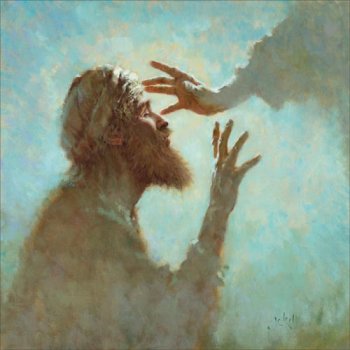
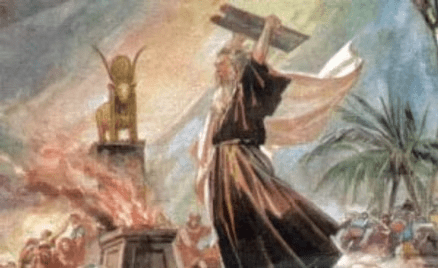
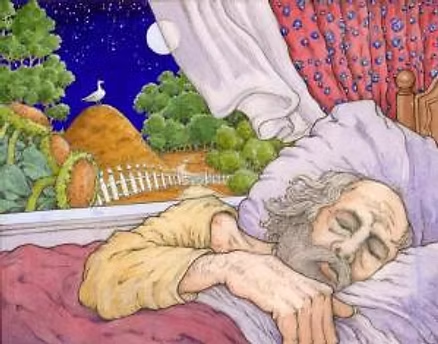






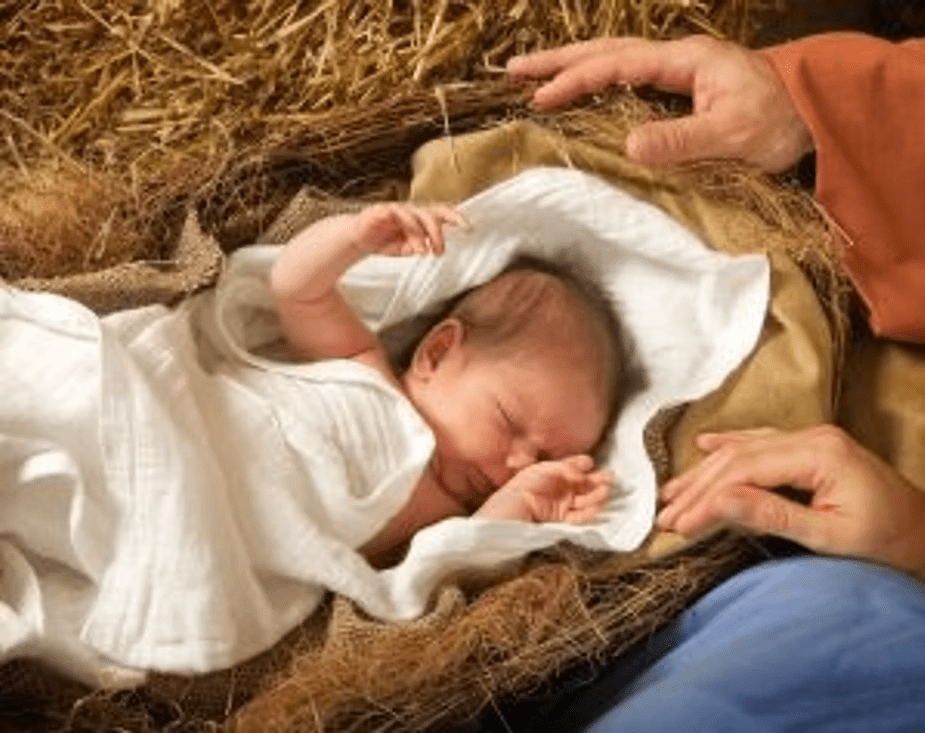

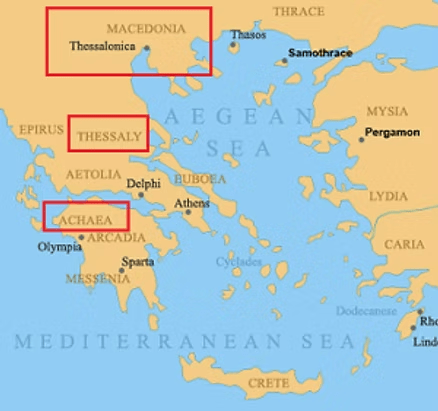

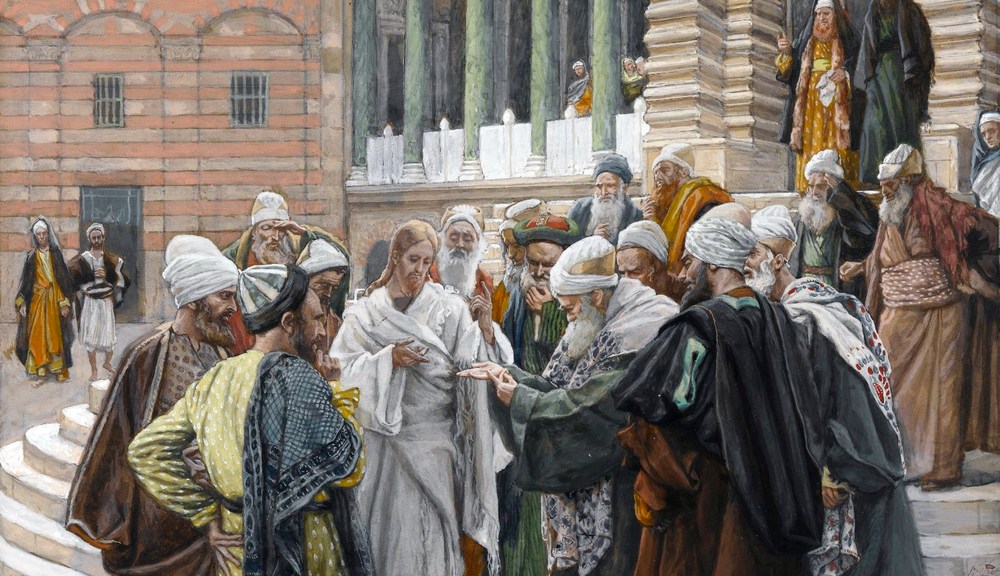

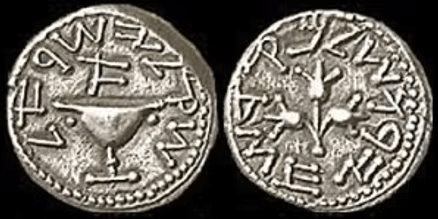


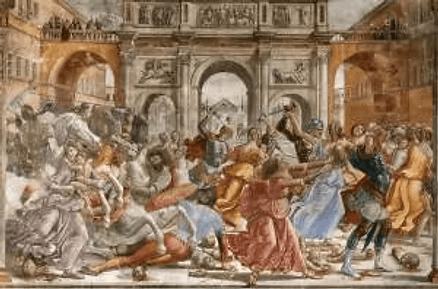
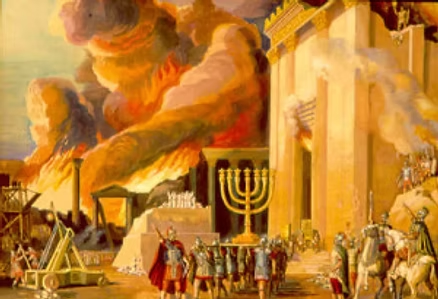

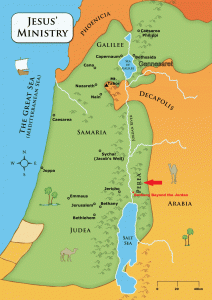



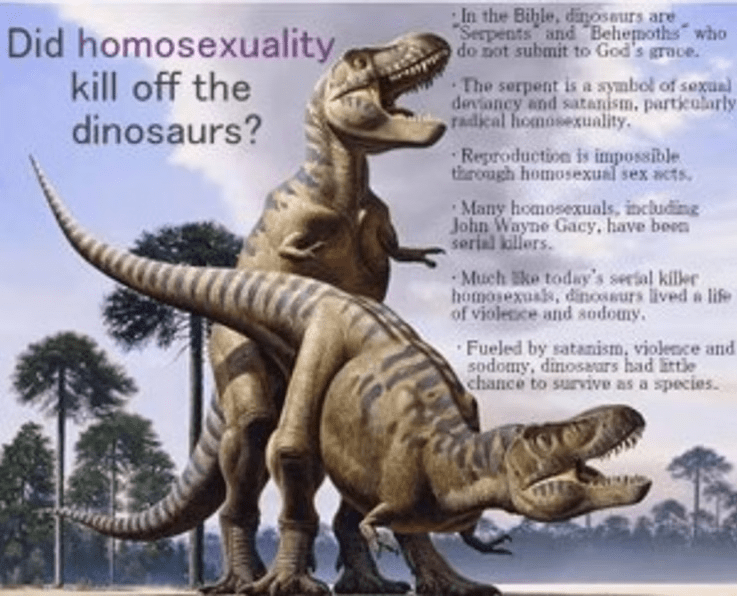



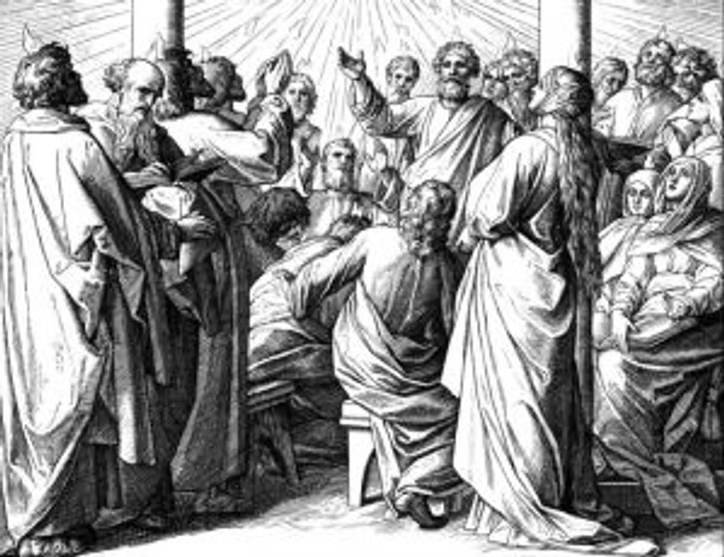












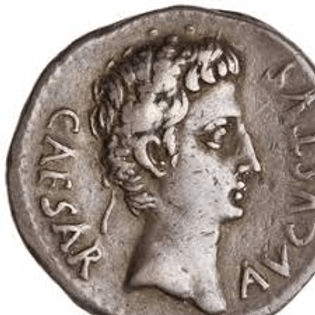
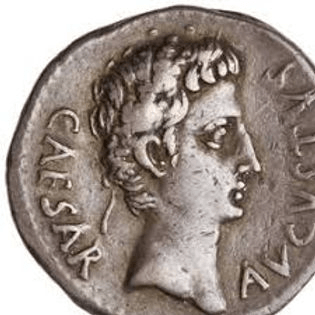

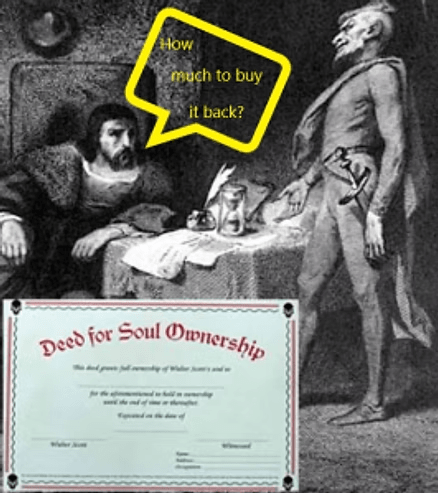

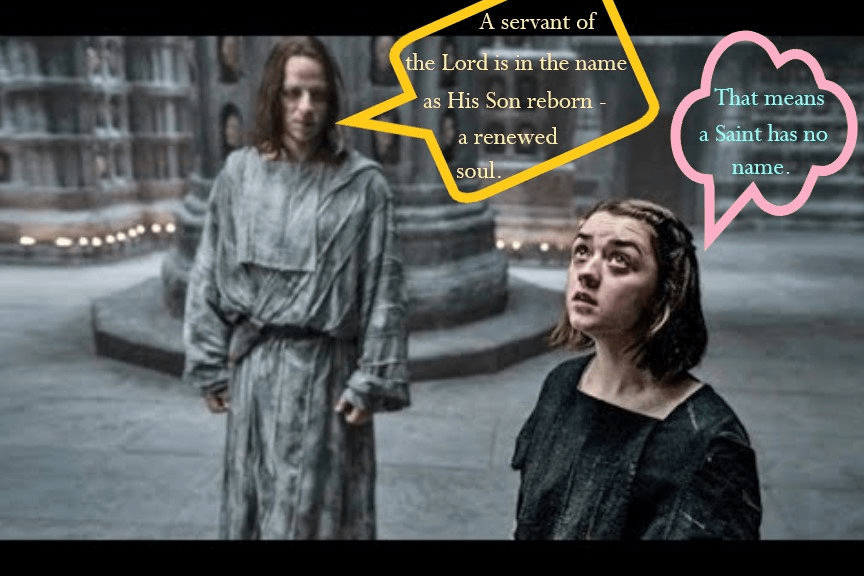
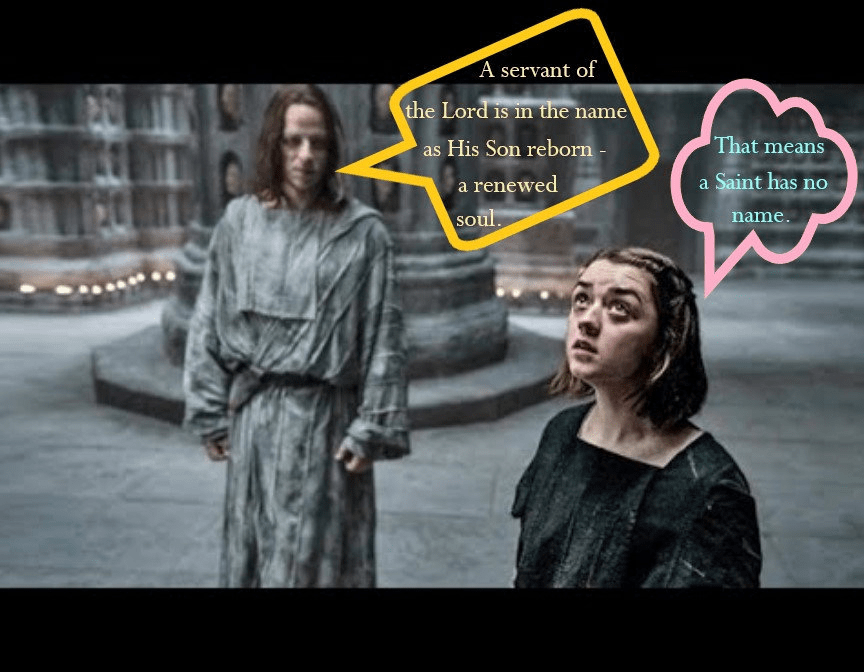
 Explaining the Readings