Tag Archives: Twenty-fifth Sunday after Pentecost

Mark 12:38-44 – The poor widow gave everything she had

As Jesus taught, he said, “Beware of the scribes, who like to walk around in long robes, and to be greeted with respect in the marketplaces, and to have the best seats in the synagogues and places of honor at banquets! They devour widows’ houses and for the sake of appearance say long prayers. They will receive the greater condemnation.”

He sat down opposite the treasury, and watched the crowd putting money into the treasury. Many rich people put in large sums. A poor widow came and put in two small copper coins, which are worth a penny. Then he called his disciples and said to them, “Truly I tell you, this poor widow has put in more than all those who are contributing to the treasury. For all of them have contributed out of their abundance; but she out of her poverty has put in everything she had, all she had to live on.”

———————————————————————————————————-

This is the Gospel selection from the Episcopal Lectionary for the Twenty-fifth Sunday after Pentecost, Year B 2018. In the numbering system that lists each Sunday in an ordinal fashion, this Sunday is referred to as Proper 27. It will next be read aloud in an Episcopal church by a priest on Sunday November 11, 2018. It is important because Jesus pointed out the disparity between those who wear church robes and the laity, as well as the wealthy of the church compared to the poor. Jesus said to beware of incorrect assumptions of piety because of collars and donations to the church treasury.

On the heels of the Gospel lesson from Mark that was delivered the prior Sunday[1], where Jesus made a spiritual connection with “one of the scribes,” we now read of Jesus saying, “Beware of the scribes.” This follows the encounter with a scribe, but after Jesus was again teaching [being inspected for blemishes] in the Temple. As part of that day’s discussion, Jesus had pointed out the error that the scribes had used in stating their conclusion that the Messiah will be the “son of David.” Jesus used logic to defeat the logic of the scribes, who spent more time than ordinary Jews coming up with answers to the questions the people had, such as, “Who will the Messiah be?”

Following that answer to the crowd [of which those trying to find error in Jesus’ words were present], Jesus then gave this warning about the scribes, giving his assessment of the privilege the scribes took advantage of, even when they knew less than they put on that they knew. To fully grasp what Jesus said next, it is important to realize that the scribes were the equivalent of modern scholastic researchers of holy texts [Judeo-Christian], with most then being like those now – far removed from life as a practicing Jew or Christian. As scholars they considered themselves to be part of the elite.

When we read that the scribes were those “who like to walk around in long robes,” this paraphrase misses the point of the word “thelontōn,” which means “desiring.” While “desire” can be reduced to “wanting, wishing, intending, and designing,” the “liking to walk around” is based on personal “will,” and not some mandatory rule that says a scribe must always wear a robe ‘in the work place AND in public’. Even if there were a ‘scribe dress code’, they would have written it and made it a point of mandating what they liked to wear.

When Peter recalled Jesus adding that the scribes did this “to be greeted with respect in the marketplaces, and to have the best seats in the synagogues and places of honor at banquets,” this is stating that the wearing of robes ‘off campus’ was to gain personal profit from being a scholar. The robes worn within the Temple’s library and as theological professors on the steps of the Temple were that of academia. The robes of a scribe let those within the Temple walls know who was a scribe, without needing to ask. It would be like a military officer wearing his or her uniform, which displayed a rank that others on a base must immediately recognize, as a matter of maintaining a service hierarchy. However, ‘off base’ or outside the Temple walls, where common people displayed no rank or privilege, dressing like normal folk was allowed.

By Jesus pointing out how the scribes were always found wearing their finest uniforms in public, he was saying they purposefully intended to play the role of elite rank, in order to gain favors that were not required of the poor and common people to give. They got discounted food and at-cost dry goods from vendors. The synagogues would give them front row seats and make others stand, placing them close to the speakers, while others might not hear as clearly in the back. The seats of favor would intimidate the rabbis, influencing them to say what they knew the scribes had taught, rather than speak from a connection to the Godhead. The places of honor at the banquets were near the head of the table, where the host sat. There, they would reap royal service and the choicest meats and drinks.

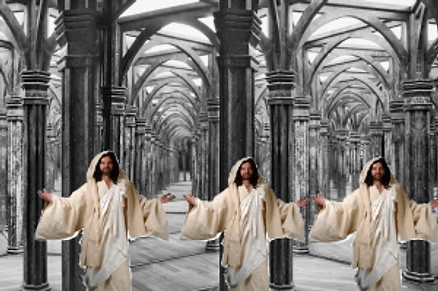
Imagine how skinny I would be without this frock!

Not only do the scribes profit from good deals and free lunches, they visit widows and make demands on their property, which a widowed woman without sons could do little to prevent. Jesus said they were “devouring” (from “katesthiontes,” meaning “eating up, eating until it is finished, squandering, and injuring”) what little a widow could have. They did this by placing guilt on them and making threats of laws being broken, forcing the Temple to make them outcast. The scribes did this for personal gain.  For old Jewish women, being one of God’s chosen people was all they had.

Then after going out to rob old women of their last jar of meal and oil [an allusion to an optional accompanying Old Testament reading], leaving them to starve to death, the scribes would recite their scholastic dissertations as if they were prayers to God. They would pretend to pray for the contributions of the dead, when such prayers of thanks never came when they were alive.  Therefore, the scribes offered up prayers for self-recognition, as if lengthy prayers were the only prayers they thought God appreciated.
As we remember our dear departed donor, on whose land our new cathedral will be built, let me now offer this prayer of thanksgiving.

Of this corruption Jesus had witnessed [and had inside information via the Christ Mind to know], he said, “They will receive the greater condemnation.”

The word translated as ‘condemnation” is “krima.” That is a legal term that means “judgment; a verdict; sometimes implying an adverse verdict,” as “a condemnation.” It bears the essence of “a lawsuit, as a case at law,” which was what the scribes specialized in studying and teaching.

The word translated as “greater” is “perissoteron,” which implies an abundance of, leaning towards “excessive,” “vehemently” administered. That says the judgment of God, towards those who the scribes condemn publicly and privately, will pale in comparison to the verdict that will be handed down in their cases, for the misdeeds of the scribes.

But I used to pretend to be a fine, upstanding doctor and respected citizen on TV.

It is important to see how the Law was given to the children of Israel for each to memorize and live by them. The “rabbi” for each family was the father. Each tribe of Israel had elders, who were connected to Moses physically, but should have been connected to God spiritually. The high priest (Aaron) offered sacrifices for the sins of the whole (and himself individually). A “scribe” was a useless position in that initial organization, as his only job was to record the Law on scrolls, not interpret them.

The elevation of scribes to being scholarly teacher and interpreters of the Law came after all of Judah had been lost. It was lost because few knew the details of the Law, and fewer followed them. A scribe then became one judge amid the returning Jews to Judea and Galilee, to whom the common people were told to turn to, so failure would not happen again.

The problem was the scribes did more misinterpreting of the Word of God than they showed competence, through divine guidance. Their failing to tell the people, “I really don’t know what it means, other than what the words appear to say, because I, like you, am not that much smarter than you are,” meant falsely representing themselves as those approved by God to speak for Him.

God did not give His approval. That was what Jesus was telling the people to “Beware” (with a capital “B”).

The Greek word written is “Blepete,” which is rooted in “blepó.” It better says to “Look, See, Perceive, or Discern,” with the implication being to “Be careful” and “Take heed.” This says to be vigilant and aware when one hears a scribe teaching, because one must question them as to how they draw their conclusions.

In other words, Jesus called the scribes (largely) liars, which meant the long robes they wore made them false shepherds. Because they avowed to speak the language of God (from the scrolls) they were self-proclaimed prophets. However, due to their lies about the meaning of the Word, they were not true prophets but false prophets.

This leads one to the warnings of God, through Moses, in Deuteronomy 18:20. There is written: “The prophet who dares to speak a message in My name that I have not commanded him to speak, or who speaks in the name of other gods—that prophet must die.” While a physical execution could certainly be read into that commandment, one must realize that “death” is metaphor for not gaining the reward of eternal life.  That was (and still is) the purpose of being God’s chosen people. Therefore, when Jesus said the scribes faced “greater condemnation,” that judgment would be banishment from Heaven.

Unfortunately, the realm of Christianity today has become top-heavy with false prophets, many who proclaim to speak for Jesus Christ, the external (yet ethereal) divine presence at the right hand of God. Simply by pretending to know what Jesus would do, they are breaking the same commandment the scribes broke; and, it is known to be a lie, because the right hand of God is an Apostle, who has been reborn in the name of Jesus Christ.

It is impossible to speak for Jesus Christ when one is supposed to be Jesus Christ AND when one is reborn as Jesus Christ, then one does not enter the realm of politics.  Is that not what “Give unto Caesar what is Caesar’s” mean?  Does not “Render unto God what is God’s” a statement that spirituality is the only goal of God’s people?
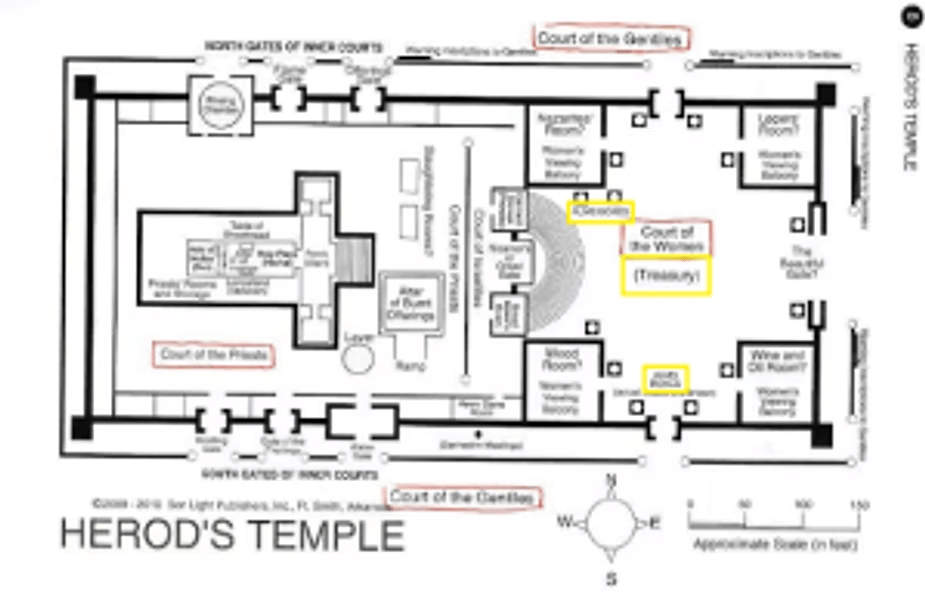
Jesus would have been talking to pilgrims on the Temple steps, outside the Nicanor Gate. Those steps rose from the Court of the Women, from which the Treasury alcoves were located. While it is not known how many alms boxes were arranged in those opposing rooms, it would have been near that court area that Jesus and his disciples “sat down opposite the treasury, and watched the crowd putting money into the treasury” (or “collection boxes”).
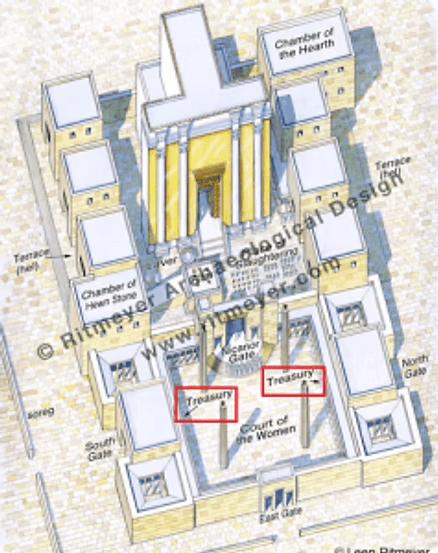
Having just recently answered someone’s question on the steps to the Nicanor Gate (about why that Jewish someone had heard a scribe explain a law differently than Jesus had taught), Jesus’ warning about the scribes using their position within the Temple to profit from both rich and poor, led him to point out to his disciples what he meant.  As he sat and watched the treasury activity, he knew the treasury would bring forth an example of what he had said to be wary of.

Jesus made his disciples learn by seeing for themselves how: “Many rich people put in large sums.” The disciples were from humble roots and had never known the wealth possessed by the rich. They had not yet faced any temptations to turn their backs to God for thirty pieces of silver [not copper].  One can imagine they were impressed by the amount of money they saw being dropped into the collection boxes [especially Judas Iscariot].

Jesus would have known the disciples would have wide eyes over such large donations being made, so he sat quietly and let the “many rich” that were present make their ritual commitments, so the Temple business of dealing with the poor could be funded. Then, after “a poor widow came and put in two small copper coins, which are worth a penny,” Jesus called their attention to that donation.

Jesus said, “Truly I tell you, this poor widow has put in more than all those who are contributing to the treasury. For all of them have contributed out of their abundance; but she out of her poverty has put in everything she had, all she had to live on.”

Don’t think the widow was unhappy about only being able to give two pennies. See her with a smile on her face, because she gave her all.

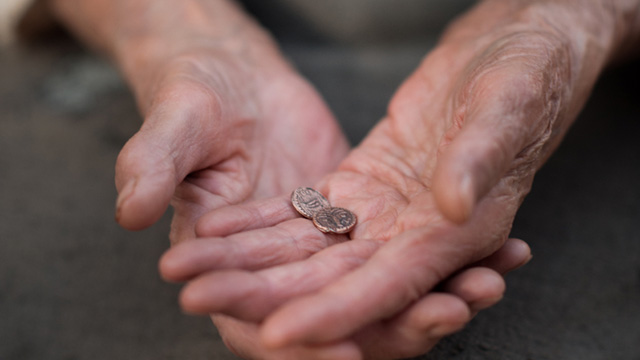
That meant that the “poor widow” only had “two small copper coins” to her name (called “kodrantés” in Greek, but “quadrans” in Latin), which were the smallest Roman coins minted. She put “everything she had” into the collection box.

For as little as she had, the rich gave about that little of their wealth, even though the amounts given seemed large and generous. When the donation ratio is 100% [poor widow] to 1% [many rich] (a 100:1 ratio), the rich were certainly not giving as much as they could.

Now, while this ratio is a figment of my imagination, it is likewise a figment of the imagination of those who pretend to speak for Jesus Christ as they stand on soapboxes with megaphones and lead protests against the players on Wall Street.  The wealthy have recently been targeted [within the last decade] as being those who are said to be “the one percent.”  Someone has come up with the number that says one percent of all people own ninety-nine percent of the world’s wealth.
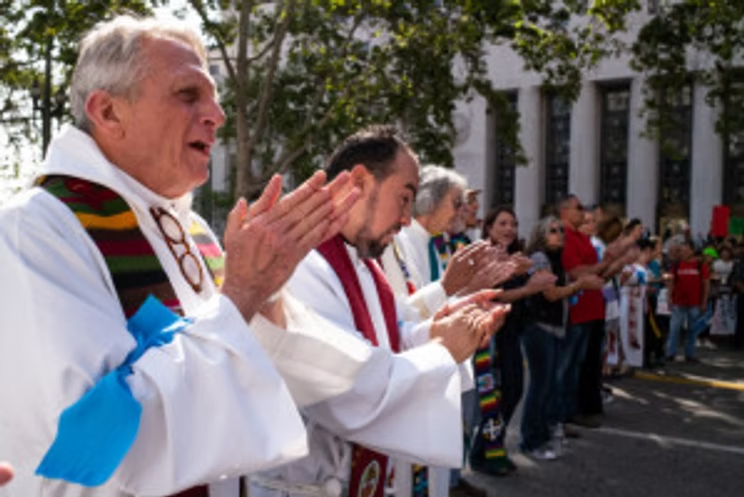
Holy protesters who demand the wealth of the world be shared equally?

Jesus did not point out the law that said the land owners (the rich) had to leave the outer ten percent of their crops for the poor, such that this reading was meant to make a statement that the rich were not putting in ten percent of their wealth.  At that time, when the Roman’s owned all the land, but Jews were allowed to buy deeds for parcels of land and pay taxes to Rome, Jesus was not proposing that an uprising should take place.  Jesus was not teaching his disciples that it was necessary to force the rich to support the poor (something alms were for), such that the laws of Moses should be amended and new laws written, which would force the rich to become poor.

Jesus was not saying that future Christian churches should establish a heuristic of ten percent tithing … not to support the poor, but to support the organizations called churches.  In short, Jesus was not concerned with the money element of this lesson.

He was driving home a point about the scribes. This “poor widow” was just like the other poor widows whom the scribes “devoured widows’ houses.” They were said to “eat it up until finished,” by misusing the Law when they visited old ladies with houses of value. Wealthy Jews could pay higher rent in such properties. Rather than the poor widow being left with two cents to by food to eat (again, this ties in to an optional Old Testament reading that can accompany this Gospel reading), this devoted Jewish widow gave one hundred percent to those who pretended to be her shepherds.

She was “all-in,” even though she barely had two pennies to rub together. She gave “everything she had” because she trusted the false shepherds.

In Ezekiel 34:16, God said through His prophet (about false shepherds and the flocks they were prophesied to bring harm to): “I will seek the lost and bring back the strays; I will bandage the injured and strengthen the sick, but the fat and the strong I will destroy. I will feed them—with judgment!”
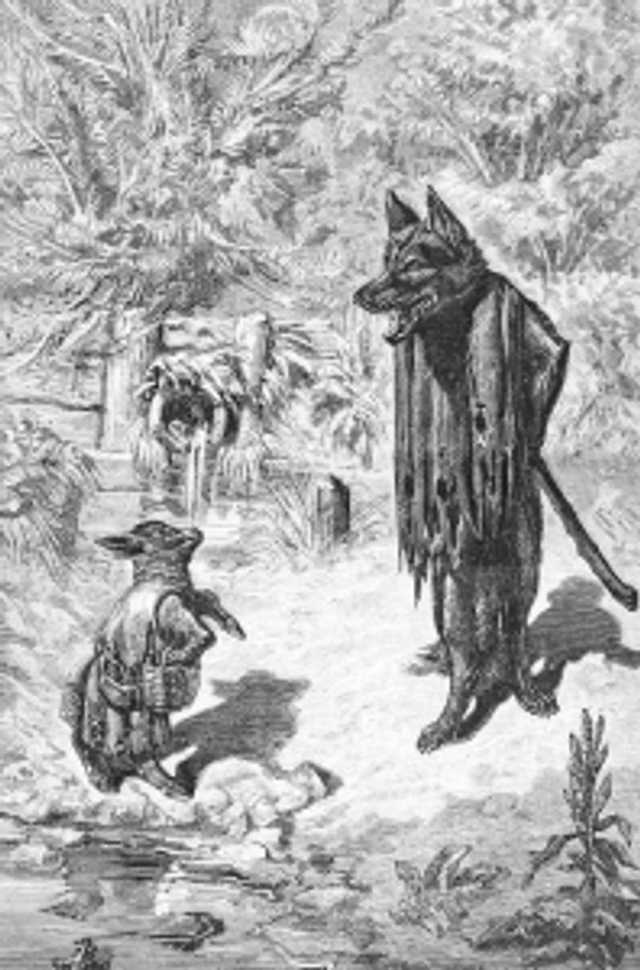
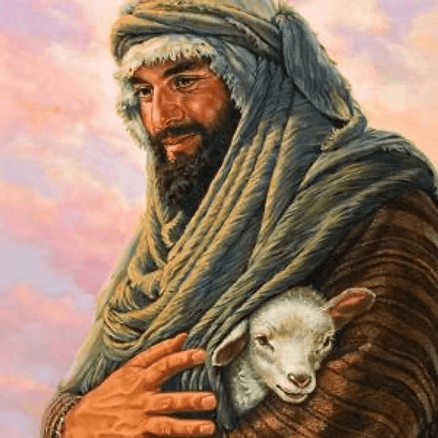
Hey little lamb, you lost? I can show you the way, if you would like me to.

Jesus was using the example of a poor widow woman being injured by the lies of scribes. The poor widow was probably old and feeble. Giving all the money she had would play into the hands of the scribes, who wanted to inherit her rights to a house. She had no heirs, as her son would have assumed her debts as being his own. She was poor because she was unable to provide for herself and she was soon to die because of the injury done by the men of law.

Their verdict was to kill her, using her love of the law and wanting to remain in good standing as a Jew.

God’s verdict, however, would be to grant the poor widow eternal life for her devotion, while the scribes would face a greater judgment … one they would not be expecting.

As the Gospel reading for the twenty-fifth Sunday after Pentecost, when one’s own personal ministry for the LORD should be underway – one should have been made aware of the false teachings of those saying they know what Jesus would do if he were alive today – the message here is to see the verdict that comes from God’s Judgment, for having lived a life under the pretense of religion, rather than having loved God with all one’s heart, soul, and strength, is one that just might be an unexpected shock that a soul is unprepared to hear.

In the Book of the Acts of the Apostles, there is the story of Ananias and his wife Sapphira (Acts 5:1-10).

They wanted to become members of the new church of Jews that Peter and the other Apostles were forming. That church was not for people pretending to believe in Jesus as the Messiah. Disbelievers still had the Jewish synagogues.  The new church was only for those who had been filled with the Holy Spirit, due to an immediate opening of their hearts and love pouring out to God. They were all those who had been reborn as Jesus Christ, through the Holy Spirit and the Christ Mind.

Membership in that new church required the sacrifice of self-ego, such that wealth was not something individually held. Wealth was held in common (a treasury) for the good of the whole church (all Apostles[2]). In that way, no one was poor, no one was rich, all needs were met and all served the Lord as a most holy and righteous priests (i.e.: Christians).

In verses one and two we see how Ananias and his wife sold a piece of property, and then agreed to hold back a portion of the proceeds for themselves. Think of this as a situation of wanting to be Christians, but they were lying about having received the Holy Spirit.  They were “desiring” just like the scribes.  They so wanted to get in on this new church venture (for whatever self-motivations they saw) that they sold one piece of property (possibly of many they owned). Still, because they were not totally committed to God (perhaps they had some reservations about losing everything they had) they held back some of the cash. One can assume they kept it hidden somewhere secret that only they knew: how much that was and where it was stashed. The remainder Ananias took and lay at Peter’s feet (as it was coins in a bag).[3]

In verses three, four and five we read, “Then Peter said, “Ananias, how is it that Satan has so filled your heart that you have lied to the Holy Spirit and have kept for yourself some of the money you received for the land? Didn’t it belong to you before it was sold? And after it was sold, wasn’t the money at your disposal? What made you think of doing such a thing? You have not lied just to human beings but to God.” When Ananias heard this, he fell down and died. And great fear seized all who heard what had happened.”

Peter’s questions asked were statements that said, “Nobody told you to give anything up.  God certainly did not tell to lie as a way to gain His favor.”
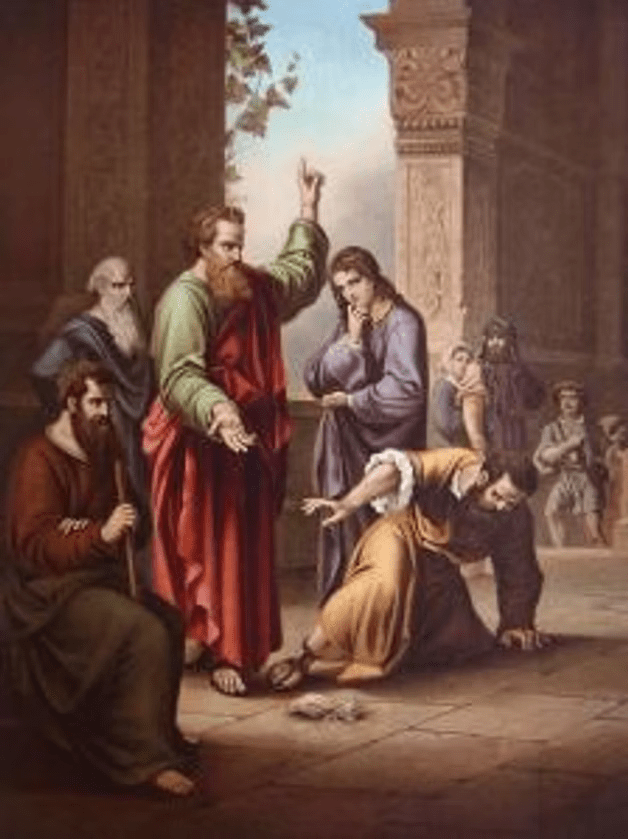
Some texts say he “gave up the ghost.” Death is the release of a soul, but Ananias gave up his chance for the Holy Ghost by lying to it.

When that reading was discussed in a church lectionary class that I attended (years ago), the discussion ended as it was about time for the next church service to begin. As the leader of that lectionary class hurried off to get settled into his favorite seat in the church (possibly a favored seat?), I hurried to ask him, “Whatever happened to that all-in church?”

He barely turned his head my way as he said with a smile, “That didn’t work out very well.” Then he kept hurrying to his seat.

Just by coincidence, the man was a wealthy lawyer. He contributed large sums of money to that church, and he was involved with leading discussion groups and being deeply involved with more in-depth study programs. He was what I consider a very nice man … a Christian man … in today’s partially-in church.

I can only imagine that he saw the two pennies the poor widow woman gave, in this lesson today, as a good example of how the poor widows today are better off, due to taxing the rich more. The welfare state cares for poor widows, unlike the Jewish leaders of Herod’s Temple. It took Christianity to appoint bishops to correct that problem.

Not long ago, the lesson was Jesus telling his disciples, “It is harder to get a rich man into heaven, than it is to get a camel through the eye of the needle.” There also was the parable of the talents, which so many today see as a lesson on signing up for church stewardship pledges, reminding the people how much they can afford to give. One cannot forget that there also was the parable about the poor beggar Lazarus and the rich man.   All [so many] have a theme of money.

Then there is the saying, “The love of money is the root of all kinds of evil.” (1 Timothy 6:10)
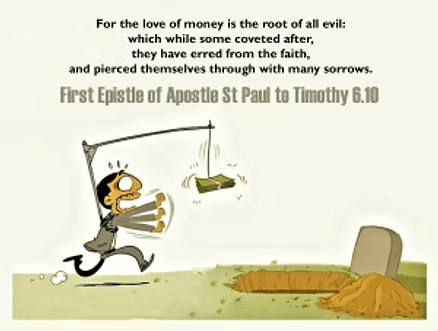
None of those lessons say anyone has to give any money, to anyone, at any time.  Money only has value in the earthly realm.

Being Christian is not about joining a club, such as Ananias and Sapphira thought. There are no monetary dues for being a Christian. The love of God cannot be placed on a scale and measured by ounces and pounds. The only portion of love of God that can make one a Christian is one hundred percent (“Love God with all your heart, with all your soul, and with all your strength.”) Therefore, it never worked out very well for a church of All Saints to be anything less than All Saints.

We are supposed to be all-in.  That “membership fee” is not based on one’s material wealth.  It is based on faith.

When everything one has is given to assure that God’s work is done (knowing God does not seek to feed the world or allow anyone capable of walking a thousand miles to be given some amount of free wealth, but God wants Saints to pass on the Holy Spirit to those who seek to know God), then God will make sure that the money jar you just emptied, so a fellow Saint could have a coat, is now full again (this related to that optional Old Testament reading that associates with this Gospel reading).  Money becomes nothing more than a tool that must be used, so positive growth can result (parable of the talents).  Positive results are measured in faith given and faith returned.

When one is all-in for God, then there is no need to worry about someone wearing a collar coming to visit, suggesting that it is time to remember the church when you pass away.  That promise of eternal happiness can only be promised to those who held back most of what they owned, having never given God any love.

When one has submitted to God completely, any physical property left over when one dies will go to surviving family.  Material inheritance will have been set up for a church of people, not an organization with buildings to maintain and employees to pay.  A church of people is usually sons and daughters and close friends who have had the Holy Spirit passed onto them, keeping worldly wealth at the feet of Saints.

In the end, it will not matter what physical possessions are left behind.  After all, you can’t take it with you.  What you do take is your soul and physical death needs to become the entrance into the eternal kingdom.  This is how this reading in Mark ends; it states, “all she had to live on,” or literally from the Greek, “all the life of her.”

When Jesus pointed out to his disciples, “she out of her poverty has put in everything she had,” everything she had was eternal “life.”  The time to suffer through physical life [mortal existence], for a promise of eternal life, is long before one is set upon one’s death bed.  That is not when one wants to ask God to forgive a lifetime that kept total commitment held back.

Eternal life does not come at discounted rates.  This lesson says to always give all you have, with love of God being the only currency that ultimately matters.

———-

[1] The Proper 26 readings were probably rejected in lieu of the All Saints readings that normally fell on Thursday, November 1, 2018.  Because few went to a mid-week church service [too lazy], many churches will feel it customary to toss out the Proper 26 readings and give a [usually] poor assessment of what All Saints represents.

Actually, this Gospel reading that warns of such berobed changes, in order to meet the lazy needs of high roller contributors [who never attend church on any day other than Sunday morning], is why the Episcopal Lectionary says, “All Saints may be celebrated” instead of the readings set up for Proper 26.  I add this just in case you went to church and heard nothing that came from Mark 12, Hebrews 9, and Ruth 1.

[2] It is important to return to the element of All Saints day, as this can now be seen not as a tribute to all the dead Saints that have been officially recognized by one or more Christian churches, but a recognition that all members of a church should be Saints.  If it is not All Saints, then the church becomes a chain of weak links, which ultimately leads to a weak chain that breaks apart.  Think about that and ask yourself, “When was the last time I saw a real, true Saint?”

[3] While not stated in this story in Acts 5, the bag of money laid at Peter’s feet would have been returned to the heirs of Ananias and Sapphira, not kept as an unholy offering.

Hebrews 9:24-28 – The foundation of the world

Christ did not enter a sanctuary made by human hands, a mere copy of the true one, but he entered into heaven itself, now to appear in the presence of God on our behalf. Nor was it to offer himself again and again, as the high priest enters the Holy Place year after year with blood that is not his own; for then he would have had to suffer again and again since the foundation of the world. But as it is, he has appeared once for all at the end of the age to remove sin by the sacrifice of himself. And just as it is appointed for mortals to die once, and after that the judgment, so Christ, having been offered once to bear the sins of many, will appear a second time, not to deal with sin, but to save those who are eagerly waiting for him.

———————————————————————————————————-

This is the Epistle selection from the Episcopal Lectionary for the Twenty-fifth Sunday after Pentecost, Year B 2018. In the numbering system that lists each Sunday in an ordinal fashion, this Sunday is referred to as Proper 27. It will next be read aloud in an Episcopal church by a reader on Sunday November 11, 2018. It is important because Paul gave further details about each true Christian sacrificing their own self-ego to be reborn as Jesus Christ.

[Omitted text that no longer applies here.]

Speaking of long-winded explanations of holy text, the Epistles (especially those of Paul) require many words that point out the nuances of God’s Word. It is purposefully written so that the whole truth is not readily seen. In the Gospels the whole truth is hidden under the cloak of parables and symbolic stories, which makes them seem easily understandable, but question, “What was the point?” Paul’s letters were almost like in a code that only Apostles could grasp. Breaking codes become more complex.

Here is this week’s breakdown of five verses from the ninth chapter of Paul’s letter to the Hebrew-speaking Jews [Christians] of Rome. There are fifteen word segments that are marked off by punctuation marks. There are five capitalized words, with God found once, Christ found twice and then “Otherwise” and “Namely” requiring insight as to why they are important.

The hard work has been done, by looking at the literal Greek [the ordering of each word being maintained] and looking up each Greek word for viable translation possibilities. By my having restated this reading in the following format, it should be just a matter of slowly reading my words of translation and letting a flow of thought [from reflection, meditation, and comparison to the read aloud translation] to see for oneself where that train of thought leads. Keep in mind how my translations are limiting many words from representing the fullness of translation viability.

Here is Hebrews 9:24-28 restated, from the Bible Hub Interlinear:

24. not then into artificial [made by human hands] has come in sacred ones Christ  ,

corresponding to those sincere ones [genuine ones]  ,

except towards self together heaven  ,

immediately to be made appear those the face followers of God on behalf of ourselves  .


25. nothing so that many times he should make an offering oneself  ¸

just as the high priest enters into those sacred places according to cycle of time when blood belonging to another .


26. Otherwise it was necessary for him many times to have suffered from laying down inhabitants of the world  .

at this instant then once for all on the basis of joint action followers of the present age  ,

towards setting aside followers sin  ,

through those sacrifice self he has been made known  .


27. Namely according to how much he has appointed followers to mankind once more to die  ,

beyond on top of this his divine judgment  .


28. in this manner namely followers Christ  ,

once more having been offered in sacrifice to those who many to offer up as sacrifices for sins  ,

from out of subsequently separately from sin  ,

will appear before him awaiting for salvation  .

Now, let’s look at what each verse says, realizing that each verse is actually like a separate paragraph of text, with a central statement that then presents statements in support of that theme.

Verse 24 begins by saying the central idea is relative to what is “not” to be assumed. As the first word stated, it must be understood that “not” is a transitional word that is based on that stated prior, in verse twenty-three. The segment of words leading up to verse twenty-four spoke of “heavenly sacrifices” or “spiritual offerings.” As such, verse twenty-four can be seen as explaining what “not” to assume about that statement.

By following “not” with the words that state “artificial” or “made by human hands,” this can be visualized as an altar on which slaughtered animals would be burned as burnt offerings. When the inverse of “not then into artificial” is seen as the positive (rather than the negative), Paul was stating “then into one made from God’s hand.” This should be read as implying a human soul, within a human body of flesh.

Still, recalling that this verse was written as an address to “sacrifices” and “offerings,” that which is the soul of a human being, Paul then wrote that this soul sacrifice “has come in” spiritually. It has not been summoned through the slaughter of flesh and the transformation of meat into smoke and ash (all physical changes). Instead, it “has come in” by the hand of God, from above. That presence has then created “sacred ones,” which is translated from the Greek word “hagia,” as the plural number of those who have been “set apart by (or for) God, holy, sacred.” Rather than assume the plural of “sacred” means places [that “made by human hands”], the deduction should be to “those spiritually made holy.”

The last word of this central idea is then “Christ,” which means the “Anointed one.” Therefore, the “offerings” stated in verse twenty-three are now said to be human beings, presumably those who believed Jesus of Nazareth was the Messiah [disciples], sacrifice their souls to God [self-ego slaughtered and transformed], which in return makes them Saints [“holy ones”] in the name of Jesus “Christ.”

The first supporting statement to this central idea begins by stating “antitypa,” which is Greek [in the plural number] for “copies” or “images” that are “corresponding to” the “Christ.” This means those “Saints,” in whom “has come in” the “Christ” spirit, are “patterned” or “representative of” Jesus of Nazareth.

Those representations of the “Christ” are then said to be “sincere ones,” which means they are not pretending to be Christ-like. They are “genuine” in this reproduction, as the Greek word “alēthinōn” states. They are “real” resurrection of Jesus Christ, not fake fans in a “We Love Jesus” club. They are “true” or “made of truth,” which is an inner [heart-driven] motivation, not a head-driven calculation.

The next supporting segment of words begins with “alla,” which states what is “to the contrary” of this recreation of “truth.” This “exception” is relative to the “self,” where “auton” emphatically refers to the “self,” in the sense that “oneself” then identified “the same” as a “condition” of or having joined “together” with “heaven,” the “spiritual” place of God.

Once the “self” has changed spiritually, there is an “immediate” change in the “self.” While still wearing the flesh that is identifiable as one’s own, a glow [invisible to human eyes] emits from “the face.” This is expressed in the “followers” of Jesus of Nazareth, so they too wear “the face of God.” This “face” becomes the “countenance” of a “presence” within; but it is not for the glorification of “self.” Instead, it is a “presence” that comes “on behalf of others.” This means Saints are made by the hand of God [resurrections of the Son of Man] for the purpose of ministry, just as was that recorded of Jesus of Nazareth.

Verse 25 then begins a subsequent paragraph that follows this line of thought. It begins with the Greek word “oude,” which is a negative word that is relative to those who are reborn as Jesus Christ and wear the face of God. The word means, “neither, nor, not even, and not,” such that it is a conjunction that says “nothing.” This should be read as a statement that God has the power to reproduce His Son in those who devote themselves to God – totally and completely – such that such an act is “not even” unfathomable. This negative word is then a balance to the negative word that began verse twenty-four, such that the inverse reading says “everything” is possible of God. This repetition is an example of symmetrical applications of God’s Word.

This is then a statement “so that” wearing the face of God is possible “many times.” This not only states that being reborn as Jesus Christ – as a Saint – has occurred “so that many time” one should find “nothing” that keeps one from also “make an offering of oneself.” Paul was writing this letter to the Saints reborn as Jesus Christ in Rome, who were many and growing in number. Paul was therefore encouraging them to lead more to God and have more wear the face of God. There were “no” limits, as long as one offered oneself to God.

Paul then supported that idea by saying a cycle of change is no different than a “cycle of time,” as one “year” follows with another “year,” so the same cycle of change is always taking place. He compared this to the cyclic entrance of the high priest into the Temple area for sacrifices, as commanded yearly. Just as a man wearing ceremonial robes enters into sacred places according to cycles of time, so too does God’s Holy Spirit enter into human temples that have accordingly been prepared for a ritual sacrifice. The presence of Jesus Christ is the pleasing smoke that rises from a self that has been given fully unto the Lord. The blood of the old has been transformed by the blood of Christ.

Verse 26 then begins with the capitalized Greek word “Epei,” which is elevated in importance. The word commonly translates as “of time: when, after; of cause: since, because; otherwise: else.” The word is said to imply: “properly, aptly if, introducing something assumed to be factual and fitting, i.e. as appropriate to what is assumed.” [HELPS Word-studies] It then becomes an important statement of what would be “Otherwise,” if one did not become filled with the spiritual blood of Jesus Christ. This assumption of fact then says that failure of others to become the resurrection of God’s Son would mean (as translated in the reading in church), “for then he would have had to suffer again and again since the foundation of the world.”

The Greek word translated as “foundation” is “katabolé.” Rather than seeing this as a statement of God’s worldly Creation, the cornerstone should be recalled as Jesus Christ. Paul wrote to the Ephesian Christians, “Consequently, you are no longer foreigners and strangers, but fellow citizens with God’s people and also members of his household, built on the foundation of the apostles and prophets, with Christ Jesus himself as the chief cornerstone.” (Ephesians 2:19-20)

As such, “katabolé” should be realized as a word of “conception,” dating back to the sewing of priests into the world [Adam and sons], the conception of holy lineage promised to Abraham, and the laying down of holy seed into the womb of a holy land [Israel]. The purpose of that “foundation” having been “laid down” means Jesus Christ would fulfill that promise. “Otherwise,” Jesus of Nazareth would have to continually rise from his tomb in human form, only to go through the same suffering and the same end, countless times … all for the sins of others that could not be stopped. Only with Jesus Christ reborn within one [a priest of Yahweh] can sin be stopped.

From that talk of the “foundation of the world.” which would be Christianity, Paul then supported that central idea by beginning, “at this time.” He was talking to Saints who presently were that “foundation” intended by God. Jesus Christ was the cornerstone on which was sacrificed “once for all,” as the “basis of joint action.” Apostles were “joined” with that cornerstone as the “followers” Jesus of Nazareth called for when he lived. Then was realized by Paul and his fellow Saints “at that present time.” The intent had become a living reality.

They had been laid down “towards setting aside sin.” Their sins had been washed clean by their baptisms by the Holy Spirit. That is the only way to set aside sin. For them to go forth [“towards”] others with that promise, they had to be sacred, holy, and righteous, as was Jesus of Nazareth. They had to promote sin-free existence by demonstrating that in themselves [not a “do as I say, not as I do” scenario].

That step could only be possible by “the sacrifice of self.” Those who knew the Apostles prior to their transformations would be most able to see marked changes in personality. Their known “self” would be “made known” as changed. Instead of the persons they used to be, “he has been made known” instead. That was by them wearing the face of God; and that was the “tag, you’re it” immediate transformation that made Christianity grow exponentially in the beginning. Jesus was known to have been reborn in Saints, which then “laid down” more Saints.

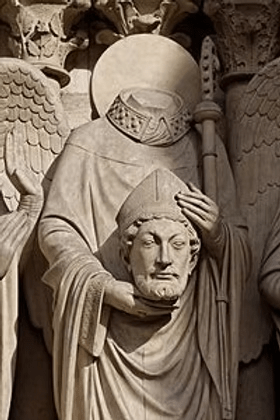
Saint Denis was beheaded and then walked seven miles home, holding his head, which preached a sermon all the way, to many witnesses. What is a more apt symbol of sacrificing self-ego than being beheaded and still being able to be God’s voice?

Verse 27 begins with the capitalized Greek word “Kai,” which we saw in the past Sunday’s translation of Paul’s letters to the Hebrews of Rome. As was found there, the same applies here. The importance of capitalization has less impact as the common conjunction “And,” as it does when translated as “Namely” (a viable translation). Seen as an adverb that indicates the importance of “Specifically,” from which a name acts to identify “he who has been made known,” the importance “That is to say” is God and Christ.

Christ is known “according to how much he has appointed followers.” God is the source of the Christ Spirit, which filled His Son on earth, Jesus of Nazareth, the Son of Man. God has appointed Christ as the “Anointed One,” the “Messiah.” The repetition of Jesus is then his being sent again into “mankind once more,” in each Apostle that has “to die” in his place to receive that Holy Spirit.

Going beyond this inheritance from self-sacrifice is the promise of eternal life. This is God’s “divine judgment” to give and it is the righteousness of the Christ presence that assures one’s soul will end his or her physical life [“to die”] without further sins.

Verse 28 Paul again used “kai” (in the lower-case), where it is again translated as “namely,” with “Christ” following as the importance of specificity. This naming of the “Christ” Spirit as the means to facing God’s “judgment” successfully, Paul returned to the central idea of “sacrifice,” where “Christ” is the high priest that makes “sin offering” unto God. The Christ Spirit within the flesh of a human tabernacle the self will die to please God.

This means the cleansing of past sins, “from out of subsequently” the followers of Jesus of Nazareth will be delivered. Their past histories [as Saul transformed into Paul] then have their souls “separately” divided “from sin.” What was once will be no more. The sinful soul will die with the sacrifice of the self-ego it was led to sin by.

The remaining soul, which will have been cleansed of sin by the Holy Spirit, will be the one that “will appear before him” – the Lord. God will be “awaiting” the return of a lost soul to His realm. This return will be ‘for salvation.” The presence of Jesus Christ in the flesh, replacing the previous ego, then makes Christ the Savior.

When this translation is deeply compared to the translation that will be read aloud in church, one can see how the public reading says nothing that can lead one to anything more than belief. That belief is not sound and capable of withstanding the temptations of Satan. The alternate translation I offer makes it possible to see that faith can only come by being Jesus Christ reborn. Paul was an example of that transformation, as were all the early Saints upon whose works Christianity was built as a “foundation in the world.” The call is for the “followers” to sacrifice, as did Jesus of Nazareth, due to a deep love of God.

As the Epistle reading selection for the twenty-fifth Sunday after Pentecost, when one’s own personal ministry for the LORD should be underway – one should have died of self and been reborn as Jesus Christ – the message here is to see the sincerity that is required to sacrifice self and be joined with God and His Christ Spirit. This is basically the same thing Paul says [over and over] in all of his letters. Again and again, the Apostles to whom he wrote understood what he was saying.

The confusing nature of Scripture is designed by God. Being His Son is not meant to be accomplished by wishful thinking, with zero work required. One has to actually want to do as I have done here – as tedious as it is to write down what I see – to prove to God that one is refusing to read the Holy Book upon which the final exam will be written. Reading what I write and what others write is like buying the Cliff Notes of divine meaning.

There are no such cheat sheets available. If you do not read the assigned material and come to your own deeply reached conclusions, you will forget what you studied and be left with no retention of meaning. Making a C on a religious studies test means one cannot only not save oneself, it means one cannot save anyone else. It means the sins of laziness will always be knocking on one’s door and one will always be yelling from the sofa, “Come in! The door is open!”

Ruth 3:1-5; 4:13-17 – A son has been born to Naomi

Naomi her mother-in-law said to Ruth, “My daughter, I need to seek some security for you, so that it may be well with you. Now here is our kinsman Boaz, with whose young women you have been working. See, he is winnowing barley tonight at the threshing floor. Now wash and anoint yourself, and put on your best clothes and go down to the threshing floor; but do not make yourself known to the man until he has finished eating and drinking. When he lies down, observe the place where he lies; then, go and uncover his feet and lie down; and he will tell you what to do.” She said to her, “All that you tell me I will do.”

So Boaz took Ruth and she became his wife. When they came together, the Lord made her conceive, and she bore a son. Then the women said to Naomi, “Blessed be the Lord, who has not left you this day without next-of-kin; and may his name be renowned in Israel! He shall be to you a restorer of life and a nourisher of your old age; for your daughter-in-law who loves you, who is more to you than seven sons, has borne him.” Then Naomi took the child and laid him in her bosom, and became his nurse. The women of the neighborhood gave him a name, saying, “A son has been born to Naomi.” They named him Obed; he became the father of Jesse, the father of David.

———————————————————————————————————-

This is an optional Old Testament selection from the Episcopal Lectionary for the Twenty-fifth Sunday after Pentecost, Year B 2018. In the numbering system that lists each Sunday in an ordinal fashion, this Sunday is referred to as Proper 27. If chosen, it will next be read aloud in an Episcopal church by a reader on Sunday November 11, 2018. It is important because we see that the commitment Ruth [“Beauty”] made to stay with Naomi, as a Gentile married into the family of Yahweh, paid off as she found a new husband and bore the grandfather of David [Obed].

In last Sunday’s ‘episode’ we left off with the camera zooming in on Naomi, who had nothing to say about Ruth’s promise to stay with her mother-in-law until death, because she was part of her dear family.

She would not return to her homeland [Moab] and her birth family. Now the story has progressed to Naomi doing the works of matchmaking, because Ruth has become Naomi’s full-fledged daughter.

Once again, the reader has to be fluent in the language of names, as all the names of the Holy Bible play a role in establishing the character of those given their names. The first name of importance is Boaz, the eligible Israelite bachelor who will be seduced by Ruth’s “Beauty.” The name “Boaz” means, “By Strength,” implying “In Him [the Lord] Is Strength”. Thus, Naomi knew that Boaz was a righteous man, whose strength was greater than physical.

Now, this reading is the beginning of chapter three [five verses] and then it skips to near then end of chapter four [five verses], which can leave the impression that some hanky-panky took place. Nothing of the sort happened. This reading simply tells how Naomi led Ruth to be introduced to a man of importance, so that a friendly relationship could begin. This then led to Boaz marrying Ruth, out of love, and conceiving a holy child by God’s assistance.

The name of the child is then Obed. The name “Obed” means “Servant” or “Slave.” Some sources say the name means “Serving.” For such a name to be given to an infant by his father means service was a valued characteristic in the Israelite people.

Ruth identified herself to Boaz as “your maidservant” (“’ă·mā·ṯe·ḵā”), because she and Naomi had to serve as slaves because they had no husbands.

Boaz was identified as a “kinsman redeemer” (“ḡō·’êl”) because Naomi was from the same bloodline and as a kinsman with property and wealth, Boaz provided a service to widows by becoming their employer. Therefore, the pair bonded through their service to the tribe and their service to Yahweh; meaning their child was to reflect that value.

As an optional Old Testament reading selection for the twenty-fifth Sunday after Pentecost, when one’s own personal ministry for the LORD should be underway – one has entered into deep-felt Service to God – the message here is the redemption that comes from marriage to God. God is our Strength; and from God entering into our hearts is born the ultimate Servant, Jesus Christ.

The story of Ruth is she was seen as a Moabite, which is a Gentile. She was not born of the blood of the descendant of Jacob. She married into that family when she wed Naomi’s son Mahlon [“Great Infirmity”], but with his death coming before they had a child together, Ruth was free to return to her Moabite roots. She refused to be released from Naomi [“Pleasantness of the Lord”].

Christians [males and females] should all see themselves as Ruth. Being Christian means adhering to the principles of Mosaic Law, believing in only One God – YHWH. In today’s modern world, there is much rejection of the Old Testament stories, where people who sin are called abominations and the enemies of the Israelites were ordered slain [men, women, children and animals] by God’s prophets. Westerners of Christianity reject what they see as no longer viable. They reject it as uncivil and many lean on the concept of Jesus telling everyone to love, rather than judge others for what they are. That is not being a reflection of Ruth.

Ruth was the lowest of the low in the Israelite societal pecking order. She had no voice about what was right or what was wrong, according to the Laws of Moses. She had been given her freedom to practice whatever rules and customs the descendants of Lot had established which might have included idol worship and human sacrifices to please many gods. The same freedom is given to ALL human beings in the world, because God never sent a fireball from outer space to destroy the Egyptians or the Canaanites or anyone else. However, being one of God’s chosen people means: agreeing to the Mosaic Laws; and choosing to only SERVE Yahweh.

When those two stipulations are met, then one lays at the feet of God as His maidservant [regardless of human gender]. There can be no Big Head of self that tells God, “Hey God, we’ve been thinking and all this harsh legal stuff is just too much to agree to anymore. So, we are going to make a few changes here and there and instead of praying to You, we are just going to idolize You Son Jesus. How’s that sound to You?”

[SILENCE] [Cue the cricket chirping soundtrack]

That means turning one’s back on God, so call yourself whatever you want to call yourself, it does not make you one of God’s chosen people. You have rejected God, so God has rejected you. You have gone all Old Testament on your soul and killed its chance of eternal life in Heaven.

Ruth symbolizes a love of the Law – which is symbolized by Naomi being “Pleasantness of the Lord” – where nothing bad ever happened to those who followed the commandments of God through His Prophets. Only the evil suffered physical death – but those souls all lived to be reincarnated another day, with no real harm done. Ruth became a servant of the law, even though the law made he the lowest of the low, as a widow without issue. She did not rise in rebellion to the unfairness of the Law. She complied out of love, trusting in the God of Israel to show His love in return.

It is vital to realize that the STRENGTH of Israel was the Ark of the Covenant. When a judge or prophet was told by God to encounter an enemy, the Ark was always carried into the field of battle. The Israelites were able to defeat evil because God was with them. Israel was a body of parts [the Twelve Tribes] with the Ark of the Covenant being the heart of that body. This is how a heart symbolizes the strength of courage, which is also symbolized in the lion’s strength and kingliness.

When Ruth was taken in marriage by Boaz that symbolizes one today being married to God. One is totally committed to being God’s wife [regardless of human gender]. From that marriage is born Jesus Christ, which is the STRENGTH of God within that defeats all attacks by evil. The Ark of the Covenant has not been lost; it has been transformed into an inner tabernacle, where Jesus Christ serves the Father as one’s personal high priest. Wherever one goes, the Ark of the Covenant is there – in the battlefield of life.

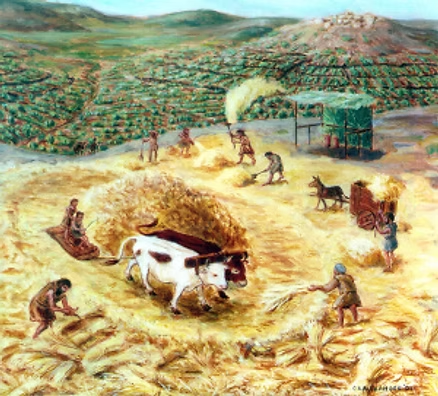
The threshing and winnowing of barley is a necessary work that separates the chaff from the grain.  Ruth was sent to the threshing floor to see the work that is necessary for the bread of life to be gained.  The STRENGTH of Boaz was witnessed, through the work that he did.

Whoever refuses to have the Law written into their hearts is not Ruth. Anyone calling himself or herself Christian, while bending the laws of Moses to suit one’s needs, is more in line with the ex-daughter-in-law of Naomi, Orpah [Mane or Neck]. One proudly holds high the head and its inner brain as the personal source of strength. While one kissed the “Pleasantness of the Lord” and the Law Naomi stood for, one feels strong enough to remember some of the Law, while rewriting that which was misunderstood. One has not then married Yahweh, but one has returned to pagan worship and idolizing multiple gods.

To truly be Christian, one must say to the Law the same as Ruth told Naomi: “All that you tell me I will do.” Jesus said, “Do not think that I have come to abolish the Law or the Prophets; I have not come to abolish them but to fulfill them.” (Matthew 5:17)

Jesus Christ being resurrected within a true Christian is the miracle blessing of the Lord, as one has been recognized as a “next-of-kin,” a Brother [regardless of human gender] in the holy bloodline of God’s chosen people, another Son of Man. Being reborn as Jesus Christ means, “he shall be to you a restorer of life and a nourisher of your old age.”

A true Christian has been redeemed by the STRENGTH of the Lord and made a SERVANT that offers salvation to other lost souls. As such, when one reads, “Naomi took the child and laid him in her bosom, and became his nurse,” this is the “Pleasantness of the Lord” [the Law] being written onto one’s heart and nourished daily. One does not seek to change the Law to match the laws of Gentiles. Instead, the Laws nourish the SERVANT that one has become, as the Son of God reborn. This is why the women [all Christians, regardless of human gender] gave a name to those who honor the Law: “A son has been born to Naomi.”

The Law’s Pleasantness has delivered one’s Savior, once again.

#Matthew517 #Ruth315 #Ruth41317

1 Kings 17:8-16 – Make God a little cake to eat

The word of the Lord came to Elijah, saying, “Go now to Zarephath, which belongs to Sidon, and live there; for I have commanded a widow there to feed you.” So he set out and went to Zarephath. When he came to the gate of the town, a widow was there gathering sticks; he called to her and said, “Bring me a little water in a vessel, so that I may drink.” As she was going to bring it, he called to her and said, “Bring me a morsel of bread in your hand.” But she said, “As the Lord your God lives, I have nothing baked, only a handful of meal in a jar, and a little oil in a jug; I am now gathering a couple of sticks, so that I may go home and prepare it for myself and my son, that we may eat it, and die.” Elijah said to her, “Do not be afraid; go and do as you have said; but first make me a little cake of it and bring it to me, and afterwards make something for yourself and your son. For thus says the Lord the God of Israel: The jar of meal will not be emptied and the jug of oil will not fail until the day that the Lord sends rain on the earth.” She went and did as Elijah said, so that she as well as he and her household ate for many days. The jar of meal was not emptied, neither did the jug of oil fail, according to the word of the Lord that he spoke by Elijah.

———————————————————————————————————-

This is an optional Old Testament selection from the Episcopal Lectionary for the Twenty-fifth Sunday after Pentecost, Year B 2018. In the numbering system that lists each Sunday in an ordinal fashion, this Sunday is referred to as Proper 27. If chosen, it will next be read aloud in an Episcopal church by a reader on Sunday November 11, 2018. It is important because it tells a story of faith being rewarded by God.

This is not the primary Old Testament reading selection, which means it will probably not be read in most Episcopal churches on the twenty-fifth Sunday after Pentecost. It is obviously chosen, however, because the message is centered on a widow woman, which is half of the focus in the Gospel reading of Mark 12. The alternative Old Testament reading selection (from Ruth 3 and 4) also deals with a widow (two actually: Naomi and Ruth) and a son, although they are not named as widows and the boy is a birth celebrated by a new marriage to a widow.

That theme of a widow with child is more pronounced here in 1 Kings. It should be read as symbolic of Mary and Jesus, as a prophecy of God protecting that most holy lineage. In the story of Ruth, Obed was the child born from her marriage to Boaz. Obed would be the father of Jesse, who would be the father of David. The same preservation of a bloodline is stated here in 1 Kings, although the woman and her child are nameless.

When this reading begins, “The word of the Lord came to Elijah,” Elijah is not named in these verses. It is understood that “to him” (Hebrew “’ê·lāw”) means Elijah, from his name having been mentioned earlier in chapter seventeen. The reading is best translated to begin by saying, “And came about the word of Yahweh.” While Elijah was a prophet of the Lord, one who heard the Word, the Word of God was a presence that was not limited “to him” alone.

Because this is a story of God speaking to Elijah, it is worthwhile to realize that the name “Elijah” means: “Yahweh is God” or “Strength Of The Lord.” Every story of Elijah is then one that shows the STRENGTH [this is the meaning of the name “Boaz”] of YHWH in a human form in worldly settings. Elijah had been sent “east” by Yahweh, after he confronted Ahab about his wicked ways, where Elijah could find safety. Ravens brought food to Elijah each day that he was in a place Ahab could not find him.

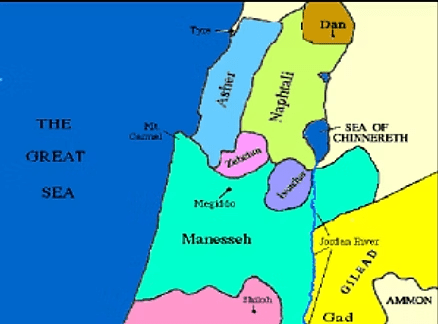
The setting now has God telling Elijah, “Go now to Zarephath, which belongs to Sidon, and live there.” Zarephath was a “Phoenician village that belonged to Sidon and was located in the northern extremity of Canaan.” Its name means, “Workshop For Melting And Refining Metals” or “Smelting Place.” Sidon was a “town a little over a day’s journey north of Tyre.” Based on the name meaning, “Sidon” was a “Fishery” or a “Place Of Fish.” Zarephath was between the two towns, but under the rule of Sidon.

One way to look at Zarephath is as a place where raw ores and other materials were placed in a furnace and transformed from separate solids to a unified molten liquid.  This liquid would then be poured in shapes, such as ingots and bars, for easy handling and shipment elsewhere.  The production of refined [purified] metals [most likely iron alloys] was hard work, with danger being ever-present from accidents from burning by molten rock or crushing under raw materials being offloaded and transported from a nearby pier [perhaps how the widow woman became a widow?].  Because it was the possession of Sidon [a larger seaport town], it could have smelted more valuable metals, such as gold, copper-bronze, tin-lead or any of the ancient iron alloys, depending on the number of smelting furnaces that were built there.  The symbolism of God telling His Prophet to “live there” should be realized as that where the metal of the widow woman’s heart would be tested for purity.

It also should be recalled that Jesus traveled to Tyre (Matthew 15:21), where he was confronted by a Canaanite woman that pleaded with Jesus to heal her demon possessed daughter (Matthew 15:22). Jesus said he had only been “sent for the lost sheep of Israel.” (Matthew 15:24) The woman begged for help, causing Jesus to say, “It is not right to take the children’s bread and toss it to the dogs.” (Matthew 15:26) The woman agreed and then said, “Even the dogs eat the crumbs that fall from their master’s table.” (Matthew 15:27) Jesus was amazed at her having spoken via the Holy Spirit and said, “Woman, you have great faith! Your request is granted.” That story then says, “her daughter was healed at that moment.”

Because that story was of Matthew saying, “Jesus withdrew to the region of Tyre and Sidon” [Phoenicia], the implication could be that the mother traveled to Tyre to find Jesus, having left her daughter in Sidon, but the whole region had once been the land allotted to the Asher tribe.  It became an “alloy” of Israelite, Hittite, and Canaanite blood.

When God sent Elijah to the same region, the land that was once given by God to the Israelites had long been ceded to the neighboring Hittites, who later became the Sidonians and Phoenicians. This region is then symbolic of the outward reach of the Israelite faith, which remained true to Yahweh amid Gentile influence. Just as God sent Jesus into that mixed land, at a time when Jesus was sought by the evil rulers of the land, so too had God previously sent Elijah into the same mixed land for the same purpose of avoiding those searching for him.

When we read, how God told Elijah, “I have commanded a widow there to feed you,” the story obviously does not play out as if the widow woman had received any divine orders from God. Therefore, the Hebrew word translated as “I have commanded” (“ṣiw·wî·ṯî,” from “tsavah”) is better understood as, “I have put” or “I have committed a widow there to feed you.” The implication is a statement of God knowing the commitment of a devoted servant in that region, whom God would allow to serve Him through Elijah; further protecting Elijah, through a woman whose life was committed to following God’s Commandments.

Once Elijah reached the entrance into Zarephath and saw the widow there gathering sticks, one needs to know that the land was near the end of a three and one-half year drought. Rather than picking up vegetables and things growing in a garden, the widow was picking up the death that surrounded Zarephath as sticks were then plentiful. It should be understood that sticks (from “‘ê·ṣîm,” wood from trees) would have been used to feed the furnaces.  It would not be unexpected to find a woman gathering sticks for that purpose.  However, during a period of drought, the smelting operations would probably have been curtailed, if not shut down completely, to avoid a wildfire burning down the village.

When Elijah asked the woman to bring him a cup of water, she immediately began going to the well, which had not gone dry. One needs to see how water symbolizes emotions, so when God appeared in the form of Elijah asking the widow to produce the emotions of faith, she was prepared to readily show God her love.

Because the widow woman did not hesitate when asked to serve Elijah a cup of water, God had him then command, “Bring me a morsel of bread in your hand.” One needs to see how bread is more than simply food that keeps human beings alive. It is the nourishment that comes from faith and is shared with those of the same faith. When it was instructed to come from her “hand,” God wanted the widow woman to share her own encouragement with a stranger, beyond showing her love of God.

When we hear the widow woman say, “As the Lord your God lives,” that was a confession of faith. By adding, “I have nothing baked, only a handful of meal in a jar, and a little oil in a jug; I am now gathering a couple of sticks, so that I may go home and prepare it for myself and my son, that we may eat it, and die.” That confession said she said she was unprepared to serve encouragement to anyone beyond her own family, which was just her and her son.

The meal symbolized the Torah and the oil symbolized those who were anointed by God as the blood of Israel. The sticks would burn as an altar fire, with death being self-sacrifice.

The assumption could then be made that her husband had died leaving his wife and their young child with enough physical foodstuff to last through three years of famine. Elijah then arrived when that inheritance had dwindled to one last supper. Death was then their sacrifice of themselves to God, in thanks for all they had already received. The husband [like Ruth’s departed Mahlon – meaning “Sickly” or “Great Infirmity”] had left behind the Laws of Moses as his only possession. While that had kept the widow and son alive until Elijah’s arrival, she had not foreseen prolonged life on earth.

When God spoke to the widow woman through Elijah, saying “Do not be afraid; go and do as you have said,” the widow was told not to fear death. She was to go and prepare for herself and her son to die, but that would not be soon. She was going to die, as all mortal human beings die … eventually, but her soul had just been assured eternal life, with God’s command through Elijah.

When Elijah then said to the widow, “First make me a little cake of it and bring it to me, and afterwards make something for yourself and your son,” the implication was asking her to make more bread than the woman had said she had left.  There is a change of request made, from “a morsel of bread” (from “paṯ-le·ḥem“) to now a “small cake” (from “u·ḡāh qə·ṭan·nāh).  From unleavened flatbread [implying hand me one of your scrolls of text] to a cake of risen bread [implying the fullness of knowledge that comes from the Holy Spirit], God had Elijah ask the woman to share her knowledge of the meaning of God’s laws, because she had then been touched by a divine presence.

Just as Jesus remarked to the Canaanite woman, “Woman, you have great faith! Your request is granted,” the faith of the widow woman of Zarephath has also been blessed.  The Holy Spirit fell upon her.  She was no longer an unmarried widow, as she was one with Yahweh, her Lord.

This is then the miracle of Jesus feeding the multitudes (twice), before that event occurred.  While Jesus had this same effect of marrying God to His devoted lovers, in numbers of five thousand and four thousand [minimally], each one that was touched by Jesus [as him through his disciples] was exactly like the widow woman touched by Elijah.  In all cases, it is God telling His devotees, “Prepare for eternal life by not fearing death by first serving others before you serve yourself, trusting that I [God] will provide for all My [His] children.”

This reading ends by stating: “For thus says the Lord the God of Israel: The jar of meal will not be emptied and the jug of oil will not fail until the day that the Lord sends rain on the earth.” She went and did as Elijah said, so that she as well as he and her household ate for many days. The jar of meal was not emptied, neither did the jug of oil fail, according to the word of the Lord that he spoke by Elijah.”

That says it was Yahweh speaking through Elijah. The Law of Moses and the anointed of God will not be emptied [disappeared from the world] before new emotion falls upon the land [the rainwater of God’s love]. The widow woman followed the instruction given to her by God’s Prophet. She never once questioned how a miracle could happen. She never doubted that Yahweh lived. Just as the widow who put all she had into the Temple treasury boxes [to feed the poor], the widow woman of Zarephath also gave everything she had to God.

In return, she was promised eternal life.

As an optional Old Testament reading for the twenty-fifth Sunday after Pentecost, when one’s own personal ministry for the LORD should be underway – one should be willing to die without losing one’s faith in God – the message here is God knows His flock. He watches over them all and sees who needs Him to appear before them as a Prophet. Strangers will come when true Christians need reinforcement and strength, to keep one’s spiritual emotions high and to give all you have to other Christians that bring orders from God.

In many Old Testament texts where a prophet is recognized as such, but not known by name, the address given to them is read as “Man of God.” It was a title of respect for the position. The widow woman did not make such an address to Elijah.

That says she only recognized him as an Israelite, but since all Israelites were expected to be men and women of God, she acted without pretense as any Israelites making demands on her during a famine would have found the same responses of service. This also says that Elijah did not travel to draw attention to himself [especially when Ahab was hunting for him], which Jesus pointed out the scribes did.  He said they wear their long robes in the marketplace, meaning that made sure the common people knew what rank they held upon their arrival.  They took advantage of the poor without concern for their lives.  Elijah did nothing of the sort.

In the optional reading from Ruth, the conclusion said the women gave Naomi a name in Hebrew that proclaimed “A son have been born to Naomi.” The son [Obed] was actually born to her daughter[in-law] Ruth, who married Naomi’s kinsman Boaz. Naomi took that son to her bosom and nurtured it, which caused her women friends to name her as a wet-nurse. Naomi was not a wet-nurse, but a woman much like the widow woman here. She helped Ruth much like Elijah helped the widow woman and her son – Elijah took them to his bosom and nurtured them, so the bloodline of God would grow strong and remain pure.

In this way it is vital to see oneself [regardless of human gender] as the widow woman. The assumption always seems to be of an old woman, but the human age [like gender] does not matter. We are all women looking for a husband’s redemption, where redemption means having all one’s debt be assumed by one who had the means to pay that off. Our debts are our sins and the only one who can forgive those debts is God. We must find a way to please God so He will marry each of us; but for that to happen we must be totally committed to pleasing God.

The widow woman was submissive to God when He appeared in the form of His Prophet Elijah. We must likewise be willing to hear the commands of God and obey as good wives. When we prove our devotion, God will show us how the bread and oil will not run out.  The basic materials of faith will give rise to new knowledge that must be shared with others. The child born to each of us, through marriage to God, will be Jesus Christ. We will take him to our bosoms and nurture him forever.

In return, we will be promised eternal life

1 Samuel 1:4-20 – Hannah prayed and Eli made fun of her; but Yahweh answered

On the day when Elkanah sacrificed, he would give portions to his wife Peninnah and to all her sons and daughters; but to Hannah he gave a double portion, because he loved her, though Yahweh had closed her womb. Her rival used to provoke her severely, to irritate her, because Yahweh had closed her womb. So it went on year by year; as often as she went up to the house of Yahweh, she used to provoke her. Therefore Hannah wept and would not eat. Her husband Elkanah said to her, “Hannah, why do you weep? Why do you not eat? Why is your heart sad? Am I not more to you than ten sons?”

After they had eaten and drunk at Shiloh, Hannah rose and presented herself before Yahweh. Now Eli the priest was sitting on the seat beside the doorpost of the temple of the Lord. She was deeply distressed and prayed to Yahweh, and wept bitterly. She made this vow: “Yahweh of hosts, if only you will look on the misery of your servant, and remember me, and not forget your servant, but will give to your servant a male child, then I will set him before you as a nazirite until the day of his death give him to Yahweh all the days of his life. He shall drink neither wine nor intoxicants, and no razor shall touch his head.”

As she continued praying before Yahweh, Eli observed her mouth. Hannah was praying silently; only her lips moved, but her voice was not heard; therefore Eli thought she was drunk. So Eli said to her, “How long will you make a drunken spectacle of yourself? Put away your wine.” But Hannah answered, “No, adonai, I am a woman deeply troubled; I have drunk neither wine nor strong drink, but I have been pouring out my soul before Yahweh. Do not regard your servant as a worthless woman, for I have been speaking out of my great anxiety and vexation all this time.” Then Eli answered, “Go in peace; welohe of Israel grant the petition you have made to him.” And she said, “Let your servant find favor in your sight.” Then the woman went to her quarters, ate and drank with her husband, and her countenance was sad no longer.

They rose early in the morning and worshiped before Yahweh; then they went back to their house at Ramah. Elkanah knew his wife Hannah, and Yahweh remembered her. In due time Hannah conceived and bore a son. She named him Samuel, for she said, “I have asked him of Yahweh.”

——————–

This is the Track 1 Old Testament selection to be read aloud in churches following the Track 1 course in Year B, on the twenty-fifth Sunday after Pentecost [Proper 28], according to the lectionary for the Episcopal Church. If read, then it will be followed by an additional reading from First Samuel, which is the song of Hannah, including the verse: “My heart exults in Yahweh; my horn is exalted in Yahweh.” That set will precede the Epistle reading from Hebrews, where Paul wrote, “since we have confidence to enter the sanctuary by the blood of Jesus … let us approach with a true heart in full assurance of faith, with our hearts sprinkled clean from an evil conscience and our bodies washed with pure water.” All will accompany the Gospel reading from Mark, where it is written: “As Jesus came out of the temple, one of his disciples said to him, “Look, Teacher, what large stones and what large buildings!” Then Jesus asked him, “Do you see these great buildings? Not one stone will be left here upon another; all will be thrown down.”

I wrote about this reading selection the last time it came up in the lectionary cycle (2018) and I posted those views on my website at that time. A copy of that commentary can be read by searching this site. I welcome all to read what I wrote then, as everything presented is still valid as instructional today. I will state that in 2018 I was more trusting of the text read aloud in Episcopal churches, than I am now. I see a need to correct the translations so the truth can be known. In that endeavor, one will note how eleven times in this reading the proper name Yahweh was translated as (thus to be read aloud) “the Lord.” This reduces the value of the name Yahweh and should not be done. Additionally, verse eleven has been presented as the true Word, when it is a paraphrase. In that paraphrase the proper name of Yahweh is eliminated altogether, while adding the word “nazarite,” along with words that imply Hanna promised no consuming of alcohol. I have stricken out the false text and replaced it with a true translation into English. Finally, the words “adonai” and “elohim” have been obliterated in translation; so, I have restored the Hebrew text.

I will address these changes first. Then, I will add new insight into this reading selection, before showing how it fits into a theme established by the other reading selections for this Sunday. By reading my 2018 commentary and comparing it to todays, a better view of Scripture should be gained.

In my 2018 observations, I did not place focus on the names that appear in these selected verses. The names are always important to understand, as they add depth to the story. My primary reference for name meaning from the Holy Bible is Abarim Publications. The first name is “Elkanah” [or “El-kanah”], which means, “God Of Jealousy, God Of Zeal.” Strong’s translates this as meaning “God has created” or “God has taken possession.” Elkanah is the husband of Peninnah and Hannah. The name “Peninnah” means “Curler, Coral, Pearl.” The name “Hannah” means “Graciousness.” Then there is the name of Eli, who was the high priest of Shiloh; and, his name means “My God, (Yah is) High.” The name of the child that would be born is Samuel, whose name means “Name Of God.” The names of the places mentioned: Shiloh and Ramah, respectively mean: “Tranquility Town” and “Lofty Place.” In these name, I want to place focus on the three men, all of whom contain “el” in their names, which ordinarily translates into English as “God,” in some form.

According to the Wikipedia article entitle “Elkanah” the following is stated [under the heading: Lineage], “According to the Priestly Code/Deuteronomic Code only Aaronic priests/Levites (depending on the underling tradition) were permitted to perform these actions, and simply being a nazarite or prophet was insufficient.” This means that Elkanah was a Levite and a priest, able to make sacrifices in the Tabernacle in Shiloh. Eli was the high priest at that Tabernacle; and, Samuel would be left by Hannah with Eli to be trained to be a priest of that Tabernacle. As such, the inclusion of “el” in their names is not coincidence or happenstance. All three men must be considered to be “elohim” of Yahweh, which means His priestly servants, with all being Levitical obligations of their parents to be submitted into service to Yahweh. thus, they were given those names with divine purpose.

As for Elkanah, when “God” is retranslated to say “an el of Yahweh,” or “one of Yahweh’s elohim,” this makes the name say he took this service to Yahweh with fervor. The Strong’s translation that says his name means “God has taken possession” clearly becomes a statement of his soul having married with the Spirit of Yahweh, so that Spirit is the possessing factor that leads Elkanah’s life. He was without a doubt a most holy man. This would be why each year he traveled to Shiloh with his family and sacrificial animals, to offer blood to Yahweh as a sin offering. One could see this as a Passover observance, so the angel of death would not take their souls away from Yahweh. One can presume that Elkanah was the firstborn son of his parents. The Wikipedia article says the Talmud lists Elkanah as a prophet, making him be on the same list with Moses.

When this is realized here, the name from the last two Sunday’s readings from Ruth say that Naomi’s husband, Elimelech, was a priest of the Tabernacle, as a first born male son, who left Judah because he could be a high priest wherever he went, not wishing to serve wayward peoples as one who would offer sacrifices to redeem their sins. His name would then say he was one of Yahweh’s elohim, to whom his whole body and soul was a nation unto Yahweh, with Yahweh his King. Additionally, it shows the first born son of Adam was named “Ab-el,”* a name that means an el born to serve the Father (Yahweh, not Adam). Thus, Abel offered animal sacrifices (blood to Yahweh), which pleases Yahweh and Cain was not allowed to do the same.

In the name Eli, we can also see the root in Elijah, showing that both men were designated by their parents to serve Yahweh. The name “Elijah” means “My God Is He” or “God Is Yahu” (where “Yahu” is “Jehu,” meaning “Yah Is He”) thus, “Elijah” means “I am possessed by Yahweh as one of His elohim.” The same is implied in the name Eli, as “I am a possessed elohim (of Yahweh).” This means Eli was a true high priest, as he was not just holding down a day job (like so many priests in Christian churches today), so when he heard what Hannah said about her prayer, he was not just sprinkling some holy water on her and handing her a wafer to eat when he said, “Go in peace; welohe of Israel grant the petition you have made to him.” Those words were Yahweh speaking through His servant Eli.

In the use of “welohe,” which is a combined form that adds “and” to “elohim,” Eli said, “and I say “Go in peace” as one of Yahweh’s official hands on the earth, one of His elohim, who Retains Yahweh as His elohim [the meaning of “Israel”]. This was Yahweh telling Hannah her silent prayer was heard; and, after Eli had spoken as a human guard of the Tabernacle in Shiloh, insulting Hannah by using his human brain, Yahweh is now apologizing for him, to you. This change in demeanor needs to be seen as an elohim not always being the best representative of Yahweh as could be; but it shows Yahweh will access His servants in times of need.

In the naming of Samuel, having previously in Year B read about his role with David and Saul, we realize he was a more attentive elohim of Yahweh. The name Samuel also means “Heard Of God,” which is why we read Hannah saying the reason for the name given is “I have asked him of Yahweh.” That specifically names “Yahweh,” while saying “Samuel” means “Heard Dedication to Yahweh, to be one of His elohim.” Samuel was able to hear the voice of Yahweh, unlike Eli. Eli had Yahweh speak through his lips, but his inability to hear Hannah’s prayer, only seeing her lips move, he was unable to hear divine communications. Samuel was able to hear Yahweh’s voice, therefore able to convey Yahweh’s messages, just as was Jesus [a name meaning “Yah[weh] Will Save]. It should be realized that Samuel would be the last judge of the Israelite people, before David. Eli would fail Yahweh because he could not punish his mortal sons (both priests); and, Samuel also had sons who were not able to be divine as was his soul.

In the translation that I have stricken through, as it is not written in the Hebrew text [checking multiple Hebrew references], the words written as “then I will set him before you as a nazirite until the day of his death. He shall drink neither wine nor intoxicants, and no razor shall touch his head,” they are a paraphrase. What is written is a promise to “give a male son to Yahweh [not written in translation as “the Lord”] for as long as he lives. The aspect of “He shall drink neither wine nor intoxicants” is also not written. These are the translators assuming Hanna promised her son to be dedicated to a “nazarite” life, where these traits are stated in Deuteronomy 6. As the Wikipedia article on Elkanah states, relative to being “a nazarite,” that is merely a physical expression of one’s beliefs, not a guarantor of one’s soul in marriage to Yahweh. So, lots of Jewish priests can not trim their beards or heads and abstain from drinking alcohol, while not being able to do blood sacrifices in the Temple. That alone does not make them Yahweh elohim.

In this reading from First Samuel, the element of being able to hear the voice of Yahweh is missing. Eli could speak for Yahweh, through divine possession of his soul by Yahweh. He therefore offered a prophecy that would come true. The reading from Daniel, as the Track 2 Old Testament offering, tells of Yahweh speaking to Daniel in a dream. Coming from Daniel’s twelfth (and last) chapter, Daniel was no longer the young prophet who won the trust of Nebuchadnezzar, as he was old in years. His dream vision with audio matches the prophecy of Joel, who said, “Your old men will dream dreams.” The point is one who is an “el” of Yahweh [“Daniel” means “Judge Of God” or “God Is My Judge”] is a conduit of prophecy, due to the marriage of one’s soul to Yahweh and a commitment in marriage to serve Yahweh wholly.

The prophecy spoken to Daniel by Yahweh is seen as an “End Times” prophecy, such that the theme stated in that reading is related to a them stated in John’s Apocalypse. In the same way, when Paul writes in Hebrews about a “second coming,” people who do not have their souls married to Yahweh see lips moving, but cannot hear the truth. Christians who wait until the End Times for Jesus to return are missing the fact that Jesus has already returned in Apostles and Saints for two thousand years. The prophecy of Daniel is them speaking of their ignorance to hear the truth and let Yahweh speak through those silent lips.

In the Hebrews reading that accompanies this reading from First Samuel, Paul quoted Jeremiah 31:33, where the Hebrew that would have been written by Paul [the letter is named “Hebrews”] would have said in an English translation: “But this covenant that I will make with the house of Israel [“He Who Retains Yahweh as one of His elohim”] after days, those speaking as Yahweh, “I will put my law in their mind and written on their hearts, and they will be My elohim and they will be My people.” The English translation from a Greek reproduction of the Hebrew written by Paul becomes translators trying to read the lips of Paul, thinking whoever wrote this Hebrews epistle must have been drunk on new wine. They totally miss the truth that was told and set before them.

In the Gospel reading from Mark, where Jesus told his disciples of major changes to come to the Temple of Jerusalem and those who called themselves believers, Christians today read those English translations and think of the End Times, making this Gospel selection be more in-line with the reading from Daniel. They fail to see the misunderstanding of divine text, in the same way Eli did not hear what prayer Hannah was speaking to Yahweh. The lesson to be learned from Eli is he let Hannah speak, after he ridiculed her wrongly. When he heard what she said, Yahweh flowed through his being and gave a blessing to Hannah. Certainly, Eli learned from his mistake. Hopefully modern Christians can do the same.

As a reading to be read aloud on the twenty-fifth Sunday after Pentecost, when one’s own personal ministry for Yahweh should already be well underway, the lesson is to pray to Yahweh and offer one’s soul up in marriage to Him. Then, one needs to look for the sings and listen to the voice of Yahweh coming to oneself [a “self” equals a “soul”] and hear Yahweh answering prayers. One is not put into the worldly realm to be given special privilege over others. Hannah was mistreated for years because she was barren. She prayed to be fertile, where the symbolism for a reader today is to stop crossing your legs [proverbially], asking Yahweh [“the Lord” to fake Christians] for everything in the Wish Book, while doing nothing to help anyone other than oneself. Until one becomes a Yahweh elohim, one is refusing to hear the voice of Yahweh and have faith in Yahweh. One cannot enter ministry as less than a Yahweh elohim, as only Yahweh can lead one to do His Will and bring others to do the same.

———-

* The name “Abel” is not read in this manner. It is instead translated as “Habel” or “Abel,” as one word, either meaning “Vanity, Breath” or “Stream.” The first two are stated to be the meaning of the son of Adam.

1 Samuel 2:1-10 – Hannah’s Psalm of thanksgiving

[1] Hannah prayed and said,

“My heart exults in Yahweh;

my strength horn is exalted in Yahweh.

My mouth derides my enemies,

because I rejoice in my victory.

[2] “There is no holy one like Yahweh,

no one besides you;

there is no rock like kelohenu.

[3] Talk no more so very proudly,

let not arrogance come from your mouth;

for Yahweh is el of knowledge,

[Yahweh] by him actions are weighed.

[4] The bows of the mighty are broken,

but the feeble gird on strength.

[5] Those who were full have hired themselves out for bread,

but those who were hungry are fat with spoil.

The barren has borne seven,

but she who has many children is forlorn.

[6] Yahweh kills and brings to life;

he brings down to Sheol and raises up.

[7] Yahweh makes poor and makes rich;

he brings low, he also exalts.

[8] He raises up the poor from the dust;

he lifts the needy from the ash heap,

to make them sit with princes

and inherit a seat of honor.

For the pillars of the earth are Yahweh‘s,

and on them he has set the world.

[9] “He will guard the feet of his faithful ones,

but the wicked shall be cut off in darkness;

for not by might does one prevail.

[10] Yahweh! His adversaries shall be shattered;

the most high will thunder in heaven.

Yahweh will judge the ends of the earth;

he will give strength to his king,

and exalt the power of his anointed.” [פ]

——————–

This is the accompany reading that falls in the category of a “Psalm” because it is a song of Hannah. It therefore will be read aloud in unison or sung by a cantor on the twenty-fifth Sunday after Pentecost [Proper 28], Year B, according to the lectionary for the Episcopal Church. It will follow the story of Hannah in First Samuel, which says, “Her rival [‘sister wife’ Peninnah] used to provoke [Hannah] severely, to irritate her, because Yahweh had closed [Hannah’s] womb.” This set will be read loudly in churches following the Track 1 path and precede the Epistle reading from Hebrews, where Paul wrote, “Let us hold fast to the confession of our hope without wavering, for he who has promised is faithful. And let us consider how to provoke one another to love and good deeds, not neglecting to meet together.” All will accompany the Gospel selection from Mark, where it is written: “For nation will rise against nation, and kingdom against kingdom; there will be earthquakes in various places; there will be famines. This is but the beginning of the birth pangs.”

The above translation, which the Episcopal Church says comes from the NRSV, is presented without verse numbers supplied [for whatever reason, since the NRSV supplies verse numbers]. I have placed the appropriate verse numbers in bold type, within brackets. In addition, there are nine times the proper name “Yahweh” was translated by the NRSV as “the Lord.” That is not the meaning; so, I have restored “Yahweh” in bold type. In verse three, Hannah wrote “Yahweh” twice, but the second time is changed by the NRSV to say “and by him.” This is a lie. So, I have restored the name “Yahweh” in bold type, within brackets. Next, a Hebrew word is translated as “strength,” when the word written means “horn.” I have stricken out the bad translation and replaced it with “horn.” Finally, in verses two and three are uses of “kelohenu” and “el,” both of which were translated by the NRSV as a capitalized form of “God.” That too is wrong; so, I have restored the Hebrew text as written. All will be explained in the verse-by-verse breakdown I will now add.

In verse one, I have stricken out the translation that says “strength.” I have done this because the Hebrew word written is “qeren,” transliterated in the text as “qar·nî,” with the meaning being “my horn.” While the use is acceptable as a figurative word denoting “strength,” such as a ram’s horn reflects that, one cannot think Hannah all of a sudden got big muscles because Yahweh answered her prayer and allowed her to get pregnant and deliver a son named Samuel. Thus, the word is used to denote a “horn” that is used as “an oil flask.” This means Hannah praises the fact that her soul had been anointed by Yahweh, so she became “raised up, on high, or exalted” because “Yahweh” became the possessor [“my”] of her soul, through an outpouring of His Spirit. The “strength” she needed to become pregnant was from “Yahweh.”

In the same first verse, the use of “leb,” transliterated as “lib-bi” (adding the possessive as “my” to “heart”), states the reality that this word reflects on the “inner being, mind, and will.” The “inner being” is the soul. This means Hannah pronounced: “my being rejoices Yahweh.”
[Nothing is written that adds a preposition to “Yahweh,” such as “in”]. This says the presence of Yahweh with Hannah’s soul immediately became an elevation of spirit that led to singing songs of praise and thanksgiving. This explains why this song is written. The words flow forth from the “horn” of Yahweh then within her being.

When this view of “horn” is realized, then the continuation of verse one says the rejoicing of words that flow from Yahweh through Hannah come out her “mouth.” Without expressing words, Hannah’s “mouth” made a “smile.” This smile becomes an expression of happiness that cannot be removed, even when in the presence of “enemies.” It is a constant elation that is caused by the outpouring of Spirit from Yahweh, which made Hannah smile with rejoicing because she had her prayer answered by Yahweh.

The conclusion to verse one is poorly stated as “because I rejoice in my victory.” While Hannah was happy being a mother, the Hebrew states, “because I rejoice in your salvation,” where the “your” is a designation of Yahweh. The root Hebrew word for “salvation” is “yeshuah,” which should be seen as the root of Jesus’ name, with the name “Jesus” meaning “Yah[weh] Saves.” Rather than read this as Hannah flaunting her “victory” in the face of others, as “my salvation,” nah nah nah nah nah; it should be sung as her not only having conceived a male son (Samuel), but her soul had been promised salvation by the possession of Yahweh’s Son merged with her soul. This proclaims she was reborn herself, as Jesus within her soul.

Verse two is then misleading to show Hannah singing, “There is no holy one like Yahweh.” While that is a truth that can certainly be assumed, it is not what is written. The literal translation of the Hebrew says, “nothing is sacred Yahweh.” There is no comparison to be made [such as “like”]. The clear statement is “nothing is sacred” or “nothing is holy.” The name “Yahweh” is then a statement by itself of holiness. Thus, the intent and meaning is Hannah avowing that “no one is sacred” unless his or her souls have married “Yahweh.” Only by divine marriage of a soul to Yahweh’s Spirit can the holiness of Yahweh be expressed in the material realm. It says all flesh is “nothing;” and, without Yahweh married to a soul (a natural state of being from birth), this says “no one is holy.” Only a divinely led soul can emanate holiness through dead matter; and, such a soul must have come into union with Yahweh.

That is the meaning of the following words that sing, “none besides you,” which must be known that the word translated as “besides” also means “except.” Anyone who is without Yahweh is unholy and not sacred (a natural state of being from birth). This means people can dress up like priests all they want; but if their souls are not married to Yahweh, then they are “except” or “not” holy or sacred. Thus, verse two then concludes by singing that a truly sacred one becomes “a rock” of stability and certainty, when that soul has been transformed into one of Yahweh’s elohim – His angels in the flesh, or His “gods” given His powers on earth.

When verse three is shown to translate as saying, “Talk no more so very proudly, let not arrogance come from your mouth,” this hints at what Hannah actually said. The literal translation repeats the word “gə·ḇō·hāh” [root “gaboah”], which translates as “high, exalted.” This repetition is omitted by translating it as “very proudly.” The words written literally sing, “not many speak high exalted , let come no arrogance from your mouth ; for el of knowledge Yahweh , no not are measured deeds .” This says first that the vast majority of Israelites were designated as high priests, who could speak the word of Yahweh truly. Next, it says no true high priest – a Saint – will ever speak as if their egos proudly say, “I speak for God, when I say!” That arrogance is a sign of a liar. No true Saint speaks as if he or she is Yahweh, as they are all mere servants who have no “I” to be arrogant about.

This is where the use of “el” must be read in the lower case, as a “god,” not as Yahweh. If Hannah was referring to Yahweh, she would have written that proper name. The “god of knowledge” is a Saint who is one of Yahweh’s elohim, who speaks the truth that flows through his or her mouth, as a servant to Yahweh. This makes them appear to be “gods,” but they are not; and, they will not make that claim. This is why Hannah wrote a double negative – the first in brackets and the second in parentheses – saying “no not” as to this assumption that an “el” is “God.” The only measure of Yahweh is found in humans whose souls have married Yahweh, so His Spirit has them perform “deeds” that are impossible without Yahweh in their beings.

Verse four then fairly accurately sings, “The bows of the mighty are broken, but the feeble gird on strength,” as this relates to the “no not” statement prior. It says those who pretend to be the “archers” of Yahweh, as His priests in tabernacles, they will not know the truth of Scripture. They will bend the truth to suit their feeble knowledge of divine Word, which is the only height possible to achieve, by the most advanced human brains. Those “bows” bend to the point of breaking, which is proved by their history of having said something means one thing, which then comes back as an arrow landing up their butts, proving to mean something completely different. The second half of this verse sings happily that all Scripture puts a “gird on strength,” by purposefully being written by souls married to Yahweh, so only other souls married to Yahweh will know the meaning, as “an el of knowledge.”

Verse five is misleading when shown to sing, “Those who were full have hired themselves out for bread, but those who were hungry are fat with spoil.” The literal translation sings, “satiated with bread have hired themselves out , and the hungry have ceased ; even the barren has brought forth seven , and she who has many children has become weak .” Because the story of Hannah portrays her sister wife, Peninnah, as a woman who had seven children with Elkanah, the meaning of seven goes beyond that microcosmic analysis. This verse is singing about the failure of all within the Tribes of Israel who pretend to be priests of Yahweh, when their souls refuse to marry and submit themselves to His Will.

The “full of bread” must be seen as brains that have been filled with the bread from heaven, which is the teachings of Moses. They have filled their brains with memorizations of words, while being spiritually barren of the meaning that comes from those words. Those Big Brains then make a profit from their intellectualism. Because they then teach emptiness to the children of Israel, they are no longer “hungry.” They lack hunger because of that weak sense of understanding that is taught.

Because Yahweh’s Creation was finished on the sixth day, He rested on the seventh day. This means the number seven symbolically states a time of rest has come to the Israelites, due to the weakness of the elders, unable to properly teach their children. This makes the feminine gender in “wə·rab·baṯ” – “she who has many” – reflects the wives of Yahweh [ALL souls in bodies of flesh claiming to be His children]. Those children she has given birth to in the Promised Land have become “weak” and “feeble,” completely due to them not having married their souls to Yahweh. This makes the modern lingo applied to “they who were full have hired themselves out for bread” be a perfect prophecy of the “selling of religion,” which is prevalent today; with today’s children likewise “feeble” in their faith.

Verse six is then shown to sing, “Yahweh kills and brings to life; he brings down to Sheol and raises up.” This needs to be seen not as Yahweh “killing,” so He can raise the dead, because all human flesh is death to begin with. Yahweh breathes in spirit [“rauch”] that animates that dead flesh, bringing life to dead matter. This that Hannah sings needs to be seen as Yahweh offering souls the choice to die of self-will and self-ego, in order to be married to His Spirit [become His wife]. Such self-sacrifice then assures a soul of eternal life, beyond the term limits of a body of flesh. All flesh is death in waiting, with death a certainty that comes when the eternal soul will be released. That release is for judgment, which is what happens in “Sheol.”

It is most important to realize that an eternal soul has three options after it has been released from a body of flesh that has died and is no longer able to sustain a place for a soul to reside. All options are based on Yahweh’s judgment. The first option is reincarnation, which is a soul being recycled into a new body of flesh. This says the soul did not marry Yahweh, therefore it had too many sins to allow it to become one with Yahweh for eternity. Reincarnation implies some sense of good works done will allow the soul a ‘second chance.’ The second option is banishment into the outer darkness and into the eternal fire of punishment. This implies the soul sold itself to Satan, doing sins that harmed other souls. This becomes an eternity of unavoidable torment. The third option is then salvation, when the soul had married Yahweh prior to death AND had served Yahweh as a Saint, leading other souls to find marriage to Yahweh as their path to eternal life. That option is the reward of one’s death of self, in submission to Yahweh. In that process, the death and resurrection is mirrored in one’s transformed life in the same flesh. Hannah was one so transformed, as before she had been barren, but then she was a mother whose soul knew Yahweh.

Verse seven is then shown to sing, “Yahweh makes poor and makes rich; he brings low, he also exalts.” This is a reflection of the death and rebirth that was stated in verse six. Yahweh lets one know how spiritually “poor” one’s soul is, with reincarnation being the best it can look forward to, without a spiritual transformation. A soul becomes “rich” by marriage to Yahweh and the added value His Spirit brings to a soul. One must reach the depths of human existence, which is where Hannah was when she prayed to Yahweh to listen to her plea and bargain to offer her son up as a priest of Yahweh. This song of thanksgiving says Hannah was “exalted” with her rejoicing, from having come to know Yahweh as His wife.

Verse eight is then shown to sing at first, “He raises up the poor from the dust; he lifts the needy from the ash heap, to make them sit with princes and inherit a seat of honor.” Here, the first segment says a soul is breathed into “dust,” which gives life to dead matter and allows it “to stand up.” The “poor” is a body of flesh with only a soul. The “ash” is then a symbolic statement about transformation, where the body of flesh has died of self [been burned to ash], so it has sought salvation through “need.” In the days when judges maintained the direction of Israel, to be “set among princes” means for Saints to be seen as the voice of Yahweh to lead the people. This makes a Saint be one “inclined” as the hand of Yahweh on the earth, such that such prophets would be recognized as being themselves the “seat of honor,” with Yahweh reigning within them as their King.

This then led Hannah to write, “For the pillars of the earth are Yahweh’s, and on them he has set the world.” This says those who serve Yahweh are his “pillars,” which means they are freestanding supports that connect heaven to the earth. In the story of Boaz and Ruth, the name “Boaz” means “Strength,” such that one of the two “pillars” outside the Temple of Jerusalem was named “Boaz.” Neither of those two pillars supported any physical structure above; but the pillar to the left was named “Boaz.” This is how the words of Hannah should be read. A Saint or Prophet is that support on earth that upholds the Word of Yahweh for all to see. Each should aspire to become one of Yahweh’s “pillars.”

Verse nine is then shown to sing, “He will guard the feet of his faithful ones, but the wicked shall be cut off in darkness; for not by might does one prevail.” In this is found a similarity to verse three’s presentation of “no not,” with the use of brackets and parentheses. Here, that translated as “faithful ones” is written “[ḥă·sî·ḏōw] (ḥă·sî·ḏāw),” with the repetition being of Yahweh’s “saints,” of his “pious, or kind” ones. The brackets and parentheses are marking unseen proof to these states of being. This becomes how a “Saint” cannot be determined by looks or appearances. Everything is unseen, as the brackets and parentheses indicate as asides or unspoken words.

These become “the feet” of Yahweh, as His pillars set upon the ground. They are placed on the earth as His guards of His Will. They do not need to be “guarded,” but the “wicked” do. The pillars of Yahweh on earth are sent to guard the children of Yahweh from being tricked by Satan to do evil deeds. Those are the deeds that come from “darkness,” which leads souls to eternal banishment from Yahweh. This leads to the final segment of this verse, which literally sings, “for no strength shall prevail man.” This says no “man” is capable alone to resist the influenced of Satan, thus not be tricked into wicked ways. Only when one’s soul has married Yahweh, so oneself has the strength of being a pillar of Yahweh on earth, can one resist the temptation of Satan and make his whispers become silent.

Verse ten is then shown to sing, “Yahweh! His adversaries shall be shattered; the most high will thunder in heaven. Yahweh will judge the ends of the earth; he will give strength to his king, and exalt the power of his anointed.” In this verse are more words presented in repetition, again placed within brackets and parentheses. The words repeated are “[mə·rî·ḇōw] (mə·rî·ḇāw)” and “[‘ā·lōw] (‘ā·lāw),” which draw from “rib” and “al” respectively. Those two words mean: “to strive, contend” and “upon, over, above.” This reflects a silent statement, which has been shown to be “His adversaries shall be shattered:’ but a better way of understanding this is as “those who shall contend against that from above.” These silent words follow the beginning words that loudly sing, “Yahweh shall descend.” The result will be the sound of thunder.

This verse of Hannah should be seen as similar to the words of John, who spoke of the voice of Yahweh that were heard by some, but not all. Those who could not hear the voice of Yahweh clearly said they heard thunder in the distance. That says they were not souls married to Yahweh, based on what Hannah wrote here. The meaning should be seen as a statement that when Yahweh descends to the worldly plane, His servants will clearly hear His voice of direction. Those directions will be to avoid or overcome those who contend against the truth of Yahweh, disbelieving in His presence over the people. This ability to hear and respond to that heard will then be how souls will be judged.

When Hannah wrote, “he will give strength to his king,” it should be remembered that Israel was not led by royalty at that time. We need to recall the name Elimelech means “An elohim whose King is Yahweh” [“God Is My King”]. This makes Hannah be saying the “king” of all who submit in marriage to Yahweh are those soul in submission to Yahweh as King. This is why Yahweh would tell Samuel, when he said the elders want a king to be like other nations, “I am their King.” One is not Israel [one “Who Retains Yahweh as one of His elohim”] if Yahweh is not one’s King. The strength of Yahweh is how one resists all temptations to sin and thus gains eternal life through salvation.

When Hannah’s song ends with the segment of words that have been translated as singing, “exalt the power of his anointed,” this is why I have stricken out “strength” in verse one and replaced it with “horn.” In these words is repeated the word “horn” – as “and exalt the horn of his anointed.” Again, the Hebrew word “qeren” is repeated and again it means a horn that is “used as an oil flask.” Here, it is most important to realized that one “anointed” by the “horn” of Yahweh becomes like David, and like all Saints who are souls married to Yahweh. It means His Spirit has been poured out upon those souls forever, which makes them be “Messiahs” or “Christs.” This song is a statement that Hannah was likewise a Christ of Yahweh, as Yahweh is the one who determines who His wives will be. Yahweh is able to Anoint the whole world, if the whole world were to submit to His Will.

As the accompanying song of praise to the First Samuel story of Hannah giving birth to Samuel, after having been barren, will be sung on the twenty-fifth Sunday after Pentecost. That is when one’s own personal ministry for Yahweh should already be well underway and easily understood as one’s own song of praise to Yahweh. The lesson that must be clear here is to be one of Yahweh’s Anointed, as a Christ, who is Jesus reborn. The warning is the world is led by those full of intelligence, which goes in one ear and out the other of the children listening to adult praise themselves and not Yahweh. This lack demands those like Hannah step forward and pray to things to change. The world is barren of spiritual food; and, it can only be revitalized by the presence of Yahweh in His wives on earth.

Daniel 12:1-3 – Finding everlasting life or the shame of everlasting contempt

The Lord spoke to Daniel in a vision and said, “At that time Michael, the great prince, the protector of your people, shall arise. There shall be a time of anguish, such as has never occurred since nations first came into existence. But at that time your people shall be delivered, everyone who is found written in the book. Many of those who sleep in the dust of the earth shall awake, some to everlasting life, and some to shame and everlasting contempt. Those who are wise shall shine like the brightness of the sky, and those who lead many to righteousness, like the stars forever and ever.”

——————–

This is the Track 2 Old Testament selection that will be read aloud in churches following that path on the twenty-fifth Sunday after Pentecost [Proper 28], Year B, according to the lectionary for the Episcopal Church. It will be paired with Psalm 16, which includes the verse that sings, “For you will not abandon me to the grave, nor let your holy one see the pit.” That set will precede a reading from Hebrews, where Paul wrote, “We have confidence to enter the sanctuary by the blood of Jesus, by the new and living way that he opened for us through the curtain (that is, through his flesh).” All will accompany the Gospel selection from Mark, where it is written that Jesus said, “When you hear of wars and rumors of wars, do not be alarmed; this must take place, but the end is still to come.”

I wrote about this selection from Daniel the last time it came up in the lectionary cycle (2018),; and, I posted those views on my website at that time. Those opinions can be read now by searching this site. I firmly stand behind what I wrote then and I feel they are quite appropriate today and well worth reading. Because I have already stated those views, I will not go into depth repeating what I have already said I see in these prophetic words. I will briefly touch on some points I made then, while adding some fresh perspective, focusing on how this short reading from Daniel fits into the theme of all readings for this Sunday. I welcome all to read my 2018 post and compare it to what I will now add.

In my commentaries of this 2021 Year B, I have talked much about the meaning of elohim. This is a word that means an “angel,” simply because it was elohim who Yahweh used to create the Universe. The word “elohim” is written thirty-two times in Genesis 1, each time it is translated into English as “God” [when the word is clearly plural in number, meaning “gods”]. Before there was the creation of “man,” the “elohim” could not have had any physical form. The elohim took physical form in Genesis 2, when the combination of words – “Yahweh elohim” – is found written eleven time, each relative to the making of Adam. They are therefore angles of Yahweh, which are placed in human forms as divine souls. While Satan is also an “elohim” [Job twice says Satan appeared in a meeting of the “sons of elohim”], a human soul can be possessed by an elohim and not be divinely led. Therefore, a “Yahweh elohim” is how one determines who are the wives of Yahweh, as souls married to His Spirit, becoming His angels in the flesh.

In the analysis I did of the Track 1 Old Testament reading, about Hannah, I mentioned the many names that contained the word el. Here, again, we see a name that contains “el.” That name is “Michael,” which questions, “Who Is Like God?, What Is God Like?” Those translations take the word “el” and translate it into English as “God.” The proper translation of the name “Michael” should be this: Who Is Like Yahweh as one of His angels [elohim]? Or, Who Is Yahweh Like when He possesses a human soul in the flesh [an elohim as a Saint]? In this way, the name Israel was applied to the human soul in the flesh named Jacob, elevating his soul to be one Who Retains Yahweh as one of His elohim. That is the way “Michael” should be addressed in this prophecy.

In my 2018 analysis, I mentioned how these three verses in Daniel are linked to the introductory verses of John’s Apocalypse, which is done because this vision of Daniel is seen as a prophecy still unfulfilled, as it The Revelation of John. This is then a selected reading on this Sunday because Jesus spoke of end times, just as did Daniel. In this, it is most important to see that Jesus spoke to each disciple individually, even though they sat together as a collective. In that gathering, Judas Iscariot is among those to whom Jesus spoke individually, which was not the same outcome (his ‘end time’) that was to be, compared to the other disciples. This means the “end times” are specific to each individual soul in a body of flesh, as that is the only ‘end time’ that matters. Thus, all ‘end times’ prophecy must be read as a prophecy that is relative to one’s own soul, relative to when that soul is released for judgment upon death.

This brings up the difference Jesus pointed out (in a later teaching on Mount Olivet) between the sheep and the goats. The same differences in human souls, in particular those who all claim to have some beliefs in Jesus, because the difference is that between belief and true faith. This is how this Daniel reading must be read. Otherwise, one does not see anything spoken by Yahweh through one of His divine prophets as being applicable to oneself. It is always easier to say, “This is not the End Times [yet], so I don’t need to read this as important to me.”

When we read verse one beginning by saying “At that time Michael, the great prince, the protector of your people, shall arise,” this is not the reality of that written. The literal translation into English says, “and in time it shall stand up Michael the ruler great , it stands over the sons of your people”. Rather than a “prince,” this is the possessing Spirit of those souls married to Yahweh. Because Daniel was such a soul, the designation “your people” must be seen as all souls who will be like Daniel and have their souls married to Yahweh. This means “your people” will have all be truly known as “Israel” – those “Who Retain Yahweh as His elohim” – will then “rise up” to assume the name “Michael.” That “stance” will be when souls married to Yahweh will question all who claim to be Yahweh elohim [as Jews in captivity, which will include Christians born after Jesus], “Who Is Like Yahweh through divine marriage?”

To see this as a prophecy of these modern times, one then needs to understand the prophecy saying, “all who attain to written in the book” [which is translated by the NRSV as saying “everyone who is found written in the book”]. In my 2018 interpretation, I assumed this “book” to be the Akashic Record, which would be an ethereal listing of all history – past, present, future – which a divine angle, like Michael, could access. I now see this “book” as the “written” history of “your people” [Jews, and thus Christians], which is the Holy Bible. The prophetic portions of that “book written” would be the New Testament. Therefore, the prophecy shown to Daniel is saying the “time” would come when the “standing up of a spirit that questions, “Who Will Be A Yahweh elohim?” will refer to “all” who have done as the Gospels and Epistles have said, so they will be measured by who is Jesus reborn and who is not.

In the verse that states [NRSV], “Many of those who sleep in the dust of the earth shall awake,” this does not refer to past soul, whose bodies of flesh have been long buried. Instead, it refers to all who will be living, prior to death [a personal ‘end time’], where the metaphor says “dead men walking” (from “those who sleep in the dust of the earth”) will then become “alive” in Spirit (from “shall awake”). When the verse then continues to say, “some to everlasting life, and some to shame and everlasting contempt,” this means the deaths of some people claiming to be Christians [just as in the past there were Jews having the same ‘end times’ judgments] will find some truly are souls married to Yahweh, who had given birth to His Son Jesus [as written], so as Apostles or Saints their souls will find “eternal life” with Yahweh in heaven. Many others will find they had lived lies and their judgment will be continuous reincarnations, leading their souls to experience “eternal contempt” for Yahweh, serving self rather than Him.

The final verse then says [NRSV], “Those who are wise shall shine like the brightness of the sky, and those who lead many to righteousness, like the stars forever and ever.” In this, the word translated as “wise” means “prudent,” where the intent can be seen as a willingness to receive instruction from the Christ Mind and teach others. The “brightness of the sky” is the light of the sun, which shines as the truth of Yahweh, through the soul of Jesus resurrected within a Saint. They “teach” others, just as Jesus of Nazareth taught his disciples. Those who will truly be saved will be those who enter ministry as Jesus reborn, in order to save others. Therefore, those will “lead many to righteousness,” where the numbers of Saints born into the world over time [the past two thousand years roughly now] will be like the stars hinging light into the expanse of darkness.

In this reading being compared to the others, notice how the First Samuel reading tells of the past record (prior to Daniel’s old age), when the same ‘sheep and goats’ of Israel were shown as Eli and Samuel. Eli could not hear Hannah speaking to Yahweh and belittled her prayer as the utterances of a drunkard. Samuel would be her son, who she would leave with Eli to develop him into a high priest. Samuel would “stand up” to be a judge of the people. Eli would have two sons who were lousy priests; and, rather than punish his own sons for belittling the truth of an Israelite, he refused to do as Yahweh said, choosing to be judged as a failure. Both Eli and Samuel had personal ‘end times.’ One was rewarded, while the other was punished. This is the message of Daniel, shown as fulfilled in the past.

In the Hebrews reading, Paul quoted Jeremiah 31:33, where the words ‘written in the book” are translated into Greek with limitations, when are then further limited in a translation into English, so the original Hebrew of Jeremiah is not seen. We do not read Paul writing the name “Yahweh.” Instead, we read him quoting, “his is the covenant that I will make with them after those days, says the Lord: I will put my laws in their hearts, and I will write them on their minds.” Paul was writing this because the only way to have the law written in one’s heart and in their minds is to have their souls married to Yahweh and be Jesus resurrected, as the Christ Mind. The true measurement of what Paul wrote – “we have confidence to enter the sanctuary by the blood of Jesus,” where one’s real blood becomes the blood of Jesus by his soul being merged with one’s host soul, as his soul resurrected – will be as Daniel wrote. One claiming to believe in Jesus, while worshiping self over Yahweh, will be finding death brings “everlasting contempt.” Those who are truly Saints, as Jesus reborn, through divine marriage of their souls, they will have been sent into ministry as Jesus reborn and granted “everlasting life.”

As a parallel prophecy to that told by Jesus to his disciples, the Temple would be destroyed; but the Temple is not just a building. It represented a false religion where the Jews of that institution were the goats who would be separated and cast into the other darkness, where there would be gnashing of teeth. The sheep would be those, like the disciples, who Jesus warned, ““Beware that no one leads you astray. Many will come in my name and say, ‘I am he!’ and they will lead many astray.” Just like the last Sunday, when Jesus warned “Beware the scribes!” the same warning is there will be those who claim to serve Yahweh, when in fact they only sever themselves. They are the one who will lead others astray, rather than be Jesus reborn and lead others to righteousness. This becomes the future of this prophecy, which is always fulfilled and awaiting fulfillment, for as long as soul animate dead flesh.

For a reading that will be read aloud on the twenty-fifth Sunday after Pentecost, when one’s own personal ministry for Yahweh should already be well underway, the lesson is to read this prophecy as a personal prediction of your soul’s fate. The time to look into the distant future and say, “When Jesus comes again in the clouds” and “When the Rapture will punish all the evil creatures on earth and reward me” – who does nothing for anyone other than self – the reality is each and every human being has a soul that is on loan by Yahweh. When each soul is released at death [and all mortals will certainly die], then Yahweh will judge them for how long they had served Him as a submitted servant and wife. Those who have refused to see their name written in the book – the names Israel and Jesus – they will have brought on their own “everlasting contempt.” The time to hear the word and respond favorable, through self-sacrifice, is now. There can be no meaningful ministry for Yahweh without divine marriage and the resurrection of His Son with one’s soul. Without Yahweh’s Spirit, one is merely saying “I believe in Jesus,” when those lies will be revealed upon one’s ‘end time.’

Hebrews 10:11-14 (15-18) 19-25 – Hebrew transformed into Greek and English

Every priest stands day after day at his service, offering again and again the same sacrifices that can never take away sins. But when Christ had offered for all time a single sacrifice for sins, “he sat down at the right hand of God,” and since then has been waiting “until his enemies would be made a footstool for his feet.” For by a single offering he has perfected for all time those who are sanctified. [And the Holy Spirit also testifies to us, for after saying,

“This is the covenant that I will make with them after those days, says the Lord:

I will put my laws in their hearts, and I will write them on their minds,”

he also adds,

“I will remember their sins and their lawless deeds no more.”

Where there is forgiveness of these, there is no longer any offering for sin.]

Therefore, my friends, since we have confidence to enter the sanctuary by the blood of Jesus, by the new and living way that he opened for us through the curtain (that is, through his flesh), and since we have a great priest over the house of God, let us approach with a true heart in full assurance of faith, with our hearts sprinkled clean from an evil conscience and our bodies washed with pure water. Let us hold fast to the confession of our hope without wavering, for he who has promised is faithful. And let us consider how to provoke one another to love and good deeds, not neglecting to meet together, as is the habit of some, but encouraging one another, and all the more as you see the Day approaching.

——————–

This is the Epistle selection that will be read aloud on the twenty-fifth Sunday after Pentecost [Proper 28], Year B, according to the lectionary for the Episcopal Church. It will follow one of two sets of Old Testament and Psalm (or song) readings, either those of Track 1 or Track 2, depending on the path predetermined for an individual church. The Track 1 offerings will be from First Samuel, where Hannah’s story includes this verse: “Hannah was praying silently; only her lips moved, but her voice was not heard; therefore Eli thought she was drunk.” The accompanying Song of Hannah will then include this verse: “Those who were full have hired themselves out for bread, but those who were hungry are fat with spoil.” The Track 2 set will offer a reading from Daniel, which says, “There shall be a time of anguish, such as has never occurred since nations first came into existence.” It will be accompanied by Psalm 16, which sings, “I have set Yahweh always before me; because he is at my right hand I shall not fall.” All will accompany the Gospel selection from Mark, where Jesus told his disciples, “Do you see these great buildings? Not one stone will be left here upon another; all will be thrown down.”

I wrote about this reading selection the last time it came up in the lectionary cycle (2018) and I posted my views on my website at that time. That interpretation explains how so much text from an Epistle, as is that bitten off for today’s serving, becomes more written in explanation than most ‘casual’ Christians bear to read and ponder. I, therefore, presented a quick run-through of the meaning this reading conveys. I stand behind those views today, as they are still pertinent and worth study. I have made that commentary available now through this link. What I will add now is slightly different, based on the way I see Scripture today being evolved over time. I will now add some additional comments, none of which will lessen those made three years ago.

The first evolution in my thinking has occurred just recently, when the reading selections under the Epistle heading began coming from Hebrews. I have explained how I now see this text as one written by Paul, while in prison in Rome, with him writing these chapters in Hebrew, rather than Greek. His words written in Hebrew were then received by a Christian who was a Jew and fluent in Hebrew; but, more importantly, as a true Christian being the recipient of Paul’s letter, he knew the deeper truth of the Hebrew written. That person, or one with whom he shared these documents written in Hebrew, would have been the one translating (while divinely inspired) Paul’s Hebrew into his Greek. That ‘middle man’ would then be why scholars question who wrote this book that is named “Hebrews.” In this selection presented for this Sunday, Paul quoted Hebrew text, which would have certainly been a match for the Hebrew text of Jeremiah 31:33-34, which the translation into Greek would weaken – purposefully.

On a day when this reading is sandwiched between the prophecies of Daniel and Jesus, which makes one’s mind immediately jump to see scenes from some Left Behind movie, the last verse of this reading needs special attention. The NRSV has translated this to say, “and all the more as you see the Day approaching.” They capitalize the word “Day,” to place highlighted importance on Judgment Day, as an End Times event. In reality, the Greek word written is “hēmeran,” which is not capitalized. The lack of capitalization means this “day” is not one single “Day” when all will finally know Jesus is returning to judge the living and the dead. Instead, the lower case makes this be a statement that every soul animating a body of dead flesh will eventually find that dead body no longer capable of sustaining an eternal soul, so the body will return to death, releasing the soul. This is a “day” all mortals will know, at the chosen time.

Because there is no reason for Yahweh to follow the mindsets of ignorant human beings, as if Yahweh can only have His Son return one time, that makes the advent of true Christianity be reduced to the dismal state of present existence, when false shepherds tell this lie to paying customers. That makes the reality of true Saints (also called Apostles) be reduced to some humans who made names for themselves, simply by telling the people what they figured the people wanted to hear. Simply because there are fewer Saints in the world today does not mean it was that way when Christianity first began, when all Christians were Anointed by Yahweh, all reborn Saints in the name of Jesus Christ. To look for one “Day” that is always still to come, diminishes the truth that Saints were the truth of the Gospels, all being the return of Jesus into the bodies of flesh who were the souls married to Yahweh; and, Paul was such a wife of Yahweh, a Son of man in the name of Jesus.

In the first verse of this reading, the translation has Paul state, “Every priest stands day after day at his service, offering again and again the same sacrifices that can never take away sins.” This translation misses the fact that the Greek word “Kai” (capitalized) begins this statement, signifying it is of great importance to grasp. It is oh so easy to read those words and become locked into a mindset that says, “Those words talk about times long gone.” The closest American Christians come to eating sacrificial foods is when they eat beef, pork, or chicken bought at the grocery store. Perhaps, some might even consider eating a ‘kosher’ hot dog as eating blessed food? The problem comes from seeing that image and not realizing the importance of these word written, as they come from the Godhead and have lasting meaning, through all times – even now.

The Greek words written [translated from Hebrew] are this: “Kai pas menhiereus hestēken kath’ hēmeran leitourgōn,” which literally translates to say, “IMPORTANTLY all surely priest makes a stand each day performing religious ceremony”. This is a statement of truth that continues today. There are those who call themselves “priest,” or “minister,” or “pastor,” or “rabbi,” all of whom (males and females) take a daily responsibility to maintain the practices and religious dogma of a church organization. What was the Temple of Jerusalem – local synagogue system then – is now the whole that envelops all the Judeo-Christian world. They continue today, just as they continued then, practices taught to be holy and pious. [It is also worthwhile to see the word “hēmeran” written here, as this is the exact same word written in the last verse of this selection, which the NRSV saw need to capitalize it as “Day.”]

When Paul then wrote [translated into Greek], “kai tas autas pollakis prospherōn thysias,” this is another segment of words that must be realized as important. These words literally translate to say, “importantly these selves many times offering sacrifices”. In that, the word “autas” is the feminine plural form of “autos,” which means “self.” A “self” should be read as a “soul.” The same word can imply “same,” such that the “souls” of the “priests” are those being “sacrificed.” That means to be a “priest” means to give up something that ordinary people have the right to do. This, for example, could mean not mixing with the great unwashed, during one’s ‘off hours.’ There is nothing stated here about the killing of animals and the sprinkling of their blood and the serving of cooked flesh to others. Thus, it is important to realize a “priest” sees oneself as a projection of Yahweh in fine robes and set practices. That never goes out of style.

Following a comma mark [in the Greek translation], Paul then said, “haitines oudepote dynantai perielein hamartias,” which literally translates into English as: “all who never have the power to take away sins.” This says that everyone who joins a church organization [modeled after the Temple system] has done nothing and can do nothing that washes away sins of any kind. Not even his or her own sins can be cleaned by wearing robes and fancy hats. Much less can such cleansing come upon anyone who takes a wafer and a sip of wine from a priest [modern replacements for sacrificial animal parts]. This is Paul being divinely led by the voice of Yahweh within his soul to say anyone pretending to be a priest does nothing whatsoever that will eliminate sins anywhere. That is quite applicable today, just as it was when he wrote those words (in Hebrew) in a Roman prison cell.

In the NRSV translation, they present selected text in quotation marks, as it Paul were quoting Jesus. Paul never met Jesus of Nazareth physically. There were no ‘early editions’ of the New Testament circulating for him to read and memorize quotes. There were no marks written as indications Paul was quoting anything in what he wrote. The literal translation of verses twelve and thirteen say this: “here now , one on behalf of sins having offered sacrifice towards this continually , appointed in right hand who of God , this something that remains waiting until should be placed this hated of self a footstool of those feet of self”. In this, the first two words – “here now” – is a statement of Paul. Paul was there then, writing about a true “priest.” As such, Paul was “one” soul who had been an “offered sacrifice” to Yahweh, for his own sins of the past. This sacrifice is then “continual” or “perpetual,” as no sins will ever return to him. It is Paul who had been “appointed” by Yahweh to be His “right hand,” which is a statement of Paul being a Yahweh elohim. Paul was not unique, as Paul is writing to other true Christians who fully understood the meaning in the words he wrote.

That “hated” is Satan, who brings the influences to sin to a soul. The element of “feet” and a “footstool” says Satan is placed in his rightful position that does as Jesus told Satan to do, which is serve Yahweh as His elohim and get behind him. The footstool becomes the parallel to behind, as under one’s feet. It says one whose soul has become a self-sacrifice unto Yahweh (becoming His wife and begetting His Son) will always have the soul of Jesus “waiting until” it needs to defeat Satan and send a true priest into true ministry.

The translation of verse fourteen [NRSV] has Paul then writing, “For by a single offering he has perfected for all time those who are sanctified.” In this, the word “mia” means “one,” which is implied to be Jesus, as “one” sacrificed. Instead of that limitation, the use of “one” must be seen as not only being Jesus, but also the “one” who sacrifices to become Jesus reborn. When the Greek word “teteleiōken” is seen as a form of “teleioó,” stating “he has perfected” [3rd person singular active indictive], one cannot think Jesus was in need of perfection. Therefore, it is the addition [“one”] of Jesus’ soul to the sinner’s soul [“one”] that makes that divine possession be the act that “perfects, brings to an end, or completes” that which was imperfect or ongoing.

When Paul then quoted from Jeremiah’s thirty-first chapter, the verses he listed were relative to the “new covenant,” which “will not be like the covenant I made with their ancestors when I took them by the hand to lead them out of Egypt, because they broke my covenant, though I was a husband to them,” declares Yahweh.” Paul was saying the fulfillment of this “new covenant” will be when Yahweh’s Spirit is within each individual soul of his people, so each will be reborn in the name of Jesus Christ. The difference says people following the lead of priests, refusing to submit themselves to Yahweh [a “self” is a “soul”], as only those souls merged [possessed by] the resurrected soul of Jesus [a name that means “Yah[weh] Will Save”] will be the people of Yahweh.

In verse eighteen [the last of the verses listed by the Episcopal Church as optional], Paul wrote [NRSV], “Where there is forgiveness of these, there is no longer any offering for sin.” The “these” who are forgiven are those whose souls have married Yahweh and have had the laws written on the walls of their hearts and minds. That is a Spiritual presence that has nothing to do with going to see a priest in a building, one who wears fancy robes and high hats. It is a personal relationship with Yahweh. When one has been possessed by Yahweh [becoming one of His elohim] then one is forgiven once, which means no more sinning, therefore no more need to offer sacrifices of animals. One’s own soul has been sacrificed to Yahweh; and, one time means forever.

In verse nineteen, Paul wrote the word that was translated into the Greek that is “hagiōn,” translated by the NRSV as “sanctuaries.” That word is the: “Genitive plural form of άγιος (ágios).” [Wiktionary] This means the word states “saints’ or “pious people.” To translate this as “sanctuaries” is to transform a human body of flesh (with a soul) into a building, wherein abides a most divine soul. It is in those bodies of flesh that physical blood flows. Paul then called that “the blood of Jesus,” which says one’s own physical being has been transformed into that of Jesus. Jesus is a soul merged with a cleansed soul, so one’s body becomes a holy tabernacle, in which dwells Jesus, the high priest of that “saint.”

Verse twenty is then translated by the NRSV to state: “by the new and living way that he opened for us through the curtain (that is, through his flesh).” There are no parentheses in the written Greek text, meaning this is a fabrication, where the added parentheses imply an aside that was not meant to be part of the prior text. The parentheses act as a supplement to that written prior, as some form of clarification to the prior text. This is not the case.

The Greek text of verse twenty is this: “hēn enekainisen hemin hodon prosphaton , kai zōsan , dia tou katapetasmatos , tout’ estin , tēs sarkos autou”. This literally translates to state: “who he renewed ours a path new , kai living , through this curtain , here exists , of this flesh of self”. All of this follows the prior verse that ended with the name “Jesus,” meaning “who” is referring to Jesus; and, Jesus has entered into one as one’s own “blood,” in order to ‘renew one’s path.” From waywardness then come righteousness.

When one sees the word “kai” denoting it being important to realize what is “new,” the word then stated is “living.” This means the presence of Jesus’ soul within one’s own being grants one’s soul eternal life. Just as one is “living” within one’s body of flesh, so too is Jesus “living” there as well. Jesus is just not visible materially, as his soul emanates through one’s flesh, as a “veil” or a “curtain,” which is how Moses had to shield the divinity of Yahweh within his body of flesh. It means Jesus cannot be seen physically, as only one’s body of flesh can be seen. Still, Jesus’ presence becomes the halo of a Saint – unseen but present.

When Paul wrote the words translated from Hebrew into the Greek “tout’ estin,“ this becomes a statement of Yahweh, as “I Am.” The word “estin” is a form of “ego,” which is a statement of “I am, as “is.” This “is” is a statement of being that says the soul of Jesus “isnow one, as a “brother” soul attached to one’s own soul. Thus, “of this flesh” [one’s own] is one “self” the “same” as the “self” of Jesus. This is a reborn “self,” as the “same” Jesus in new “flesh.”

The NRSV then translates this as the following: “since we have a great priest over the house of God, let us approach with a true heart in full assurance of faith.” Jesus is the high priest, but the Greek word “oikos” better translates as “dwelling,” than “house.” The translation of “house,” like the translation of “sanctuaries” gives the impression of Jesus being external to oneself, as a building one can enter. The “dwelling” is one’s own body of flesh, as one’s soul has submitted to Yahweh and received His Spirit in marriage. Jesus is then resurrected within one’s soul, making one’s flesh be where his soul dwells.

The element of “heart,” from the Greek word “kardias,” is then where Yahweh will have written His laws in one’s “heart,” with the word “kardia” meaning (other than “heart”) “mind, character, inner self, will, intention, center.” This then says Jesus is the writing on the walls from Yahweh. It is also a presence that is known personally, which is an elevation of “belief” to true “faith.” That is stated in the meaning of “pistis” as being “faith, belief, trust, confidence; fidelity, faithfulness.”

All of what Paul wrote is profound, when one looks at the truth of what is written, rather than putting one’s trust in translation services, which are not married to Yahweh and divinely inspired. I welcome all readers to look at the remaining three verses of this reading on one’s own and let oneself be led to see the truth before one’s eyes. Nothing I can write can produce that in oneself. In the same way nothing greater than belief can come from reading what I say these words mean. One has to see for oneself to have a personal experience of the meaning, thus have true faith in what that meaning is. This is how believing in Jesus and Yahweh is nothing like knowing both personally. One can only come to that transformed state of being by seeking to go there. Please do that.

As the Epistle to be read aloud on the twenty-fifth Sunday after Pentecost, when one’s own personal ministry for Yahweh should already be well underway, the lesson here is to learn to read divine text divinely. That requires work and effort. It demands one seek the truth and not be content by only hearing what others think. One has to realize Paul is saying Jesus died once so Yahweh would have his soul to perpetually place into his people, as his law written on their hearts and minds. One has to be there to have true faith.

Mark 13:1-8 – Spiritual famines brought on by rulers setting snares for souls

As Jesus came out of the temple, one of his disciples said to him, “Look, Teacher, what large stones and what large buildings!” Then Jesus asked him, “Do you see these great buildings? Not one stone will be left here upon another; all will be thrown down.”

When he was sitting on the Mount of Olives opposite the temple, Peter, James, John, and Andrew asked him privately, “Tell us, when will this be, and what will be the sign that all these things are about to be accomplished?” Then Jesus began to say to them, “Beware that no one leads you astray. Many will come in my name and say, ‘I am he!’ and they will lead many astray. When you hear of wars and rumors of wars, do not be alarmed; this must take place, but the end is still to come. For nation will rise against nation, and kingdom against kingdom; there will be earthquakes in various places; there will be famines. This is but the beginning of the birthpangs.”

——————–

This is the Gospel reading to be read aloud by a priest on the twenty-fifth Sunday after Pentecost [Proper 28], Year B, according to the lectionary for the Episcopal Church. This will follow one of two sets of Old Testament and Psalms (or song) that is either Track 1 or Track 2, depending on the course predetermined by an individual church. The Track 1 path will present First Samuel’s story of Hannah, which includes this: “[Hannah’s] rival used to provoke her severely, to irritate her, because Yahweh had closed her womb. So it went on year by year; as often as she went up to the house of Yahweh, [Peninnah] used to provoke her.” That will be accompanied by the Song of Hannah (from 1 Samuel 2), which sings, “The barren has borne seven, but she who has many children is forlorn. Yahweh kills and brings to life; he brings down to Sheol and raises up.” The Track 2 option will present from Daniel 12 this vision of the things to come: “There shall be a time of anguish, such as has never occurred since nations first came into existence.” That will be followed by Psalm 16, which sings, “But those who run after others [gods] shall have their troubles multiplied.” One of these two sets will precede a reading from Hebrews, where Paul wrote, “Let us hold fast to the confession of our hope without wavering, for he who has promised is faithful.”

I wrote about this reading the last time it came up in the lectionary cycle (2018) and I posted my views on my website then. That commentary includes pictures of the Temple of Jerusalem and the proximity of the Mount of Olives, from which Jesus explained the end times to his disciples. I made clear observations that are still valid at this time; and, I invite all readers to read that publication now. It can be accessed by clicking on this link. I will not change any of my views to present here now, as I will only add new light to this topic of the end foreseen by Jesus. It must be understood that what Jesus said has not only already happened, but it reflects an ongoing prophecy that speaks to all who claim to be Christians … past, present and future.

I made observations about the Temple of Jerusalem [Herod’s Temple] in my past commentary and the literal prophecy of Jesus was the destruction of that building, which was roughly forty years in the future. It needs to be understood that everything written in the Holy Bible is applicable at all times, no matter what history came and went and leaves people questioning if the Scriptures got some thing wrong, because the words don’t match the facts known. Everything is prophetic through metaphor; and, the metaphor of the beautiful building that was a reflection of Judaic self-worship would be destroyed. Not one brick of their belief system would be left standing as it was then. When Christianity is said to be the reason for a New Covenant, then Jesus speaks of that ‘shining building on a hill’ that also cannot stand without the plan being Yahweh’s elohim, with their cornerstone being the soul of Jesus resurrected within their individual souls. Souls in bodies of flesh are therefore the “stones” of true tabernacles unto Yahweh.

It also must be realized that when Jesus said, “Many will come in my name and say, ‘I am he!’ this is the truth of the advent of Christianity. It is Christianity that would destroy the Temple system of Judaism, so “not one stone will be left upon another.” The Romans who physically destroyed Herod’s Temple were not Christians. The “many who did come in the name of Jesus destroyed everything of value in a failed religion, failed race.

When Jesus then followed that statement of truth by saying, “they will lead many astray,” that is a mistranslation. Following a separate segment of words in Greek that say, “Egō eimi,” which is a statement of Yahweh that says, “I am,” which is the truth of possession by the Spirit of Yahweh, with Yahweh speaking through the lips of true Christians, Anointed by divine marriage and reborn as Yahweh’s Son, is a separate and subsequent statement that says, “kai pollous planēsousin.” That literally translates to say, “importantly many will be misled.” This has nothing to do with the truth of Christians being filled with the Spirit of Yahweh and saying truthfully, “I am.”

The spelling of “planēsousin” is the future active indicative, 3rd person plural, form of “planaó,” which means “to cause to wander, to wander,” (Strong’s Definition) and “I lead astray, deceive, cause to wander.” (Strong’s Usage) This is then a future state in the plural, as “they will cause to wander” or “they will be misled.” This becomes the future beyond the advent of true Christianity, when the Roman Church ceased the ministry of true Saints and turned Christianity into a business model, as an exact reproduction of the Judaic system that had been totally ruined. This needs to be seen as the ongoing warning that Jesus gave, stating first, “Beware that no one leads you astray.”

That warning was stated to all the disciples who sat on the hillside of Mount Olivet, as they looked down on the Temple below. One can assume that Judas Iscariot was sitting there listening to Jesus prophesy, so the message was as valid that evening as it is now. That warning is Jesus telling twelve men (therefore all who read his words forevermore), “Do not follow a leader to ruin. A leader will not take your soul to heaven. Only you can take your soul to heaven; but to do that, your soul has to marry Yahweh and submit totally to His Will. That includes having no say in anything, so Yahweh will speak truthfully through your lips, just like He does through mine now. Yahweh will say, “I am,” and it will be the truth. However, if you let someone tell you, “I am Jesus,” and you start walking behind that person, then you will be lead to ruin by a liar. So, beware that no one leads you astray.”

This is where I wrote in 2018 about the “ego” of “I” and human being worshiping self as a god. Christianity has fallen into idol worship by elevating popes to some false level of piety. Simply by putting on fancy robes and wearing a high hat and walking with some overblown shepherd’s hook, all of that regalia has made the statement, “Look at me! I am special!” There are mega-church ministers and televangelists who beg for money to do “God’s work,” when it is all about making themselves rich off ignorant people who are too lazy to not be led astray. It is the wolves knowing which of the flock is the weakest, thus the easiest to catch and feed off of. True Christianity is each soul given the expectation to submit fully to Yahweh AND ONLY TO YAHWEH and then minister to the seekers, showing them the truth, so they too can do the same and save their souls. It takes Yahweh elohim to do this; but the presence of true Yahweh elohim will lead to fakers. The fakers know to say the words that allow the lazy to be lazy, all losing their souls in the end.

In the verse that is translated to say, “For nation will rise against nation,” the Greek word “ethnos” is repeated. That word can equally translate as “a race, people,” with the word used to denote Gentiles often. When the following segment places focus on “kingdoms” [from “basileia”], to read “ethnos” as “nations” becomes repetitious and misleading. When “race” is seen as a sign” of the future times when everyone is being led astray, look at how the world began to divide along racial lines (including the religions that denote other religions much like Gentiles), where the Jewish “race” and the Arab “race” came after Jesus left [enter Mohammed] and then they discovered the darkest parts of Africa [not Nubia or Ethiopia], where the tribal system killed people nearby or captured them and sold them into slavery. The times when the world became more migratory and mixed have led to such pitting or races against other races; and, the Black Lives Matter pretense of modern America is just another “sign” of “race” being used in hostile ways.

In the part when Jesus said, “there will be famines,” it is important to see the recent reading options from First Samuel, relative to Elimelech and Naomi, and First Kings, relative to Elijah and the widow woman, both stories placed focus on “famine.” This has to be seen as not the repetition of drought, earthquakes, and wars on an earth, brought about because human beings exist and are like wild animals, but spiritual famine. The earthquakes and wars are both physical, but the aspect of religious upheavals and wars due to religions must be seen as being relative to the true form of Christianity being led astray, due to false shepherds and hired hands.

The last verse in this reading is translated to say, “This is but the beginning of the birthpangs.” In reality, only three words of Greek are written, after a period mark that followed “famines.” Those words are: “archē ōdinōn tauta.” Those words literally state, “beginning of birth pains these.” Certainly, this forces one to understand the meaning of “ōdinōn” and how “beginning of birth pains” are relative to all the conflict Jesus mentioned prior.

The Greek word “ōdinōn” is the genitive plural form of “ódin,” which means “the pain of childbirth, acute pain, severe agony, a snare.” This makes the Greek word “archē” important to be understood as also meaning “rulers, magistrates,” with “beginning” being in the temporal sense, as a starting point. This should be seen as a word referencing the laws of races and kingdoms, where it all begins with “rules” installed by “rulers,” which have nothing to do with birthing babies and everything to do with the pain a trapped animal feels, when in a “snare.” Thus, Jesus said all the things prior would be due to the “rulers” of the world bringing about all those “pains.”

To see this Gospel reading paired with the reading from First Samuel, when Hannah was ridiculed by Eli, this needs to be seen as a reflection of how little the leaders of Christianity will have become. Eli is a reflection of a priest who offers personal opinions about those whom he oversees, having little connection to Yahweh. When he saw how distraught his words made Hannah feel, as she was talking to Yahweh, not knowing she was being judged, Eli becomes a middle mad of useless abilities. Hannah talked directly to Yahweh and her prayer was answered. Eli felt he could get into trouble somehow, by insulting a woman, saying she was drunk. Had it not been for Hannah’s need for Yahweh in her life, she might have been led astray by Eli. That says to Christians today, “Speak directly to Yahweh. Beware letting others be your go-between to Yahweh.

In the Daniel reading, it begins by stating, “At that time Michael, the great prince, the protector of your people, shall arise.” While I explain the fault of that translation, which keeps the truth from being seen, look at the name Michael, knowing that is the name of an archangel. The name asks the question, “Who Is Like God,” with an adjustment to meaning being, “Who Is An elohim of Yahweh?” When Michael “arises” within a soul, it becomes a question that asks, “Can you say “I am” as Yahweh’s elohim? Or, do you say, “I am Jesus” when you have never known Yahweh in relationship?” That question becomes key to comparing the prophecy of Daniel to that of Jesus.

In the Hebrews reading, Paul again says the “priest stands day after day at his service, offering again and again the same sacrifices that can never take away sins.” This is saying there will always be Elis holding down positions in churches. They are only there following some organization handbook of procedures and rituals, where talking directly to Yahweh for the cleaning of sins, with no new sins ever being a worry in the future, is not allowed. Such talk as that is ridiculed. The inability for a priest to explain the truth of the Hebrews reading – being Jesus resurrected within one’s soul – is why Christianity has reached spiritual famine times, when the rules are being changed to suit the needs of Gentiles, not promote true Christianity.

This reading from Mark will be read aloud on the twenty-fifth Sunday after Pentecost, when one’s own personal ministry for Yahweh should already be well underway. The lesson to be gained is to see the dangers of being led astray. Being led by anyone other than Yahweh means wandering away from the only source of truth. One must find Yahweh and talk to Him about yo0ur needs. Anything less than saying, “I need my soul saved” will be ignored. Hannah promised her soul to Yahweh, along with her son, if her prayer was answered. That is what one’s soul must say to begin a relationship of love with the God one will marry for eternity. That means one will submit and Yahweh will speak through your body of flesh saying, “I am.” Jesus will then be moving your lips and feet, so you enter ministry seeking those souls in need of salvation.

Psalm 16 – Raising a cup and singing a song in honor of one’s coming death

1 Protect me, el, for I take refuge in you; *

[2] I have said to Yahweh, “You are adonay,

my good above all other.”

2 [3] All my delight is upon the godly that are in the land, *

upon those who are noble among the people.

3 [4] But those who run after others *

shall have their troubles multiplied.

4 [4] Their libations of blood I will not offer, *

nor take the names of their gods upon my lips.

5 Yahweh, you are my portion and my cup; *

it is you who uphold my lot.

6 My boundaries enclose a pleasant land; *

indeed, I have a goodly heritage.

7 I will bless Yahweh who gives me counsel; *

my heart teaches me, night after night.

8 I have set Yahweh always before me; *

because he is at my right hand I shall not fall.

9 My heart, therefore, is glad, and my spirit rejoices; *

my body also shall rest in hope.

10 For you will not abandon me to the grave, *

nor let your holy one see the Pit.

11 You will show me the path of life; *

in your presence there is fullness of joy,

and in your right hand are pleasures for evermore.

——————–

This is the accompanying Psalm to be read aloud in unison or sung by a cantor on the twenty-fifth Sunday after Pentecost [Proper 28], Year B, according to the lectionary for the Episcopal Church. If an individual church is set upon the Track 2 path for Year B, this will be sung after a reading from Daniel 12, where it is written: “Those who are wise shall shine like the brightness of the sky, and those who lead many to righteousness, like the stars forever and ever.” That set will precede a reading from Hebrews, where Paul wrote, “Where there is forgiveness of these [sanctified by Yahweh], there is no longer any offering for sin.” All will accompany the Gospel reading from Mark, where Jesus told his disciples, “Many will come in my name and say, ‘I am he!’”

In the above translation into English, derived from the NRSV, you will note that the Episcopal Church has slightly altered the verse numbering, making verse two be shown as part of verse one, which changes verse three into verse two; and, the first half of verse four is transformed into verse three, with the second half of verse four remaining verse four. I have restored the verse numbers but placing bold type numbers within brackets, indicating the true numbering. This matches what the NRSV presents. Additionally, I have placed in italic type words that have erroneously been translated as “God” [changing a plural word to the singular number] or are misleading as referring to “God,” when that is not the intent. David knew the name of his divine Husband, which I have restored in bold type as “Yahweh.” These four uses of the proper name have been translated as “Lord,” in some way. Because David knew the difference between Yahweh [a name that needs no title lessening that name applied to Him] and a “god” or “lords.” I will explain these as each verse is interpreted.

Omitted from the translation is the announcement in verse one that this song is a “miktam,” a word whose meaning is unknown. There are six “miktam” Psalms. It is believed this means the songs are more memorial poems, as epigrams, with some saying it has similar connection to the Babylonian word “nakamu,” which means a “lid, a cover to a vessel.” When one realizes the elders of the Church who arranged this Psalm to accompany a short reading from Daniel 12, which is seen as prophetic of times still to come, to see this song as a “lid to a ceremonial container for ashes,” one can see this leans the meaning of David’s words to prophecy the most typical of end times – one’s own death. Thus, for those who say a “miktam” can be satirical, David is singing praise to Yahweh at his soul’s release, well in advance of that release coming to be. As a funeral poem of celebration, this song can be sung by all whose souls have married Yahweh.

In verse one, the word that says “preserve me” [“šā·mə·rê·nî”] leads to the word “el,” which means “god” in the lower case. It is then David referring to “me” as a “god,” which means David’s soul has married Yahweh and become one of His elohim, as one “el.” Rather than see David asking for Yahweh’s protection or preservation [keeping or watching], David is making the statement that he is “preserved” as an extension of Yahweh on earth, through divine marriage.

Following a comma mark, that statement is then explained by David singing, “I put my trust in you.” In that, the translation of “my refuge” is most accurate to translate, as David knew his soul had been “preserved” because it did not attempt to stand alone, seeking Yahweh as his helper. Instead, David submitted his soul to Yahweh fully, allowing Yahweh to envelop his soul, placing his soul within that divine “refuge” or place of safety.

Verse two then sings, “has said Yahweh “lords you” , my goodness is not apart from you .” In this, the word “adonay,” which is Hebrew stating the plural number of “lords,” not a statement in the singular, as Yahweh calling Himself a Lord. It is a word stated by Yahweh, relative to David and all souls like him, who were “lords you,” meaning as extension of Yahweh in the flesh, they could become good shepherds of the flock of Israelites, which was Yahweh’s. Therefore, the truth of that arrangement says Yahweh’s “goodness, pleasantness, agreeableness” is one with their souls. This is the creation of an aura of righteousness that emits from a Saint to those seeking Yahweh for their souls, so a commitment to His Covenant is welcomed.

Verse three then sings, “as for the sacred ones who on earth they ; the excellent ones , all whom delight of mine .” This takes the statement of verse two, as those who are “lords” of Yahweh projecting to seekers the ease of marrying their souls to Him are now “sacred ones” or “saints.” Those like David walk the earth in flesh, as those who are elevated above all others, due to the ‘halo effect.’ As a “saint” of Yahweh, all are His possessions, as His wives [the “elohim”], whose souls take great delight in that presence.

Verse four then sings, “shall be greater their pains another who hasten not I will offer their drink offerings of blood ; nor take up their names , on my lips .” In this, the Hebrew word “acher” [transliterated “’a·ḥêr”] means “another,” with the assumption being “another” means “another deity.” This should be seen as anyone whose soul seeks “another” to serve in marriage by their souls, which makes anything less than Yahweh be “another,” with no need to specify that as a “god.” The element of “hasten” means a soul [also called a “heart”] does not rapidly beat in desire [love] of Yahweh, because their lusts are in material desires. It is those desires that those souls “drink,” which offers their “blood” to a lesser idol. Thus, those who celebrate marriage to “another” will not be “taken up” and those will not receive the “name” of Yahweh [“Israelite” – “He Who Retains Yahweh as His elohim”]. Those souls will not know the “kiss” of marriage, as Yahweh will not face them.

Verse five then sings, “Yahweh part my inheritance and my cup ; you , support my destiny .” Here, “Yahweh part” must be seen as a statement that one’s soul is “part” or a “portion” of His greatness, as one of His elohim. Because that comes from self-sacrifice in divine union, one’s “inheritance” is returning to be one with Yahweh after death. The “cup” is the shared blood of marriage, which is celebrated by the cup two drink from in marriage. The one-word statement that says “you” means a soul has totally submitted to Yahweh, so there is no “me” or “we.” Only Yahweh matters. In return for that complete commitment of marriage, Yahweh will then “support the destiny of one’s soul,” which means Salvation.

Verse six then sings, “the lines have fallen in me pleasantly ; yes possession , plenty abounds .“ In this, the Hebrew word translated as “lines” can also mean “bands” or “cords,” with “bands” being the physical things worn by a prophet. This then means the difficulty in communicating with Yahweh have “fallen” or gone away. Speaking with Yahweh becomes a “pleasant” ability. The use of “yes possessions” should be seen as a soul saying “I do” in the submission of oneself to Yahweh. He is then the owner of one’s soul, which places a wife soul in His name, as His wife. In that marital arrangement, there is nothing that cannot be accomplished by a soul-wife of Yahweh in ministry. All of His power can be used, when He sees fit.

Verse seven then sings, “I will kneel to Yahweh who has given me counsel ; also in the night , he disciplines my heart .”The use of “kneel” is another symbol of submission to Yahweh, as the altar of marriage. It also denotes a position of prayerful subservience, through which Yahweh leads one through life. The use of “night” reflects upon the darkness of a world that offers no light of truth, meaning Yahweh shines light in those dark times of need. One is taught to have faith in inner guidance, where one’s soul has great love of Yahweh.

Verse eight then sings, “I have set Yahweh before me always ; for at my right hand , not I shall be moved .” In the first word’s translation as “I have set,” this is less about what one’s soul has determined to be best, but that which has been set, which one allows. Where the translation is “Yahweh before,” this must be seen as oneself wearing the face of Yahweh, which is maintenance of the First Commandment. This then says a soul married to Yahweh will “continuously” wear the face of Yahweh as one’s own. Rather than see Yahweh as one’s right hand, the meaning is one becomes the right hand of Yahweh, becoming His arm reaching out to the world. One become a hand for the right, as a wife of Yahweh. Once this commitment has been made, there will be no changing back, as no divorce is desired, nor sought.

Verse nine then sings, “thus is glad my heart and rejoices my glory ; yes my flesh will abide in hope .” Here, the use of the Hebrew word “leb” means “inner man, mind, and will,” which is deeper than simply “heart.” This is the delight a soul feels merged with Yahweh’s Spirit. The presence brings forth “rejoicing” and projects the “glory” of Yahweh for others to sense also. When Yahweh is one with one’s soul, the body of “flesh” is then the projecting presence of “hope” that seekers will find.

Verse ten then sings, “when not you will leave my soul in Sheol ; not you will place your pious , to see the pit .” Here is where David sings of death known to come to all mortals. The first word then sings of ‘when,” adding that the guarantee of the Covenant says no divorce will leave a soul alone at the time of judgment [“Sheol”]. That judgement will “not” have a negative effect on where a soul will be “placed,” as all who have been made “sacred” will join Yahweh in His realm. Never again will those souls be returned to earth, or thrown into the pit of corruption.

Verse eleven then sings, ‘you will show me the path of life abundant with joy in your presence ; pleasures at your right hand forevermore .” This sings of the Salvation promised to come after service as Yahweh’s wife and Saint on earth. The “path of life” means eternal “life,” which is “abundant with joy in Yahweh’s presence.” This is the meaning of being seated at the right hand of Yahweh, as one’s soul will have become an angel of Yahweh, to be used forever as He sees fit.

As a companion Psalm to the Daniel reading that raises the name Michael, which asks the question, “Who Is Like God?” this sings all Yahweh’s elohim will pass that call when one’s end time comes. Being sung on the twenty-fifth Sunday after Pentecost, when one’s own personal ministry for Yahweh should already be well underway, the lesson here is to realize this is a song of thanksgiving, sang by all souls who have been assured of Salvation after their mortal lives end and their eternal life go one. Verse four is the warning to all who will fear “End Times,” not once thinking they will die, making that the only ‘end time’ of significance. One must sacrifice self in submission to Yahweh and be transformed into His blood, as His servant. Ministry is only meaningful when one’s soul has married Yahweh and one does as He commands.