Tag Archives: Twenty-fourth Sunday after Pentecost

Mark 12:38-44 – Beware of the scribes who bring famine to the widows

As Jesus taught, he said, “Beware of the scribes, who like to walk around in long robes, and to be greeted with respect in the marketplaces, and to have the best seats in the synagogues and places of honor at banquets! They devour widows’ houses and for the sake of appearance say long prayers. They will receive the greater condemnation.”

He sat down opposite the treasury, and watched the crowd putting money into the treasury. Many rich people put in large sums. A poor widow came and put in two small copper coins, which are worth a penny. Then he called his disciples and said to them, “Truly I tell you, this poor widow has put in more than all those who are contributing to the treasury. For all of them have contributed out of their abundance; but she out of her poverty has put in everything she had, all she had to live on.”

——————–

This is the Gospel selection that will be read aloud by a priest on the twenty-fourth Sunday after Pentecost [Proper 27], Year B, according to the lectionary for the Episcopal Church. It will follow one of two pairings of Old Testament and Psalm readings, according the Track an individual church is on during Year B. The Track 1 pair will pull from Ruth, where it is written, “Naomi her mother-in-law said to Ruth, “My daughter, I need to seek some security for you, so that it may be well with you.”’ Psalm 127 will then be sung, including this verse: “Unless Yahweh builds the house, their labor is in vain who build it.” The Track 2 pair will offer a reading from First Kings, which says, “The word of Yahweh came to Elijah, saying, “Go now to Zarephath, which belongs to Sidon, and live there; for I have commanded a widow there to feed you.”’ Psalm 146 will follow, including the verse that sings, “Who gives justice to those who are oppressed, and food to those who hunger.” The Epistle will then follow one of those pairs, coming from Hebrews, where Paul wrote, “Nor was it [for Jesus] to offer himself again and again, as the high priest enters the Holy Place year after year with blood that is not his own; for then he would have had to suffer again and again since the foundation of the world.”

I wrote about this selection the last time it came up in the lectionary cycle (2018) and posted my interpretation on my website at that time. That commentary can be read by searching this site. I believe that observation is most appropriate for others to read now, as this Gospel reading selection is a strong reflection on the failures of all organizations that propose to worship any gods, most strongly all who profess to have belief in God (while being afraid to name Him Yahweh) and believe in His Son being Jesus. After all, it is the clothing and special privilege one’s beliefs give one, enabling them to cast judgment on everyone other than themselves. For that reason, I will not attempt to reinterpret these verses as I did in 2018. Instead, I will address this Gospel reading selection as if Jesus were sitting with me and others like me, having us all watch and be observant of the routine daily activities of churches proclaiming to be in his name today. Then, I will address how this reading is supporting the other readings for this Sunday.

I have written prior about the time I sat in a church lectionary class when this reading was discussed. When the class ended and the main church service was about to begin, the class leader – a high-ranking church volunteer – hurried off to get his reserved seat in the nave. I had to shout out to him, “What happened to the ‘all-in’ church?” He barely turned his head to tell me, “That did not work out too well.”

His flippant response paints a clear picture of what this Gospel reading selection says about today’s Church. That man identified as an Episcopalian; but the same reflection he cast is found in all denominations of Christianity. Just recently, while watching a Baptist minister’s sermon that is broadcast each Sunday morning live, via the Internet, he reminded his congregation of a visiting minister who would come soon. That visitor would speak instead of the minister, telling everyone about some mission work being done somewhere. The Baptist minister made a point of saying that future Sunday’s offering would be handed over to that visiting minister, as a gift from that Baptist church to that ministry. The preacher made a point of saying that donation was above and beyond the normal budgetary plans for that quite wealthy church. Because all denominations of Christianity have their own versions of grand churches, which come with grand monetary expectations from their congregations (tithes and gifts), the motto of those churches has to be seen as “You have to spend money to make money.” Money becomes their god of worship; and, that is the point Jesus was making in the lesson.

A wealthy relative of mine told me how his church separated from the main Episcopal Church of North America, because it elected a presiding bishop that was an openly confessed homosexual, a highest-ranking leader who believed the church should marry homosexuals. In that split, my relative’s church congregation – who most all were in agreement to split – found their church building was owned by the Episcopal Church they were splitting from; and, the church would not condone a congregation rejecting the decrees of the presiding bishop. That meant his congregation had to rent space at some other church, where they could continue to gather together where services would be held. They had to do that until the time came that they could purchase land and build a new church that would be theirs.

My relative was so influential that he helped raise over thirteen million dollars for that building, which in a couple of years became a reality. Of course, the problem was that expensive new church building became the property of the new Episcopal Church that congregation joined, in order to use that organizations name on the sign out front. Thus, my wealthy relative, like that leader of the lectionary class, was a high-ranking volunteer for a church, whose greatest asset was his elbows rubbed the elbows of people with lots of money and similar ideas about religion. This means people like them are in the class that is described as scribes; and, Jesus said to beware of them.

The scribes must be seen as those so wealthy that they are not employed by a church. More importantly to them, they have great influence on the church itself, as to what the church believes. In this sense, the wealthy man who led the lectionary class [a lawyer by profession] had great influence in what ideas and ideals governed the church he influenced. Likewise, my wealthy relative played no official role in his church, as his world of expertise was financial; but he had great influence on how the church would be managed. Both would play a volunteer role in the committees that decided who their church’s priest would be; and, that priests had to match their religious beliefs, not vice versa. Thus, it would be a church organization that would supply the applicant priests for open positions, to be chosen based on the interview questions of the vestry. This should be seen as who Jesus was speaking about, as to who should be warned to watch. They would be the ones who hired the hands who would preach, making sure all applicants of ordination saw the meaning of Scripture that matched their needs to be absolved of Mammon worship, pretending to be worshipers of “the Lord.”

A bishop of a diocese that I am well aware of was elected to fill that position, when I know for a fact he was worthless as a priest. He was chosen to be the priest of a parish because he supposedly had fundraising talents. The vestry that hired him needed a new church building built; and, their only need for a pastor of that flock was to lure in huge donors and get that building built. In that endeavor, the lowly priest eventually hired a church fundraising consulting group, who knew all the strongarm tactics of bleeding a congregation for money they were holding tightly onto, forcing them by guilt to sign pledges that would allow a bank to loan the money for church construction to begin. That priest, who the congregation would routinely whispered about, saying he orated the worst sermons they had ever heard, took credit for getting that new church built; and, he used that money success to be elected as the bishop, after the previous bishop got tired of being bishop and wanted to go play with his ‘retirement investments.’ After he became the new bishop, the COVID19 plague befell the world and he has since led his diocese to near default on everything they have gone in debt to possess. The promise of him renewing the vitality of the diocese has fallen into the reality of a church filled with hired hands that is running in panic from the threat of a virus, leaving the entire flock in danger of the wolves.
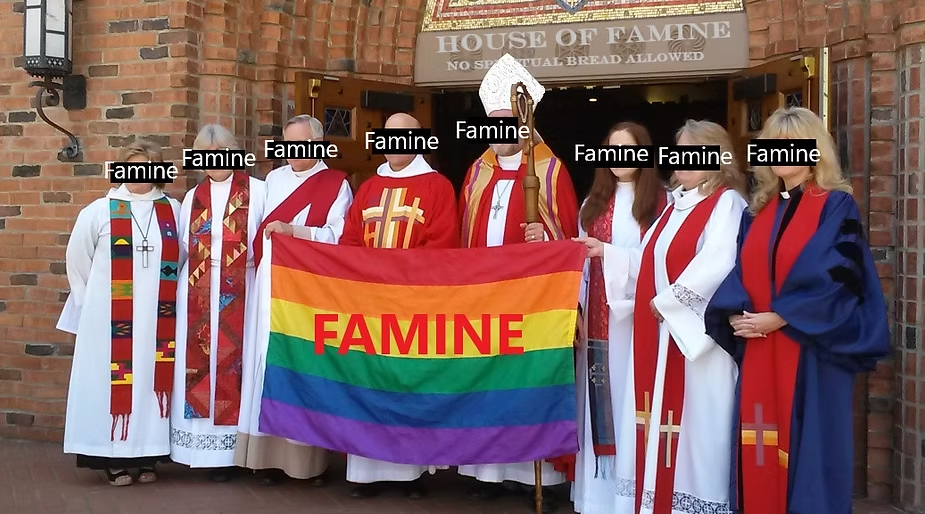
This is the warning Jesus spoke of in this Gospel reading. When he said, “[The scribes] like to walk around in long robes, and to be greeted with respect in the marketplaces, and to have the best seats in the synagogues and places of honor at banquets! They devour widows’ houses and for the sake of appearance say long prayers. They will receive the greater condemnation,” this speaks of every church that has bowed down before government mandates and forced restrictions on religious practices, because the priests and pastors who comply with the government’s mandates. They see the government as their ticket to wealth, not Yahweh. They will weather any financial storm by playing on the guilts of old women with holdings of value. Even if nobody came to church and put two cents into the offering tray, the church organization would still be valuable … only in material terms, not spiritual values.

The key term that needs to rise to the top is “widow.” That word implies one who was married, but her husband has deceased. That implication of marriage needs to be then applies to the other characters in this scene that Jesus had his disciples watch. Jesus was a soul in human flesh that was married to Yahweh. His disciples were souls in human flesh engaged to be married to Yahweh, as His bridesmaids. The widow woman was a soul in human flesh that was married to Yahweh, through her birth as a Jew. In that sense, her flesh had been married to the Judaic religion; but because that religion rejected her as having any value, she became the widow of the Temple of Jerusalem. All of the ones who took loads of valuables to deposit into the Temple treasury, they were still married to the Temple. None of their souls were married to Yahweh. That is why the widow giving two cents, which reflected everything she possessed of value (money), is the ‘all in’ church that the leader of a church I attended said did not work out too well. The Temple in Jerusalem became an example of Mammon worship, where everyone that was only partially ‘in’ was sinful. The widow, in contrast, was making a statement that said, “Take this sin away from me, because I willing give all money to the sinners, to rid myself of it as something to worship.”

In the story told in First Kings, when Yahweh told Elijah where to go and have his needs met by a widow, the place named Zarephath means “Smelter; Blast Furnace; and/or Workshop For Smelting And Refining Metals.” When Yahweh said that place “belongs to Sidon” the meaning of “Sidon” is “Fishery; Hunting Place.” This means the region was formerly of one of the Tribes of Israel [Asher], where the Israelites there were to hunt or fish for souls. Instead of spreading faith in Yahweh, the northern reaches of Asher were ceded to the Gentiles of that region [today Lebanon]. This says Elijah was sent to the remnant Israelites who suffered from famine over the land, because of bad rulers. The symbolism of Zarephath must be seen as the people laboring to turn ores mined from underground into the precious metals that produced the “large sums” that had “the crowds putting money” into the treasury. Those “large sums” were gold and silver refined by smelting places, which were turned into currencies in the Roman Empire. The widow woman only had two copper coins, which she gave willingly.

The lesson of Elijah being sent is the same lesson as Jesus being sent, as both saw the widows of a mega-church being ‘all in’ for a religion that at least says it believes in God, even though is does all its hunting and fishing for capital campaigns and ‘special offering takes’ for ministries that serve heathens, stepping all over the widows of Yahweh in those attempts to convince Yahweh to let them sit at the preferred seating around His table in Heaven [probably a table made of gold!].

The untold story of Ruth is why Naomi became a widow woman. Her husband Elimelech was the brother of Boaz; and Elimelech had sold everything he owned in Bethlehem because of a spiritual famine, which caused a time when the people were wayward and breaking the Covenant of marriage between their souls and Yahweh. Because Boaz remained [he did not buy the land sold by Elimelech], he must be seen as less willing to leave a place where sinners abound. In the story not read this Sunday, Boaz had to present his offering that would deny his inheritance, as a son of his father [who was still living], and pay the price to buy back the land that had been sold by Elimelech. In doing that, Boaz would be the redeemer relation that would restore Elimelech’s possessions, which would be those of Boaz through death. The untold story says the elders past were led to not release holdings of value; but the times had changed to those when a judge had restored faith to Israel, so the elders approved the redemption by Boaz.

This untold story needs to be seen in the Gospels that tell of Jesus, who was in essence the return of Moses and Elijah to the land that had turned away from its Covenant to Yahweh. While the marriage of Boaz with Ruth – symbolizing the marriage of a soul committed to Yahweh joining with a foreigner relation by marriage, making a union that bring forth a son of promise for the future – can be seen as Jesus joining with all the widows of Judea and Galilee, so they could be redeemed as in relationship with Yahweh. The lesson of Mark 12 is the land had fallen and was like Zarephath in Sidon, where all hunting and fishing was for silver and gold, not souls interested in marrying Yahweh. When the reading says, “Then Naomi took the child [Obed] and laid him in her bosom, and became his nurse,” Jesus was the nurse of his disciples. His teachings were what made their souls grow to love Yahweh. That made Jesus and Naomi the antheses of scribes, whose inability to properly interpret Holy Scripture led to all the failures the people would bring upon the land.

As the Gospel reading to be read aloud on the twenty-fourth Sunday after Pentecost, when one’s own personal ministry for Yahweh should already be well underway, the lesson is to realize only being a believer for show, where the truth of one’s beliefs is seeing religion as some blessing from God to get rich (a sin) and never have to pay for taking wealth from underground and worshiping it as a god. When I was told by a wealthy lawyer, “The ‘all in’ church did not work out,” that was a sinner using religion to cover all his sins in the fancy robes of a religion that can be led to bless sinners, because the wealthy own the churches. The moral of Ruth is one has to buy back – redeem – that given up, in order to be reborn and saved (redemption means salvation). Too many people call themselves Christians, when they are nothing more than Mammonites (money worshipers), in a land that cannot even pretend to offer wafers and wine sips as some blessing from God, because the government has warned them not to spread disease. By doing what the government commands, they reject a Covenant of marriage to Yahweh and spread the disease of spiritual famine across the land.

For many weeks now I have ended these commentaries by saying, “your own personal ministry for Yahweh should already be well underway,” because Pentecost Sunday is the symbolic day when one graduates as a wantabe believer in God and Jesus and actually becomes a soul married to Yahweh, reborn as His Son, sent into ministry as Jesus, in a new body of flesh that is a Christ. This Sunday is third from the last of the Ordinary after Pentecost season. Advent then begins and recycles us to preparations of our souls to receive the seed of righteousness that will be Jesus born within us [Year C]. Ministry is Yahweh’s call to marry one’s soul to Him and become His Son reborn, in order to save the world from spiritual famine. The land is in such a famine now because so many refuse to be “all in” in commitment to serve Yahweh and only Yahweh.


Psalm 127 – Building a house unto Yahweh

1 [1] Unless Yahweh builds the house, *

their labor is in vain who build it.

2 [1] Unless Yahweh watches over the city, *

in vain the watchman keeps his vigil.

3 [2] It is in vain that you rise so early and go to bed so late; *

vain, too, to eat the bread of toil,

for he gives to his beloved sleep.

4 [3] Children are a heritage from Yahweh, *

and the fruit of the womb is a gift.

5 [4] Like arrows in the hand of a warrior *

are the children of one’s youth.

6 [5] Happy is the man who has his quiver full of them! *

he shall not be put to shame

when he contends with his enemies in the gate.

——————–

This is the accompanying Psalm to the Track 1 Old Testament reading from Ruth. It will be read aloud in unison or sung by a cantor on the twenty-fourth Sunday after Pentecost [Proper 27], Year B, if an individual church is on the Track 1 path, according to the lectionary for the Episcopal Church. The Ruth reading will say, “When [Boaz and Ruth] came together, Yahweh made her conceive, and she bore a son.” That pair will precede a reading from Hebrews, where Paul wrote, “[Jesus] has appeared once for all at the end of the age to remove sin by the sacrifice of himself.” All will then accompany the Gospel reading from Mark, where it is written, “Then he called his disciples and said to them, “Truly I tell you, this poor widow has put in more than all those who are contributing to the treasury. For all of them have contributed out of their abundance; but she out of her poverty has put in everything she had, all she had to live on.”

Omitted from this Psalm 127 is the announcement at the beginning of verses one that says, “This is a ‘Song of ascents of Solomon.’” It should then be realized to not be a song of David. This is worth knowing, as in three places the proper name “Yahweh” is written [all mistranslated as “the Lord”], with Solomon not known [from his Wisdoms or Proverbs] to write “Yahweh” often. One can then assume this song was written by the boy king, before the Tabernacle was replaced by the grand Temple of Solomon, when the Ark and the Covenant was moved. As a “song of ascent” this song would have been sung by the faithful slowly proceeding up the steps leading to the “House” of Yahweh, wherever that was at the time sung.

In this Psalm 127, the NRSV clearly shows it as being five verses in length. The Episcopal Church, however, has modified this so they make it be a six-verse song. I have placed the name “Yahweh” in bold text. Additionally, I have placed the proper numbering of the verses in bold text, within brackets. I will refer to those numbers in the following interpretation.

In verse one, where it says, “Unless Yahweh builds the house,” the Hebrew word translated as “house” if “bayith.” That word most typically states a “dwelling place,” but on a broader sense it means a “family of descendants,” as those of one central relationship to one another. In this sense, Solomon was making a statement about the nation of peoples called Israel, of which he was the king. In essence, his wisdom stated it to be an accepted truth that without the “House” of Israel being created by Yahweh, the lasting ability of that nation of peoples would be nill. This means Solomon knew Israel was doomed to failure, if it did not have Yahweh as the “builder” of each and every Israelite, including himself.

As an accompanying Psalm to the story of Ruth, one needs to see how what Solomon wrote was mirrored in that story. When it is stated that Boaz and Ruth “came together,” the truth of the Hebrew written says, “when he went into her.” This clearly states the reality of sexual intercourse; but the metaphor of “entering into” must be seen as the greater statement. A soul is already within a body of flesh; but when a soul marries Yahweh, then Yahweh entering into one’s soul. This is how a “house” to Yahweh is built. Thus, when the story of Ruth then follows by stating, “Yahweh made her conceive, and she bore a son,” that states the truth that Yahweh is the builder. The “house” He built was “the son,” which reflects the Trinity that makes a “house” built by “Yahweh” be truly Holy.

The Ruth story ends by saying that the “son” who was built was named “Obed,” which means “Servant, Slave.” This says the true “house” of Yahweh is one where all family within that “house” is subservient to Yahweh. Yahweh becomes their King. The story of Ruth says Obed would lead to David, so David became a “Son” of this “house,” who was the “Beloved” of Yahweh. Solomon was not a replacement to Yahweh. Thus, a house built by a human king was prophesied by Solomon as bound to failure. The story of Ruth’s fourth chapter follows the famine that existed during the times of judges, when Israel (as a nation of peoples) had cheated on Yahweh and turned away from His Covenant – the agreement of the marriage of their souls to Him. All the down times of Israel were due to having human builders of that “house.”

When verse one continues this theme of being without Yahweh, we see how a soul married to Yahweh has a watcher who protects the “house” from unwanted influences. This has to be seen as the metaphor of the marriage between Boaz and Ruth, which made Naomi so happy. The son born became the watchman sent by Yahweh to protect the city of Bethlehem. When the elders would later go to Samuel and demand a king, to be like other nations, those other nations were not built by Yahweh’s hand. The capital cities were incapable of rejecting invading influences, which would ultimately destroy them from within.

In verse two, the element of “sleep” must be realized as being metaphor for death. To say Yahweh “gives his beloved sleep,” this means a soul in love with Yahweh has submitted itself unto Him, having died of self-importance. As such, that soul no longer needs to keep a vigil over one’s ways. Vanity comes from trying to be smart enough to rise up early and stay awake late, in order to prevent evil from entering into one’s “house.” Only through the sacrifice of “self” [a “self” equals a “soul”] to Yahweh can one enjoy a peaceful life, without worry that evil will overtake one’s “house.”

In verse three, the connection to Ruth is stated in “Children are a heritage from Yahweh, and the fruit of the womb is a gift.” It must be realized that the story of Ruth says, “Yahweh made her conceive.” This is also a statement that Yahweh controls barrenness as necessary; and, at all times He develops the fetus in the womb. It is not the hand of the mother that creates a body of flesh that will receive the breath of life [“ruach”]. The theme of barrenness in the Holy Bible says human beings are incapable of making life. Yahweh is the Creator. Without His hand in play, nothing is sacred. This means Yahweh must enter into one’s soul, in order to build a life cleansed from sins, making one able to bear good fruit.

Verse four then sings, “Like arrows in the hand of a warrior are the children of one’s youth.” This restates the message of Moses to the Israelites, before they took possession of the Promised Land [when they entered into that “house”], which was to teach their children’s children’s children. This means the watchman is the renewal of vigilance through offspring, all made by the hand of Yahweh. The war is against evil, so the souls breathed into flesh built by the hand of Yahweh becomes the arrows that shoot straight and defend the “house” from attackers [the story of Satan going to war with Job].

Verse five then sings, “Happy is the man who has his quiver full of them! he shall not be put to shame when he contends with his enemies in the gate.” This, again, restates the message of Moses to the Israelites, to have many children [be fruitful and multiply] and then teach them to save their souls, through marriage to Yahweh [when adult influences abound]. To have many children who are slaves or servants to Yahweh is truly a blessing. The shame those children of one’s youth prevent is that brought on by the acts of sin. Those warriors will shoot down all efforts by Satan to possess a soul and lead it astray. Well-trained children will prevent that failure, so a “house” will not collapse into ruin.

The story of Ruth began with the failures to uphold the Covenant, when the times of judges means forty years of waywardness, followed by the righting of the ship by a judge sent to be the warrior against evil. The marriage of Boaz and Ruth symbolized the beginning of forty years in service to Yahweh again. Still, after Jesse brought forth David into Israel, the elders were again leading the peoples to ruin. David would become the last judge of Israel, the last child born to defend the people at the gates, so evil was kept away. Everything then boils down to the realization that only the children can defeat evil, as did young David. The longer one goes in life, the weaker one becomes; so, the children are to be raised to take one’s place. This is why Naomi placed the son Obed to her bosom and nursed him. She was teaching Obed the ways of the righteous.

As a song of praise to be sung loudly on the twenty-fourth Sunday after Pentecost, when one’s own personal ministry for Yahweh should already be well underway, the lesson here is to raise one’s children to be submissive to Yahweh. That is a wonderful plan, if one’s parents had married their souls to Yahweh and drew your soul to their bosom and nursed you on moral values. The reality is we are in one great long downturn away from Yahweh. Evil is not only at the gates of the “house” of Christianity, it is the Trojan Horse that has entered the “house” and infected the body of flesh. The COVID19 fears are symbolic of this loss of faith. The religion of Jesus has collapsed into ruin, in the same way Israel and Judah fell in disgrace and shame. The salvation of the land demands individuals submit their souls to Yahweh and go to sleep and stop being the whores of society that cannot stop petting their cell phones as their god. They cannot stop checking their investments for imaginary gains of wealth, none of which will ever leave this material realm.

As the season after Pentecost approaches a close, it is time to realize there are no children defending the walls of a “house” built by Yahweh. We are headed to destruction and enslavement by overlords, thinking the whole time everything is okay. Now is the time to repent and submit totally in service to Yahweh. Otherwise, an eternity of misery will be in one’s future. Ask Solomon. He knew how vain it was to expect anything lasting, without the builder being Yahweh.

Psalm 146 – Same song, Elijah verse

1 Hallelujah! [Praise Yah!]

Praise Yahweh, O my soul! *

[2] I will praise Yahweh as long as I live;

I will sing praises lelohay while I have my being.

2 [3] Put not your trust in rulers, nor in any child of earth, *

for there is no help in them.

3 [4] When they breathe their last, they return to earth, *

and in that day their thoughts perish.

4 [5] Happy are they who have se-el of Jacob for their help! *

whose hope is in Yahweh elohaw;

5 [6] Who made heaven and earth, the seas, and all that is in them; *

who keeps his promise for ever;

6 [7] Who gives justice to those who are oppressed, *

and food to those who hunger.

7 [8] Yahweh sets the prisoners free;

Yahweh opens the eyes of the blind; *

Yahweh lifts up those who are bowed down;

8 [9] Yahweh loves the righteous;

Yahweh cares for the stranger; *

he sustains the orphan and widow,

but frustrates the way of the wicked.

9 [10] Yahweh shall reign forever, *

elohayik, O Zion, throughout all generations.

Hallelujah! [Praise Yah!]

————————-

This is the accompanying Psalm that will be read aloud in unison or sung by a cantor, if an individual church is following the Track 2 path set for the Ordinary after Pentecost season. As a Track 2 accompaniment, it will follow the reading from First Kings, where it is written: “Elijah said to [the widow woman], “Do not be afraid; go and do as you have said; but first make me a little cake of it and bring it to me, and afterwards make something for yourself and your son. For thus says Yahweh elohe of Israel: The jar of meal will not be emptied and the jug of oil will not fail until the day that the Lord sends rain on the earth.” That pair will precede a reading from Hebrews, where Paul wrote, “Christ, having been offered once to bear the sins of many, will appear a second time, not to deal with sin, but to save those who are eagerly waiting for him.” All will accompany the Gospel reading from Mark, where the Apostle wrote: “[The scribes] devour widows’ houses and for the sake of appearance say long prayers. They will receive the greater condemnation.”

Psalm 146, as I have stated before, is an important Psalm of David. In the Year B schedule, it is read on the fifteenth, the twenty-sixth and the twenty-seventh Sundays after Pentecost [Proper numbering]. It is also read twice in the Year B schedule, and partially once in Year A. As this is Proper 27, this same Psalm 146 was read last Sunday. The difference is last week it was Track 1, while now (and on Proper 15) it is Track 2. All of the changes made in the above text were presented the two times before, so nothing has changed there. The only difference now is this same Psalm of praise is applied to the story of Elijah and the widow woman who Yahweh promised would provide for Elijah.

When this is seen as an accompaniment for First Kings seventeen, this is the first chapter where Elijah is mentioned in the Holy Bible. While Elijah is identified as “Elijah the Tishbite,” a name that says “Elijah the Returnee,” it should be seen that Elijah was a judge returned to Israel, at a time when famine was great upon the land. Seeing this in that Old Testament reading makes it clear that David was prophesying by song about all who were judges [as was David] and prophets [as was Elijah], because all would have their souls married to Yahweh and praise Him mightily. This is relative to the first and last words of this song being “Hallelujah!” which means, “Praise Yah!”

In verse two the aspect of “life” or “living,” from the transliterated “bə·ḥay·yāy,” meaning “while I live,” sings praise to the eternal life promised a soul by divine marriage. It is this presence of Yahweh within, One with one’s soul, that makes a soul be experiencing the eternity of heaven while in a body of flesh. Because one is giving life to such dead matter, one has become one of Yahweh’s elohim. Thus, David sang the same praise as would Elijah, where the Hebrew word “lelohay” says “to my [being one of the] elohim.” The “my” becomes a statement of divine possession, which means a soul has fully submitting itself [a “self” is a “soul”] to Yahweh. Thus, “while I have my being” is a statement that says one will serve Yahweh as one of His elohim “for as long as my soul inhabits a body of flesh.” This must be seen as how Elijah could hear the voice of Yahweh speak to him, telling him to go to Zarephath.

Verse three then sings, “not to put your trust in nobility,” because those are only “sons of man,” not immortal or divinely married to Yahweh. In First Kings, Elijah confronted Ahab in the third year of drought. Ahab seems at times to see the divinity of Elijah, but his position as king and his marriage to Jezebel kept him from listening to Elijah. Ahab was merely a “son of man,” who would die in time, leaving no lasting legacy of merit. Thus, those who do not have souls possessed by Yahweh are unable to do anything more then shuffle matter around, usually only in ways that are only beneficial to themselves (temporarily).

Verse four then sings of reincarnation, when “departs” one from his or her body of flesh. Then the “spirit” or “soul” [“ruach”] “returns to the earth,” where “earth” equates to more flesh to be born. David sang this return ends any “plans” that might have been put in place prior to death. Keep in mind here how the Egyptians believed their nobility could return and pick up where they left off. In the case of Elijah, he died under a broom tree and then returned in the same body, without any need for mummification or special priestly chants or embalming fluids. Jesus did the same. This shows how David was led to see reincarnation as not being something mortals can control. Only souls married to Yahweh can return, as He sees fit.

Verse five then sings of those who have followed in the steps of Jacob, who wrestled with himself [a “self” equals a “soul”] and defeated the demon possessing spirit within him. His victory meant his soul was renamed “Israel” [a name meaning “He Who Retains Yahweh – as one of His elolhim”]. Thus, David sang the reward was the “hope” that comes from being one of “Yahweh’s elohim.” David was one, as a judge of the people of Israel [also named king], and so was Elijah.

Verse six then sings of Genesis 1, where thirty-two times is written that “elohim” made everything. The lack of Moses naming “Yahweh” in Genesis 1 was purposeful, as the “elohim” who made everything in the material realm were first created by Yahweh, in order to do the acts of His plan. This verse does not play directly into the Elijah story; but, Elijah, like David and all Yahweh elohim, are the creations of Yahweh. The “elohim” do not create divine wives of Yahweh; although they are the ones who demonically possess human souls, as Jacob knew.

Verse seven then makes a direct link to the First Kings story, where the famine in effect when Elijah was sent by Yahweh relates to the widow woman and her son being “hungry.” While “food” was scarce, the same word [“lechem”] means “bread.” This becomes metaphor for spiritual “bread,” which symbolizes the famine that was under the reign of Ahab and Jezebel. When David sang Yahweh “gives freedom to the prisoners,” this is the story of Elijah meeting the widow woman, who was picking up sticks to burn and make her and her son’s last meal. They were prepared to die and then release their souls from the prison of the flesh and the earthly realm. Elijah was sent by Yahweh to meet her needs, as her soul was one of Yahweh’s faithful.

Verse eight then sings of the “blind,” where this is less about not having physical sight, and more about refusing to see the lures of the material realm as the carrots on a stick or bait on a hook that attempts to steal souls for Satan. They are “blind” because their eyes are looking down, while they are “bowed down in worship of Yahweh.” This is metaphor for those who submit their souls in marriage to Yahweh, which is why David sang of “love.” It is that marriage that makes one be “righteous;” and, Elijah and the widow woman were in this classification of people.

Verse nine then sings of the rescue of the widow woman and her son, which tightly fits the story of Elijah in 1 Kings 17. As for the “wicked,” whose “ways will be turned upside down,” that will be found in the priests of Ba’al, who were imported by Jezebel and Ahab. Because Elijah would put them to shame and then death, Ahab and Jezebel swore to have Elijah killed. That did not work out the way they expected.

Verse ten then sings of the righteous being the ones who will always praise Yahweh and make sure His presence on earth is maintained through a line of “elohim.” Elijah would pass this Spirit onto Elisha, who Elijah would go find and tell. This verse sings praise for the lineage that keep judges remaining on earth to fight Satan.

As a Psalm that will be sung on the twenty-fourth Sunday after Pentecost, when one’s own personal ministry for Yahweh should already be well underway, the lesson is the same as before, when this Psalm of praise has been sung. It sings of faith that comes from a soul being married to Yahweh and acting as His servants on earth. This is the purity of ministry, which is not a position of nobility, where someone is from a bloodline of wealthy who go to the best schools and wear the finest robes after graduation from the most elite seminaries (after multiple degree of education prior). Elijah, like David, was a true teacher because his soul praised Yahweh by doing whatever He led him to say and do.