Tag Archives: Twenty-second Sunday after Pentecost

Joshua 3:7-17 – Crossing the Jordan on dry ground [Twenty-second Sunday after Pentecost]

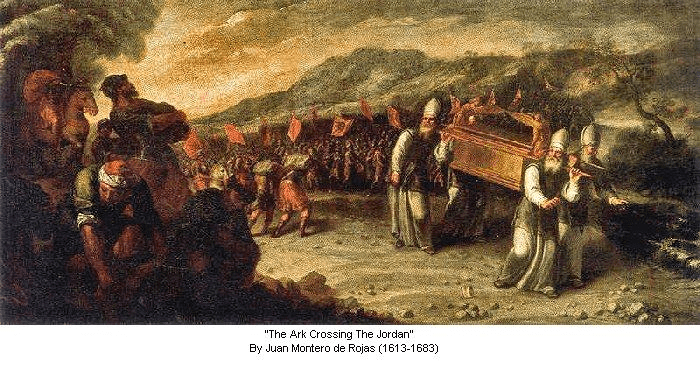
The Lord said to Joshua, “This day I will begin to exalt you in the sight of all Israel, so that they may know that I will be with you as I was with Moses. You are the one who shall command the priests who bear the ark of the covenant, ‘When you come to the edge of the waters of the Jordan, you shall stand still in the Jordan.’” Joshua then said to the Israelites, “Draw near and hear the words of the Lord your God.” Joshua said, “By this you shall know that among you is the living God who without fail will drive out from before you the Canaanites, Hittites, Hivites, Perizzites, Girgashites, Amorites, and Jebusites: the ark of the covenant of the Lord of all the earth is going to pass before you into the Jordan. So now select twelve men from the tribes of Israel, one from each tribe. When the soles of the feet of the priests who bear the ark of the Lord, the Lord of all the earth, rest in the waters of the Jordan, the waters of the Jordan flowing from above shall be cut off; they shall stand in a single heap.”

When the people set out from their tents to cross over the Jordan, the priests bearing the ark of the covenant were in front of the people. Now the Jordan overflows all its banks throughout the time of harvest. So when those who bore the ark had come to the Jordan, and the feet of the priests bearing the ark were dipped in the edge of the water, the waters flowing from above stood still, rising up in a single heap far off at Adam, the city that is beside Zarethan, while those flowing toward the sea of the Arabah, the Dead Sea, were wholly cut off. Then the people crossed over opposite Jericho. While all Israel were crossing over on dry ground, the priests who bore the ark of the covenant of the Lord stood on dry ground in the middle of the Jordan, until the entire nation finished crossing over the Jordan.

———————————————————————————————————

This is the Old Testament primary selection from the Episcopal Lectionary for Year A, Proper 26, the twenty-second Sunday after Pentecost. It will next be read aloud in church on Sunday, November 5, 2017. This is important as it tells of the Israelites’ entry into the Promised Land in the same manner that they departed Egypt, with all threats removed and the waters of emotional unbalance made dry.

It is easy to read this selection and think that God has told Joshua, “Not to worry, I’ll still be with you guys, making sure things go well for you.” But, that misses several important points that are stated in that assurance.

To read, “This day I will begin to exalt you in the sight of all Israel, so that they may know that I will be with you as I was with Moses,” the well-trained reading brain comes away thinking God said, “The Israelites will see Joshua as a big man;” but that fails to grasp God telling Joshua, “I will make you greater with the sight (or eyes) of Israel (the next place for the growth vision for a land of God’s priests).”

The Hebrew words “gad·del·ḵā bə·‘ê·nê” say, “to magnify you in the sight.” This is then a promise to “grow” the “sight” of Joshua, in the same way God gave “eyes” to Moses, through his prophetic dream state visions. The promise now says that Joshua will have the same talents of prophecy, as this is how God speaks to His prophets; but it still says that the Israelites will see this comparison to Moses in Joshua.  So, the Israelites will follow the lead of Joshua in the same manner.

Now, beginning in verse 8, the words “ark of the covenant” (“’ă·rō·wn hab·bə·rîṯ”) are found. That combination of words is then repeated (in variations) two more times (verses, 11 and 17), with “ark” stated alone, in verses 13 (“the ark of the Lord of lords”) and 15 (“the ark”). It should be noted that repetition is not to make one’s eyes tired, but to alert one to an important element being stated.  That awareness becomes important in this reading selection.

If one watches the plethora of programming on The History Channel, about “Ancient Aliens,” or if one reads any of the number of books that attempt to solve the mystery of the Holy Grail, one invariably comes across wild conjecture about the ark of the covenant. Some say, if you follow the directions given in Exodus 25 (verses 10 through 22) and repeated in Exodus 37:1-9, then you end up with a highly charged conductor of energy. The addition of a requirement that it should never be touched, thus carried by wooden poles, is another aspect of some device having been created that has super powers.

As ancient alien theorists believe, it connects to a spaceship somewhere, and God is more like the Wizard of Oz … just some guy behind a curtain.

The point I want to make about the carrying of the ark of the covenant into the ankle-deep waters of a swollen Jordan River, causing it’s waters to separate and the ground to be exposed and become instantly dry, a larger body of water was likewise effected by Moses and his staff. With all the mystery about the missing ark and if the Knights Templar found it and stole away with it, where is the mystery over the loss of the staff of Moses? Would Moses have been buried with his staff, when that staff had such amazing powers?

Perhaps it was not the staff as much as it was God. In the same way, perhaps it was not so much the electrical properties of a gold-plated cedar chest, but the presence of God in the holy men carrying those wooden poles (horizontal staffs). What if the ark of the covenant was symbolic of the powers of God, when He is placed inside a human body?

Imagine the diodes of the heart causing highly charged spiritual energy being fed through neural wires leading to the hands, eyes, ears, mouth, and of course … feet.

Anyone see the science fiction movie about a woman who accidentally gains psychokinetic powers, Lucy? I digress.

Not Lucy.

When we read or hear read, “Joshua then said to the Israelites, “Draw near and hear the words of the Lord your God,” this means he told them “the conditions set forth that must be met, coming from the LORD your God.” The Hebrew word “diḇ-rê” (root debar) means “speech” or “words,” but is also translatable as “commandments, conversations,” and ”conditions.” These “words” or “commandments” do not demand the Israelites recognize God had them craft a machine, in which to carry the stone tablets, as a chest that was radio-controlled from outer space and could zap anyone at will.

Joshua announced he was speaking as Moses had, allowing the words of the Lord God of Israel to use his voice to sound Spiritual instructions. We then see the conditions that were set said nothing immediately about an ark doing anything. Initially, we read that “Joshua said, ‘By this you shall know that among you is the living God who without fail will drive out from before you the Canaanites, Hittites, Hivites, Perizzites, Girgashites, Amorites, and Jebusites,’” The part that says “living God” is vital to grasp, as an ark is made of non-living materials.

“Among you is the living God” means “God is alive within you,” so the Israelites were the ones who had the power of God. It means that those human beings who were “without” that power within them (all those specifically named), they would “fail” to defend the land they had lived on. It would not be an ark leading the victories, as victories would be won by those with God’s power within them. Joshua, speaking “the words of the LORD,” then named all those tribes of people who were “without” the Holy Spirit, whose lands would be lost to the Israelites.

In a verse that precedes the selected verses above, in Joshua 3:5 is found: “Then Joshua said to the people, ‘Consecrate yourselves, for tomorrow the Lord will do wonders among you.”’ This order said to take steps to sanctify themselves and to take the necessary steps to be holy means the Israelites were prepared to be filled with God’s Holy Spirit.

The words translated as “the LORD will do wonders among you” can be read as “the LORD inwardly to be extraordinary.” As such, when Joshua gave instructions to the priests who carried the ark of the covenant (verse 3:6), where they were told to pass by the Israelites and lead the crossing with the ark of the covenant. The Israelites were filled with the Spirit of God within them, just as the ark contained their agreement with God inside it. That made the ark of the covenant symbolize those who followed it were empowered by the LORD.

When we read then in verse 11, “the ark of the covenant of the Lord of all the earth is going to pass before you into the Jordan,” and in verse 13, “the Lord of all the earth, rest in the waters of the Jordan,” we find repeated “the Lord of all the earth.” The Hebrew word “eretz” means “earth, lands, or world,” such that the LORD is not simply a deity that rules over all humanity; but God created everything material, of which human bodies are formed and of which lands and their rivers are made. Therefore, God is the LORD of all anomalies of physics (metaphysics?), including those that stand still flowing waters and force them back, making wet soil become immediately dry.

In the Old Testament reading of Proper 25, where Moses was told by the LORD, “You will not pass over there,” as reference to both his going across the Jordan River and his passing over from life to death, the same meaning can now be seen here in Joshua 3.  The words translated as “passing before” (“‘ō-ḇêr lip̄·nê·ḵem”) are repeated in some variation, multiple times.  Joshua 3:1, 3:4, 3:6 [not read in this selection], plus Joshua 3:11, 3:14, 3:16, and 3:17, state either “passed” or “before” or both.

The root words are “abar panim,” or “pass over to face.” This, again, is a hidden statement about the First Commandment that says, “Thou shall wear no other face as a god in the presence of the LORD.”

This acts as a confirmation that the priests – one from each of the twelve tribes [or “two and ten men from the tribes of Israel”] – were filled with God’s Holy Spirit. By not being limited as Levites, the priests of the tabernacle in which the ark of the covenant was kept, choosing “ordinary Israelites” demonstrated they all were holy, by having a love of the LORD in the chest [their ark] that was their hearts. Therefore, all of Israel had consecrated themselves, so the face of the LORD passed over theirs, so all had the same face of holiness.

This then leads to the statements, “When the soles of the feet of the priests who bear the ark of the Lord, the Lord of all the earth, rest in the waters of the Jordan” and “when those who bore the ark had come to the Jordan, and the feet of the priests bearing the ark were dipped in the edge of the water,” where “feet” become a focus. This brings back in mind the Psalm quoted by Jesus to the Pharisees (110:1), in the Proper 25 Gospel selection: “Sit at my right hand, until I put your enemies under your feet,” or “until I make your enemies a footstool for your feet.”

The Hebrew word translated as “your enemy” is “’ō·yə·ḇe·ḵā,” where an “enemy” is a “foe” or “adversary.” When Joshua named the tribes of Canaan who would “fail” before the “living God of Israel,” he was naming the “enemies” who would become “the footstools under the feet” of God’s priests. Thus, they would be defeated by God, with the priests being God’s agents, who were given the powers of the LORD.

As the LORD of the world, nothing material could overcome this power, meaning not even a swollen Jordan River could oppose the children of God entering into the lands the LORD had promised them; and, as with the difficulty factor of escaping Egypt in the face of a great sea, no earthly barrier can be a match for those who bear the power of the LORD.  Anything is possible to the LORD.

Because we read, “the waters of the Jordan flowing from above shall be cut off; they shall stand in a single heap” and “the waters flowing from above stood still, rising up in a single heap far off at Adam, the city that is beside Zarethan, while those flowing toward the sea of the Arabah, the Dead Sea, were wholly cut off,” after we read of the “feet” in the Jordan, this feat cannot be attributed to the ark of the covenant.  It was “the feet” of those carrying the ark of the covenant that entered (barely) the waters of the Jordan.  Because of that realization, one needs to see the subsequent actions involving water to be attributed to the human factor as the cause, more than the mechanisms of the ark of the covenant.

Consider how the wayward Israelites (under the priest Eli) had caused the loss of the ark of the covenant to the Philistines (1 Samuel 4). They lost it because they thought using the ark would bring about victory; but the ark had no effect that day in battle, when 30,000 foot soldiers died, the ark was captured and two sons of Eli (tabernacle priests) died. Without the human factor, where the Israelites became like the ark of the covenant, filled with the love of the LORD and the powers He bestows, the ark of the covenant is only a reflection of whose face one wears as a god before the LORD.

Then, the Israelites wore their own faces and depended on Eli, who had two sons committing atrocities that he would not punish.  They had turned away from God, selfishly.  The Palestinians wore the face of Dagon, their idol god, before which they placed the prize ark of Israel.  That act provoked the LORD, we are told (1 Samuel 5), and the Philistines would rue that act of putting the idol of another god before the LORD.

Ancient alien theorists don’t give much thought to this negative power that surrounded the ark of the covenant. If the ark of the covenant were some amazingly powerful energy generator, why would water be stopped, when water is a conductor of electricity? Why were the priest not electrocuted, once their feet touched the water? In the hypotheses of the Templar Knights, if they had found the ark of the covenant AND THEN STOLEN IT, would they not soon realize the same negative powers of an angry God, so the plague-ridden remainders of those knights would have left the ark out in the open land of southern France with a sign on it saying, “Do not touch unless you are a Saint”?

The point here is the power of God was in His priests, who bore the sacred chest that held the sacred tablets that represented the total commitment of the Israelites to the LORD their God. That love consecrated them, so their faith turned back the waters of the Jordan, in the same manner that the faith of lepers, blind men, possessed people, and the lame equally created miracles, as told in the Gospels. Jesus was a totally committed human, who represented the reappearance of the ark of the covenant, which had been lost by the time the Israelites lost the Promised Land [the Covenant broken was no longer stored away]. Therefore, Christians can make water (symbolic for emotions) “stand in a heap,” as the conduits of God’s powers on earth.

When we are then told the extent of the cessation of waters flowing, “rising up in a single heap far off at Adam, the city that is beside Zarethan,” this needs to be grasped both physically (actual locations) and spiritually (why those places bore those names). Here is a map that someone who has written about Joshua has posted online:
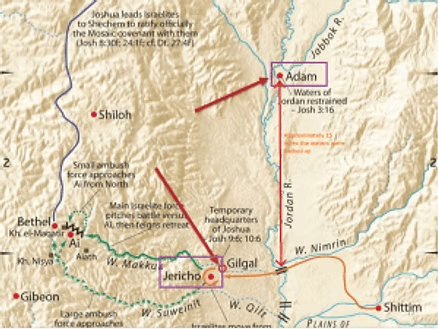
This map shows the physicality of what is stated. The Wadi Nimrin represents a dry ravine during the dry season, but since the text states, “Now the Jordan overflows all its banks throughout the time of harvest,” the wadi would have been flowing a lot of water into the Jordan, causing it to overflow its banks. Just north of Adam is the Jabbok River, which flows into the Jordan, and just to the south is where the Wadi Tirzah had its confluence. The sheer size of this area affected (15 miles roughly) must be seen as a necessary space that could accommodate a great number of Israelites.  If that many who were filled with the Holy Spirit of God were ready along the banks of the Jordan, awaiting Joshua’s commands of the LORD, the feet touching far away to the south would have started a backwards flow northward.

On a deeper level of thought, my opinion (which will not be found commonly stated in scholarly interpretations of Joshua) is that one has to ponder what the presence of the two names and what that means. All names presented in the Holy Bible are symbolic statements of meaning. Names were not made up because they sounded funny or cool back then. Names stood for people, places, and things for reason and purpose; and that reason and purpose needs to be examined here.
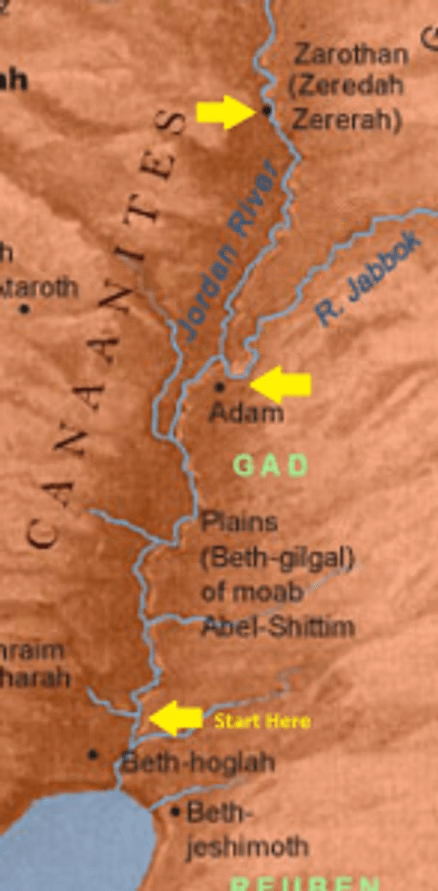
It does not take a biblical rocket scientist to see the name Adam and think of the Son of God, the one who used to live in the “eretz” (“land”) called “the garden of Eden.” Of course, little-a “adam” is Hebrew for “man,” but some say the word implies “red man,” or even “mud” (I assume “reddish clay”). In that case, the name of a place known as “Adam,” could be because of the muddy land surrounding it, where two rivers join – like a red delta. Still, after Adam and Eve were found to have sinned, they were cast out of Eden, with God placing cherubim to the east of Eden. Such a place where Adam could have begun to toil, working the land, could very well have been where this place named Adam was. The purpose of the name was that settlement identity.  While outcast, Adam might have still wanted to stay close to his old home, so he only went as far as just beyond where he was no longer allowed.

Now, the name “Zaretan” [a.k.a. “Zarethan”] means “the Fortress” or “Narrowness of Dwelling Place,” according to Abarim Publications. The map above shows where a place named Zaredah was located, and this is presumed (by some) to be the same place as Zaretan. As this location is about as far away from Adam (north), as Adam was from the crossing point opposite Jericho (south), it is not near and certainly not “beside” it.

In that regard, the word written (“miṣ·ṣaḏ”) means “beside, to the side,” or “an arm of.” This means the reference to “from the city” (“hā·‘îr“) means Adam was a place of “excitement,” as “towns” are (from “iyr”).

In the picture above, the southern tip of the land between the Jordan River and the Jabbok River is to the eastern side of Adam.  That land appears like an arm reaching down, with its hand almost touching the “town” of “Adam.” This can then be seen as defining that land as a “Narrowness of Dwelling Place,” with purpose and reason behind that name. As such, Zaretan can be read as descriptive of a delta formation of land that is next to the city (or town) that was Adam; and that could infer that Adam, the son of God, toiled that earth, from that place of “excitement.”

Beyond Joshua making a statement about how far north the Jordan River backed up, the symbolism states a claim that this crossing is into holy land, which is then backing up the flow of time, to the time when Adam lived in Eden, prior to his expulsion. It says the ark of the covenant and the Israelites filled with God’s Holy Spirit are returning to their ancestral home, as Adam’s heirs, through Abraham, Isaac, and Jacob.

From seeing this statement of two names that do little more than create surface confusion, as to “Why?” the continuation that is translated as: “while those flowing toward the sea of the Arabah, the Dead Sea, were wholly cut off,” then speaks of those who had migrated into that holy land (which Joshua, as a spy, had said was “flowing with milk and honey”).  To read “toward the sea of the Arabah, the Dead Sea,” where people were “wholly cut off,” the inference is cut off from that holy lineage.  The ones named held no rights of ownership.

As such, “the sea of the plain” (“yam ha-arabah”) and “the sea of salt” (“yam ham-melah”) are references to the sea of mankind that was “Arab” (“Arabah” is the Hebrew feminine form of “Arabia”). This means a statement of waters not being replenished to the south is something Captain Obvious would say, as it adds nothing of value to the miracle of waters backed up 15 miles.  The people there were “of the plain,” thus not “elevated” through consecration.  They were the “salt” of the earth, but the Salt Sea is known also as the Dead Sea, meaning the “salt” was mortal, not everlasting.  As the descendants of Ishmael and Esau, they were “wholly cut off” from knowing the LORD Yahweh.

When the reading then makes its conclusion by stating, “While all Israel were crossing over on dry ground” and “the priests who bore the ark of the covenant of the Lord stood on dry ground in the middle of the Jordan,” this element of dry ground is repeated. The Hebrew word “be·ḥā·rā·ḇāh” has that meaning, but implies a “desert.” This means more than the powers of God stopping the flow of rivers and wadis that were swollen with fall rains, backing those up 15 miles, and instantly making hard earth be under the feet of men holding the ark of the covenant. It means, despite the amount of annual rainfall, the land was void of spiritual recognition of Holy Land.  That earth was dried of all emotion for the true God, because the people had become lost.

This understanding then allows one to see the flow of living waters – spiritual waters that never need replenishing – coming back into the land that was once the garden of Eden. Without that presence of God being the source of the bounty of the land, since Adam had been cast out, and since Melchizedek, Abraham, Isaac, and Jacob had last dug wells and given life to that land, it had become a desert, as far as Spirituality was concerned. Therefore, when “the entire nation finished crossing over the Jordan,” so the garden was again in bloom. The Spirit of the LORD was being reinstated into the heart of the land, with the sacred ark becoming the central pump of the Holy Spirit to the far reaches of the Twelve Tribes of Israel.


1 Thessalonians 2:9-13 – Witnesses of Yahweh speak the truth of Jesus [Twenty-second Sunday after Pentecost]

You remember our labor and toil, brothers and sisters; we worked night and day, so that we might not burden any of you while we proclaimed to you the gospel of God. You are witnesses, and God also, how pure, upright, and blameless our conduct was toward you believers. As you know, we dealt with each one of you like a father with his children, urging and encouraging you and pleading that you lead a life worthy of God, who calls you into his own kingdom and glory.

We also constantly give thanks to God for this, that when you received the word of God that you heard from us, you accepted it not as a human word but as what it really is, God’s word, which is also at work in you believers.

——————————————————————————————————–

This is the Epistle selection from the Episcopal Lectionary for Year A, Proper 26, the twenty-second Sunday after Pentecost. This will next be read aloud in church on Sunday, November 5, 2017. This is important as it makes clear the work that is involved in being truly Christian.

To repeat what I posted previously about Paul’s letter to the Thessalonians, the statement above that says “brothers and sisters” is not what was written in this letter. The Greek word Paul wrote is “adelphoi,” which is the plural form of “adelphos” and says “brothers.” We can accept “brothers and sisters” in translation, because “brothers” was used in the epistles of Paul to denote “members of the same religious community, especially fellow-Christians.” (Strong’s) However, to translate it as both masculine and feminine Christians can become confusing, when one gets to the part where Paul wrote, “We dealt with each one of you like a father with his children.”

This is confusing because Paul treated the Christians of Thessaly “like a father.”  The deeper meaning in that statement says it was the Father’s love of Paul in him which Paul then modeled behavior from. God raised Paul to raise others like Paul, so all would have the same love of the Father within them, with all modeling their behavior after God the Father. This is why priests are addressed as “Father.”

This issue will be further addressed by Jesus in the Gospel reading that accompanies this epistle reading in 1 Thessalonians (Matthew 23:1-12). That was when Jesus made the remark that Pharisees and those of the Temple liked to be called “rabbi,” but they never taught by example. They were never the “Fathers” of the Jews, as those lowly people were raised as if they were orphans. So, when Paul said, “We dealt with each one of you like a father with his children,” all the “sisters” could be confused about what that means.

My wife is an Episcopalian priest. In seminary, she had a woman professor who was referred to as “Mother.” When my wife was ordained, the parishioners began calling her “Mother.”  In my mind, this is not a complimentary title.

Before I comment on that, let me also say that I have sat in some Episcopal churches and read along in the Prayer Book, for the Eucharist Rite II, Prayer C: “Lord God of our Fathers; God of Abraham, Isaac, and Jacob,” only to hear the priest (a male) say, “Lord God of our Fathers and Mothers; God of Abraham and Sarah, Isaac and Rebekah, and Jacob, Rachel and Leah.”

What?

I asked a different male priest, who did not make those additions for the wives of Patriarchs (Pater is Latin for Father), why some priests did and some did not. He said it was up to the priest; but it was a modern way of making unofficial changes to the Prayer Book, which took into consideration the role women play in the Church.

If that is why “adelphoi” is translated as “brothers and sisters,” then it misses the point of the Father as the teacher of His children, with Jesus Christ the Son of God, where ALL Christians are “brothers” [male and female He made them], as reborn Jesuses.  If that is why a female priest of the One God is called “Mother,” it misses the point of who is teaching, what is being taught, and how children know the difference between mommy and daddy.

It misses the point that ALL Christians are called to be “the brides of God” [male and female He calls them], with the consummation of that marriage bringing about the baby boy Jesus, with the Mind of Christ – who sits at the right hand of the Father, as the male heir to the throne – making a human being become One (a Trinity) in the flesh.

It misses the point that Christians are ALL “brothers,” because nobody speaks their sex organs as a servant of the LORD. The FATHER speaks, while Christians just open their pie holes and let the words come out.

Now, that said, let me inform whoever reads this that I had no father around when I grew up. I had a mother, and that was it. My mother did lots of things a father could do, such as go to work and leave me in someone else’s care, or go to work and leave me alone at home. Occasionally, my mother spanked me with a belt, but she never made me so afraid of punishment that I felt compelled to toe the line. In all actuality, I was allowed to do as I pleased, more and more the older I got.

My mother saw me as the “man of the house.” My mother loved me. My mother sacrificed for my benefit. My mother gave me as much as she could afford to give, and was sorry she could not give more. My friends with fathers AND mothers never had as much as I had; and as I grew older, I felt guilty for having too much … as a lower, middle-class male. (I call it middle-class because my mother bought a house to raise me in.)

From that personal historic background and experience, when I hear a priest of the LORD referred to as “Mother (fill in the blank),” it gives me the impression of one who is permissive, more than demanding.  It makes me think that “parent” is there to make all my boo boos feel better, more than tell me to get up when I fall … “Rub some dirt on it!”

Without the presence of a real father in my life (my father visited on some holidays – he was not dead, just very absent), I grew up male, but knowing very little about things boys with fathers are taught. As some model by which I could become an adult male, with eventually a wife and family and responsibilities of fatherhood, I looked to other fathers. Some were real fathers I spent time with, as a friend of their sons; and some were fictional characters on TV.

At no time did I ever learn any adult male skills from my mother. I watched other males and learned through observation.  Male teachers and gym coaches were the ones who told me how to become a man and do manly things; and I absorbed that knowledge like a sponge. Of course, my peers helped me learn too, by leading me down all the wrong paths of masculine ignorance.  Without a real father to guide me, I found trial and error was my best teacher.

In defense of my mom, she was always buying things that I was tasked to put together and she bought some tools that I could use in that effort. Indirectly, my mother taught me to read the directions first, not after you try to put something together wrong … over and over again … never thinking to read the print under the pictures.

The point that I have made in the past and still make today is this: A priest (or pastor, minister, reverend, padre, et al titles) is THE Father, via the Holy Spirit, regardless of one’s human gender. Paul said this when he wrote how he, Silvanus and Timothy had been acting like a father to his children, “urging and encouraging you and pleading that you lead a life worthy of God, who calls you into his own kingdom and glory.”

It was not those three men who were acting like fathers, because they called the Thessalonians “brothers.” They acted as “God” who was within them.  God is “who calls you into his own kingdom and glory.”

The modern Western rationale now is to find equality in the sexes (which is the same rationale that is applied to all efforts calling for equality).  This is little more than a philosophy of man that seeks (through the Big Brain) to lower those who have been artificially elevated, and to raise those who have been downtrodden. This is good when the ones pointing our all the mistakes in others comes from THE Father, and not some personal agenda.  That message, again, is the point made in the accompanying Gospel reading for Proper 26, where Jesus said, “All who exalt themselves will be humbled, and all who humble themselves will be exalted.”  He was referring to the usual suspects in Jerusalem (Pharisees, scribes, et al).

I am reminded now of the lyrics of a song written by Roland Orzabal (Tears For Fears video), about the humbling of Spain, due to its devotion to the philosophy of Salic Law and Patrilineal or Agnatic Succession, where only male heirs could wear the crown.  In two verses the song lyrics sing, “Did you know your father was an island Did you know your mother was the sea” and “Did you know all mothers come from heaven Did you know all fathers come from hell.”  The lack of a male heir in Spain was then symbolically stated as a lack of a fixed (island) and ruthless (hell) ruler, which led to the ultimate ruin of the Spanish monarchy.

The Spanish refused to make a Queen their supreme leader, as that would be recognizing Mother Spain as capable of being inspired by God THE Father.  A nation was not allowed to be ruled by changing emotions (the sea) or the nebulousness of spiritual faith (heaven) in the physical realm.

The Spanish did this (I presume) because the Pope had become their father figure, by whom Spain was raised.  The Vatican denied women the right to serve God as His priests, for Christians.  Therefore, Queens had no rights to serve God as His national rulers, over Christian lands.

That philosophy crumbled when a King of Spain sired no male heirs before dying.  The War of Spanish Succession ensued.  Because of that war, the Holy Roman Emperor, Charles IV, declared it would be legal for his daughter to become the Empress upon his death; a transition that was challenged by the War of Austrian Succession.  All the while, the English had managed to do fine with the succession of Queens, mixed with Kings.

I imagine it was the costs of wars over succession that led some to reflect on how priests of Rome could call themselves “Father,” when they were denied marriage, by edict, thus denied all capability of actually having children.  That system came tumbling down when brains began pondering, “Why can’t women be priests, if a queen can rule England?”

Still, men and women are different, or they would be called the same word (without gender application necessitating separate words). The same goes for fathers and mothers: They are different and not the same, because each was created for specific purpose, as compliments of the other.  The Commandment to honor your father and your mother recognized the equality of separate responsibilities.  Both sexes have equal value in the production of offspring and raising those children to serve a purpose.  However, anyone who exalts him or herself because of gender (this is called “Pride,” which is a Deadly Sin) is then destined to be humbled in the eyes of THE Father.

The Israelites went to Samuel and asked to be given a king, to be like other nations.  No man (and thus no woman) can ever be more than a human figurehead, because God told Samuel, “they have rejected me as their king.”  “All who exalt themselves will be humbled,” as only THE Father  leads His subjects to the true Promised Land.  Mother Earth is the ruler of the physical and material, and as harsh and/or as gentle as she can be, she can only offer ashes to ashes and dust to dust as the rewards for serving her.

This means to call oneself “Father,” simply because one is a male graduate of a seminary, ordained into a job for a religious order that brings that title of masculinity, because one is masculine, is wrong. Likewise, to call oneself “Mother,” simply because one is a female graduate of a seminary, ordained into a job for a religious order that brings that title of femininity, because one is feminine, is wrong. To deny women the right to be THE Father to a congregation is equally wrong.

It is wrong because everything religious is then reduced to the human level of gender identification, rather than being elevated Spiritually.  The trick question of the Sadducees put to Jesus, about who would be the rightful husband to the widow of seven brothers (where none produced a male heir), was answered by Jesus saying, “At the resurrection people will neither marry nor be given in marriage; they will be like the angels in heaven.”  That means the soul has no gender.  It is placed into flesh that may or may not be reproductive on earth.

Humans love attaching gender to angels. Gender is a human trait for reproduction. Angles are immortal and cannot reproduce.

The model of THE Father as being the one who sets the rules for a congregation to follow, and then fairly making sure those rules are followed – “urging and encouraging you and pleading that you lead a life worthy of God” – is God (Yahweh, the LORD). Moses did not make anything up from his own brain, such that a human male was written in stone as the only gender of humanity that could ever lead the Israelites. We know this because in the Book of Judges we are told of the Priestess Deborah, who God used to lead the Israelites back to leading lives “worthy of God.”

You might note that the Priestess Deborah was not referred to as “Mother Debbie.” She did not become a Judge of the Israelites because she knew how to raise children. Deborah was a prophet of the God of the Israelites, while also being recognized as being “a counselor, warrior, and the wife of Lapidoth.” As a wife, she presumably had babies, so that would mean she also was a mother; but her human roles, based on gender, had nothing to do with her saving the wayward from ruin. She was the physical embodiment of THE Father.

When Paul said God “calls you into his own kingdom and glory,” he did not mean a call for you to imagine your soul floating away to some magical place, where if unicorns do exist, then they run and play in heaven; and the ghost of Jesus is there to pick flowers with you, after Saint Peter allows your soul to enter that kingdom and glory, where God is the cloud that surround everyone. Paul said “God calls you.” His call is for you to be the physical embodiment of His own kingdom. Receiving that call means you become “the unspoken manifestation of God” (from the Greek word “doxa”).

To be my Brother as the Son reborn into flesh.

There is no sexual bias attached to this call “into his own kingdom and glory.” All are welcomed to open their hearts and become engaged to the LORD. Once married, your ego becomes completely subservient to the LORD. You are God’s committed wife (till death does your soul depart your flesh), so you stand to the rear as the LORD speaks out of your mouth. The LORD speaks as THE Father, just as He spoke through Jesus, as the Mind of Christ fills the newborn baby (reborn Christian) of that marriage.

In this arrangement, you are not alone. God takes on as many wives as He can afford (and He can afford every human being). You are summoned to marry God, and His proposal is that message brought by Apostles (male and female), and served as a father to his children.  Acceptance means you become “brothers” with all the other wives of the LORD. You all become like Paul and seek new Christians to raise, like a father does to his children. God calls you to be a Father, in the name of His Son, Jesus Christ.

In this way all Christians “accepted it [the words of proposal to marry God] not as a human word but as what it really is, God’s word.”  It does not matter what human form God takes, as it is not their gender uttering those words.  All words spoken by Saints come from THE Father.

Matthew 23:1-12 – The do not practice what they teach [Twenty-second Sunday after Pentecost]

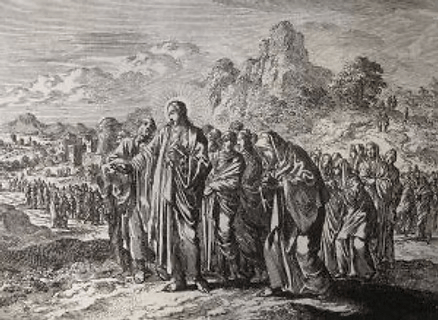
Jesus said to the crowds and to his disciples, “The scribes and the Pharisees sit on Moses’ seat; therefore, do whatever they teach you and follow it; but do not do as they do, for they do not practice what they teach. They tie up heavy burdens, hard to bear, and lay them on the shoulders of others; but they themselves are unwilling to lift a finger to move them. They do all their deeds to be seen by others; for they make their phylacteries broad and their fringes long. They love to have the place of honor at banquets and the best seats in the synagogues, and to be greeted with respect in the marketplaces, and to have people call them rabbi. But you are not to be called rabbi, for you have one teacher, and you are all students. And call no one your father on earth, for you have one Father– the one in heaven. Nor are you to be called instructors, for you have one instructor, the Messiah. The greatest among you will be your servant. All who exalt themselves will be humbled, and all who humble themselves will be exalted.”

———————————————————————————————————-

The is the Gospel selection from the Episcopal Lectionary for Year A, Proper 26, the twenty-second Sunday after Pentecost. It will next be read aloud by a priest in church on Sunday, November 5, 2017. It is important because Jesus pointed out how people who stand highly as religious leaders, in the eyes of human beings, will be humbled in the eyes of the LORD. This means the most exalted Spiritual teachers on earth will serve only God.

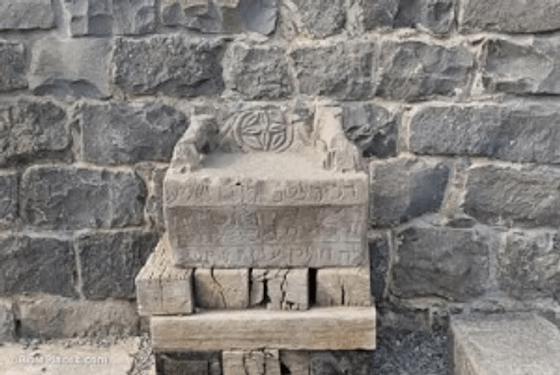
Verse two of this selection has Jesus telling his followers (both general listeners and valued assistants), “The scribes and the Pharisees sit on Moses’ seat.” This is the only specific reference to “Moses’ seat” in all the Holy Bible. Some take this statement as meaning there was some physical “seat, chair,” or “bench,” upon which Moses sat. Some say the Roman Catholic Church and the Pope now sits on that figurative “seat,” as the See of St. Peter.

Some might sell tickets in the Holy Land, for pilgrims to have their picture taken by the “seat of Moses.”

Found in Chorazin, which is just north of the Sea of Galilee … a place Moses never went.

To best understand this statement by Jesus, one has to grasp how “Moses’ seat” was a reference to the state of Judea then, where Jerusalem was a place that had been set aside for exilic Jews to play the game, “What if?”

“What if our ancestors had not lost our land?” they would say. Then they would surmise, “We would be returned to the days when Judges would be sent by God to save us.” It was the Judges of Israel, before the Twelve Tribes had a king, and before they had a powerful prophet of the LORD in Samuel, who every 80 years would snap the wayward children of Israel back from their pagan ways, getting them to remember their Covenant to be righteous in the eyes of the One God.

The Judges of Israel sat on “Moses’ seat,” just as Moses had judged the Israelites prior to their entrance into the Promised Land. Thus, “Moses’ seat” stands for “Tradition,” which is the claim the Vatican has made. The Pope and his entourage sit as Judges of Christians. Unfortunately, that makes Rome the epitome of what this Scripture says, where Jesus warned the Jews around him, “Do not do as they do, for they do not practice what they teach.”

This statement of “Moses’ seat” is best understood from careful examination of Exodus 18 (as all examination of Scripture should be … carefully done … as if one cares about the truth being revealed). Here is a link to that chapter, which the New International Version has entitled, “Jethro Visits Moses.”

Jethro was the father-in-law of Moses, the father of Zipporah, and a priest of Midian. In Exodus 18:13 we read, “The next day Moses took his seat to serve as judge for the people, and they stood around him from morning till evening.” (NIV) The actual Hebrew states, “way·yê·šeḇ mō·šeh liš·pōṭ,” rooted in “yashab Mosheh shaphat,” meaning “Sat Moses to judge.” The act of sitting implies a “seat, chair” or “bench,” but that specificity was not directly stated. Moses could have “sat” on the ground; but the implication of “sitting in judgment” implies an elevated position, like a mound that overlooked the people.

Today, furniture manufacturers sell “Judge’s chairs,” which have high backs, much like a king’s throne. In a courtroom setting, such a Judge’s chair would be set upon a raised floor (24”), higher than the people’s benches and the chairs of the jurors’ (set on a floor raised 12”).  This could imply the “seat of Moses” was a high-back chair, which went wherever the Tabernacle went, along with some platform to set the chair on.

In Exodus 18, the wisdom of Jethro is imparted to Moses, after Jethro saw Moses being the Judge of the Israelites. In Exodus 18:17 we read, “Moses’ father-in-law [said], “What you are doing is not good.” Jethro saw that doing everything alone was too heavy of a burden to bear; so he recommended that Moses choose “good men” to do the majority of the judging, so that only the major problems came before Moses.

Moses listened to Jethro and did what he advised; so we read in Exodus 18:26: “They [the “good men” chosen by Moses] served as judges for the people at all times. The difficult cases they brought to Moses, but the simple ones they decided themselves.”  Thus, the seat of Moses was only for matters that needed to be petitioned to the LORD.  It would be more in line with America’s Supreme Court, rather than a lesser court.

For Jesus to say, “The scribes and the Pharisees sit on Moses’ seat” (in the plural number), the intent was to point out how the wisdom of Jethro was missing in the Temple of Jerusalem’s justice system. That system revolved around a series of changing High Priests, with Joseph Caiaphas the ruler of that roost at that time. His appointment was based on support from “the scribes and the Pharisees,” in the artificial environment that made the Second Temple (Herod’s Temple) be like Disneyland (a Magical Kingdom), in the midst of Roman empirical domination.

The logic of that system was, “We lost our land because of our failure to follow the Laws of Moses, therefore we will model Judaism after the times when Judges sat on the seat of Moses, until God sends us our next Savior Judge.”  The idea of a Messiah (or a Christ) was thought to be a strong warrior-leader; but when the Roman Empire was the current champion whose title belt needed to be taken in a fight to the death, few scribes and Pharisees gave that prophecy any chance of ever happening.  If you ask a Jew today about that prophecy, he or she will say they are still waiting.  To wait 3,000 years for a prophecy to come true means one does not believe it will ever happen, but faith calls for polite patronizing.

This means those judges were sitting upon the seat of Moses, like Moses did prior to taking the advice of Jethro. The scribes and Pharisees eschewed such wisdom and shunned any thoughts about sharing the responsibilities of judgment, keeping that heavy burden all for themselves. After all, that system of Kings replacing Judges had failed miserably … to the Assyrians and the Babylonians. Thus, when Jesus said, “Do whatever they teach you and follow it; but do not do as they do, for they do not practice what they teach. They tie up heavy burdens, hard to bear, and lay them on the shoulders of others; but they themselves are unwilling to lift a finger to move them,” they had no problem with bearing a heavy burden, because they only had to pass judgments that benefited themselves, at the expense of others.

Because Jesus told the crowd and his disciples to do as they taught, he was saying they taught the Laws of Moses.  All the descendants of the Israelites must follow those rules. As for not allowing those judges to be their personal role models, the actions of writers and lawyers would only lead the crowds, and disciples who followed their leads, to lives of corruption.

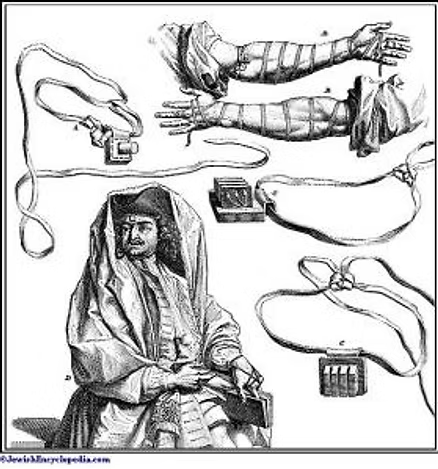
When Jesus said, “For they make their phylacteries broad,” I imagine most Christians are like me and hear a word like “phylacteries” and wonder, “Hmmm what the heck is that.” Then, the majority of Christians ignore that thought and keep on reading, never doing anything to learn what Jesus said and what that meant.

These are “phylacteries.”

They are defined as: “two small leather boxes worn during morning prayers by Orthodox and Conservative Jews after the age of 13 years and one day. Each box contains strips of parchment inscribed with verses from the Scriptures: Ex. 13.1–10; 13.11–16; Deut. 6.4–9; 11.13–21. One box is fastened to the forehead and the other to the left arm; they are intended to serve as a reminder of the constant presence of God and of the need to keep Him uppermost in one’s thoughts and deeds, thereby safeguarding the wearer against committing a sin. They are not worn on the Sabbath or holy days, since these days are in themselves a reminder of God. Phylacteries are also called tephillin.” (Columbia Electronic Encyclopedia, via The Free Dictionary by Farlex) The word is Greek for “safeguard,” just as is the meaning of the Hebrew word “tephillin.”

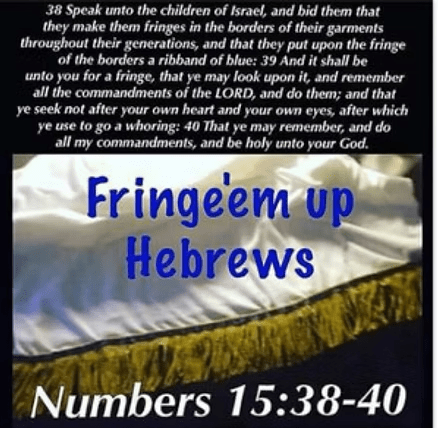
When Jesus said, “They make … their fringes long,” this is what that refers to:

By increasing the size of two symbols of devotion to God, which made it easier for everyone to notice, the scribes and Pharisees were skilled in the art of deception.  They knew the power of suggestion.  They understood that acting a part makes people believe you are the character whose role you are playing.  And it technically wasn’t lying, if you never said you were what you led people to believe you were … erroneously.

The point made by Jesus saying the scribes and the Pharisees was that they were quite showy about their religious pedigree. They put on airs.  The saying, “The clothes make the man” (Mark Twain, as a paraphrase of Shakespeare: “Apparel oft proclaims the man”) means that the way one looks is how others will think of that one.

In the words of Billy Crystal (pretending to be Fernando Lamas): “You dahling? You look mahvelous!”

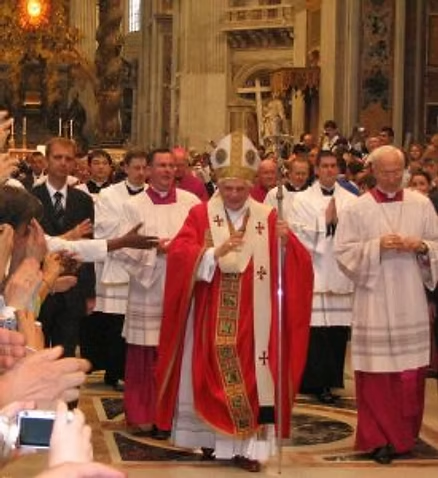
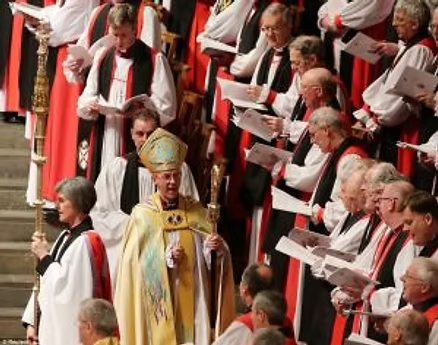
If Jesus were to reappear as Jesus before the crowd and his Christian disciples today, he would be pointing out the same flaws still present in religious clothing.

Popes
Archbishops
Televangelists

Jesus said of the writers (scribes) and the lawyers (Pharisees), “They love to have the place of honor at banquets and the best seats in the synagogues, and to be greeted with respect in the marketplaces, and to have people call them rabbi.” Those translated words make it easy to see the special societal favors that were expected by high-ranking Jews in ancient times. However, do the same words not identify these modern personalities, who “teach” as idols?

Tricky Dick
Hey hey hey
The wheels on the bike go round and roun

Seeing how such glittering stars in politics, acting, and sports have risen to the top and fallen to the depths of their popularity, after their public images have been exposed as unworthy of worship, Jesus spoke the truth when he said, “Do not do as they do, for they do not practice what they teach.”

We look up to teachers (rabbis) that surround us, blindly trusting that they are there to help us. Then, time and again, the truth comes out that our idols were only helping themselves. They were taking advantage of common ignorance.

Jesus warned the crowd and his disciples, “You are not to be called rabbi, for you have one teacher, and you are all students.” Our only teacher is God, who sent us laws to live by, through Moses. The only thing that can be taught of true value is this: “Listen to the LORD.” The word of the LORD can be recited for us, but only fear of God will make one obey that word.

Then, Jesus went on. He added, “And call no one your father on earth, for you have one Father– the one in heaven.” This applies to the interpretation that I did on Paul’s first epistle to the Thessalonians, where he wrote, “We dealt with each one of you like a father with his children, urging and encouraging you and pleading that you lead a life worthy of God.” (1 Thessalonians 2:11-12) Paul was not a genetic parent to adults he met in his evangelism. Paul was filled with the Holy Spirit of the Father; therefore he taught the Thessalonians how to be Christian, as the Father in heaven told him.

For that reason, Jesus then said, “Nor are you to be called instructors, for you have one instructor, the Messiah.” The “Messiah” is the “Christ.” This means Paul was an instructor, just as Jesus was instructing the crowd and his disciples in Jerusalem. If you ponder that instruction carefully, then you will see that every Apostle becomes an instructor, just as did Paul, Silvanus, Timothy, and those of Thessaly, the same way Jesus became one – God sent His Holy Spirit to be One with the faithful, allowing all to become “the Messiah,” “the Christ.”

I have said it before, and I will repeat it once again now: You fall in love with GOD and accept His proposal for marriage (males AND females). The you consummate your love of GOD by doing acts of faith, until you give birth to a new you, which is the rebirth of Jesus Christ in your body. Just as Jesus was “Christ Jesus,” you become “Christ (fill in your name here),”

The birth of Jesus Christ as you means you cease trying to “have the place of honor at [awards] banquets and the best seats in the [houses of worship], and to be greeted with respect in the marketplaces [places of employment, where so many sell their souls routinely], and to have people call [you] role model [based on the materials you amass].” You stop serving self and begin (forevermore) serving Yahweh. Thus, Jesus said, “The greatest among you will be your servant.”

To be reborn as Jesus Christ means “the abundance” [“the greatest”] of “the Christ” will be in “yourselves,” as within “you” [meanings of the Greek word “hymōn”]. This presence will ensure “you” or “yourselves” [repetition of “hymōn”] of becoming a “servant” or “waiter” or “anyone who performs any service.” As a “servant” of “the Messiah,” you will do exactly as Jesus of Nazareth did, and repeatedly say, “I speak the truth, for the Father.”

This way of grasping verse 11 makes understanding verse 12 easier. “All who exalt themselves will be humbled, and all who humble themselves will be exalted,” says that you choose which path you take in life. Do you lie, cheat, steal, prostitute yourself and covet those who wear the finest clothes and get into the most exclusive nightclubs and restaurants? Or, do you thank God for what little you have, while praying for those who are destroying the fabric of our society? One way will raise you to the heights the world has to offer. The other will raise you to the heights heaven holds for those who serve the LORD.

Either way, you will be humbled. As the old Fram oil filter commercial said: “You can pay me now or you can pay me later.” One way or the other, you are going to pay for your life choices.

When you play this forward to modern times, then you understand what Jesus meant, when he said what to watch out for. Can you see holy looking men and women that are “tying up heavy burdens, hard to bear, and laying them on the shoulders of others [Christians raised to think the Laws were etched in stone]; but they themselves are unwilling to lift a finger to move them”?

Are political challengers not interpreting Scripture in ways that seek to destroy all links between Christianity and American laws, through the pollution of the representatives who sit on the seat of Washington D.C.?  Jesus pointed out the writers of law (the scribes) and the enforcers of law (the Pharisees) were in no way holy, because they did not talk to God.  When they used holy Law as their excuse for leadership, then they were repeating what Moses had brought down from the mount to the people.  The long-standing fairy tale of the United States of America was it was founded as a nation of Christians (Protestants), who (collectively) did not want a King or a Pope sitting on the seat of Law in the New World.

Then non-Christians began elevating themselves into the government of the people, for the people to become as screwed as were the Jews of Judea and Galilee, when Jesus pointed out this is not preventable.  It is the common way of the world.  It is the way things will always deteriorate, degenerate, corrupt, and disintegrate, when led by self-serving men and women.

Moses spoke to God and then Moses passed on what God demanded to those who listened to Moses.  The Judges of Israel who sat on that same seat of holy Law did the same thing.  David did it with the help of Samuel.  Elijah, Elisha and other Prophets helped other kings, with less and less compliance to what God demanded.  Those holy people all  spoke holy Law  – the Word of the LORD – and then the people did what they wanted.

When Jesus said the scribes and the Pharisees were making up interpretations of holy Law, while quoting God’s Commandments, they were creating huge burdens for God-fearing Jews.  By saying, ” they themselves are unwilling to lift a finger to move them,” the key word to understand is the Greek word “kinēsai,” which means “to move,” as “to set in motion, excite, stir up.”  That says the written laws of Jerusalem, enforced by the lawyers of Jerusalem (the Disneyland police), never helped any typical Jews be inspired by explanations that said “God will reward you,” coming from anyone who said they sat on the “seat of Moses.” It was always demand more money and threaten punishment for sins.

Today, little has changed.  Who can be “moved” by a government that is in gridlock because two parties hate one another?  The members of Congress sit on the seat of legislative laws, which do little to “lift a finger” to cut taxes, guarantee health, welfare, and safety of the citizens; although they will pass benefit packages for themselves, none of which are commonly available for “regular folk.”

The Judicial Branch is petitioned by lawyers and law checkers, challenging any right to actually legally punish cities that break Federal laws, because local ordinances have been written that are contrary (approved by local voters).  Lawsuits have forced judicial reason to justify removal of monuments that are representative of Judeo-Christian faith, justify a redefining of marriage (which went unchanged for millennia prior) to meet modern needs, and to justify the killing of babies while people scream for the preservation of the lives of heinous criminals.  It has become a hate crime to defend America as a nation standing for Christianity, if that means trying to keep those who hate Christians out of America.

Jesus was not telling the crowd nor his disciples to rise up in rebellion and overthrow a world gone to the dogs.  Nope.  The world is the homeland of sin.  It will always find a way to rewrite the laws that makes good stand out of the way of evil.  Jesus was simply pointing out how you cannot be led by any human, no matter how big they smile, how fancy they dress, and how much of the world they promise can be yours.  People always talk a good game; but then they play by the rules they make up as they go.

You can only do what God’s Law says; and that means looking within, not without.  The only role model to follow is Jesus Christ, who fills one’s Mind, through the love of God.

If you listen to your heart, you know Jesus is talking to you when he said, “Do not do as they do, for they do not practice what they teach.” They are hypocrites, which means “actors” and “pretenders.”

Ron & Jerry

Mark 10:35-45 – Being the hands of Jesus

James and John, the sons of Zebedee, came forward to Jesus and said to him, “Teacher, we want you to do for us whatever we ask of you.” And he said to them, “What is it you want me to do for you?” And they said to him, “Grant us to sit, one at your right hand and one at your left, in your glory.” But Jesus said to them, “You do not know what you are asking. Are you able to drink the cup that I drink, or be baptized with the baptism that I am baptized with?” They replied, “We are able.” Then Jesus said to them, “The cup that I drink you will drink; and with the baptism with which I am baptized, you will be baptized; but to sit at my right hand or at my left is not mine to grant, but it is for those for whom it has been prepared.”

When the ten heard this, they began to be angry with James and John. So Jesus called them and said to them, “You know that among the Gentiles those whom they recognize as their rulers lord it over them, and their great ones are tyrants over them. But it is not so among you; but whoever wishes to become great among you must be your servant, and whoever wishes to be first among you must be slave of all. For the Son of Man came not to be served but to serve, and to give his life a ransom for many.”

———————————————————————————————————-

This is the Gospel selection from the Episcopal Lectionary for the Twenty-second Sunday after Pentecost, Year B 2018. In the numbering system that lists each Sunday in an ordinal fashion, this Sunday is referred to as Proper 24. It will next be read aloud in an Episcopal church by a priest on Sunday October 21, 2018. It is important because the disciples are seen to fear the death of Jesus that he foretold a third time.  Jesus told them not to think in terms of fists of strength but hearts of service to others.

It is important to realize three background elements of this reading. First, this follows the third time Jesus told his disciples of his coming death. He did this after they had gone to the other side of the Jordan following the Feast of the Dedication (late December on the Roman calendar) and now they were beginning their return to Jerusalem for the coming Passover, about three months later. Jesus said his death would be in Jerusalem (Mark 10:33), so that factors into this reading.

Second, Matthew’s version of this request by James and John of Zebedee was made by their mother (Matthew 20:20-28), although one can assume she brought her two sons along with her to make the request we read here now. This means that James and John did make the request; but, rather than them going directly to Jesus, their mother initiated the discussion.

The presence of their mother is important as it shows that Jesus would not take his disciples away from their families for an extended period of time; and it shows that women were routine followers of Jesus, who assisted in the care and maintenance of Jesus’ ministry. Mark (Peter’s account of Jesus’ ministry) was not one to give much credit to those who were part of his Gospel, accompanying him or encountering him, as far as naming them or giving them specific recognition. However, it is important to know that women did follow Jesus and have influence on him and his disciples.

When one accepts that the Gospel of Luke is the story of Jesus’ ministry as seen through the eyes of his mother, Mary, one can see how chapter 18 of the Gospel of Luke recounts the same events as Mark’s chapter ten and Matthew’s chapter nineteen, including Jesus heading to Jerusalem.  All recount how Jesus told the disciples again of his coming death. This means the mother of Jesus, minimally, crossed the Jordan to hear her son teach in the synagogue (probably one in Bethany Across the Jordan).  She was present when Jesus made that announcement.  Mothers were then welcomed to accompany their sons as Jesus traveled and the disciples followed their teacher.

John, on the other hand, told of Jesus escaping Pharisees attempting to grab hold of Jesus and stone him, when he said he was the Son of God at the Feast of the Dedication. John did not write of any teachings of Jesus while on the other side of the Jordan River; but he told of Jesus being alerted that Lazarus had fallen very ill. This absence of John says (minimally) that he was not an adult and certainly not John of Zebedee.  Because Mother Mary knew where Jesus could be located, John was probably allowed to go with the party sent to tell Jesus of Lazarus having fallen ill, then returning to Bethany afterwards. Jesus would begin to return to Jerusalem because of that message and because it was time for the Passover Festival.

Jesus, we have come to tell you Lazarus is gravely ill and you are needed in Bethany.

Third, it should be recalled from the Gospel reading for the twenty-first Sunday after Pentecost that Jesus, while explaining how difficult it was for a rich man to get to heaven, concluded by saying, “Many who are first will be last, and the last first.” While that event might have been some time prior (perhaps a month or so), it should be remembered as a factor for James and John of Zebedee asking to be given Jesus’ approval to sit to his right and left. One can assume they recalled that teaching and were not asking for those positions as a favoritism.

When one has a three-dimensional view of the setting for this reading from Mark’s Gospel, one can get a feel for how James and John (and their mother) were not trying to gain favor in the eyes of the other disciples. They sought to be close to Jesus to protect him, after Jesus said the rulers of Jerusalem and the Gentile governor would take him and kill him (but after three days he would rise). Because Peter had tried to rebuke Jesus for talking such nonsense (to him), the direct approach of rebuking Jesus was known not to work (Jesus told Peter, “Get behind me Satan!). The motherly approach (the idea of James’ and John’s mother) was to ask Jesus to let the two strongest, most muscular disciples (burly from being sailors and fishermen) always stand closest to Jesus, where they would give up their lives in order to save their Teacher (Rabboni).

Seeing their request in this light, one is able to see them saying, “in your glory” as a statement of the “dignity, honor,” and “praise” that was due Jesus. They were not trying to get closer to an important person, as they were already close. The Greek written shows this separate segment of words as stating, “We might stay in the realm (sphere) of [a figurative statement, conditional of future “sitting”] under divine quality of you” (from “kathisōmen en doxē sou”). This makes it more evident that the request was as protection, so the disciples (and other followers of Jesus) would be able to defend the life of Jesus, as his “hands” of strength.

It should then be understood that Jesus knew full-well the intention of the request. The way it was worded, James and John (and their mother) had heard Jesus say, “Truly I tell you that if two of you on earth agree about anything they ask for, it will be done for them by my Father in heaven,” (Matthew 18:19) and thought that if two disciples asked for the same thing, then they could coerce Jesus “to do for us whatever we ask of you.” Jesus was talking then about Apostles who were joined with the Father in Heaven, while being on earth, as the definition of a Church. The disciples only understood earthly matters, not those heavenly. Therefore, Jesus said to them, “You do not know what you are asking.”

To answer James and John (and their mother), Jesus asked, “Are you able to drink the cup that I drink, or be baptized with the baptism that I am baptized with?” This question had nothing to do with asking, “Can you drink out of the same cup I drink from” or “Can you be baptized by the same water as I was baptized in?”

The “cup” (from “potērion”) that Jesus drank (the contents thereof) was the emotionally uplifting “wine” of God (where “wine” is an undistilled “spirit,” by alcohol content). The “baptism” that Jesus was “baptized with” was the Holy Spirit having merged with the soul of Jesus. At that point in time, none of the disciples could make the claim that their souls had been submerged into the Holy Spirit, so the Will of God was not then totally leading their actions.

When Jesus added, “To sit at my right hand or at my left is not mine to grant, but it is for those for whom it has been prepared,” this was Jesus knowing that his “hands” would be Apostles in the name of Christ. Neither his right hand nor his left hand would be idly by his side, waiting like Secret Servicemen, to act after a threat had been exposed.

Little did the disciples know that Jesus had already touched the souls of many people in his three years of ministry (in all of his miracle healings) leaving the bodies of those souls as the first Apostles, who became the “hands” of Christ that extended to the right (Jews) and the left (Gentiles). They had all been “prepared” or “made ready” (from “hētoimastai”) to receive the Holy Spirit because their hearts had opened to God’s love and they were born of true faith.

By James and John saying “We are able,” they were not hearing Jesus asking them if they were prepared to receive the Holy Spirit (the “cup” and the “baptism”). They felt prepared to drink ceremonial wine and be figuratively washed clean in the Jordan River, as the two who would defend Jesus with their lives. The Greek word written by Mark, which was their answer to Jesus was the capitalized “Dynametha,” which said, “We are powerful” or “We have the strength.” Not only did that mean they were able-bodied men, but they were mentally prepared to die defending Jesus.

When the reading then says that the other ten disciples became angry at James and John, this says the two brothers had not planned this with the other disciples. Hearing their proposal made them angry and moved by great grief (from “aganaktein”), because their request made it seem that the other ten were thought to not be willing to die defending Jesus. Not only that, the other ten were not physically suited to be strongmen, meaning they could be harmed without being effective in that role.  Their anger had nothing to do with James and John asking to sit next to Jesus at dinner time.

The disciples knew James and John of Zebedee were nicknamed by Jesus “Boanerges” – the sons of thunder. (Mark 3:17) This name, stemming from Aramaic (“bēn” [“sons”] and “regesh” [“of thunder, tumult”]), probably was because of how easy it was to tick them off, at which point they would get loud and break things. (Perhaps, they had a history of easily getting into fights, prior to following Jesus?)

Easy boys.

When Jesus encountered Samaritans balking at making accommodations for the group, it was James and John that said, “Lord, do you want us to call fire down from heaven to destroy them?” (Luke 9:54) One would have to think their nickname spurred them to use the “fire from heaven” metaphor [lightening], as thunder comes before such strikes.

Jesus also chose the two brothers to go up the high mountain with him and Peter (Mark 9:2), probably because they were needed to carry most of the gear (tabernacles, rope, warm clothing, food, etc.). Their being picked because of the strength necessary to a somewhat dangerous journey safer means Jesus did not favor James and John of Zebedee over any of the other disciples.  It was logical to pick the strongest men.

With that realized, the other ten knew James and John were going into the area of brains, when their forte was brawn.  Asking to be the bodyguards of Jesus is what made the other disciples incensed at the thought that James and John (and mother) tried to maneuver it so they could keep Jesus alive by a show of manly-man strength.  Their thick skulls kept them from realizing the dangerous position that would put the others in, when they were probably less physically imposing.

Jesus saw just reason for the ten disciples to be angry, so he called them all together and said, “You know that among the Gentiles those whom they recognize as their rulers lord it over them, and their great ones are tyrants over them.” This is a somewhat misleading translation, which needs to be clarified.

The Greek word “katakyrieuousin” means “exercise authority over, be the master of, and hold in subjection,” as well as “lord it over.” This is followed by the Greek word “katexousiazousin” that means, “exercises power over” or “exercises authority over,” with abuse of those powers implied, such that oppression and strong domination can lead one to assume tyranny. Because the identification here is “ethnōn,” meaning “heathen people” or “foreigners,” such that “Gentiles” is translated rather than Romans, one needs to look closer at who Jesus was referring to when he said, “You know” or “You remember” (from the capitalized “Oidate“) to his disciples.

It is always easier to remember the past horrors than to see the present dangers.

In all of the four Gospels there is little mention of the Roman presence in Galilee and Judea, until Jesus is tried, whipped and crucified. It is understood that the Roman Empire was in control of all that was ancient Israel, but nothing was written about Romans accosting Jesus and his entourage, in Judea or Galilee, in Tyre, Caesarea Philippi, Gardara (or Gergasa of the Decapolis), or any of the places beyond the Jordan. The rulers of tyranny that all the disciples knew amounted to those in Jerusalem. Those rulers were those in power who knew Rome would rather give the Temple elite whatever they wanted, than not.  Rome sent a governor that would appease Jerusalem’s rulers, simply to avoid another costly revolt led by religious zealots.

This makes the third announcement of Jesus’ coming death, which he recently repeated to his disciples, become important to understand, now that Jesus has talked about leaders who exercise authority over subjects, to the extent of being tyrants. Jesus had just recently told his disciples, “Behold, we are going up to Jerusalem, and the Son of Man will be delivered to the chief priests and the scribes; and they will condemn Him to death and will hand Him over to the Gentiles.”

The word translated as “Gentiles” is “ethnesin,” which is a form of the same word Jesus just spoke (“ethnōn”), rooted in “ethnos.” Whereas the word “gentile” (in the lower case) is a general classification of races and peoples of nations that were non-Jewish, the implication was heavily leaned towards an identification of idolatry worship and not worshiping the same God of the Jews. When that classification is understood, the rulers of Jerusalem were capable of being put into this category of peoples, simply because they worshiped money and power. In the same way that Samaritans were deemed gentiles by the Temple Jews, the same shoe fit them in the eyes of God.

As the third (and final) time Jesus would predict his death, it is worthwhile to realize the details of the other two. The first time, Mark said Jesus “began to teach them that the Son of Man must suffer many things and be rejected by the elders, the chief priests and the teachers of the law, and that he must be killed and after three days rise again.” (Mark 8:31) That focused solely on the Temple rulers.

Then, the second time Jesus said, “The Son of Man is going to be delivered into the hands of men. They will kill him, and after three days he will rise.” (Mark 9:31b) That focused solely on the gentiles, who would be those executing the judgment brought about by the ones who truly exercised authority as tyrants, using injustice to make it seem otherwise.

Now, the third time, Jesus combined the two, so it would be the chief priest and the scribes that would condemn Jesus, handing him over to the gentiles to do their dirty work.  This becomes the necessary background element that caused Jesus to importantly remind his students about the tyrants they knew personally, not some emperor far away in Rome.

It must be seen how Jesus pointing out the exercise of authority in oppressive ways was accepted as how Rome maintained control over a vast empire. The Romans would have no moral difficulties in executing condemned men, whether they would judge them by Roman laws or have some local yokels use their laws to judge their own. Still, for Jesus to break into this aspect of tyranny, one must realize that had absolutely nothing to do with James and John wanting to sit next to Jesus at dinner time.

Jesus saw their intent was to surround Jesus with brute force bodyguards, which the other ten saw as an open invitation for the Romans to suddenly have a problem with Jesus, as a leader of rebels against Roman domination. Jesus then was telling his disciples (paraphrasing), “We are not like them.” (Literally translated above, “It is not so among you.”)  That meant, “We do not depend on might making right, in a physical sense.  We are about the inner strength and power of God.”

Jesus told his twelve disciples, “Whoever wishes to become great among you must be your servant, and whoever wishes to be first among you must be slave of all.” As Jews under the denomination of Rome and the Temple of Jerusalem, greatness was dependent on being a slave of all, as a servant of God.  Jesus had sent all his disciples out to serve the needs of the Jews; not to incite an overthrow of oppression.  Service meant giving spiritual strength to those suffering from oppression, thus freeing them to also serve God.

We are all slaves to gravity, even those born with silver spoons in their mouths. Wait until the next Great Depression and see how many will volunteer to be slaves, rather than be free to die.

This meant (even though they would not understand this meaning until after they were filled with God’s Holy Spirit) that Jesus said, “If you are to drink from the cup of salvation,” (remembering that Judas would not) “then you will be baptized by the Holy Spirit and be reborn as me.”  Jesus was teaching his disciples to lead by example, where greatness came from serving the spiritual needs of seekers.  Sacrifice of self made being a slave of all the lesson of Jesus.

To reach that point of commitment to God, there could be no revolt against the tyranny of Rome, or the tyranny of the Temple in Jerusalem. Greatness does not come from calling upon God to rain fire upon one’s enemies, such that one man’s punch given in anger deserved a punch likewise in return. Worldly power is exemplified by the pendulum, where one swing to the right means an equal and opposite swing to the left.  The hands of linear time pound the drumbeat of both victory and defeat.

The Temple rulers saw themselves as the great among the Jews, just as the Romans saw themselves as the great of the western world; but (in time) they would dissolve into nothingness. While the Temple’s ruling class of Pharisees, Sadducees, scribes, Sanhedrin, and high priest held the common Jews as their slaves, just as the Romans held their conquered as their slaves, (in time) they would become the slaves of others (Saracens and Barbarians). Those who would be filled with God’s Holy Spirit would be freed to eternal life, by submitting to marriage to God and living as His Son, Jesus Christ.

This is why Jesus then concluded this reading selection by stating, “For the Son of Man came not to be served but to serve, and to give his life a ransom for many.” Jesus told his disciples that just as he came to serve others, they (in time) would be reborn as the Son of Man and likewise expected to serve God, the Father.

It would be that subjection to God – as a wife to one’s Husband, so the Father of all Sons of Man will come as Jesus Christ reborn – that would cease trying to use brute force to change the will of powerful worldly men.  Subjection to God would mean the use of spiritual power to influence the masses to likewise forego rebellion against tyranny and serve God as true Christians. That holy service, just like the service of Jesus, would bring about persecution by the great, leading to a servant’s death. However, giving a life as the ransom paid for many other lives to be saved means eternal life and the greatness of Heaven.

As the Gospel selection for the twenty-second Sunday after Pentecost, when one’s own personal ministry for the LORD should be underway – one has already become a hand of Christ reaching out to serve others – the message here is to stop trying to use strong-arm tactics to force one’s will onto others, is some ill-conceived plan to save Jesus from being killed. One cannot act like James and John of Zebedee (and their mother) and expect Jesus to grant your wish, just because it makes good sense personally, but regardless of how little thought one gives to others following Jesus.

As it is with all Scripture, the reader needs to put oneself in the role of the characters that are not Jesus. Rather than have a priest stand before a congregation and preach his or her personal politics, which uses the “servant of all means greatness” theme as reason to vote for this politician or hate that politician, while not thinking once about how many innocent lambs are slaughtered by such persecutory speech, one needs to tune those ideas out and simply serve God. When one serves God, God will have one serve those in need of God’s help.

When Jesus asked James and John (and their mother), “Are you able to drink the cup that I drink, or be baptized with the baptism that I am baptized with?” the knee-jerk response is exactly like theirs: “We are able.” Simply by walking around town or posting memes on social media that proclaim, “I am Christian,” one is saying, “I drink the holy wine of Communion (and eat the wafer too!), which is my right as a baptized (by holy water) Christian (denominational specific membership).” However, that is totally missing the point.

The only way to “drink the cup that [Jesus] drinks, or to be baptized with the baptism that [Jesus is] baptized with” is to be Jesus. That metaphor is not some fancy chalice kept in a ‘Jesus box’ in a church, washed clean by some altar guild member after each use, as it is not a physical cup that holds physical drink.

The cup is symbolic of deep-felt emotions, which cannot be touched physically. Science cannot observe the emotional center of the human body, although they can probe and monitor electrical impulses stimulated in the heart and brain and try to measure them. The cup that Jesus drank was the love of God within his heart-center, which came from Jesus being married to God, thus His servant forever. Thus, Jesus asked every reader of this reading (and everyone listening to this reading be read), “Have you married God, having submitted your self-ego fully to His Will, lovingly speaking only the truth, from the love of God that makes one’s cup runneth over with joy?”

People dance ecstatically and wave their arms in the air for a love of Jesus, but do they love God?

The ones dancing each should be Jesus Christ reborn, but if they are truly Christians, wildly dancing and praising Jesus as the one he or she loves, then that either says: a.) I am a liar and not Christian; or b.) My heart is not devoted to God, but to an idol named Jesus.

James and John of Zebedee were the same way. So too were the other ten disciples, including Judas Iscariot, such that each worshiped Jesus of Nazareth as a most holy prophet that could never be replaced by another human being. They were, after all (at that time), Jews and not yet Christians. They believed God is great, which meant they believed God sent them a great prophet named Jesus.

That is an opinion not exclusive to Christians. Jesus would be killed because most Jews did not believe in a Messiah, unless he was a strong man that would overthrow Rome and return the land of Israel to the remnant Jews. Jesus would not pass the physical test of immortality. The Muslims, unlike the Jews, say Jesus was a most holy prophet … just not the last great prophet. They think (like did James, John, their mother, and the other ten disciples of Jesus) with their brains (and brawn); not feeling the love of God in their hearts and souls.

Christians feel faith with their hearts and follow the insights of the Christ Mind.  They go beyond the limits of belief (the words of others), feeling a presence they had never felt before, which is more than human emotions can attach a word to.  They see in inexpiable ways, with inaudible whispers leading them to go places their brains would have never thought for them to go.  They experience God, so there is no need to memorize His words through others, when a Christian has the same knowledge of God as did all true prophets.  To worship a prophet then means to take one’s eyes off God.

When Jesus asked James and John of Zebedee (and mother), “[Can you] be baptized with the baptism that I am baptized with?” one only has to remember the words of John the Baptist. He said, “I baptize you with water for repentance. But after me comes one who is more powerful than I, whose sandals I am not worthy to carry. He will baptize you with the Holy Spirit and fire.” (Matthew 3:11) Again, baptism is a word that means “submerged,” implying water. But the Holy Spirit and fire do not represent a physical “dipping,” but a spiritual transformation.

Few people understand the Holy Spirit. While they can grasp the Father and the Son of the Trinity … because they have physically seen fathers and sons … there is difficulty explaining the Holy Spirit to doubters.

Does that mean belief in ghosts?

Many Christians cannot answer that question, nor can they explain the Holy Spirit to non-believers. The reason is few people are indeed filled with the Holy Spirit.

Again, dancing wildly with ones hands raised in the air is not an indication of being filled with the Holy Spirit.  The hands of God reach out to seekers, not towards a sky or ceiling.

Being filled with the Holy Spirit comes after one’s marriage to the love of God. It is when one’s soul is submerged with God’s Spirit, so the two are one. Sin becomes a thing of the past. That union brings the resurrection of God’s Son in a new servant in his name. One serves God as Jesus reborn, which means “whoever wishes to be first among you must be slave of all.” It means the expectation has been set, “to give [one’s] life [as] a ransom for many.”

It does not mean being a pastor of a megachurch. It does not mean having a need to demand donations for another new private jet. It does not mean greasing one’s path to a fast track to riches, vacation homes, and fancy cars. It does not mean being so poor that others will not take the time to listen to what one’s message from God says.

Being married to God and baptized by the Holy Spirit means raising a family of Christians, who may or may not be one’s own physical flesh and blood. It means loving God with all one’s heart and wearing His face always. It means telling the truth and shedding the light into a world of lies and darkness. It means being persecuted for doing that, but with nary a worry.

Hebrews 5:1-10 – According to the order of Melchisedek

Every high priest chosen from among mortals is put in charge of things pertaining to God on their behalf, to offer gifts and sacrifices for sins. He is able to deal gently with the ignorant and wayward, since he himself is subject to weakness; and because of this he must offer sacrifice for his own sins as well as for those of the people. And one does not presume to take this honor, but takes it only when called by God, just as Aaron was.

So also Christ did not glorify himself in becoming a high priest, but was appointed by the one who said to him,

“You are my Son,

today I have begotten you”;

as he says also in another place,

“You are a priest forever,

according to the order of Melchizedek.”

In the days of his flesh, Jesus offered up prayers and supplications, with loud cries and tears, to the one who was able to save him from death, and he was heard because of his reverent submission. Although he was a Son, he learned obedience through what he suffered; and having been made perfect, he became the source of eternal salvation for all who obey him, having been designated by God a high priest according to the order of Melchizedek.

———————————————————————————————————-

This is the Epistle selection from the Episcopal Lectionary for the Twenty-second Sunday after Pentecost, Year B 2018. In the numbering system that lists each Sunday in an ordinal fashion, this Sunday is referred to as Proper 24. It will next be read aloud in an Episcopal church by a reader on Sunday October 21, 2018. It is important because Paul wrote of a high priest being the designation God gave to Jesus Christ, which is manifest in mortals as Apostles and Saints that have been reborn as that high priest. All become high priests according to the order of Melchizedek.

In this reading one can clearly see how Jesus is a high priest in the order of Melchizedek. The wonder of knowing that is meaningless. If Jesus is a high priest in that order of high priests – where one must assume God was the one who established that order – why do we want to kneel down before a cross nailed to the wall with an icon of dead Jesus hanging from it and pray to a dead and long gone high priest?

“Oh,” you might say, “Jesus didn’t stay dead; he ascended to be with the Father.”

Okay. Then since Melchizedek never died, and always is, like God, why don’t we worship him? Elijah ascended into Heaven without dying, and he appears next to Moses in the Transfiguration. Why don’t we kneel down and pray to Elijah?

Don’t forget Enoch, the son of Jared who fathered Methuselah. He lived for only 365 years, when Enoch “walked with God: and he was no more; for God took him.” That is kinda like Jesus only living 34 years before God took him early in life. Let’s throw some worship towards Enoch too!

Okay, I have been facetious long enough. Jesus is the high priest in the same way that God is the King. God sits on the throne of one’s heart, while His high priest controls the spiritual direction of God’s kingdom (one’s body) as the Christ Mind. Paul wrote of this often; and Paul wrote of this in this reading. If one cannot see this appear from the words Paul wrote (as his spiritual direction from the Christ Mind leading him), then one will never become a Saint in the name of Jesus Christ.

As I have done before and do again now, I have broken down the Greek segments of words (based on pause points), so one can see how each segment should be read as a stand-alone statement that then connects to the next stand-alone statement, and so on. The translations I use are based on the Greek word analysis provided by links in the Bible Hub Interlinear of Hebrews 5.

My translations differ from those set by Bible Hub, which are more inclined to lead one to paraphrase the Greek into seemingly understandable English (American version). However, reading Paul in the manner I have painstakingly prepared makes it easier to see the true intent of his words, rather than some fluffy, warm and fuzzy, misconstrued gobbledygook that is based on preconceived notions of only one can be a high priest in the order of Melchizedek (except the aforementioned others that fit the qualification, not to mention David and Aaron).

Nope. Still not gonna let you kick that ball around.

Here is my literal translation of the Greek segment of words:

1. All for high priest  ,

out from among men being laid hold of  ,

for the sake of men being put in charge  ,

they interfacing with the [one] God so that he should offer gifts not only offerings beyond sinful deeds  ,


2. to preserve moderation in the passions empowered  ,

to those having no knowledge and being misguided  ,

seeing that also the same is surrounding frailty  ;


3. and by reason of them he is indebted  ,

according to the manner in which about those people [of the Lord]  ,

in this manner also about self  ,

to make an offering concerning sinful deeds  .


4. Namely not upon oneself a certain one takes hold of this honor  ,

but instead being name given by the [one] God  ,

according to the manner in which also Aaron  .


5. Thus also the Christ not himself did bestow value to come about a high priest  ,

but one who having spoken referring [to] him  :

Son of mine are you  ,

I today have begotten you  .  [Psalm 2:7]


6. Just as also on another he tells  :

You [are] a priest for the ages  ,

according to the order of Melchizedek  . [Psalm 110:4]


7. Whom in those days together body the same  ,

entreating both and olive branches of peace  ,

towards those who were powerful to rescue him from physical death  ,

after outcry vehement and tears having made a sacrifice  ,

and having been intently heeded  ,

deserting companions godly fear  ,


8. although being Son  ,

he gained knowledge away from this he suffered  ,

those submissiveness  ,


9. also having been made perfect  ,

he was born to all others obeying him  ,

the cause of salvation eternal  ,


10. having been addressed by name under authority one God a high priest according to the order of Melchizedek  .

Let’s break this down now.

Verse one, basically, says the plan for a human “high priest,” based on the system established by God, through Moses. Those were physical beings of righteous status who allowed entrance into the holy places and were allowed to offer sacrifices to God and communicate with God, all for the children of Israel.  They are not to be mistaken as the high priests of pagan gods.

Verse two says the purpose for a “high priest” was to be the source of strength for the weak masses. Because of that common lack of knowledge and general tendency to wander and get lost spiritually, God would offer the people guidance and stability for all, through the wisdom given to their spiritual leader.

Verse three then adds that the presence of a “high priest,” for the benefit of the people of God, leaves all the people in debt to God. This is not all people in the world, but those who believe in Yahweh – the One God of Israel. The debt is oneself, such that each individual should sacrifice their self-identity as an offering for their sins. The ultimate purpose of a “high priest” is to remind the children of God of that debt and personal responsibility for their sins.

Verse four is how one receives the title of “high priest.”  In the system of order that Moses set in place, fathers named their children; usually this was some name that devoted a child to service to God. The child did not take credit for a name given to it; but a child was expected to live up to that name. Likewise, the title of “high priest” was a name given by God to His servant, as the ceremonial one who would lead the whole gathering of Israel. As such, the child named Aaron was made “high priest” of Israel by God, the Father. All honor and praise given to that title was due to God.

Verse five then directs this theme of “high priest” to Jesus of Nazareth, who Paul referred to as “the Christ” (or “the Messiah”). Jesus of Nazareth never called himself a “high priest,” because that hat was worn by a rotation of Sanhedrin members (such as Annas and Caiaphas). God made Jesus Christ be a spiritual “high priest,” with Paul using David’s Psalm 2:7 as a prophecy of that anointment. One can then assume that David was also a “high priest” of God in a spiritual sense.

Verse six then has Paul quote another verse from David’s Psalms (Psalms 110:4), where God told David he was a “high priest according to the order of Melchizedek.” There, the Hebrew word translated as “order” (“dibrah”) means, “cause, reason, and manner.” This means it is important to understand that Melchizedek was essentially the physical embodiment of the angel placed at the entrance into the Garden of Eden, after Adam and Eve were banished. That place on earth became known as Salem and/or Zion, where Melchizedek was the King and High Priest. This was also where David was King and spiritual “high priest” of Israel. Thus, Paul compared Jesus Christ to the Holy Spirit that forbids sinners from entrance into Heaven.
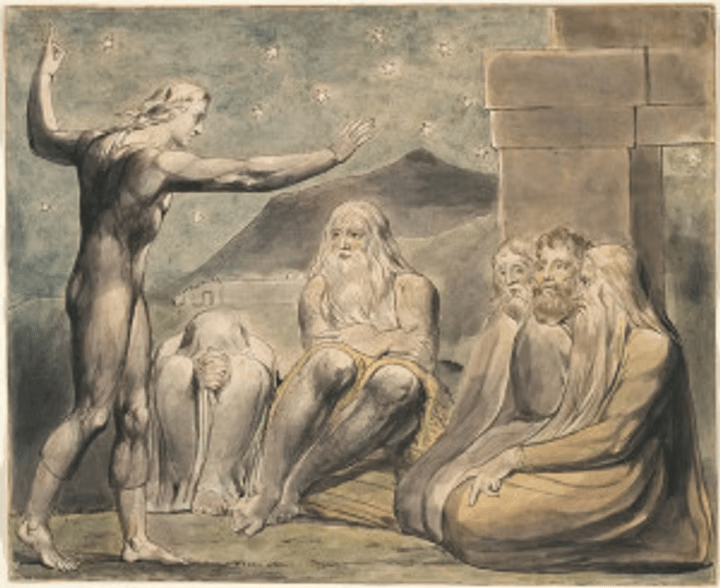
Abram meeting Melchizedek in Salem.

This comparison to Melchizedek should be investigated. The name Melchizedek means “King of Righteousness.” Jesus Christ is also called a King, but he said, “My kingdom is not of this world … but … from another realm.” (John 18:36) That makes Jesus the King of Heaven on Earth, as Melchizedek was the King of Salem, which was the earthly terrain on which Jerusalem was built, but the spirituality underneath that terrain was Eden. Seeing this High Priest title as the one who allows entrance into the Father’s kingdom makes it be how Jesus said, “I am the gate; whoever enters through me will be saved. They will come in and go out, and find pasture.” (John 10:9) That is like the Angel who guards Eden.

Archangel Uriel is said to guard as written: “After he drove the man out, he placed on the east side of the Garden of Eden cherubim and a flaming sword flashing back and forth to guard the way to the tree of life.” (Genesis 3:24)

Verse seven then is Paul explaining how “the order of Melchisedek,” as “high priest” named by God (not an election by men) means a joining together of this Angelic guardian Spirit to the body of a human (as was Jesus of Nazareth joined with the Christ Spirit of God), so both are peacefully as one. This presence is then the promise of eternal life (entrance into Heaven), which is the power that rescues one from mortal death. This does not prevent death of the body; in fact, it promises to bring persecution from those who cry out against such a holy presence, along with the tears offered by those who fear death more than they fear God. Only those who are joined with God’s Holy Spirit can hear His comforting call, fearing nothing but losing that closeness to the Father.

Verse eight then is Paul explaining that even though Jesus of Nazareth was the Son, he was made man. Only by knowing the sufferings of human beings can one gain “high priestly” understanding through the Christ Mind. That spiritual guidance can only be known through complete submission of oneself (self-ego) to God’s Will.

Verse nine says that perfection can only be a result of one’s past sins being erased through baptism of the Holy Spirit, when God sits on the throne within one’s heart-center and the soul has been merged with complete righteousness. Jesus Christ has been born as the “high priest” that must be raised within each of God’s faithful, so only those perfected can return to Eden. All who will be reborn in the name of Jesus Christ will have Jesus Christ as their personal “High Priest.” They will obey his commands, and in return they will be granted eternal life.

Verse ten is then Paul saying that each Apostle and Saint will be addressed by the name of Jesus Christ, which is the title that comes under the authority of God. As such, each Apostle and Saint becomes the embodiment of a “high priest” on the earthly realm. As a “high priest,” one like Paul is another “according to the order of Melchisedek.” This is the ultimate result of “All for high priest.”

As the Epistle selection for the twenty-second Sunday after Pentecost, when one’s own personal ministry for the LORD should be underway – one should have received the high priest Jesus Christ within one’s flesh – the message here is arise to the state of being where God speaks to us individually, telling each and every one of us, “You are My Son, today I have begotten you” as another in the holy order of Melchizedek. Each of us has to be reborn as the Angel that not only guards the stairway to Heaven that Jacob witnessed in a dream, but become the high priest that instructs others what it takes to return to God’s garden.

It is too easy to read Paul’s words here and see Jesus of Nazareth as that very special guy that could put up with the insults, the false claims against him, the scourging, the ridicule as a lowly commoner claiming to be a king, the nails piercing his flesh and bones, the spearing in his side, and the rolling of dice to see who would take possession of a fine robe, too nice to cut into pieces. It is too easy to say, “He was a better man than I (regardless of one’s human gender)” and pretend that Jesus suffered so others could never suffer, while getting the password that gets them past the Angel that forbid Adam from coming back. After all, Adam ate a cookie from the cookie jar after being told not to. Whose sins could ever be greater than that?!?!

The problem with Christianity is having too many people not having a clue what being Christian means. As long as Jesus is the spiritual high priest in Heaven watching over our miserable selves, forgiving all our sins if we believe in the cross of his murder, why should anyone ever try to become Jesus Christ reborn? As long as we let common men stand up on pedestals, proclaiming, “I am the High Priest” (a.k.a. those like Mr. Roman Pope), it is just a matter of paying an indulgence fee and then go out and play. This modern version of Christianity is all about self, with very little being about sacrifice of self to God.

The holy order of Melchisedek has left the building … so to speak. The world had reverted into paganism, where an unknown number of people have posters, icons, and statues made in their likeness. Babies are named after them (when not just randomly chosen letters pulled out of a Scrabble bag arranged in some order).

Those who are given names from the Old Testament (fewer these days) have little idea of the name’s original meaning. Therefore, no one grows into a responsibility to be a servant of God Almighty.

As an accompanying reading to the Gospel reading where James and John of Zebedee asked Jesus to give them the right to be the right hand and left hand of Jesus, when Jesus told them, “You do not know what you are asking. To sit at my right or left is not for me to grant. These places belong to those for whom they have been prepared.”

Newsflash: The preparation was for all the followers of Jesus of Nazareth to be prepared to receive his Holy Spirit and become a high priest.

Maybe the reason is no one is teaching this lesson? Listen carefully to the sermon coming soon to a Christian church near you. See if that message is preached.

Job 38:1-7, [34-41] – Gird up your loins like a man

The Lord answered Job out of the whirlwind:

“Who is this that darkens counsel by words without knowledge?

Gird up your loins like a man,

I will question you, and you shall declare to me.

“Where were you when I laid the foundation of the earth?

Tell me, if you have understanding.

Who determined its measurements—surely you know!

Or who stretched the line upon it?

On what were its bases sunk,

or who laid its cornerstone

when the morning stars sang together

and all the heavenly beings shouted for joy?

[“Can you lift up your voice to the clouds,

so that a flood of waters may cover you?

Can you send forth lightnings, so that they may go

and say to you, ‘Here we are’?

Who has put wisdom in the inward parts,

or given understanding to the mind?

Who has the wisdom to number the clouds?

Or who can tilt the waterskins of the heavens,

when the dust runs into a mass

and the clods cling together?

“Can you hunt the prey for the lion,

or satisfy the appetite of the young lions,

when they crouch in their dens,

or lie in wait in their covert?

Who provides for the raven its prey,

when its young ones cry to God,

and wander about for lack of food?”]

———————————————————————————————————-

This is an optional Old Testament selection from the Episcopal Lectionary for the Twenty-second Sunday after Pentecost, Year B 2018. In the numbering system that lists each Sunday in an ordinal fashion, this Sunday is referred to as Proper 24. If chosen, it will next be read aloud in an Episcopal church by a reader on Sunday October 21, 2018. It is important because God finally responds to Job, not only showing that patience is indeed a virtue but showing why Job was a righteous man that God knew would pass Satan’s test.

The last we read from the Book of Job (the previous Sunday, Proper 23), it was from chapter 23. Now, we have moved ahead to chapter 38. In between three friends came to counsel Job, basically saying no true God would punish the righteous. Then, from out of nowhere, comes this person named Elihu, who rebukes those three, saying there is good reason for the righteous to be punished, because it can prevent sin.

When Elihu spoke, everyone listened.

The character named Elihu is questioned by modern scholars, as possibly a late addition to the book, because Elihu was not mentioned early in Job and he is not mentioned after his monologues cease. Elihu spoke in the last part of chapter 34 and all of chapters 35-37. Here, in chapter 38, is God finally responding to Job … not Elihu.

The name Elihu means “He Is My God.” This means Elihu is not a physical character, but the Holy Spirit within Job. It is the Holy Spirit within Job that has made him a righteous man, as no man alone it capable of withstanding the sufferings of a physical life without the presence and assistance of the Holy Spirit. Elihu is, therefore, the reason God accepted the challenge by Satan, because Satan was right that no ordinary man punished unjustly will remain faithful to God.

In the Gospel reading that this Old Testament reading is associated with, Jesus told James and John of Zebedee that no one can be allowed to sit at the right hand or the left hand of Jesus, to sit in his glory, because Jesus was not the one who could grant such a request. That had to come from God, and then it was only for those who had been prepared to receive His glory – the Holy Spirit. The Holy Spirit does not sit beside one, like Job’s three friends did, but within one, as Elihu did in Job.

Imagine yourself as the Temple-Tabernacle, with the Law written inside the ark in your heart, with the high priest being the Christ Mind that makes offerings at this holy altar inside you.

The Epistle reading that associates with this Old Testament reading is from Paul’s letter to the Hebrew-speaking Jews of Rome, when he told all Apostles there to have Jesus Christ as their high priest. Jesus Christ is not a high priest that is to the right or the left, or above in Heaven. Jesus Christ is one’s high priest when he has been resurrected within one’s being. As such, Elihu was the Christ Spirit within Job, meaning Job was a high priest according to the order of Melchizedek also.

When one sees Elihu as within Job, one can then see how chapter 38 is God’s response to Job, after Elihu had spoken through Job. When one sees how Elihu equates to Jesus Christ, Elihu is then relative to what John wrote at the beginning of his Gospel:

“In the beginning was the Word, and the Word was with God, and the Word was God. He was with God in the beginning. Through him all things were made; without him nothing was made that has been made.” (John 1:1-3)

When one reads this response by God, realizing that Job had “the Word” within him, a whole new light shines. The Hebrew word translated as “darkens” (“maḥ·šîḵ,” rooted in “chashak”) also means “hides, conceals, or obscures.” As such, the first question asked by God is, “Who is this that conceals counsel by words without knowledge?”

The answer is now understood to be:

“The high priest Elihu speaks the Word within thy servant Job, who has no opinion of his own to voice.”

The question that follows, “Where were you when I laid the foundation of the earth?” is now answered by Elihu, who strengthened the man he was within, so the answer would be, “I was with you Father, in the beginning.”

The whole of this reading changes complexion. It ceases to sound like Angry God, who was perturbed that the mortal He knew [God is omniscient] would not succumb to the sores of Satan, unjustly.  Job would not lose faith because of Elihu being with Job.  God knew that because God sent Elihu to be in Job.  The whole of this chapter now sounds like Loving God having a nice chat with His Son, the High Priest in Job.

Hey Son. Finger bump!

As an optional Old Testament reading selection for the twenty-second Sunday after Pentecost, when one’s own personal ministry for the LORD should be underway – one has the high priest Jesus Christ within one, bringing with him all the knowledge of God – the message here is to gird up your loins (regardless of one’s human gender) and find the strength of Christ within you.

As I write these interpretations week in and week out, I am able to churn them out regularly because I spend little time looking up what someone thought about this reading or that reading. If I had to depend on what someone else had to say, I would just let someone else say it and save myself a lot of time trying to duplicate what comes from the brains of others. Sometimes I recall a reading and bits of pieces of things I have written before, but I always approach a reading like it is the first time.

In this process (which is not some grand plan or checklist of intelligent things to do), I find myself going back in time, as though I lived the events of the reading. By feeling a part of the past, I am able to understand the past just like I understand the present. Insight whispers to me, saying “Look this up” or “Go over there.” I follow those leads and astonishing revelations come forth. The timing of the Age of Information helps a lot; but … without the Interlinear assistance of Greek translations (Greek is Greek to me), the ability to search ideas and concepts, people, places and thing I previously knew nothing about, God could certainly ask me, “Who is this that conceals counsel by words without knowledge?”

“Not I, Lord,” I would say. “You know that.”

“Lord, you know.”

What I find every time is amazing to me. I write these for my own benefit. It is a joy and a passion. I thank God for letting me use my computer to voice His Word.

Isaiah 53:4-12 – The arm of the Lord

Surely he has borne our infirmities

and carried our diseases;

yet we accounted him stricken,

struck down by God, and afflicted.

But he was wounded for our transgressions,

crushed for our iniquities;

upon him was the punishment that made us whole,

and by his bruises we are healed.

All we like sheep have gone astray;

we have all turned to our own way,

and the Lord has laid on him

the iniquity of us all.

He was oppressed, and he was afflicted,

yet he did not open his mouth;

like a lamb that is led to the slaughter,

and like a sheep that before its shearers is silent,

so he did not open his mouth.

By a perversion of justice he was taken away.

Who could have imagined his future?

For he was cut off from the land of the living,

stricken for the transgression of my people.

They made his grave with the wicked

and his tomb with the rich,

although he had done no violence,

and there was no deceit in his mouth.

Yet it was the will of the Lord to crush him with pain.

When you make his life an offering for sin,

he shall see his offspring, and shall prolong his days;

through him the will of the Lord shall prosper.

Out of his anguish he shall see light;

he shall find satisfaction through his knowledge.

The righteous one, my servant, shall make many righteous,

and he shall bear their iniquities.

Therefore I will allot him a portion with the great,

and he shall divide the spoil with the strong;

because he poured out himself to death,

and was numbered with the transgressors;

yet he bore the sin of many,

and made intercession for the transgressors.

———————————————————————————————————-

This is an optional Old Testament selection from the Episcopal Lectionary for the Twenty-second Sunday after Pentecost, Year B 2018. In the numbering system that lists each Sunday in an ordinal fashion, this Sunday is referred to as Proper 24. If chosen, it will next be read aloud in an Episcopal church by a reader on Sunday October 21, 2018. It is important because Isaiah spoke of how weak all human beings are, but the ones who hold true to God are upheld.

Not read in this selection is verse one, which says this song of praise was written with a theme that asks, “To whom has the arm of the Lord been revealed?” The “arm of the Lord” is known today as Jesus Christ, as the Christ Mind brought within those to whom that “arm” has been “revealed.” Therefore, the verses in this reading are addressing (as a prophecy, but also as a truth that is always) characteristics that would later become identifiable as the Son of Man, Jesus of Nazareth.

Because God was speaking through the prophet Isaiah, who was a human being of faith (an Israelite of Judah), Isaiah spoke the words sent by God to his Holy Spirit companion that was the Christ Mind. Before there was a physical Jesus of Nazareth, there always existed the arm of God, with God, as God. John called that presence “the Word” (“Logos”). As such, Isaiah knew Jesus Christ as his high priest, without knowing him by that name. All Prophets, Apostles and Saints have this reach of God within them, so all become the arm of God in the earthly realm.

This manifestation of the Holy Spirit that is Jesus Christ then heals those of their worldly maladies. Jesus Christ comes to increase the faith of others, passing them the torch of fire for God, so sins become a failure of the past. Those who are lost and seeking God’s help will be found.

Still, because the earth is the realm of Satan, who tries to always lead mankind away from the true God, all who carry the Holy Spirit of Jesus Christ will face oppression. Silence and obedience comes from the strength of God, not fear of Man. Humans abort the Law of God and pervert justice. Because of that lack of a firm cornerstone to build trust upon, the future for godless Man is always in doubt. However, Jesus Christ offers the reward of eternal life, by his presence in the righteous.

Those who sell their souls for worldly gains will find them all short-lived. Their deaths will be when their souls pay the price of retribution, for having tried to harm the flesh of God’s perfect servants. In this way, Jesus Christ bore the transgression of many, not once flinching from fear of his own flesh being harmed. Those who are reborn as Jesus Christ have the same strength given to them; all they have to do to earn that strength is go out and be a beacon of light to all seekers of faith.

As an optional Old Testament reading for the twenty-second Sunday after Pentecost, when one’s own personal ministry for the LORD should be underway – one should have become the arm of the Lord reborn – the message here is to expect persecution without fear. When Jesus Christ has been resurrected within one’s being, then the only fear one should have is failing to serve God with all one’s heart.

This alternative reading restates the unjust punishment Satan laid upon Job. The reading from Job that is the option that parallels this reading from Isaiah says that Job, like Isaiah, was a righteous man, with both filled with God’s Holy Spirit that allowed them to be righteous. That presence brings a most holy presence into one’s soul, joining the soul to its Maker. The Son of God is then reborn in both Job and Isaiah, allowing them to speak to God and speak for God.

The sufferings stated by Isaiah that prophesy the coming of Jesus of Nazareth, which paralleled the sufferings of Job, project the expectations of all minister for the LORD. The easy way out is the way of sin, as Satan takes it easy on those who turn away from God. The lessons of Job and Isaiah are the same, as no ordinary human being can remain righteous by self-will alone. This is where sufferings come from the sacrifice of self-ego, while accompanied by a smile, knowing all worldly pains are fleeting. The reward of eternal life is lasting.

Close up of man’s arm showing biceps

For those who are too weak of spirit to find love in their hearts for God, they will become married to the material, which can only exist on the physical plane. For those who cannot pay the dowry required for marriage to God (the change of lifestyle that comes with commitment to only one), then there will be no offspring coming that will be called the Son of God. For all the comforts a soul can be sold for, the life expectancy of an American is merely 75 years. That time pales in comparison to eternity, as it is only a dewy thought of one drop in a bucket of time.

Isaiah should be read based on one’s commitment to God. Without a commitment, Isaiah wrote of some imaginary figure in the clouds of Heaven – pie in the sky that is unseen, and not proved. With a commitment to God, one feels the reality of Jesus of Nazareth, as if one lived through all his pains and sufferings.

Job 42:1-6, 10-17 – Happy days are here again!

Job answered Yahweh:

“I know that you can do all things,

and that no purpose of yours can be thwarted.

‘Who is this that hides counsel without knowledge?’

Therefore I have uttered what I did not understand,

things too wonderful for me, which I did not know.

‘Hear, and I will speak;

I will question you, and you declare to me.’

I had heard of you by the hearing of the ear,

but now my eye sees you;

therefore I despise myself,

and repent in dust and ashes.”

And Yahweh restored the fortunes of Job when he had prayed for his friends; and Yahweh gave Job twice as much as he had before. Then there came to him all his brothers and sisters and all who had known him before, and they ate bread with him in his house; they showed him sympathy and comforted him for all the evil that Yahweh had brought upon him; and each of them gave him a piece of money and a gold ring. Yahweh blessed the latter days of Job more than his beginning; and he had fourteen thousand sheep, six thousand camels, a thousand yoke of oxen, and a thousand donkeys. He also had seven sons and three daughters. He named the first Jemimah, the second Keziah, and the third Keren-happuch. In all the land there were no women so beautiful as Job’s daughters; and their father gave them an inheritance along with their brothers. After this Job lived for one hundred and forty years, and saw his children, and his children’s children, four generations. And Job died, old and full of days.

——————–

This is the Track 1 Old Testament selection to be read aloud on the twenty-second Sunday after Pentecost [Proper 25], Year B, according to the lectionary for the Episcopal Church. If an individual church is on the Track 1 path, this will then be accompanied by a reading from Psalm 34, which sings, “Look upon him and be radiant, and let not your faces be ashamed.” That pair of readings will precede a reading from Hebrews, where Paul wrote, “Jesus holds his priesthood permanently, because he continues forever.” All will accompany the Gospel reading from Mark, where it is written, “Jesus and his disciples came to Jericho. As he and his disciples and a large crowd were leaving Jericho, Bartimaeus son of Timaeus, a blind beggar, was sitting by the roadside. When he heard that it was Jesus of Nazareth, he began to shout out and say, “Jesus, Son of David, have mercy on me!”’

I wrote about this reading selection the last time it came up in the lectionary cycle (2018), and I posted my views on my website at that time. I have made this commentary available for your reading pleasure by searching this site. I feel this writing is a good interpretation of this reading; and, I stand behind is completely. I feel there is little more I can add to what I wrote in 2018, as an explanation of why it is chosen to be read on this Sunday. I will add some observations that expand this reading to a relationship with the other readings for this Sunday now. I welcome all readers to read what I wrote three years ago, as they are very valid points that should be understood. I welcome your input, if you feel a need to comment.

In 2018, I was not concerned with looking at the places where the Hebrew shows “Yahweh” and forms of “elohim” and “adonay” written, all which end up being obliterated in translations into English. I now see it important to point out those blinding factors. In this reading, there are five places where “Yahweh” was written; but all five were translated as “the Lord.” Because the story of Job is about his test by Satan, who is a “lord” [one of the “sons elohim” who met with Yahweh] that seeks to turn believers away from the named God Yahweh, God of all gods. It becomes Job-like to refuse to say “the Lord” when “Yahweh” is written, as the translators act as the ‘friends’ of Job who came to him telling him to turn away from Yahweh. Job knew Yahweh; and, it was his soul’s “blameless and upright” state of being that Yahweh knew could not be turned by Satan and his minions.

The place where Job 42 changes from song verses to prose is where four of the five uses of Yahweh are found. In those uses, we find that Job had his fortunes restored, so Job received in return twice what he had lost. Those who tried to sway Job away from Yahweh each gave Job worldly things of value. Job was blessed with all the wonderful things life in the material realm can afford. It is this relationship with Yahweh that has to be seen as the greatest gift any soul can ever receive; so, the moral of the story is Job passed his test and rejoiced forever after.

In the accompanying Psalm 34, there are twelve verses selected to be sung aloud (with four of those optional). In nine of those verses the name of “Yahweh” is specifically listed. In the twenty-two verses that total Psalm 34, there are sixteen times “Yahweh” is written, with only six verses not stating that name. That propensity is why Psalm 34 is accompanying the Job 42 reading, because it is David praising his experience with the presence of Yahweh in him. That was the value Job realized.

In the Track 2 optional Old Testament reading from Jeremiah 31, rather than hear Job respond to Yahweh, Jeremiah spoke the words of Yahweh (in the three verses read). This reflects on the ability to communicate with Yahweh, as a soul that has married with His Spirit. Job’s whole story was knowing his soul was married to Yahweh, but when he questioned his Husband, he could hear no response. Jeremiah sings delightfully about hearing the voice of Yahweh and letting that voice be heard by others. That is the value of Job’s reward.

The accompanying Psalm 126 is then David praising the restoration of Yahweh to Zion. This is like a return of life to that which had gone dormant. In the same manner that Job was restored by the voice of Yahweh being clear and open to him, David knew the value of that direct line of communication.

In Paul’s Hebrew letter, he continued his thoughts on Jesus being a high priest. When Paul wrote, “Jesus holds his priesthood permanently, because he continues forever,” that is the same eternal soul that existed in Job. Job, if not another name for Adam, was a “high priest” whose altar (his own body of flesh) was limited by the attacks by Satan. When Paul wrote of Jesus, “For it was fitting that we should have such a high priest, holy, blameless, undefiled, separated from sinners, and exalted above the heavens,” this was what kept Job from being swayed by evil elohim. Just like Jesus, Job was “a Son who has been made perfect forever.” Jesus and Job both knew the value of Yahweh’s presence was far greater than any worldly returns.

In the Gospel reading from Mark, where the blind man named Bartimaeus calls upon Jesus for his sight to be returned, there is more to that story than meets the eyes. Bartimaeus reflects how Job knew Yahweh was surrounding his soul, but his inability to hear the voice of Yahweh is symbolic of Bartimaeus being blinded, when once he could see. Bartimaeus cried out to see again, just as Job had cried out to hear the voice of Yahweh again. Both Job and Bartimaeus had faith that restoration would come; so, the arrival of Jesus to restore Bartimaeus’ sight is reflected in Job being restored all that he had lost in his test of faith.

As a reading for the twenty-second Sunday after Pentecost, when one’s own personal ministry for Yahweh should already be well underway, the lesson of Job is to have the faith that allows one’s soul to freely talk with Yahweh and hear His voice in return. The Holy Bible is not a collection of fairy tales created to fool the mentally weak and make them believe in a God that is make-believe. The stories read week after week are all telling one’s soul to open up one’s heart and receive the Spirit. That is a marriage proposal that only oneself can answer.

Oneself has to hear the voice of Yahweh speaking to oneself alone; and, oneself must answer Yahweh by saying, “I do.” One must submit one’s soul to Yahweh, which means dying of self-ego. Dying of self-ego means being a high priest with no one seeing one’s inner value. Dying of self-ego means being blinded, just as was Saul, before he changed his name to Paul. Dying of self-ego means seeing how everything one once had is of no value, as far as eternal life is concerned. One has to sacrifice to the Will of Yahweh and serve Him for the remainder of one’s life on earth. That is the prose story of Job 42, as it tells of the beauty of ministry as a high priest of Yahweh, who finds the blind seeking to see again and passes on the messages Yahweh sends.

Jeremiah 31:7-9 – Mourning turned to joy

Thus says Yahweh:

Sing aloud with gladness for Jacob,

and raise shouts for the chief of the nations;

proclaim, give praise, and say,

“Save, Yahweh, your people,

the remnant of Israel.”

See, I am going to bring them from the land of the north,

and gather them from the farthest parts of the earth,

among them the blind and the lame, those with child and

those in labor, together;

a great company, they shall return here.

With weeping they shall come,

and with consolations I will lead them back,

I will let them walk by brooks of water,

in a straight path in which they shall not stumble;

for I have become a father to Israel,

and Ephraim is my firstborn.

——————–

This is the Track 2 Old Testament reading selection that will be read aloud on the twenty-second Sunday after Pentecost [Proper 25], Year B, according to the lectionary for the Episcopal Church. If the church is set on this path for Year B, it will be accompanied by a singing of Psalm 126, which says, “Then they said among the nations, “Yahweh has done great things for them.” That pair will precede a reading from Hebrews, where Paul wrote, “The former priests were many in number, because they were prevented by death from continuing in office; but Jesus holds his priesthood permanently, because he continues forever.” All will accompany the Gospel reading from Mark, where it is written, “And they called the blind man, saying to him, “Take heart; get up, he is calling you.” So throwing off his cloak, he sprang up and came to Jesus. Then Jesus said to him, “What do you want me to do for you?”’

I wrote briefly about this reading from Jeremiah (only three verses), the last time it came up in the lectionary cycle (2018). I posted that commentary on my website then, which I have made available here. It can be read by searching this site. I welcome all readers to view what I wrote then and compare that to what I am about to add. Please feel free to comment, by signing up for access.

This song of Jeremiah is given a title by BibleHub Interlinear that says, “Mourning Turned to Joy.” That states the theme of Job 42, as Yahweh had finally spoken to Job again, leading Job to respond. Verse fifteen of this song of Jeremiah [not read today] is quoted by Matthew, when he wrote of the directive made by Herod to slaughter the children (seeking the child the Magi sought). While that verse is not part of this reading, one needs to see Jacob and Ephraim as relative to that weeping, coming from unnecessary loss from abuse. Seeing that as the theme that runs through these verses read aloud today is important to know.

When we hear Yahweh speak in Jeremiah’s song, it reflects back on the Job 38 reading from the past Sunday, when Yahweh spoke. This means todays’ alternate paths for the Old Testament selections, seen together as similar, has them present a two-way communication: Job speaks and Yahweh hears; and, Yahweh speaks and Jeremiah hears. This is a symbolic statement of the need for one’s soul to have the faith – from divine marriage and spiritual intercourse making two be as one – so being in a partnership of love makes it an expectation that a wife communicate with her Husband [“her” in the sense that a physical body animated by a soul is feminine essence, regardless of human gender].

When verse seven’s lyrics say, “sing aloud with gladness for Jacob,” where those songs of rejoicing sing, “save Yahweh your people the remnant of Israel,” it is mandatory to realize the word “Israel” is not intended to be seen as the name of the Northern Kingdom or the nation called “Israel.” The two must be seen as one and the same person, with Jacob being the name of a sinner and Israel being his elevated name, after his soul had married Yahweh. It is a name that means, “He Who Retains God.” The use of “el,” meaning “god,” needs to be seen as implying “He Whom Yahweh Retains” as His “el,” one of His “elohim.” When this is seen as the hidden truth of Yahweh speaking (not a lesser entity), the “remnant of Israel” becomes all the lost sheep of Yahweh’s flock, whose souls were indeed married to Him, but the sinful, evil ways of their rulers had them Unrightfully scattered throughout the world.

This becomes a parallel to the story in Job, where the hideous, painful sores that covered his body from head to toe, while his soul was still pure, becomes a reflection of the appearance of sin brought upon all the people of the Northern Kingdom. They were seen as wicked people by the Assyrians, and indeed the rulers of Israel [the nation] were. They were overrun because their souls were not married to Yahweh and the name Israel was not a statement of truth. Still, the punishment they brought on and they deserved did not have the good souls thrown out with the dirty bath water. Yahweh spoke to tell the lost sheep they were not lost after all. Like Job, Yahweh was still with them and they would be redeemed.

In my 2018 commentary, I wrote that the name “Ephraim” means “Two-Fold Increase” or “Doubly Fruitful.” When Yahweh said, “Ephraim is my firstborn,” this must be seen as a statement of the duality of a soul that has married Yahweh will not ever be left alone to fend for itself. When Yahweh has become the “father of one Who Retains Yahweh as His el, then that holy marriage brings forth a Son, whose name means “Yah[weh] Will Save” [Jesus].

“Celebrate, celebrate, dance to the music!”

This means the soul of a wife to Yahweh is then possessed Spiritually by an Advocate, so one becomes “Two-Fold Increase” or “Doubly Fruitful.” This divine presence within the body of Job, even though Yahweh had given Satan the right to test His Son and Yahweh remained silent through all the pleas of Job for answers, that was how Job always had the strength to resist the temptations of Satan’s minions, who came to influence Job to sin. This same presence would have remained in the lost sheep of the Northern Kingdom, which was reason for mourning turned to joy.

As a Track 2 reading to be read aloud on the twenty-second Sunday after Pentecost, when one’s own personal ministry for Yahweh should already be well underway, the lesson to gain from Jeremiah is to remain faithful no matter how lost the world seems to have become. The key for this state of confidence to arise is to have married one’s soul to Yahweh and transformed oneself (a “self” is a “soul”) from whatever name your parents gave you (your “Jacob”) so it has been placed in the name of Yahweh, as His Son resurrected (you being “Israel”). One needs to be blinded from all the power and influence you had in a sinful life, as was Saul, and become transformed Spiritually. Saul changed his name to Paul … willingly. You have to be willing to turn away from the world of sin (the test of Job and the remnant of true “Israel”) and face Yahweh, eternally. You need to sing aloud with gladness, enough to let others know they too can receive the same marriage proposal.

Hebrews 7:23-28 – Not prevented by death from priestly duties

The former priests were many in number, because they were prevented by death from continuing in office; but Jesus holds his priesthood permanently, because he continues forever. Consequently he is able for all time to save those who approach God through him, since he always lives to make intercession for them.

For it was fitting that we should have such a high priest, holy, blameless, undefiled, separated from sinners, and exalted above the heavens. Unlike the other high priests, he has no need to offer sacrifices day after day, first for his own sins, and then for those of the people; this he did once for all when he offered himself. For the law appoints as high priests those who are subject to weakness, but the word of the oath, which came later than the law, appoints a Son who has been made perfect forever.

——————–

This is the Epistle selection to be read aloud on the twenty-second Sunday after Pentecost [Proper 25], Year B, according to the lectionary for the Episcopal Church. It will follow either a Track 1 or Track 2 pairing of Old Testament and Psalms readings, depending on the track set for an individual church. Track 1 will offer Job’s response to Yahweh, where he said, “I had heard of you by the hearing of the ear, but now my eye sees you; therefore I despise myself, and repent in dust and ashes.” Psalm 34 then sings, “Taste and see that the Lord is good; happy are they who trust in him!” Track 2 offers a reading from Jeremiah, where Yahweh spoke, saying “See, I am going to bring them from the land of the north, and gather them from the farthest parts of the earth, among them the blind and the lame, those with child and those in labor, together; a great company, they shall return here.” Psalm 126 then sings [adjusted for truth], “Yahweh has done great things for us, and we are glad indeed.” All will accompany the Gospel reading from Mark, where it is written: “So throwing off his cloak, he sprang up and came to Jesus. Then Jesus said to him, “What do you want me to do for you?” The blind man said to him, “My teacher, let me see again.” Jesus said to him, “Go; your faith has made you well.” Immediately he regained his sight and followed him on the way.”

I wrote deeply about this reading selection the last time it came up in the lectionary cycle (2018). I broke the verses down by segments, which is a most important step for grasping the truth of all the Epistles, as the Apostles wrote divinely, in the language of Yahweh, which does not translate well with English syntax. Because I wrote in-depth about these six verses then and that interpretation is still very valid today, there is no need for me to rewrite what has already been written. I fully stand behind my observations then; and, I welcome all readers to see that commentary by searching this site. I welcome your input on those words; but today I will focus on how this reading selection fits the theme of this Sunday, as one of six possible readings.

In verse twenty-three, the NRSV shows written: “The former priests were many in number, because they were prevented by death from continuing in office.” From that translation, without any of the prior twenty-two verses read [entering the vacuum of a reading selection], it is easy to quickly become lost and assume “former priests” means a long list of names of Israelites who served as an official “high priest” of the Tabernacle-Temple (beginning with Aaron). Because they were all mortals, they died. That is not the intent of what Paul wrote, as this needs to be seen as a reference to Job and Jeremiah (et al like them), neither of which were official “high priests” in that way.

In the Jeremiah reading, where he sang that Yahweh said the people of Jacob should be happy, because Yahweh will save the remnants of Israel, that rejoicing was the expectation of those souls who had been truly married to Yahweh and were thus true Israelites [a name meaning “Those Who Retain Yahweh and His elohim”]. That means each soul married to Yahweh also possesses (animates) a body of flesh, which then becomes the Tabernacle in which Yahweh resides – He rests between the Cherubim atop the Ark that is one’s heart. This makes the soul be the ‘low’ priest who maintains that fleshy temple; but marriage to Yahweh then brings about the divine possession of a separate soul – the meaning of “Ephraim” is “Doubly Fruitful” – who is then the Spiritual “high priest.” That “high priest” is the soul of Jesus resurrected, merged with the host soul, who is then reborn in the name of Jesus” – a name that means “Yah[weh] Will Save.”

When Paul then wrote, “but Jesus holds his priesthood permanently, because he continues forever” [the referencing of “Jesus” comes from verse twenty-two, which is applied to “auton” here (meaning “of him”)], this speaks of the eternity of a soul, which extends both before and beyond birth and death of a physical body. A soul alone is not the “high priest” as it has to first become married to Yahweh [out of love], and from that divine marriage give birth [the purpose of marriage and the meaning of Husband and wife] to the Son of man, who is forever the one and only “high priest” of those Tabernacles given in marriage to Yahweh. Once this state of being comes, it lasts forever, and this means Redemption allows for marriage and Salvation is the result of becoming possessed by a most divine “high priest.”

When Paul then wrote, “Consequently he is able for all time to save those who approach God through him, since he always lives to make intercession for them,” this is how one needs to see the lives of Job, David and Jeremiah, all of whom are important figures of the “all time” that is portrayed in Biblical texts. The ‘characters’ of the Holy Bible are models for being “saved,” because of their “approach to God” and them being moved as God’s hands. The meaning of “intercession for them” is the ability to communicate with Yahweh directly, which is seen in Job 42 beginning by saying, “Job answered Yahweh” [the truth of that] and Jeremiah 31 beginning by saying, “Thus says Yahweh.’ [The truth of that also.] Intercession means a soul has become totally subservient to the Will of Yahweh, due to the divine marriage of one’s soul to His Spirit. The ‘intercessor’ is then the “high priest,” which is always “Jesus.”

When Paul then said, “For it was fitting that we should have such a high priest, holy, blameless, undefiled, separated from sinners, and exalted above the heavens,” this speaks of the character of Job, who was deemed to be “blameless and upright, who feared elohim and turned away from evil.” The use of “heavens” [from “ouranōn”] needs to be read as a spiritual term, where outer space is still the material realm of Creation. The “heavens” are the immaterial presence of all things, such as a soul is the “heaven” of one’s body of flesh. For one’s soul to be “exalted above,” this is the elevation of a mere soul (through divine marriage) to that of a saint. That state of being means a soul is no longer alone, but joined with the soul of Jesus, which makes one’s soul be also a Son of Yahweh (regardless of human gender) and a brother to all other souls likewise divinely possessed (regardless of human gender). One can presume Jeremiah was also “a high priest, holy, blameless, undefiled, separated from sinners, and exalted above the heavens,” as his soul had also been possessed by Jesus, made an Anointed one by Yahweh (a Christ), sent to do Yahweh’s Will.

When Paul then wrote, “Unlike the other high priests, he has no need to offer sacrifices day after day, first for his own sins, and then for those of the people; this he did once for all when he offered himself,” “other high priests” are those of religions, where the rulers of those religions have rooted their way into positions of organizational significance, while having absolutely no connection to any “god,” other than their own souls, which “lord” over their sinful bodies of flesh. Daily sacrifices are done by those souls who forever offer themselves up on the altars of service to Yahweh. This sacrifice is first done through marriage to Yahweh, when one’s agreement to the marriage vows (the Covenant) are forever and are a commitment to forevermore turn away from the past and go forward into the future, newly cleansed of sins. The element of ministry is then when a “high priest” further sacrifices of self-soul, so others can benefit. Here is where so many Christians are misled and misunderstand what Yahweh meant, when He had Paul wrote, “this he did once for all when he offered himself.”

Try presenting this excuse at the ‘Pearly Gates’ and see if it works as well as it did with your ninth grade homeroom teacher.

The presumption is Jesus of Nazareth became cross bait for all the filthy sinners of the world. The misunderstanding is Jesus’ death on a cross saved countless sinners forevermore. The sacrifice of Jesus of Nazareth freed that divine soul so it could enter into ALL of the souls of Yahweh’s wives, who themselves have followed the model of Jesus of Nazareth and placed their own bodies (figuratively) on a cross of self-sacrifice. In the reading from Jeremiah, Yahweh sang about the need to praise how Yahweh would save the remnant of Israel. Yahweh wasn’t going to search for the lost sheep whose souls led to the ruin of Israel. They got what they caused, which is just for them. Yahweh knew who His wives were, who had been cursed like Job by Satan, unjustly. It is to those Who Retain Yahweh as His elohim [Israelites] that Jesus would be reborn within, making them offer sacrifices for those wanting salvation.


When Paul then wrote, “For the law appoints as high priests those who are subject to weakness,” that not only spoke condemningly towards the rulers of the Temple of Jerusalem [possessed by the spirit of Herod the Great], who helped themselves to all the profits of religion, but it speaks loudly today [and always]. Paul spoke a prophecy of all who would clothes themselves with fancy clothes and expect preferential treatment by the public, simply because they can memorize things written by others well enough to pass exams at a seminary. Anyone who needs to see a man or a woman in a robe to feel saved is a weakling. Both those in robes and those worshiping those in robes are the reason Israel was scattered to the four corners of the globe.

When Paul ended these verses by saying, “but the word of the oath, which came later than the law, appoints a Son who has been made perfect forever,” that speaks of the marriage commitment that is the Covenant. The Law is written for all the berobed priests to nail on a wall in a church they call home, so they can point to it, letting all paying customers know how smart they are. What comes later is the realization that the Law is one’s soul’s marriage vows with Yahweh. That is not a group endeavor [like some mass marriage by a Asian guru]. Memorization becomes an act of defiance, refusing to bow down in submission to Yahweh, so one has faith Yahweh will always lead one to obey the Laws [His writing them on the walls of one’s heart]. This is when Jesus’ soul is resurrected within each wife of Yahweh [males and females they are made], so ALL become the “Son, made perfect forever.”

As a required reading for the twenty-second Sunday after Pentecost, when one’s own personal ministry for Yahweh should already be well underway, the lesson of Paul is to marry Yahweh, be reborn as His Son Jesus – be a Christ in his name – so one can enter ministry (without all the fancy robes) and lead others to do the same. The Ordinary time after Pentecost reflects the time of ministry. If one is listening to preachers or priests saying, “All you have to do is believe in JESUS! [pronounced “Geeez us] (and put a C-note in the basket)” and thinking everything is good to go, you are treading on thin ice. Only Jesus goes to heaven. If you plan on going there too, then you better start the ball rolling towards becoming Jesus reborn. The proof is then getting off your sinful ass and doing God’s work.