Tag Archives: Twenty-third Sunday after Pentecost

Joshua 24:1-3a, 14-25 – Serving Yahweh must be a personal choice [Twenty-third Sunday after Pentecost]

Joshua gathered all the tribes of Israel to Shechem, and summoned the elders, the heads, the judges, and the officers of Israel; and they presented themselves before God. And Joshua said to all the people, “Thus says the Lord, the God of Israel: Long ago your ancestors—Terah and his sons Abraham and Nahor—lived beyond the Euphrates and served other gods. Then I took your father Abraham from beyond the River and led him through all the land of Canaan and made his offspring many.

“Now therefore revere the Lord, and serve him in sincerity and in faithfulness; put away the gods that your ancestors served beyond the River and in Egypt, and serve the Lord. Now if you are unwilling to serve the Lord, choose this day whom you will serve, whether the gods your ancestors served in the region beyond the River or the gods of the Amorites in whose land you are living; but as for me and my household, we will serve the Lord.”

Then the people answered, “Far be it from us that we should forsake the Lord to serve other gods; for it is the Lord our God who brought us and our ancestors up from the land of Egypt, out of the house of slavery, and who did those great signs in our sight. He protected us along all the way that we went, and among all the peoples through whom we passed; and the Lord drove out before us all the peoples, the Amorites who lived in the land. Therefore we also will serve the Lord, for he is our God.”

But Joshua said to the people, “You cannot serve the Lord, for he is a holy God. He is a jealous God; he will not forgive your transgressions or your sins. If you forsake the Lord and serve foreign gods, then he will turn and do you harm, and consume you, after having done you good.” And the people said to Joshua, “No, we will serve the Lord!” Then Joshua said to the people, “You are witnesses against yourselves that you have chosen the Lord, to serve him.” And they said, “We are witnesses.” He said, “Then put away the foreign gods that are among you, and incline your hearts to the Lord, the God of Israel.” The people said to Joshua, “The Lord our God we will serve, and him we will obey.” So Joshua made a covenant with the people that day, and made statutes and ordinances for them at Shechem.

———————————————————————————————————

This is the Old Testament selection from the Episcopal Lectionary for Year A, Proper 27, the twenty-third Sunday after Pentecost. This will next be read aloud in church on Sunday, November 12, 2017. This is important as it clearly states that a Christian must serve only the LORD, totally, and there can be no variation in that service.

This selection begins by stating, “Joshua gathered all the tribes of Israel to Shechem.” This was a very special place, as Abram reached “the great tree of Moreh at Shechem,” where Abram built an altar and made a sacrifice to the LORD. (Genesis 12:6-7) This was where the LORD promised Abram’s descendants the land of the Canaanites.

The word “Moreh” is believed to mean “teacher” or “oracle.” The word “elon,” which is translated as “tree,” can mean specifically an “oak tree,” or generally a “tall tree.” As such, the site of Shechem (from shékém), indicates a “Saddle” or “Shoulder,” which sat between two ridges – Mount Gerizim and Mount Ebal. That resting place, situated between figurative shoulders and hips, is then important as the “Saddle” that was at a holy “tree.”

This makes Shechem similar to the place where Moses found the “burning bush,” on Mount Horeb. Moses was told to take off his sandals, because that was holy ground. The prophetess Deborah was said to get insights from God between two hills (near Beth-el, in Ephraim), under a palm tree.  Shechem must also be seen as where a tree of prophecy invoked the voice of the LORD, making that place be holy.

A mighty oak tree and the Kabbalah Tree of Life

Shechem was in the land given to the Manasseh tribe, which was split into two parts, on both sides of the Jordan River. Western Manasseh was between the far northern and southern reaches of Israel. Joshua was a member of the Ephraim tribe, whose land was just south of the western half of Manasseh. Because Manasseh was in a central location in Israel, and because it was the holy ground where God promised Abraham that his descendants would possess that land, and it was a place that Abram built an altar and offered sacrifices, it makes sense that Shechem was chosen for purposes that are not clearly stated in the Book of Joshua.

It is also worthwhile to realize that this reading from chapter 24 comes well after the Proper 26 reading, from chapter 3. Chapter 23 states that Joshua is getting old and is about to turn the leadership reigns over to the leaders of each tribe. This is why Joshua “summoned the elders, the heads, the judges, and the officers of Israel” to Shechem. Twenty-eight years (give or take a few months) had passed since the crossing of the Jordan, and many wars had been fought (and won), which had then secured all the lands that were subsequently divided among the tribes.

With this setting understood, the reading today is under the heading “Joshua’s Farewell Address” (Chapter 23, NASB), while this specific text falls under the overview entitled “The Covenant Renewed at Shechem” (Chapter 24, NIV). This review of the history of the Israelites, from Abraham being called by God out of Ur, to that holy ground in Shechem, where the land of Canaan was promised, to being back in Shechem again, symbolizes the history of the Israelites had come full circle. Thus, it was a time of transition, where the cycles of time repeat.

As a time of transition, Joshua said, “Choose this day whom you will serve.”  That led to him saying, “For me and my household, we will serve the Lord.”

What do you seek? I seek the Holy Grail.
Who does it serve? It serves You.

That additional statement is a powerful statement to grasp.

Joshua had told the leaders of the twelve tribes that they came from ancestry that had worshipped many different gods in the past. He basically said, “Your flesh and blood calls you as a distraction. It takes your eyes off YaHWeH” and lets your brain think, “If it was good for ole granpappy, it ought to be good for me.”’

It is the common ancestry of all human beings, since God had elohim create animal men and animal women in their likeness. Man will always find a way to do what Man wants; and knowing the difference between Good and Evil will never keep Man from being tricked into serving little-g gods: gods of harvest; gods of fertility; gods of buildings; gods of property; gods of money; and all the gods of pride, envy, lust, gluttony, sloth, wrath, and greed.

It’s what Man does.

So, serving the LORD goes beyond the oral promises made to men long since gone.  It goes well past physical agreements written or etched into stone; and it exceeds belief that someone died on a wooden cross, two thousand years ago (give or take a few decades). Serving the LORD is not what someone else did for you, so you could benefit without having to help anyone but yourself.

The cycles of time means the old is done and the new has begun.  Holding onto the past means you have an imaginary deed to a Promised Land.  It is the epitome of “What have you done for me lately?” The past is a dream that dissipates when reality wakes you up in the present.

“Oh dear! Oh dear! I shall be too late!”

Joshua said, “For me and my household, we will serve the Lord.”

The use of “we” means the plural pronoun indicating only those whom Joshua could influence via teaching [i.e.: his family]. The power of that says the history of the world is the illusion – the dream – that is as fleeting as is mortal life on earth. The future is imagination of that which one wishes for, but has no foundation in reality.

The Lord makes the reality of NOW be known, when one is awake and alive with promise fulfilled, through being in touch with YaWHeH’s Holy Spirit. NOW lasts forever, when one’s soul loves God with its whole heart and the dream state of the world becomes the holy ground upon which one walks, which others cannot detect.

Thus, each individual has to be like Joshua said and: “Choose this day whom you will serve.”  There is no better time than the present.

Of course, in the now, as one hears these words be read aloud in church or as one reads them here or in the Book of Joshua, chapter 24, as a Christian or a Jew (reading in English translation or in Hebrew on scrolls), the easy and fast answer is the same as Joshua heard shouted in unison by the leaders of the twelve tribes: “Far be it from us that we should forsake the Lord to serve other gods. Therefore we also will serve the Lord, for he is our God.”

“Here! Here!”

“Well said!”

“Same here!”

“I hear you, brother Joshua!”

“I agrees with the brother!”

“Amen to that!”

Forty years later … … prayers would go out from some last vestige of those who so gladly agreed to serve the Lord, when Joshua was old and gray (or grey). “Help us Lord,” someone cried, “for we have gone astray!”
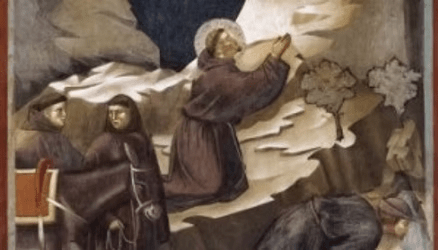
That cycle of history repeated every 80 years: 40 years serving God, followed by 40 years serving themselves (little-g gods).  They needed Judges to bail them out.  They wanted a king, then two; and then they lost everything.

You cannot serve the Lord by edict, where someone says, “You must do this or you must do that.”

Governments do that, and all government-fearing citizens do the true patriotic thing, year in and year out: They hire a lawyer, and an accountant, and a financial advisor (or adviser) that recommends their actions, where all the letters of the laws are bent every which way.  Governments purposefully write laws in gray (or grey), between the official looking black and white of legal legislation, because everyone knows the people love ways to get around the Law.  The high and mighty are selected from among the low and feeble, so it is proclaimed okay to serve as many little-g gods as your heart desires.  That way one is still (legally) able to say, “I am a Christian!” or “I am Jewish!”

“I have the receipts to prove it, dang it!” some say.

Jesus said it best: “No one can serve two masters. Either you will hate the one and love the other, or you will be devoted to the one and despise the other. You cannot serve both God and money.” (Matthew 6:24) However, Joshua said the same basic thing, well before Jesus.
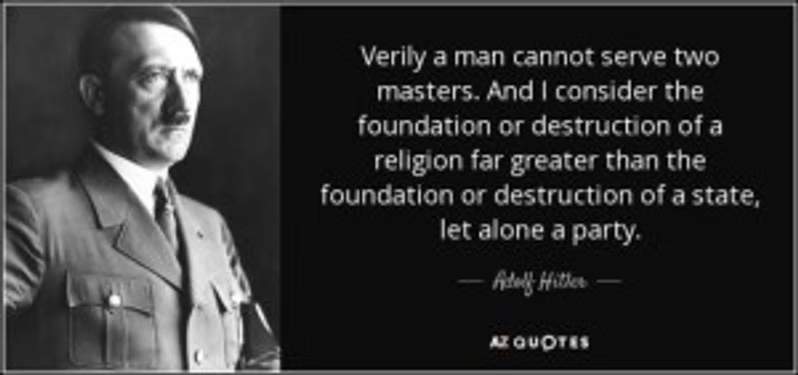
Adolf wasn’t the only one not filled with the Holy Spirit to misuse Scripture. How many Americans today (NOW) would sacrifice the State or the Party, as a master destroyed? I say few, if any.

Joshua told all those Israelites, the leaders who had seen a few things firsthand over the prior 70 years (give or take a couple of years), from Egypt to Shechem: “You cannot serve the Lord, for he is a holy God. He is a jealous God; he will not forgive your transgressions or your sins. If you forsake the Lord and serve foreign gods, then he will turn and do you harm, and consume you, after having done you good.”  Joshua said, “I know you guys.  I’ve been there and seen how stubborn you can be.”

That says that you can only serve YaWHeH by being holy [i.e.: righteous; sanctified; saintly]. There can be no “two- hours sitters” (give or take a couple of hours), as those who sit in a church or synagogue pew for that long each week, who can call themselves “servants of the Lord.”

That goes for “the elders, the heads, the judges, and the officers of Israel,” which translates in modern times (forevermore) as also going for “priests, pastors, ministers, rabbis, bishops, cardinals, archbishops, popes,” and anybody and everybody who is a leader of some religious tribe that professes complete devotion to the One God.

If you take 30 minutes off to make sure your tax receipts are in order, so you don’t miss out on any deductions; or if you take a couple of hours one day, shopping for the finest clothes to be seen wearing in church; or if you take a week off to look at exclusive properties near the beach, as an investment; or if you take 30 minutes to abuse a child sexually, or take the same 30 minutes to look the other way while that happens; or if you take a few hours to plan some political demonstration, because your fav politician-lawyer thinks your presence will have an impact on others; and so on and so on … then you are under the misconception that God does not see you serving yourself, over God.

Joshua, having been a common human being prior to becoming holy and righteous, prior to being able to hear the LORD, after being touched by Moses. He knew where the hearts of commoners (and their leaders) lay.  Hearts are fleshy muscles pumping blood, before they become spiritual reservoirs that flow forth living waters.  Joshua understood where the Israelites were bound and determined to go, whether they would admit it or not.

Joshua clearly said, “[YaHWeH] is a jealous God; he will not forgive your transgressions or your sins.”

But … but … but … Jesus said … didn’t he …?

This is because rule number one has been broken, “You shall not wear the face of any other gods before My face.” God will not forgive part-time believers or those of come-and-go faith.  It means that you cannot have a drawer of godly faces that you decide are okay to wear, interchangeably, depending on the special occasion. By thinking it up to you to decide when it is okay to take off the face of God and slide on another face of your choosing, you just made mistake Number One.

God don’t like that.

This means the moral of this story of old Joshua renewing the Covenant (the Holy Agreement, which came with legally binding words) with the Israelites (and thereby all of their spiritual descendants, Christian and Jewish) can be summed up with this statement: “Then put away the foreign gods that are among you, and incline your hearts to the Lord, the God of Israel.”

I have underscored and made bold the pronouns “you” and “your.” Please make sure you read those in the singular, as if old Joshua were having a face-to-face with you, individually. After all, nobody else in this world matters.

You think, therefore you are.” Everyone else – past, present, or future – is imaginary. Joshua wore the face of God, as His servant. Therefore, Joshua was speaking as if God where here NOW, telling you this.

This means that when we read the conclusion above: “So Joshua made a covenant with the people that day, and made statutes and ordinances for them at Shechem,” it was like when God spoke to Abram many years before.  Abram built an altar and made sacrifices after the covenant of his descendants was made.  Keep in mind that Abram had no – nada – zero – zilch – children then, meaning the agreement was based on the imaginary, not the real.  Likewise, Joshua made the leaders of Israel throw their egos on the altar he made that day, as immediate acts that sealed that agreement (with new statues and ordinances spoken).  Those leader sacrificed themselves on the altar built by Joshua, burning their egos in the flesh, so the smoke of their spiritual blood plumed towards heaven.
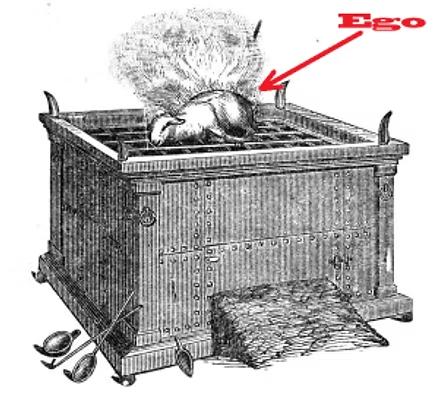
How would you like your ego cooked?


1 Thessalonians 4:13-18 – The reincarnated dead without Anointment will gain another chance for redemption [Twenty-third Sunday after Pentecost]

We do not want you to be uninformed, brothers and sisters, about those who have died, so that you may not grieve as others do who have no hope. For since we believe that Jesus died and rose again, even so, through Jesus, God will bring with him those who have died. For this we declare to you by the word of the Lord, that we who are alive, who are left until the coming of the Lord, will by no means precede those who have died. For the Lord himself, with a cry of command, with the archangel’s call and with the sound of God’s trumpet, will descend from heaven, and the dead in Christ will rise first. Then we who are alive, who are left, will be caught up in the clouds together with them to meet the Lord in the air; and so we will be with the Lord forever. Therefore encourage one another with these words.

———————————————————————————————————-

This is the Epistle selection from the Episcopal Lectionary for Year A, Proper 27, the twenty-third Sunday after Pentecost. It will next be read aloud in church on Sunday, November 12, 2017. This is important as it addresses the issue of death and the soul’s return to God, as understood by an Apostle and Saint.

Again, as I have done previously with the words of Paul, so we are forced to read what is written slowly and ponder translations that are valid, not what has been presented for us, let me simply present the above block (seemingly) paragraph in segmented fashion. Simply read this as the lines of a psalm that is slowly sung and let your mind’s eye see the message being unfolded before you. Read this before I offer an interpretation.

You can read along with the Interlinear breakdown of Greek and English here, and see how the translation above (the New American Standard Bible version) is compatible to the translation below.

13. I do not want you to be ignorant,
brothers,
concerning those who have fallen to sleep [that of death],
that not you should be grieved,
like are the rest,
those not having hope (confidence, trust, expectation).
14. If indeed we believe that Jesus died and rose again,
so also [we believe in] God,
those having fallen to sleep [that of death] for the sake of Jesus,
will bring (guide, lead away, go, carry) with him (the same).
15. This [statement of promise] indeed we declare to you in word of [the] Lord,
that [declaration] we the living surviving (left behind, remaining),
towards the coming (arrival, advent, presence) of the Lord,
all not shall proceed those having fallen to sleep [that of death],
16. because himself the Lord with a loud command (arousing outcry, word of command),
with the voice of the ruler of angels (archangel),
and with trumpet of God.
Will descend from heaven (the atmosphere, the starry heavens, the sky),
and the dead (lifeless, mortal) in Christ will rise before (at the beginning, first, in the first   place).
17. Then we the living remaining (left behind, surviving),
together with them,
will be caught away in clouds for meeting of the Lord in air (air we breathe);
and so always with the Lord will be.
18. Therefore encourage one another with these words.

If you noticed the repeating word, “died,” good for you! The repetition makes this the theme of this reading selection. Certainly, by comparing the two versions of translation, you noticed the word “died” has been replaced with “fallen to sleep” on three occasions, with “died” being maintained the other time.

The use of “fallen to sleep” is used as a symbolic statement of “death.” That translation comes from the words “koimōmenōn” (1x) and “koimēthentas” (2x), which are rooted in the word “koimaó.” The word “koimaó” (which is a variation of “keimai” – “to be laid, lie”) means, “sleep, fall asleep, die,” implying, “I fall asleep, am asleep, sometimes of the sleep of death.”

This is not insignificant, as in John 11:11 we are told Jesus said. about the news of Lazarus being “sick,” “Our friend Lazarus has fallen asleep; but I go, so that I may awaken him out of sleep.”  In John 11:4, the element of “death” was addressed when Jesus said, “This sickness is not to end in death, but for the glory of God, so that the Son of God may be glorified by it.”  Jesus being glorified by one falling asleep is an important message to hold onto as you read here how Paul wrote of that topic.

Jesus used the same Greek word as Paul used, referring to “having fallen to sleep,” with the word “thanaton” (rooted in “thanatos “) clearly meaning “death.”  The word maintained in translation here, as “died,” is “apethanen.” Immediately, a completely different word is visible (other than variations of koimaó ) as having been translated exactly the same as if rooted in “falling asleep.” The word “apethanen” is a form of the word “apothnéskó,” which means, “to die,” implying a usage saying, “I am dying, am about to die, wither, decay.”

Because the New American Standard Bible translation has presented a translation of “died” four times, with no indication of differences in the Greek, the reader’s and/or listener’s mind believes the exact same meaning is the intent, creating mental imagery of dead people in coffins, and all the finality that comes from mortal death. It then is important to grasp that the one use of “apethanen” is used in verse 14, where Paul wrote, “If indeed we believe that Jesus died and rose again.”  That states the common belief that Jesus died.

While Jesus was the name attached to a body of flesh and blood (like those possessed by Paul and the Thessalonians who had received this epistle), that state of finality (mortal death) did not end Jesus’ life. Because Jesus rose again, Jesus still lives.  Jesus lives in the bodies of Apostles and Saints. Thus, the implication in that statement (lost in translation) is that death – to a Christian (Christ Jesus and those filled with the Christ Mind) – is like being laid down to rest on a temporary basis, just like one goes to bed, sleeps, and then rises again.

To read a long-winded sentence that says, “For since we believe that Jesus died and rose again, even so, through Jesus, God will bring with him those who have died,” it is easy to come away thinking, “I believe Jesus died and was resurrected, so that belief means God will take my soul when I die.” That is as common a mistake as is thinking, “Jesus died for my sins.”

If Jesus did not die (he rose again), then Jesus awaits to awaken you from the death that is guaranteed by your sins.  Because the man Jesus was released from his physical body, his Spirit can continually rise again in others that die of sinful egos.  The ego goes to sleep, so the Mind of Christ can live again.

Nothing Jesus said in the Gospels (especially the parables where people think like that and find out the sad truth) says that anyone can sin all they want, while going to Heaven is guaranteed by belief in Jesus. Paul (even if it seems like he is saying all you have to do is believe and go to heaven) is telling believers you have to be Jesus reborn to get that reward.  It becomes a matter of seeing what you want to see, and that seeing then becomes the basis for believing.

Look again at verse 14 broken down into four segments. The first states, “If indeed we believe that Jesus died and rose again.” This segment begins with the Greek word “Ei,” which is a conjunction that relates this segment to the previous statement, “those not having hope,” which is a statement about those who do not have “trust, confidence,” or any “expectation” in eternal life. Thus, this segment depends on “If” that is the case,” “for as much as” that is the case, or as a direct reference to “that” lack of “hope,” then Christians indeed believe in a temporary state of death, because Jesus rose again.

The second segment then states how that resurrection was possible. Only God could cause a dead Jesus to rise again with life. Therefore, to believe in that miracle of the Resurrection, so also God is believed. Jesus did not raise himself from a state of being dead for three days (72 hours). God raised His Son.

Those two beliefs are more than simply the result of someone being told to believe in the resurrection of Jesus and the power of God. Keeping in mind that Paul was filled with the Holy Spirit of God, and he was writing to Christians in Thessaly who were likewise filled with the Holy Spirit of God, everybody was on the same page when Paul wrote, “those having fallen to sleep for the sake of Jesus,” he meant those who died like Jesus did – filled with the Holy Spirit.

The Greek word “dia” has been translated as “for the sake of” here, but as “through” in the NASB translation. The word means, “through, on account of, because of,” implying “through, throughout, by the instrumentality of, by reason of,” and “for the sake of.” The word is a preposition that is often used as a prefix, such that its use indicates “successfully across” (to the other side). Therefore, Paul was stating that for death to not be without “hope” or “expectations,” then one has become one with Christ Jesus, so one’s soul simply goes to sleep, to be resurrected in Heaven, because of that Christ presence within oneself.

From that realization, the fourth segment is clearly stated, such that we know Christ Jesus “will lead away with him,” “the same” as Jesus Christ “died and rose again.” Even for those who have no “hope,” they too will be “guided through” the soul’s removal from their dead mortal flesh, in an experience that is spiritual and heavenly. However, the impression given above (by the NASB), “God will bring with him those who have died,” is not stated; but to infer that meaning, one then has to realize that God will only keep those who have died as His Son reborn, with the rest recycled back into the mortal realm (reincarnation).

Paul then said that this promise of eternal life in Christ is the “word of the Lord,” which means it comes from God the Father, but was spoken by Apostles as Christ the Son. That “word” is truth, and when Paul then said, “we the living left behind,” “the living” means all those filled with God’s Holy Spirit, so those born of mortal bodies – “born of death” – had been made “living,” because they were then “alive” in Christ. That is the meaning of “towards the presence of the Lord,” as Paul explaining “we the living.”

The last segment of verse 15 begins with a double negative, “no not” or “no lest” (“ou ”), with “ou” also capable of being an indication of “all” (rather than “no”). As such, this then acts as a statement to be read two ways.

First, it says that “those having fallen asleep” (without the “presence of the Lord”) “will not proceed” to Heaven, while equally saying second, “all [that do] not expect” death, when “those have fallen asleep,” (because of the “coming of the Lord”), they will be the ones to go to Heaven. The double negative is then a reflection that not everyone (“not all”) who says they believe in Jesus and God will be saying “yes” to the “presence of the Lord” (due to the work that commitment involves).  That failure to say “yes” means, “no” “not” going to Heaven.

Verse 16 is then Paul telling of that “presence of the Lord” or the “coming of the Lord.” The first segment fails to see the importance of each word, when we think it says “the Lord with a loud cry.” We need to slow down and see the words saying, “because himself the Lord with,” where “himself” is not the Lord, but the one “the Lord is with.”

We get caught up in the imagery of God being this nebulous, separate entity on a cloud somewhere in the sky, but “the coming of the Lord” and “not” having to be recycled at death is “because the Lord is with oneself.” When one experiences God within, then there is a “loud” and clear “word of command” one hears.  It is not some sound that is audible, as vibrations registered in decibels. It means that  Christians let loose the “word of the Lord, loudly.”

It is then the Apostle who takes on the “voice” of the “ruler of angels,” and it is the “angels” sent by God that bring the whispers of the Mind of Christ. The one filled with the Holy Spirit then becomes the one who “trumpets” their faith in “God.”

At that point, “God will descend from the spiritual heavens,” in the ether that is the breath of life those born “dead,” as “mortals.”  By God coming down from above, His entrance into one’s heart means that one “will rise for the first time in Christ.” With that presence within, one stops fearing death and begins living as the resurrection of Christ.

When Paul wrote, “Therefore encourage one another with these words,” the “words” were about who dies and goes to Heaven. Not everyone gets to go to that spiritually everlasting paradise. Only those who become Jesus Christ reborn get that reward. There are only rooms set aside in Heaven for those who gave up selfishly living their mortal lives, so Jesus could return again, as the judge of who is “living” and who is dead. (See 1 Peter 4:5 and 2 Timothy 4:1)

The Greek word “parakaleite” is translated here as “encourage.” It can also mean “to call to or for, to exhort,” implying “I send for, summon, invite; I beseech, entreat, beg; I exhort, admonish; I comfort, encourage, console.” Paul was sending this letter to drive home the point to the Thessalonian Christians that they need to preach that message. No only should those filled with the Holy Spirit know their deaths are little more than falling asleep, waking up in Heaven; but, more importantly, they need to “encourage” those who are “like the rest” of humanity, “those not having hope,” that becoming a reborn Jesus is the way of “hope.”

This letter, again, was written for all who will read it, through all times, in all places. If you think you have Heaven solved and all you have to do to get there is believe Jesus died and was raised again, it is like thinking your beauty will pass that final exam, the one that will graduate you from the first grade to a doctorate in some field that means early retirement and exclusive homes on a paradise beach. You have to sacrifice to get the things you want in life … put in a lot of work, more mental than physical. Why would you think that same principle would not apply for the attainment of a spiritual goal?

The biggest problem the world has today is thinking. Heads filled with Big Brains ache when they read the epistles of the Holy Bible. To alleviate that ache, brains turn Greek words into English (or any other language, I presume, including that understood by Greek people) that makes Scripture say what they want to hear be said.

Those brains take the word “brothers” and turn it into “brothers and sisters,” so the sex organs of mortals – those born to die – are accommodated. It is so hard to see how all male and female Christians – those reborn as Jesus Christ – are all “brothers,” due to all being reborn as Jesus, the Son of the Father.

Commentaries of this selection that can be found published online focus on the “comfort of Jesus coming” to those who “have died” and to those left grieving the dead. We like to think that faith in Jesus will bring that deliverance, after it is time for us to leave this materialistic place we so fondly call home.

If we are still living to see it, then we expect Jesus to come down on a cloud at the end of the world and Rapture us, so we can watch all the heathen be fried like ants under a magnifying lens.

“Ha, ha, ha, ha,” they can say then, “Told you so, suckers!”  “You should have believed!”

Otherwise, we think it is all a matter of “We believe.  We die.  We go to Heaven.”  Since all moms are Saints, we will be greeted by mom, and she will probably have a hot apple pie ready for our arrival!

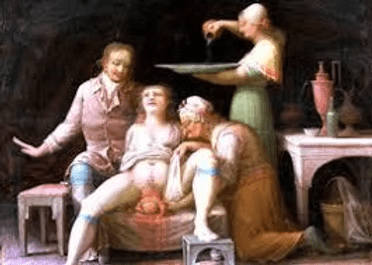
If you wait until death to find Jesus coming, then expect to be popping out of your new momma sometime soon afterwards. God will review all the common mistakes that mortals make; and, then <poof> your soul is in a mortal body again!

And the recycle of life rises again.

Everyone needs to read all the parables Jesus told and put themselves in the setting as the “fool,” rather than seeing themselves as Jesus talking about fools. The parables all say, “Never put off for tomorrow what you can do today.” Tomorrow is too late, as tomorrow may never come.

The only way to rest in peace is to know mortal death just means going to sleep, because the soul has a place reserved in Heaven. Those reservations require one’s ego taking a long, deep slumber, so God can send His Son in to make one’s body walk for the Lord and one’s tongue talk for the Lord. Now is the time to secure that reservation, because there is no better time than the present.

Matthew 25:1-13 – Vigilant and devoted bridesmaids [Twenty-third Sunday after Pentecost]

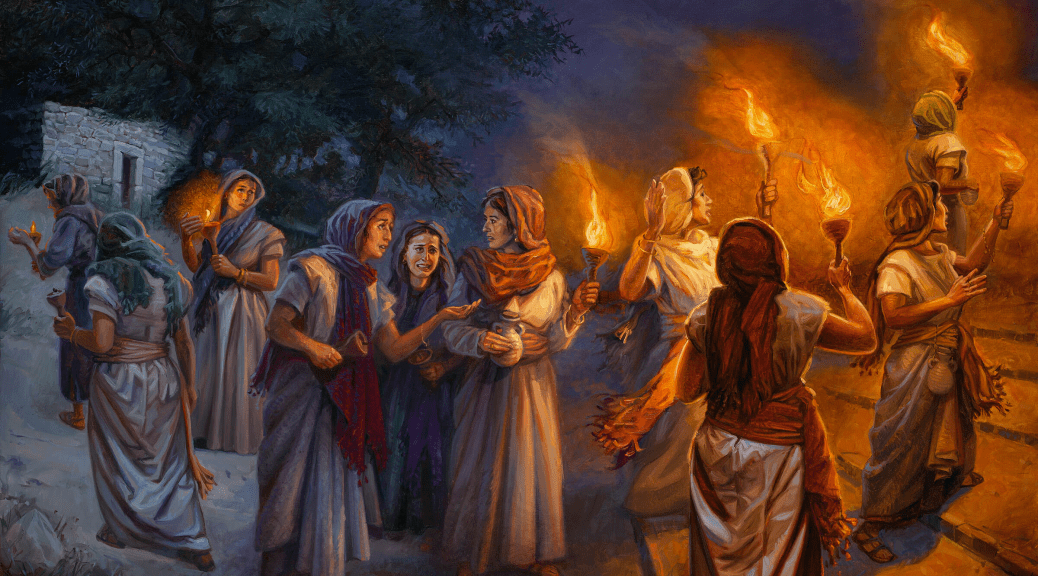
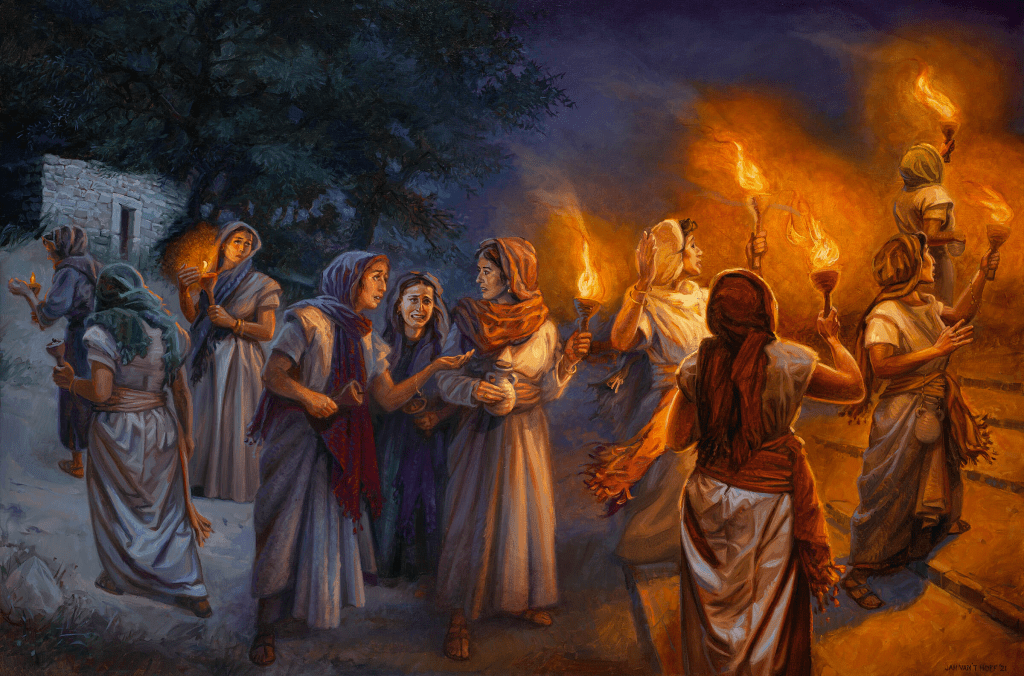
Jesus said, “Then the kingdom of heaven will be like this. Ten bridesmaids took their lamps and went to meet the bridegroom. Five of them were foolish, and five were wise. When the foolish took their lamps, they took no oil with them; but the wise took flasks of oil with their lamps. As the bridegroom was delayed, all of them became drowsy and slept. But at midnight there was a shout, ‘Look! Here is the bridegroom! Come out to meet him.’ Then all those bridesmaids got up and trimmed their lamps. The foolish said to the wise, ‘Give us some of your oil, for our lamps are going out.’ But the wise replied, ‘No! there will not be enough for you and for us; you had better go to the dealers and buy some for yourselves.’ And while they went to buy it, the bridegroom came, and those who were ready went with him into the wedding banquet; and the door was shut. Later the other bridesmaids came also, saying, ‘Lord, lord, open to us.’ But he replied, ‘Truly I tell you, I do not know you.’ Keep awake therefore, for you know neither the day nor the hour.”

———————————————————————————————————-

This is the Gospel selection from the Episcopal Lectionary for Year A, Proper 27, the twenty-third Sunday after Pentecost. It will next be read aloud in church by a priest on Sunday, November 12, 2017. It is important because of the warning of preparedness, as told in the parable of the ten bridesmaids.

This parable seems quite straightforward, in the sense that it paints a clear picture of being prepared for when the bridegroom comes, which appears to be Jesus in allegory. Of course, nothing is Scripture is that simple, as there is deeper meaning always embedded in the specific verbiage used. Every word coming from Jesus, and remembered by Matthew, came from the All-Knowing Mind of God. Each word of Greek is perfectly chosen.

In fact, one can see such knowledge as allegorically mentioned in this parable, as the oil that the lamps burn for light. Light is metaphor for the truth.  One assumes that some oil is already in the lamp, which had been lit in the evening.  By there being ten different lamps, this becomes metaphor for ten different ways the same words written in Greek can be made available to “light” one’s way in translation. However, meditation that goes beyond the apparent and ponders the scope of meaning that is possible from the Greek, then that acts as an extra “flask of oil” from which the “light” of truth can shine.

This Gospel reading is presented on the same Sunday as the story I interpreted about Joshua, who in his last year of life told the leaders of the Twelve Tribes, “Choose to serve God, or choose to serve the gods of others.” It also goes along with the first letter Paul sent to the Christians of Thessaly, where he wrote words that were read in church as saying “died,” but in reality three times the word implying death was used, metaphorically saying, “having fallen asleep.”

Can you see how this parable strongly links to those themes, when the bridesmaids have fallen asleep, with half having extra oil, and half only having the oil that was already in their lamps?  Can you see how “to become drowsy and sleep” is the same metaphor of death?  Can you see Jesus telling a parable that warns to be prepared for that time of death, which all mortals cannot escape?

In the interpretation I wrote referring to 1 Thessalonians 4, I wrote how one only needs to look at the parables that Jesus told and place oneself in the story “as the fools,” rather than as Jesus – the one telling the story. I had not read this Gospel accompaniment at that time; but as I prepared to write this, I saw the word “fool” used. Exactly as I stated prior, one has to ponder, “How am I one of the five bridesmaids that were foolish?”

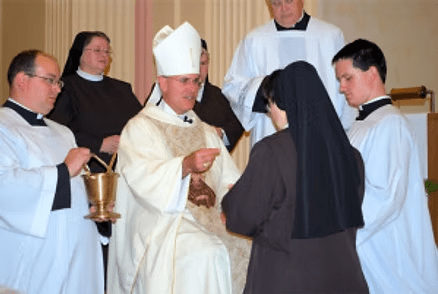
This brings us back to the point that I have made previously, where we are all called to marry the King (and become his Son), as was the allegory in the parable of the Wedding Banquet. That thought, humanly mistaking the proposal to be to marry Jesus, causes manly men to stand up and pronounce, “That is gay! No man can marry another man!” Meanwhile, all the female Christians (especially Roman Catholic nuns and nuns of other denominations) gleefully proclaim, “I am already wearing the ring of marriage to Jesus Christ!”

As I have said, sex organs play no role in spiritual matters. When Jesus told Nicodemus that being reborn did not mean finding some physical way to get back into the mother’s womb, he was heard saying, “Truly, truly, I say to you, unless one is born of water and the Spirit he cannot enter into the kingdom of God.” (John 3:5) Jesus was not talking about bridesmaids being exclusively females because sex organs are not “born of water and the Spirit.” That says “water” is symbolic of “love,” and “the Spirit” is the HolySpirit.”

Love of God brings the Holy Spirit, as the marriage of the Son to the human being of faith, devotion, and submission – the traits of God’s bridesmaids.  That marriage of one’s heart with God – a Holy Union – in turn allows one entrance into the Kingdom of Heaven. That was what Jesus was talking about to Nicodemus – being reborn is what gains entrance into God’s Kingdom (Heaven). Therefore, the bridesmaids are symbolic of Christians that have sacrificed their self-egos, to be married to God.

In this way, anyone who thinks like Nicodemus and wonders how an old man can get back into his momma’s womb (via momma’s sex organ) is as “foolish” as a bridesmaid without extra oil for a lamp. Think of it as some male Christian saying he will marry God and have God’s baby Jesus Christ be born in him, but then that “fool” never gets the extra oil of Scriptural knowledge, to help him through the threshold of death, or “having fallen asleep” like Lazarus (the one Jesus loved) did.

When we read, “When the foolish took their lamps, they took no oil with them,” one can assume they took a lamp that had some oil already in it, so the lamp was able to shine a light for a few hours. All ten bridesmaids have lamps, so the similarity means all ten are led by the light of religion. That religion represents belief in the One God, YaHWeH, the LORD. So, they are either Jewish lamps or Christian lamps today, while Jesus was talking to Jews then.

Simply by having a lamp does nothing for anyone, so being Jewish or Christian in name only (by birth), with no knowledge of what that means as an adult, means one is not  deeply committed to God. No holy light leads one’s path through life. One is (figuratively) still “playing the field,” and “keeping one’s options open.”  One is a bachelor-bachelorette and not a bridesmaid (remembering that sex organs do not matter).

The oil that is already in the lamps should then be seen as one’s personal knowledge of what one’s religion says to believe. As such, all active Christians carry the knowledge that fuels the light that shines faith in God. Jews carry around lamps that are full of the oil that reflects memorizing 613 commandments, sent from God through Moses. In this way, the extra oil that five of the bridesmaids have with them is the oil of the New Testament, which fuels the light that shines faith in Jesus Christ, as the Son of God. The foolish bridesmaids do not carry that extra oil.

Still, the five foolish bridesmaids can be broken down into five different types of Christians and Jews. These can be compared to the seven churches, to which the Spirit of Jesus told John to write letters (in The Revelation). The Jews that reject Jesus as their Messiah, while remaining devout in their adherence to the laws of Moses, simply do not have that extra oil needed to get them beyond death, into Heaven. This was the reason Jesus preached in parables to such holy Jews in Jerusalem, to no avail. But, Christians who mirror those Jews in Jerusalem today, who maintain devotion to amassing fortunes and things, through  a misguided belief that God blesses His believers with things, they are not being filled with God’s Holy Spirit; and that means a “foolish” waste of holy oil.

When the ten had waited so long they had “became drowsy and slept,” this then states symbolically that the “delay” leading to that point of rest was a lifetime of waiting “to meet the bridegroom.” The Greek word that is translated as “slept” is “ekatheudon.” That is rooted in the word “katheudó,” which Thayer’s Greek Lexicon states is used: euphemistically [as], “to be dead,” and metaphorically [as], “to yield to sloth and sin, and be indifferent to one’s salvation.”

This hints at the weights placed upon human beings, as mortals, such that the “drowsiness” is brought on not only by the deterioration of bodily parts, from age, but the weariness that comes from denying oneself the lures of the world (being faithful and true to the bridegroom), as well as succumbing to them (secretly cheating on one’s verbal commitment).  It is a lifetime of temptation to worldly things that wears one out and makes one tired.

To then hear Jesus say, “At midnight there was a shout, ‘Look! Here is the bridegroom! Come out to meet him.’ Then all those bridesmaids got up and trimmed their lamps,” the symbolism of “midnight” has to be grasped. The actual Greek words written are “mesēs de nyktos,” which says, “the middle of the night.” That can be simplified as “midnight,” but a viable implication of “nyktos” (from “nux”) can be “midnight,” by itself.  As such, the simplification makes one miss the point of the word “mesēs” (form of “mesos”), where “in the middle” becomes less a statement of time of day, and more a statement about being in transition, from life to the afterlife, when “in the middle” means the transition of death.

Seeing “the middle” from that perspective, then one can grasp how death is that period of darkness when an absence of light surrounds one’s soul. This is termed “spiritual dryness,” but St. John of the Cross, OCD, wrote a poem that has been called “The Dark Night of the Soul.” An article on that poem and its topic explains: “The term “dark night (of the soul)” in Roman Catholic spirituality describes a spiritual crisis in the journey toward union with God.” The same “crisis towards union” can be seen in this parable told by Jesus.

Jesus, the teller of this parable, said, “There was a shout, ‘Look! Here is the bridegroom! Come out to meet him,’” which can be read as Jesus Christ making that cry of alert. Seeing that as the voice of the Christ Mind exclaiming, “Good News!” is then confirmed when Jesus said at the end of this story, “Keep awake therefore, for you know neither the day nor the hour.” This is clearer when the Greek text is found to add, “in which the Son of man comes,” (“en hē ho huios tou anthrōpou erchetai“), words with translations omitted, as they have not been included in the NASB translation above.

This parable then projects the future, when Jesus told his followers, while on the other side of the Jordan, about the death experienced by Lazarus. Jesus said, “Our friend Lazarus has fallen asleep; but I go, so that I may awaken him out of sleep.” (John 11:11) That parallels this story that tells allegorically of vigilance. The Lazarus story ended when we read, “There was a shout,” as John wrote, “He cried out with a loud voice, “Lazarus, come forth.’” (John 11:43)

The slumbering bridesmaids were awakened by a shout to “Look!” or “Behold!” or “See with the Mind of Christ!” (which is the intent of “horaó”). In both stories, the command was to “Come out,” which is an invitation to leave the darkness of death, but also the darkness of mortality. That command is to enter the heavenly realm of eternal life.

Kate Bush Video Waking the witch

In the statement, “Then all those bridesmaids got up and trimmed their lamps,” the Greek word “ekosmēsan” is translated as “trimmed.” It is the past tense of the word “kosmeó,” which means “to order, arrange,” implying “I put into order; I decorate, deck, adorn.” The word “trimmed” is then used like “trimming the Christmas tree,” and not like cutting a wick, or pulling the wick of a lamp out, so it can be re-lit. According to Thayer’s Greek Lexicon, this specific usage implies “to put in order,” as well as “to make ready” and “prepare” the lamp for the meeting of the bridegroom. This is where adorning the lamp ceremoniously would mean putting the extra oil into effect, as that was what would make meeting the bridegroom possible.

We know that is the case, because we read how Jesus then said, “The foolish said to the wise, ‘Give us some of your oil, for our lamps are going out.’” Because the “fools” said that, as a command to “Give,” this makes an important point of what makes a “fool” “foolish” and not “wise.” People expect to be given Heaven. They expect to be “placed, allowed, put, bestowed, granted, and permitted” (among other possibilities stemming from “Dote,” rooted in “didómi”), rather than having to do work themselves.

Can you hear St. James saying, “Faith without works is dead”? (James 2:14-26)

One can be given many things, but entrance into Heaven (the Kingdom of God) requires the work of the wise. This means being “wise” comes from being filled with the Holy Spirit, with all the “smarts” of the Christ Mind guiding one’s works. It is that presence of the Christ Mind’s “wisdom” that gives the five “wise bridesmaids” that “flask of oil.” That “oil” anoints them with the talents of the Holy Spirit, to prophesy and to understand prophecy, which is the fuel that “lights” their way to Heaven. It is the Holy Spirit that “adorns” the “lamp” of religion and simple faith.

Matthew 11:25 writes of Jesus saying, “I praise you, Father, Lord of heaven and earth, because you have hidden these things from the wise and learned, and revealed them to little children.”  There, “sophōn kai  synetōn” says “cleverness  importantly  intelligence” is the mistake of thinking a Big Brain will be all the ‘oil’ one’s lamp needs to stay awake until the bridegroom comes.  God does not come to meet those fools.  God does not propose to those who fall in love with convoluted masses of synapses that only serve mortal existence.  God proposes to “little children” whose faith is not hindered by the limits a human organ presents one’s soul.  Children are those who are neuter gender and not those who have not become limited to love that follows the lead of a sex organ.

In one commentary that I briefly skimmed over, the refusal of the five “wise bridesmaids” to “Give” lamp oil to the five “foolish” ones was seen as selfishness or petty bickering and jealousy. This is not the case at all.

To grasp that, I want you to think now of the story Jesus told about poor Lazarus, who in life sat at the gate of the rich man, begging for the crumbs off his table. In death, it was the rich man who begged Abraham’s Spirit to let Lazarus “Give” his tongue a touch of “cool water.” When Abraham refused, because the chasm between Heaven and Hell was too wide for Lazarus to cross, the rich man still wanted Lazarus to “Give” notice to his still living brothers, so they might change their ways (which were the ways of all rich humans).

In this parable, the five “wise bridesmaids” have to be seen exactly like poor Lazarus is seen, after death. None of them were able to “Give” what was not theirs to “Give.”  It was not a matter of selfishness, but the lesson that requires one earn that which one is “Given.”  Lazarus earned reward, while the rich man earned punishment.

The translation presented by the New American Standard Bible (NASB) has the “wise” saying, with an exclamation point, “No! there will not be enough for you and for us.” This is not what is written. The capitalized first word of this reply is “Mē¦pote” (root being “mépote”) which means “Lest.” It implies, “Lest at any time” and “Perhaps,” with the connotation of “Not” beginning their reply (without that being exclaimed).

The Greek written literally states the reply to a command to be “Given” the Holy Spirit, in the form of lamp oil.  The written words say, “Not cannot no [a triple negative] it is assistance for us and you.” That does not say there is not enough to be shared. It says there is plenty to go around, but they “cannot” “Give” that which the “wisdom” allows them to know: “not is it assistance for me and you.” The statement of reply says, “No cannot  [for] it is not to suffice for us and you.”  The “wise bridesmaids” knew, through the Christ Mind, that each individual must work for the unlimited shares that God has to Give.

The completion of the “wise bridesmaids’” reply, “you had better go to the dealers and buy some for yourselves,” states this individual responsibility to secure the holy oil necessary, by which one can enter Heaven. The literal translation says this in two segments: “but go rather to those selling,” and then “buy for yourselves.”

When one is hearing an allegory told, it is natural to think in normal, human terms; so when one hears lamp oil needed (a commodity), then it is natural to go to a lamp oil “dealer” to purchase that. In this story, we visualize some stupid girls running in darkness, trying to get an oil shop to open up and sell them some lamp oil.  However, the metaphor of “oil” is spiritual oil, or holy oil.

This means the “sellers” and “dealers” of holy oil are churches and synagogues. Therefore, the lack of work done by the “foolish” is being pointed out by those of “wisdom.” The ones who said they were “Giving” away “get to Heaven oil without working for it” I.O.U.’s are those who never “Gave” them the Holy Spirit’s “oil.”  They could not give what they did not themselves have; or they refused to give what they selfishly thought they had – scholarly knowledge – not wanting ignorant commoners to be special like them.  If you have the extra flask of oil and you are still alive, then you Give it away to those who seek it.

This, certainly, was a slap to the face of the Pharisees, Sadducees, scribes and Temple priests in Jerusalem, as Jesus was speaking allegorically in parable.  That was because it pointed the finger of “wisdom” at the lack of spiritual competence in those religious leaders.

Nicodemus, identified by John as “a man of the Pharisees” and “a ruler of the Jews” (John 3:1), was asked by Jesus, “Are you the teacher of Israel and do not understand these things (the spiritual meaning of being reborn)?” (John 3:10) This made Nicodemus one of those getting rich off selling the “oil” of Mosaic Law; but he and his pals never had in stock (as a commodity to sell) “spiritual oil,” the kind that anoints one for entrance into the Kingdom of God.

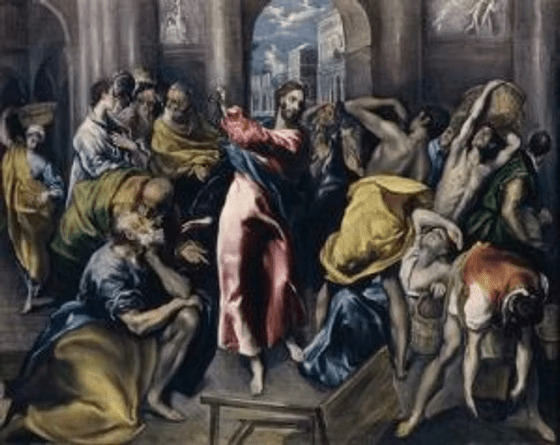
Jesus demonstrated how selling in the Father’s house was unappreciated.

Because the Holy Bible is a Living document, that which was written in ancient times, of ancient people, still applies at all times, to all people.  The eternal value of Scripture is as Paul wrote to the Hebrews of Rome: “For the word of God is living and active and sharper than any two-edged sword, and piercing as far as the division of soul and spirit, of both joints and marrow, and able to judge the thoughts and intentions of the heart” (Hebrew 4:12). Therefore, this slap at the leaders of Judaism in Jerusalem, by Jesus speaking in parable, is equally a slap at all religions professing belief in YaHWeH, the One God (the “lamps” of religion) that keep their flocks filled with costly physical “lamp oil” (like the vendors of the marketplace, selling shares of responsibility in the costs of buildings and programs), and do nothing that anoints the believers with the spiritual oil that prepares them to go beyond mortal death.

Those who are “wise” have become so by coming in touch with someone with the Holy Spirit. Jesus passed that onto his Apostles (who became Christ Jesus reborn), and they passed the Holy Spirit onto those they contacted (such as Paul and the Thessalonians). Apostles today have been led to Scripture, by those teaching programs of churches in the denominations of Christianity (readings, sermons, Bible studies, etc.); but the Holy Spirit does not come by trick or by human command.

Individuals have to show God their sincerity in wanting to become His bridesmaids-in-waiting, so that the extra flask of holy oil (the Holy Spirit) will be born within them. That rebirth of Christ Jesus in Apostles sends those Apostles out to “Give” that same opportunity to others. However, all who receive the Holy Spirit have to prove themselves as worthy, through the works of evangelism.

By the time one reaches that point of slumber, ready to meet the bridegroom they have worked so hard to please, there is no place a soul can go and “buy” or “purchase” the Holy Spirit. When Jesus said, “You cannot serve two masters. You cannot serve both God and money” (Luke 16:13), we see now how that means you cannot “purchase” a ticket to Heaven. You cannot reserve a room in the Father’s house with a credit card.

Seeing how the bridesmaids’ slumber is reference to death, after being told to go and “buy for yourselves,” the only place those five “foolish” souls could go was their own funerals.

Their souls would then hover over those grieving their passing, only to find prayers being recited over their physical corpses, as they were being lowered into the ground. Those souls then returned to the place of the wedding banquet, bringing with them the words spoken by priests, ministers, pastors, preachers, and rabbis, asking God to receive them.

Prayers are good.  Prayers are helpful to the living.  However, prayers for released souls are more for those left remaining in grief, than of any benefit for the dead.  A prayer cannot trump the requirement of being in possession of the Holy Spirit.

Reading, “Later the other bridesmaids came also, saying, ‘Lord, lord, open to us.’ But he replied, ‘Truly I tell you, I do not know you,’” that says those “virgins” (actual meaning of the word “parthenoi,” which is translated as “bridesmaids”) had supposedly set themselves apart from other lords, as committed to marry the bridegroom (God). While they promised their hearts to God, and confessed to others that was where their hearts were, the truth exposed (“Amēn legō” – “Truly I say”) is that they never did as promised nor publicly proclaimed.

God did not know those souls intimately. They were still “virgins,” “bridesmaids” with no real, committed relationship with the Lord; AND remember – we are not talking females for marriage. ALL are “virgins” until God consummates a relationship by sending His wives-to-be His Son and His Holy Spirit. The allegory of that is there must be possessed an extra “flask of oil.” Without that to light the lamp to Heaven, God can truly say, “I have not known you (in the Biblical sense).”

You have to be reborn as Christ Jesus to gain entrance into Heaven.

Jesus then said, as the storyteller who spoke for the Father, “Keep awake therefore, for you know neither the day nor the hour.” “Keep awake” means do not die before you have become baby Jesus reborn in the flesh. Do not die before the Holy Spirit has used you as an Apostle, to bring other bridesmaids-in-waiting to the Lord.

Keep awake because you never know when death will make it too late to run to the church and get some Holy Spirit.  You need to be prepared beforehand.

Mark 10:46-52 – Take heart; get up, he is calling you

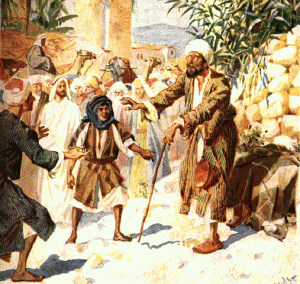
Jesus and his disciples came to Jericho. As he and his disciples and a large crowd were leaving Jericho, Bartimaeus son of Timaeus, a blind beggar, was sitting by the roadside. When he heard that it was Jesus of Nazareth, he began to shout out and say, “Jesus, Son of David, have mercy on me!” Many sternly ordered him to be quiet, but he cried out even more loudly, “Son of David, have mercy on me!” Jesus stood still and said, “Call him here.” And they called the blind man, saying to him, “Take heart; get up, he is calling you.” So throwing off his cloak, he sprang up and came to Jesus. Then Jesus said to him, “What do you want me to do for you?” The blind man said to him, “My teacher, let me see again.” Jesus said to him, “Go; your faith has made you well.” Immediately he regained his sight and followed him on the way.

———————————————————————————————————-

This is the Gospel selection from the Episcopal Lectionary for the Twenty-third Sunday after Pentecost, Year B 2018. In the numbering system that lists each Sunday in an ordinal fashion, this Sunday is referred to as Proper 25. It will next be read aloud in an Episcopal church by a priest on Sunday October 28, 2018. It is important because it tells of the healing of a blind beggar, who symbolizes all those who would follow Jesus as Apostles, due to their faith raised in the presence of Jesus, allowing the Holy Spirit to be upon them.

The setting in this reading is Jesus is returning to Bethany (in Judea) from across the Jordan River. The return takes him naturally through Jericho. When we read, “[Jesus] and his disciples and a large crowd were leaving Jericho,” it should be realized that all of the regions surrounding Jerusalem had been filling up with Jewish and Israelite pilgrims, because of the soon approaching Passover festival. Jesus was returning to Bethany because he had received news that Lazarus (his brother-in-law) had become gravely ill.

The crowd that Jesus walked with, for the most part, was not followers of Jesus.  Those in Jericho knew of him because Jesus had made himself known as a teacher in the region of Perea, especially in Bethany (beyond the Jordan).

It is also worthwhile to know that Matthew and Luke also wrote about this event that Mark tells. John did not write of it because he was too young to go on an extended trip across the Jordan. He stayed at home in Bethany, with his mother, aunt and uncle, waiting for Jesus to come back. Mother Mary (and her other sons) and the disciples (and their families) did not follow Jesus to Bethany (in Judea), as is seen in the fact that no one other than John would write about Jesus raising Lazarus (his brother-in-law) to life.  Lazarus was raised after being dead four days and stinking of death. That event was quite special; so absence is the only reason the others did not write about that miracle. They did not witness it.

In this miracle that was witnessed by three of the Gospel writers, Mark names “Bartimaeus son of Timaeus,” and calls him “a blind beggar.” Matthew says there were “two blind [men],” naming no one. Luke [Mary’s account] writes of “a blind [man] certain,” in the singular number, with “certain (from “tis”) being an indication that a blind man was known, in some way.

The name stated by Mark is redundant (as an aside clarifying the name), such that “Bar-timaeus” means “son of Timaeus.” The name Timaeus is believed to be Greek, meaning “Highly Prized.” This would mean “Bartimaeus” was named by his father as a “Son of Honor.”

Some say that the name could be rooted in Hebrew, because of the redundancy factor yielding no meaning of merit.  As such, the Hebrew verb “tame,” when seen as the root, would change the name to meaning Son of Uncleanness or Son of the Unclean One. Since Bartimaeus did not say he had been blind since birth, that history could mean a name with dual meanings, to fit the life he grew into.  That view would allow for him being a highly valued baby when born, but due to some later factor (perhaps working in an unclean environment caused cataracts to grow?) he went blind.

If there were indeed two blind beggars in the same place on the side of the Jericho road (as Matthew’s account must be seen as true), then Bartimaeus might be a name generally given to blind beggars, by Peter or others in common, to identify blindness as a sin of unclean living. That was somewhat the opinion the Pharisees had when Jesus healed a blind man from birth (who also begged), putting mud on his eyes on a Sabbath, telling him to wash the mud off in the pool of “Sent.” (John 9) Even when the man was able to see (thus no longer a sinner), the Pharisees threw him out of the Temple for giving credit to Jesus for being able to see. As such, each of two blind beggars could have been referred to a Bartimaeus, which would then be a “certain” term commonly used.

Regardless of the name stated, Mark tells us that when the beggar “heard that it was Jesus of Nazareth,” this was due to a crowd passing being louder than normal, prompting those without eyesight to ask, “What’s going on?” While Matthew is similar to Mark in the generality of what the beggar(s) heard, Luke makes it clear that they asked and were told what Mark said they heard. Still, while being told that “Jesus of Nazareth” was passing by, when he was just one in a “large crowd,” that would only have meaning to those who had heard Jesus give public sermons.

Any healings that Jesus might have done along the Jericho road (where one can assume the blind beggar had been for some time), or in Jericho, were not written of by his disciples. Only through the rumor mill would Bartimaeus have known who Jesus of Nazareth was.  It would be wrong to assume that the blind beggar(s) had traveled to Jericho to wait for Jesus, even though a traveler giving alms to the poor might have told him (them), “If a man named Jesus of Nazareth comes by here, then ask him to help.  He is a healer.”

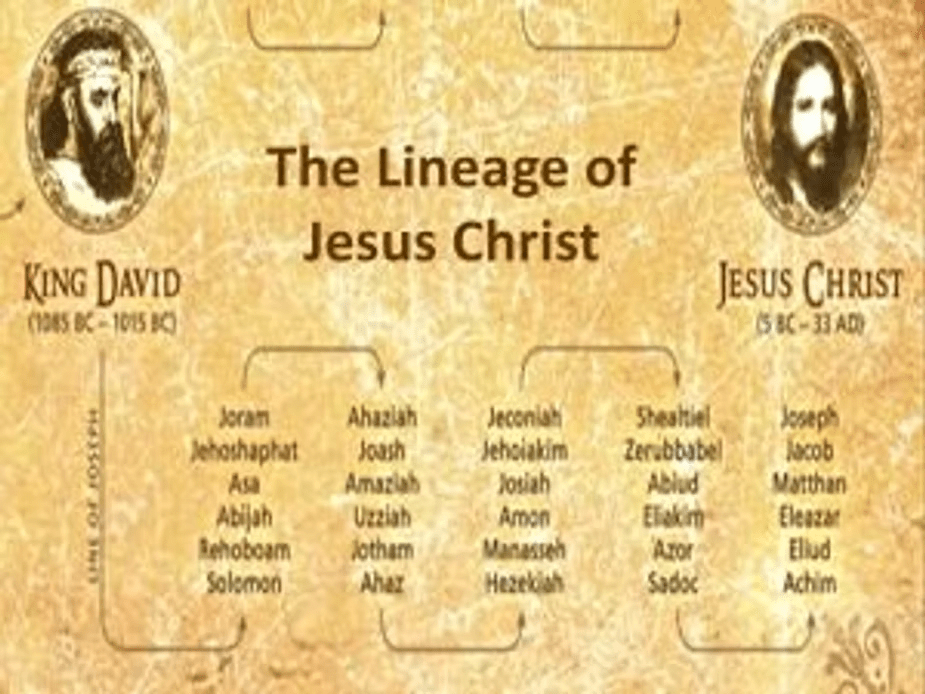
When the beggar(s) began shouting, “Jesus, Son of David, have mercy on me!” and again,  “Son of David, have mercy on me!” this was not a call that was based on what they were told by bystanders with good eyes. The shout was based on what they “heard” from the Holy Spirit moving through him (them). The shouts were akin to when Peter blurted out, “You are the Messiah, the Son of the living God.” (Matthew 16:16) In other words, God was signaling His Son by those shouts, identifying Jesus as a descendant of the holy Davidic line. That was what Jesus heard.

The Lineage of Jesus

It is important to know that the Greek word hollered by the blind man (men) that is translated as “Son” is “huios,” which is not capitalized. The lower-case spelling means a more accurate translation would be “descendant,” although figuratively the word could state “likeness.” Still, the translation as “son of David” has to be seen as coming from one whose blindness made him be known as a “Son of Uncleanness,” from a man who wanted to be returned to a “Son Highly Prized.” God knew this blind man’s heart and God knew it was time to return eyesight to a man that spoke the words of God, without regard for those rebuking him to doing so.

When Bartimaeus (and another) are said to have twice shouted out, “Have mercy on me (us),” all Gospel writers used the Greek word “eleēson,” which means “to have pity,” or “to show mercy.” The same word can imply the receipt of or the finding of mercy, when directed at someone asking for it.

The root word, “eleéō,” means “to show mercy as God defines it, i.e. as it accords with His truth (covenant) which expresses “God’s covenant-loyalty-mercy” (i.e. acting only on His terms).” [HELPS Word-studies] Thus, Jesus heard his name called, along with recognition of his holy lineage, with a plea that both requested help and stated an inner presence of God’s Holy Spirit in one of the onlookers.

This means that Jesus was not hearing over the loudness of a large crowd the voices of those making selfish requests. One can imagine that a large crowd of pilgrims were walking along with Jesus and his disciples and family (all headed generally towards Jerusalem) generated a parade-like effect, where the people on the sides of the road had heard Jesus speak in the synagogue of Jericho before and recognized him. Like it is when parades are held, recognizable people (celebrities) are asked to ride in convertible cars or fancy floats, simply to wave to the crowd. All the foreign pilgrims walking along with Jesus were just like the high school marching bands, Cub Scout troops, and local public servants in their cars and trucks (with lights flashing), where the bystanders did not know those people.  However, some of them recognized Jesus of Nazareth.

One would expect that when one of the known people was spotted, people would call out their names, as a friendly, “Hello!” No one would expect a parade to stop because a bystander recognized a celebrity and asked for an autograph.  An obnoxious screamer in the crowd would be told to shut up.

This is how those near the blind beggar(s) rebuked his (their) cries, sternly ordering the man (men) to be quiet. Parade protocol does not allow for requests to be made of the paraders. Because of the din of the traffic was noisy, the people were annoyed at how loud the cries for attention were. The people got angry because the shouts were quite loud and (in their minds) unwarranted; but the common people of Jericho were not filled with the Holy Spirit.

We then read, “Jesus stood still,” where the actual Greek written begins with “Kai stas.” That is a capitalized adverb, joined with an verb, as a two-word statement that importantly states, “Namely stopped.” Before that segment of words identifies with “Jesus,” we need to grasp how the parade, the noise, the hubbub all kept moving along, but the one whose name had been called loudly then “stopped.”

The common conjunction “kai” usually means “and,” but when capitalized it becomes more than an important conjunction. The Thayer’s Greek Lexicon for “kai” states a third usage as such:

“3. It annexes epexegetically both words and sentences (καί epexegetical or ‘explicative’), so that it is equivalent to and indeed, namely.” This is: “A.); equivalent to and indeed, to make a climax, for and besides … our and this, and that, and that too, equivalent to especially,” [Thayer’s Greek Lexicon]

This flexibility of translation (and intent) being attached to what appears to be a new ‘sentence’ beginning with the word “And” is instead detailing the one called “son of David” and bridging to the one named “Jesus.” He was “especially called,” as “indeed” the one among the many, “besides” all the rest, thus “namely” Jesus was indicated. Based on the definition of “namely,” the “son of David” “specifically stopped,” as he was named “Jesus.”

The word “histémi,” from which “stas” is the past historic form, can actually translate as “Namely became a bystander.” It states the importance of “Jesus taking a stand,” rather than moving on by with the rest, ignoring the cries made from the bystanders.

It can be assumed that the large crowd on the same road as Jesus and his disciples (and families) did not come to a halt. They had not been spiritually called to “Stand still.” I imagine Jesus made his way to the side of the road, so those going to Jerusalem would not be blocked by him standing in their way [the parade must go on]. It would have been there that Jesus would instruct his disciples, “Call him here.” In reality, based on the Greek written, Jesus was not quoted. The text states that Jesus “commanded [the blind beggar] be brought to [Jesus].”

Neither Matthew nor Luke include the specifics that Peter recounted to Mark, such that he alone wrote, “They called the blind man, saying to him, “Take heart; get up, he is calling you.” So throwing off his cloak, he sprang up and came to Jesus.”’ This means that Peter was one of the disciples sent to bring the blind beggar(s) to Jesus.

The capitalized Greek word “Tharsei” is written, which is translated as “Take heart.” The root word, “tharseó,” also means “good courage, good cheer, and emboldened.” The substitution of “heart” indicates the emotional plea made by the blind beggar(s) was heard and felt. The capitalization shows the importance given, which shows the strength of the blind beggar(s) cries.  Bartimaeus moved Jesus by his heart touching the heart of Jesus, joining them emotionally.

This one-word statement of importance [again, realizing that every word of the Gospels is the Word of God, through an Apostle], is then followed by the command to “get up” or to “rise up.” It should be recalled [from past interpretations that use this word] that the word “egeiró” has more than the mundane meaning to getting up from a sitting position, as it means “wake up” and to “elevate.”

Wake up! It is time to be born again into a new day.

The symbolic aspect of waking makes it a command to rise from death, where sleeping has that double meaning too. Likewise, to become “raised,” in a spiritual sense, means to “rise above” the mundane to the heavenly, as were the Apostles on the day of Pentecost. Therefore, Peter issued a second one-word statement relative to “Courage,” where heartfelt emotions had just elevated a lowly blind beggar (or two), saying, “be risen.”

Mark also is the only Gospel writer to indicate that the blind beggar(s) did anything other than be led to Jesus. Mark wrote (as translated in the reading), “So throwing off his cloak, he sprang up and came to Jesus.” What was written, but untranslated as a word of unspoken value, is the capitalized word “Ho,” which is the article “The.” This is then followed by another unspoken word, “de,” which is routinely not a spoken word, seen in English as “a weak adversative particle, generally placed second in its clause.” [Strong’s Concordance]

One must see how those words were purposefully written by Mark, as directed by God, with the realization that they would not translate in Greek or English, as not having any spoken worth or value.  Common people translate in common ways; but those led by God to understand holy Scripture see words that are key to understanding the cloak removal aspect.

Often “ho” is used to identify Jesus or God, such that it indicates “the[one]” who is God or the [one] who is Jesus.  It is unnecessary to speak those words in reference to those who are important individuals; set apart by the factor of being “one” of a kind.  Still, such words act to indicated “the” important singularity of “one.”

The word “de” is then more than a weak adversative particle, but a statement of conjunction that has joined with “The [one],” and that “having cast away.” As such, “de” makes sense appear from out of nowhere, as “on the other hand,” or “on top of this.”  The word that was invisible “The [one] on the other hand having cast away the cloak of him,” says that the hand of God has become one with the blind beggar(s), removing his robe of insignificance.

We then read Mark having stated fully: “The [one] on the other hand having cast away the cloak of him  ,  having risen up  ,  he came to Jesus  ”  Those series of word segments allows one to see both the mundane and the Spiritual.

As for the mundane, Jesus was traveling through Jericho before the commanded ritual of spring [Passover], so it might have been chilly in the shade of March [Roman calendar]. That would have required a sedentary beggar wear a cloak or outer robe for warmth. For a beggar (or two), one would expect this to be some rag for warmth, which was too unseemly for those with eyes, but good enough for a blind man (or two). When the blind beggar(s) was called to go to Jesus, his warmth came from within, causing him to toss aside his outer garment.

Even as that reality was witnessed, Peter told Mark that the blind beggar was Spiritually touched by Jesus welcoming him.  It was then the hand of God that removed the cloak of invisibility the blind beggar (or two) had been forced to wear, as unclean and unwelcome.  God raised him (them) to a higher spiritual state of being.  In the truest sense of a “come to Jesus” experience, Bartimaeus went to Jesus.

When the parade has passed you by, the cloak of invisibility keeps the rejected from seeing those who ignore them.

Jesus was indeed quoted, once the blind beggar had been set before him, as he asked, “What do you want me to do for you?”

Here, one needs to remember how Jesus only spoke the truth of the Father. This means God asked, through Jesus, His Son, “Ask and you shall receive.” (Matthew 7:7) God had spoken those words through His Son when he spoke the truth during a sermon on the mount. Now, Jesus was making that promise become true to a blind beggar (or two).

Bartimaeus then said, “My teacher, let me see again.”

In both Matthew and Luke, the address of Jesus was written as “Lord,” (from the capitalized Greek “Kyrie”). Mark [as Peter] recalled the Aramaic word “Rabbouni” being used.  That was the same address Mary Magdalene would use at the tomb of Jesus, when she recognized the ‘gardener’ she thought she was speaking to was the risen Jesus. (John 20:16)  This has the same meaning as Kyrie, as both say “Master,” but it is a more personal address as “My teacher.”

One needs to see the blind beggar has not been a disciple of Jesus, so he has not been directly taught by his lessons of ministry. Because of the beggar’s affliction to his eyesight, he would not even be allowed into a synagogue to hear Jesus preach the meaning of the Torah. This means he had never been taught by Jesus, so the politeness of that address, as to why the beggar said “My teacher,” is what routinely is understood by Biblical readers. However, there is more to this address that needs to be caught.

First of all, we read of a Pharisee coming to Jesus and calling him “good Teacher,” where Mark wrote the capitalized Greek word “Didaskale,” meaning, “Teacher or Master.”  (Mark 10:17)  Jesus jumped all over that rich, young ruler about what gave him the idea he could call him “good.”  The only reason the man could give, at that point, was, “Sorry.  I was just being polite.”  So being polite does not carry well here, where a blind beggar called Jesus “My teacher.”

It is then important to see the progression of events, based on the language written, for the second element of this address as “Rabboni.” We have been told to see the connection of the presence of God in the beggar’s heart [“Courage”]. His crying out “son of David” was divinely inspired, which caused Jesus to be “Namely stopped.” Peter told the beggar to be born anew [“awaken”], because God had removed the cloak that made a blind man be one his people had “cast away,” allowing him to be seen as worthy enough to be brought to Jesus. As such, Bartimaeus was reborn as Jesus by being in his presence, in the sense that both men then had the same higher thought. Instead of Bartimaeus’ own brain leading him, the beggar would forevermore depend on Jesus [who possessed the same Christ Mind] to be his Teacher within. Therefore, without having regained his sight, Bartimaeus had been taught Redemption and given Salvation by having become one with the Christ Spirit.

When he said, “let me see again,” or more precisely, “in order that I might regain my eyesight,” this is both a mundane request to see again, but it is also a Spiritual statement that prayed, “let the truth shine within me so I see the way.”

Just as there could have been others crying out for personal gains, with selfish intent, those pleas would have gone unheard by Jesus. God hears all the moans and groans of lament that are offered by the commoners of the world, but His ear is trained on those who pray to be part of His order of priests on earth. When the blind beggar(s) made this request, it was asking for a second chance, to prove a child of high values was named to serve the Lord with a vision for all to share.

Because that was asking Jesus for his permission to serve God, Jesus responded by saying, “Go.”

The capitalized Greek word “Hypage” made an important one-word statement that said, “Lead away under someone’s authority (mission, objective).” [HELPS Word-studies] That authority was God’s, as Bartimaus was sent into a mission of ministry.  The root word is “hupagó,” which has a scope of meaning that is “depart, begone, or die,” where the important statement implies, “Be dead as a blind beggar and live as the eyes of God, so that others might see like you.”

Jesus then said to Bartimaeus, “your faith has made you well,” which he said to others that were healed in his presence. Again, the key word is “faith,” which is the translation of the Greek word “pistis.” The word also means, “belief, trust, confidence; fidelity, and faithfulness.” Its use implies that it “is always a gift from God, and never something that can be produced by people.” [HELPS Word-studies] It is a derivative of the word “peithô,” meaning “be persuaded,” such that one has gone beyond simple belief (told to have faith) and become “persuaded” by personal experience to believe with trust and confidence.

As I once had a priest give an explanation of the difference between belief and faith, he said, “I once taught at the university and mentioned that I was a licensed pilot. At the beginning of each semester, I offered students to come and take a flight with me … and some would take me up on the offer. However, I would always remind them of that offer on a most worrisome weather day, when it was windy and stormy outside. I would tell them I was going to fly after class and ask for a show of hands who would like to go flying with me. No hands would ever raise. After a pause, I would look at them intently and say, ‘That is the difference between belief and faith. You believe I can fly. However, flying with me in stormy weather demands you have faith that I will not crash.”’

In the same way, Jesus told Bartimaeus, “You have proved your faith in God. In return, your eyes are no longer blinded.” Mark then wrote, “Immediately he regained his sight and followed him on the way.” Still, it must be realized that Bartimaeus did not simply walk on the Jericho road behind Jesus.

Having the faith to heal his own blindness meant having the faith of Jesus. Bartimaeus had picked up [“elevated”] his cross [“stake” for holding vines above the ground] and followed Jesus as one of his Apostles, filled with the Holy Spirit from having been healed. He became one who was Christ reborn through the Teacher being within, after his uncleanliness had been cast away by the hand of God.

As the Gospel reading selection for the twenty-third Sunday after Pentecost, when one’s own personal ministry for the LORD should be underway – one’s faith should be raised to the point of seeing the truth of Christ being born again – the message here is to be the one crying out for the Son of Man to have mercy on one. Each individual is expected to be like Bartimaeus, as a blind beggar, until one can see the light.

Christianity, that which is prevalent today and not that which began with people filled with the Holy Spirit, reborn as Jesus Christ long ago, has become like the crowd that marches like a parade with Jesus of Nazareth, including those who stand on the sidewalks of the path to Heaven as observers who shush those who might dare cry out for Salvation. While many pour their hearts out to Jesus, saying, “Save me from this sin or that sin,” coming in all forms of maladies and bad predicaments, few make Jesus stop in his tracks, from having heard the Holy Spirit of God crying out from one of faith.

We have plenty of belief still (although that is dwindling), but we have few people that have the faith of Jesus Christ within them. We have become, “the blind leading the blind.”

The cloak that all humanity wears is mortality. All human beings are born with the only preset expectation being to die. We feel cold chills from the thought of death, so we wrap ourselves snugly in the robes of denominational religion, scientific breakthroughs in medicine, and denial that there is anything beyond this material realm.  It is in those baskets of knowledge that so many have put all their trust and confidence.

The tattered, hand-me-down, donated robes we put on are what identifies us as “bar timaeus,” as “sons of uncleanness,” which shows others our obvious sins: adultery; theft; greed; envy; pride, wrath, gluttony, and sloth (to name a few). We get angered at anyone crying out loudly, “son of David show mercy on me,” because no one wants a do-gooder making all the rest look bad!

Still, when our mortality day finally comes, we are judged by having failed to wear the holy robes of sainthood, as the brides of God, reborn as Jesus Christ. The moment of death, when judgment is made, is when human failures have to weakly admit to God for having chosen to be adopted as the sons of Satan – the unclean one (human gender irrelevant).  There can be no excuses for having rejected sacrifice of self and accepted God’s love.  The love of sin was too great to set aside.

America can be called the ‘land of gods’, where the lower-case “g” means every man and woman in this country thinks his or her path is the most important path in the entire history of paths, because so many take care of self, long before some other self gets a handout. Even the ones who regularly proclaim they go to church, give willingly to charities, and try their hardest to do the right things, without the Holy Spirit and the presence of Jesus Christ within their soul and being, find that some sins (often kept secret) cannot be shaken. That keeps them beggars in the eyes of God; but begging becomes a common way of life; just not a way that leads to eternal life.

Bartimaeus is an example of standing out in the crowd. A true Christian has to be willing to serve God, no matter how angry that makes others. One has to be blind to Jesus walking by, because one needs to be in touch with God first. When one can find love for God, despite one’s abnormalities and shortcomings, then one will hear the hubbub of Jesus and begin begging God to show His mercy by letting Jesus Christ stop in one’s soul, to teach one what to do. Then one walks the walk of the path to Heaven, so someone just like that one – another blind man on the side of the road – will be told, “Jesus of Nazareth is walking by.”

The path to Heaven is a circuitous course. What goes around comes around.

Hebrews 7:23-28 – Setting up the tabernacle on holy ground

The former priests were many in number, because they were prevented by death from continuing in office; but Jesus holds his priesthood permanently, because he continues forever. Consequently he is able for all time to save those who approach God through him, since he always lives to make intercession for them.

For it was fitting that we should have such a high priest, holy, blameless, undefiled, separated from sinners, and exalted above the heavens. Unlike the other high priests, he has no need to offer sacrifices day after day, first for his own sins, and then for those of the people; this he did once for all when he offered himself. For the law appoints as high priests those who are subject to weakness, but the word of the oath, which came later than the law, appoints a Son who has been made perfect forever.

———————————————————————————————————-

This is the Epistle selection from the Episcopal Lectionary for the Twenty-third Sunday after Pentecost, Year B 2018. In the numbering system that lists each Sunday in an ordinal fashion, this Sunday is referred to as Proper 25. It will next be read aloud in an Episcopal church by a reader on Sunday October 28, 2018. It is important because Paul wrote more about Jesus Christ being the high priest of all true Christians.

One should first realize that this reading selection follows twenty-two verses where Paul wrote of the relationship established between Abraham and Melchizedek. Both figures were high priests, along with Aaron and the oath of the Law set forth by God through Moses, which Paul mentioned. This history then leads to verse twenty-three, with Paul prefacing this series of verses read today by identifying Jesus Christ as the ultimate high priest in that order of most-holy priests, now a permanent fixture as such.  In all of Hebrews 7, Paul mentioned “Jesus” specifically one time, as the last word in verse twenty-two.

These six verses seem fairly standardized, so they fit the organization concept that is promoted in Christianity today. That view sees Jesus as an ethereal high priest, who sits in a chair to the right side of the Father, who has become the god of human beings that believe Jesus of Nazareth was the Son of God, sent by the Father to die a grizzly death, so no other believer will ever have to be washed squeaky clean of all sin, in order to get into Heaven. Getting into Heaven is promoted as being just a matter of believing in Jesus.

While that view makes it easy to go to Heaven, thus easy to welcome, it is like buying an online certificate of law school completion, having done nothing that would constitute studying law and nothing that would make one ready to pass a bar exam.  Jesus was not sent to do all the work, like some modern tycoon who wants to make so much money his children will never have to work a day in their lazy lives.  It is most important to realize that God sent His Son as a model for righteousness; and being righteous is the only way to earn eternal life.

Think of God as Henry Ford. Then, think of Jesus as the Model T. Would Henry be served if he only made one car?

Paul did not sell that easy concept of Christianity when he wrote to the Hebrew-speaking Jews of Rome. Jesus Christ is the eternal high priest whose temple is each individual human body that welcomes the Christ Mind to transform an ordinary follower of Jesus of Nazareth, and believer of Yahweh as the One God, into a walking, talking reproduction of Jesus of Nazareth – the Son of God reborn on earth [not idly taking it easy in the spiritual realm]. This means being Christian is being Jesus Christ resurrected in one who is called an Apostle or a Saint.

Just like becoming a lawyer that makes lots of money requires a lot of work, becoming Jesus Christ means doing all that is required to reach that goal. Just as being a successful lawyer means having the assistance of higher-ups, becoming an Apostle or Saint demands that one be together with the Christ Spirit [baptism by the Holy Spirit], so one’s soul will not fail to live up to the Jesus of Nazareth holiness.

All of that was written by Paul in this six-verse reading. The proof of that pudding is found in a close examination of the words written and the ordering of those words. I welcome everyone to ‘double check my math’ by visiting the Bible Hub Interlinear presentation of the Greek-to-English translations that they post for Hebrews 7, as well as look deeply into the scope of meaning each word can have, beyond their immediate translations into literal English.  Minimally, looking at the Greek and then looking at the English translations makes it obvious all English translations are paraphrases, created for easy reading or easy listening.  However, God did not have His holy authors paraphrase His Word.

As is my custom, to eliminate the problem of paraphrases, I have broken each verse into segments of words, based on the presence of punctuation (written or implied). I recommend slowly reading each segment and grasping the meaning of what was stated there, before continuing onto the next segment. Reading Scripture is designed to be slowly savored.

In this reading, please note where capitalized words appear, as capitalization indicates a level of importance that must be realized. There are nine capitalized words in these six verses, with six being “Theos” (God) and one being “Huion” (Son), where the importance is readily seen.  The other two are words that require some investigation as how they reflect importance.

23. Namely followers certainly more excellent ones are having been born priests  ,

on account of followers by physical death being kept from continuing  .


24. circumstances however successfully suitable remaining with him into this age  ,

an unchangeable he possesses those of holy office  ,


25. whereby namely  ,

to preserve union followers through all time he is enabled by God  ,

all coming forward on account of him who of God  ,

at all times being alive unto followers to intervene on behalf of themselves  .


26. Such as these after all ourselves namely became [fittingly] high priest  ,

beloved of God  ,

simple [characters without guile]  ,

free of stains  ,

having separated ourselves away from circumstances sinful ones  ,

even uplifted conditions of spiritual heavens having been born into being  ,


27. these things not possesses accordingly daily necessity  ,

just as together high priests  ,

before above things one’s own failures  ,

sacrifices to offer up unto God  ,

afterwards followers those who the laity of God  ;

this because he acted one time for all  ,

himself having offered up to God on high  .


28. followers of divine laws why human beings are set in order as high priests  ,

holding weakness  ;

together divine utterance on the other hand people make an oath  ,

together beyond those of a force impelling to action  ,

Son into condition an age  ,

having been made perfect  .

Verse 23 begins with the capitalized word “Kai.” That typically is the conjunction “and,” but shows little importance as a one-word statement as that (“and”) or as “even” and “also,” especially when disconnected from that which is stated prior. This means the importance comes from the adverbial translation as “Namely,” which is a statement of specificity placing focus on a clear and precise name. As a capitalized word, verse twenty-three begins by making that statement that begins with an important specific reference that has implied intent, although it is separate from the fact that verse twenty-two ends with the name “Jesus.”

The word “hoi” follows “Kai,” and typically can translate as “those,” indicating the masculine nominative plural of “ho” (“the”). Still, an acceptable translation is as “followers,” which is important in this reading, where the “followers” of Jesus will be identified as “those” who receive the specific character of Jesus as the Christ, when they become specifically reborn to that name.  The translation of “followers” become repetitive in this selection of verses.

Notice how the translation read aloud says, “The former priests were many in number, because they were prevented by death from continuing in office.”  That translation ignores the “Kai hoi” as worthy of address.  Still, the translation I explained now begins with “Namely followers,” who are the disciples-to-Apostles of Jesus, who are the ones “having been born priests.”

This has nothing to do with a lineage of Temple high priests that were not “certainly more excellent ones,” keeping in mind the many years that the Jews spent in captivity in Babylon, when their ruin was based on a corrupted Temple and false high priests.

Seeing this aspect of human mortality means that one is not “prevented by death from continuing in office,” but one is prevented from that holy title because of being mortal and not having earned eternal life. All high priests of Jesus Christ have a record of excellence because of having gained the promise of eternal life. Once filled with the High Priest, always filled.

Verse 24 is read aloud saying, “but Jesus holds his priesthood permanently, because he continues forever.” Certainly, Jesus is the eternal high priest, but his name was not written in this verse. It has been drawn in from verse twenty-two. Rather than make it appear that Jesus is an absentee high priest (in Heaven), this verse allows one to see how his Holy Spirit “possesses those of holy office” [i.e.: high priests].

Verse 25 begins with a two-word statement of relatively insignificant Greek words – “hothen kai.” The translation read aloud basically ignores this as a separate statement (perhaps translated as “consequently”?), but the statement addresses the end of verse 24, “whereby” “those of holy office” are specific to Jesus Christ “namely.” That means being possessed by the Christ Mind brings the name of Jesus Christ upon a high priest (Apostle – Saint).

This whole verse then speaks of God sending that presence into “followers” (Christians), who become “alive” or “living” because of eternal life defeating mortal death. The Holy Spirit of God does not send His Son as a spirit that can be accessed through prayer (as intercessory implies); but access is given by the presence of the Holy Spirit, so it “intervenes” as the new self, when ego has been subjugated.

Verse 26 begins with the capitalized Greek word “Toioutos,” where the importance reflects back on verse twenty-six ending by stating, “” – in “living followers” where the Christ Mind “intervenes on behalf of themselves” saying, “Such as these.” That intervention is due to “all ourselves namely” being Jesus Christ. They “became high priest” [fittingly] because of: 1.) marriage to God through love; 2.) they sacrificed their Big Brains of self-ego so they were characters without guile; and 3.) they were baptized by the Holy Spirit and made clean of all past sins. That presence then “separated ourselves” [self-sacrifice] so no “circumstances of sinful acts” would distract them and cause them to stray. This means a Saint – Apostle has been “uplifted spiritually” to heavenly status, through being reborn as Jesus Christ.

Verse 27 begins by stating that the Holy Spirit does not come and go. Instead it remains in possession of one’s physical body at all times. The human body is joined together with the Christ Mind [a high priest having been made] by the Holy Spirit having joined with the soul. The sacrifice of self is what allows one to become a high priest, and that can only happen one time. Like Jesus only died physically once, so his Spirit would be freed to possess those who would follow him in service to God, one’s self-ego can only be sacrificed once. Apostles and Saints are likewise “offered up to God on high” so their sins can be erased and eternal life be received.

Verse 28 says the purpose of a high priest is to establish the Law as the measure of one’s divinity; but all humans have weaknesses, such that being a Pope or an Archbishop, Bishop, or high priest as a job title is no guarantee of a lifetime of holiness. One has to be joined “together” with the Law, so it is written on one’s heart. This togetherness allows one to go “beyond” an external “force” compelling others to obey the law, through an internal “force impelling” one “to actions” of righteousness.

Being adopted as God’s “Son” is the “condition of an age.” That is the Age of Pisces, which means “self-sacrifice for spiritual rewards.”  Once in the name of Jesus Christ, one has “been made perfect,” the same as the high priest possessing one.

From the Age of Fishers of Men’s Souls to the Age of Gadgets Entrapping Men’s Souls.

Again, there are two quite different translations presented here.  One will be publicly read.  One will only be found on this blog.  It is important for all who place value in Scripture to have a personal investment in knowing the truth, which ultimately has to be sought and found on an individual basis.  While listening to multiple outside opinions can help lead one to that personal epiphany, conflicting opinion can lead one away from it, towards doubt and fears.  The only way to really find the truth is to make an effort to look for it yourself.

As the Epistle selection for the twenty-third Sunday after Pentecost, when one’s own personal ministry for the LORD should be underway – one has sacrificed self and received the Holy Spirit, becoming the temple for God’s high priest – the message here is to stop looking for Jesus outside of oneself. One must find the love of God and marry Him, before His Son can be reborn within a new wife. One can no longer pretend to worship Jesus as the high priest, while admitting righteousness is a state of being that no man or woman can possibly match.

Part of the problem that brings about this negative thought process is a translation like that read aloud, which says, “For it was fitting that we should have such a high priest, holy, blameless, undefiled, separated from sinners, and exalted above the heavens.” Think about how meaningless that is.

God is “holy, blameless, undefiled, separated from sinners, and exalted above the heavens.”  What is the point of have Jesus be made as “God II,” when all we need is One God in Heaven?

There is no need for a high priest without a temple or tabernacle – a physical structure placed on holy ground – because God is “holy, blameless, undefiled, separated from sinners, and exalted above the heavens.” It becomes as ludicrous as the elders of Israel going to Samuel saying, “We want you to appoint us a king, to be like other nations.” Samuel said, “God is your King.”

He didn’t say it, but had to have thought: “If God wanted His children to be like other nations, He would have left you in Egypt.”  That means God is the King on earth, wherever one of His priests goes.  God’s kingdom is then not a piece of real estate but the body in which God resides Spiritually.

The same logic applies to a Jesus the high priest in Heaven. Who goes to God and says, “We want you to appoint us a high priest so we have someone imaginary that forgives all our sins, so we can keep on sinning,” knowing how hard You [God] are on sinners.

If Samuel were to hear that (after shaking his head in disgust) he would say, “The kingdom of God should be in YOU, so get that situation fixed and THEN YOU will need Jesus Christ to be God’s high priest in YOU.”

The reason God sent His Son to be born of a woman, was to have an extension of God incarnated on earth – in a man.  Jesus of Nazareth [born in Bethlehem] was necessary because earth is where God’s Son was needed. That man had to die in the flesh so his holy soul [an extension of God] could be reborn countless times in countless humans of faith [God has the power to do that]. But, therein lies the caveat.

God’s Son must be brought in by God, as a welcomed rebirth of God’s love.  God will not accept a freak show, where multiple personalities force their way into a body and then fight over control of one body of flesh [like in demonic possessions]. Instead, God demands all His servants fall in love with Him and as a wedding dowry each individual must wrap-up the self-ego and hand that [willingly] over to God.

One must become a submissive wife to God the Husband. That union of God and human heart brings in the Holy Spirit to cleanse the soul of all past sins. Once that setting is complete, baby Jesus Christ is born again [although he comes not really a baby – baby is metaphor for rebirth].

It is imperative that all who want Salvation know this. Paul wrote it over and over and over in his epistles. It is all through Scripture. It is there to see, if one takes the time to look and see.

In John’s Gospel (John 1:39), he wrote in Greek: “Erchesthe kai opsesthe.” Jesus spoke those words [translated from Aramaic into Greek] to his first disciples, Simon [Peter] and Andrew. The simple translation is, “Come and see.” The same words can also translate as: “Arrival namely experience.”

When one has arrived at the state of Apostlehood, then one takes on the character of Jesus Christ. That, in turn, allows one to see the meaning of Scripture as clearly as did Jesus of Nazareth, the Son of God.  The knowledge of God opens one’s eyes to see the light of truth, which is necessary for spreading that light to others.

The first step (stated by the capitalized word “Erchesthe”) is to “Come” to Jesus and learn to love the Father.

Job 42:1-6, 10-17 – I despise myself and repent

Job answered the Lord:

“I know that you can do all things,

and that no purpose of yours can be thwarted.

‘Who is this that hides counsel without knowledge?’

Therefore I have uttered what I did not understand,

things too wonderful for me, which I did not know.

‘Hear, and I will speak;

I will question you, and you declare to me.’

I had heard of you by the hearing of the ear,

but now my eye sees you;

therefore I despise myself,

and repent in dust and ashes.”

And the Lord restored the fortunes of Job when he had prayed for his friends; and the Lord gave Job twice as much as he had before. Then there came to him all his brothers and sisters and all who had known him before, and they ate bread with him in his house; they showed him sympathy and comforted him for all the evil that the Lord had brought upon him; and each of them gave him a piece of money and a gold ring. The Lord blessed the latter days of Job more than his beginning; and he had fourteen thousand sheep, six thousand camels, a thousand yoke of oxen, and a thousand donkeys. He also had seven sons and three daughters. He named the first Jemimah, the second Keziah, and the third Keren-happuch. In all the land there were no women so beautiful as Job’s daughters; and their father gave them an inheritance along with their brothers. After this Job lived for one hundred and forty years, and saw his children, and his children’s children, four generations. And Job died, old and full of days.

———————————————————————————————————-

This is an optional Old Testament selection from the Episcopal Lectionary for the Twenty-third Sunday after Pentecost, Year B 2018. In the numbering system that lists each Sunday in an ordinal fashion, this Sunday is referred to as Proper 25. If chosen, it will next be read aloud in an Episcopal church by a reader on Sunday October 28, 2018. It is important because Job responds to God, clarifying that he knew he had been given the power of God’s Holy Spirit so he could resist all temptations to surrender his faith.

In verse two Job speaks “יָדַעְתִּי) ידעת)”, which says, “yadata (yadati)”. The Hebrew word “yada” means “to know.” As such, Job said “I know” and then whispered as a correction (in the parentheses), “(I knew).” The whispered ‘aside’ is not translated into the reading; but the whisper is important to realize.

Verse two goes on to state that what was known by Job was relative to the power of God, such that God “can do everything” (from ḵōl tū·ḵāl”). While it is easy to believe in the omnipotence of God, it is another to state (twice), “I know you can do anything.” This was Job stating a personal experience of God within his being; that was so overwhelmingly presently felt (and felt previously) that this knowledge could not be held back (or “thwarted” – from “batsar”). To know God was the purpose of God’s presence, so no pain could unseat that power or cause impatience to overcome that knowledge.

That importance then further stands out when one realizes that this reading seemingly has Job quoting God’s question, which was asked in Job 38:2. While the translation read aloud here (from the New International Version) is almost the same, it is not identical. By believing that Job has made a direct quote here, one can imagine how Job was telling God he heard the question and will now answer it. However, Job did not restate what God asked.

The Hebrew of Job 38 states: “mî zeh maḥ·šîḵ ‘ê·ṣāh ,  ḇə·mil·lîn bə·lî- ḏā·‘aṯ.?”.

The Hebrew of Job 42 states: “mî zeh ma‘·lîm ‘ê·ṣāh , [- – – – – ] bə·lî ḏā·‘aṯ ?”.

The question God asked in Job 38 was: “Who is this that darkens counsel by words without knowledge?” Now, Job is restating the question as: “Who is this that hides counsel without knowledge?” There is no mention of “by words” in Job 42. This difference is significant.

In the interpretation I presented for the optional Job reading for the twenty-second Sunday after Pentecost, I explained that the root word for “maḥ·šîḵ” is “chashak,” which does mean “darken,” but has an acceptable translation as “hide and conceal,” with a figurative translation as “obscure and confuse.” The word now used by Job, “ma‘·lîm,” is rooted in the word “alam,” meaning “to conceal.” Thus, the intent that I explained as possible is now confirmed by Job.

I also offered the opinion that the intent of “by words” was alluding to the previous three chapters (Job 35-37), where the surprise character Elihu spoke to the three friends of Job, who all counseled Job to seek another god in whom to believe. The words spoken by Elihu (I suggested) came from Job’s mouth, but were not his. Instead, it was a Holy Spirit presence within him, which identified as Elihu [meaning “He Is My Lord” or “God The Lord”], in the same way that Christians are expected to be in the name of Jesus Christ.

Elihu was a presence that was concealed within the body that was Job; so Elihu spoke “by words” that countered the “counsel” of Job’s three friends, which had “darkened” the presence of God that was within Job. Elihu spoke to those “without knowledge,” while Job was not the source of the knowledge Elihu spoke through Job’s lips. Therefore, God did not speak to Job as a question of Job’s complaining, but He was asking Job, “Can you feel my power within you, even though you know nothing?”

This is now why Job answered God without quoting “by words.” Job spoke the Word of God because of God’s presence, as Elihu. Job had countered the arguments of his three friends with the convicting words of God, but they were known to not be identifiable as Job speaking them. Credit was given to a Holy Spirit within Job, named Elihu.

Job knew he was speaking; but Job also knew he was not the author of those words. That revelation (through automatic speaking) is how Job also knew he was totally “without knowledge” [lacking the Big Brain] that could generate the power of those words. Thus, Job knew Elihu was God within Him (then) and now answered God in this reading from the perspective of knowing that God is hidden within him, making the knowledge of Job [the man who thought God had been lost from him, due to a horrible skin condition] be useless.

Job told God that he realized his words of complaint were based on his brain keeping him from understanding the presence of God within him. It was Job’s thinking that he knew what God wanted him to do, so he could be a righteous and upstanding priest for the One God of all the gods, giving his brain more credit than it deserved. The success that Job had was then realized as “things too wonderful for me,” things impossible to have been brought about simply by thinking and solving problems alone. Job was then telling God that he knew all of his righteousness was based on Elihu’s presence, having been sent by God to lead Job, silently, unknown to Job’s Big Brain.

Job then said God had spoken to him before, saying, “Hear, and I will speak;

I will question you, and you declare to me.”

This had been Job’s prior knowledge of God, which was through prayers and supplications and the signs God sent to Job, in answer to his prayers. Job, in turn, would thank God for those answers. That was then explained by Job, to God, as “I had heard of you by the hearing of the ear.”

The use of the Hebrew word “ozen” (meaning “an ear”) does not mean that God physically spoke to Job and the sound vibrations registered in the small bones inside an ear, which sent electrical impulses to the brain for interpretation of sound waves. Instead, it is symbolic of “revelation” sent by God to the mind’s ear. Therefore, Job “listened” for insights from God, which would always make Job understand where the path of a righteous man would be.

Job then further revealed that his new understanding had come from seeing God. He wrote, “Now my eye sees you.” The power of this statement has to be grasped.

The power of that statement comes from remembering what God told Moses. God said, “You cannot see my face, for no one may see me and live.” (Exodus 33:20)

The same Hebrew root is found in those words by God to Moses and the word Job spoke to God.  Both spoke of “seeing” (from “raah”), which implies the physical sense of sight, registered through the eyes. However, that statement of truth does more than imply that the only way one can “see” the full glory of God is as a soul released from a human body of flesh, when the limits of physical “eyes” are lost.

Moses would wear the face of God after “seeing” God in the tent of meeting. Moses, obviously, did not physically physically die; he died of self-ego. Instead of wearing the face of Moses, he wore the face of God, because God had become one with Moses. This was the intent of Job’s statement.

Because Job had had the epiphany that Elihu was God within him, he then ceased trying to think what was right to do. When the singular number of “my eye” is stated (from “‘ê·nî”), this is then the ‘mind’s eye’ that has seen God. This is the equivalent of the Mind of Christ. It is one’s ability to wear the face of God and have sight based on the knowledge of God. While one can still listen for the voice of God to speak instructions of insight, the ability to “see God” comes from the complete surrender of self-ego and setting the Big Brain free to roam the wilderness like a “scapegoat.”

All the sins of the children of God ride on the back of stubborn intelligence.  That has to be released, so God can come into the hearts of the faithful and let them see the light of truth.

The sacrifice of the Big Brain is then stated by Job as, “I despise myself.”

The Hebrew written is: “’em·’as,” where the root word is “ma’ac,” meaning “to reject.” This says that Job had“cast off, rejected, and refused” to be “himself.” Job realized it was his own big, fat brain that kept him from “seeing” his righteousness was solely because God had been with him, leading him – in spite of his self-ego.

When this is seen, then one can understand that Job is not repenting from being a “darkness that counseled without knowledge,” but from keeping the light that was concealed within him from shining brightly. God spoke to Job after Elihu had been freed to openly express God’s perspective to the three friends of Job. Elihu spoke “by words” sent from God [“Verily I say to you … I speak for the Father who is within me.”], which was above and beyond the knowledge of Job the man. Therefore, Job repented for having tried to be important … as Job, a priest of God, known as a righteous man … until Satan had all hell fall upon Job unjustly.

Job had been incomplete because righteousness had kept him from repentance.  Elihu spoke “by words” saying that God can punish the righteous as a way of preventing future sins.  Job needed to understand that.  Therefore, Job repented by letting his self-ego become the concealed identity within him and letting God’s face be upon him forevermore.

The symbolism of “dust and ashes” goes beyond Job having sat down with a shard of pottery, which he used to scrape off his sores that were on him.  He burned the wounds with fire and clay, as an act of purification. The image we have of Job sitting in the dust of the ground and the ashes of a fire before him become inconsequential.

The “dust and the ashes” are the funeral service words, formed from the banishment of Adam from Eden: “In the sweat of thy face shalt thou eat bread, till thou return unto the ground; for out of it wast thou taken: for dust thou art, and unto dust shalt thou return.” (Genesis 3:19, KJV)  The use of ashes, dust, and death is written in  Job 17, where he began with, “My spirit is broken, my days are cut short, the grave awaits me” and ended by stating, “He has cast me into the mire, And I have become like dust and ashes.”

This means Job had repented through death. The death was not physical, but spiritual.  Job meant the end of his soul being tied to earthly things had occurred, because it had been transformed through Spiritual rebirth.

The ending of Job’s story then reads as do all happy endings in fairy tales. Many will find comfort in being given “twice as much as before.” It is always a motivation when great rewards are promised.  Such delight comes from minds that have not yet been sacrificed to God. That which is lost in the translation is the Hebrew that actually states, “kāl– ’ă·šer lə·’î·yō·wḇ lə·miš·neh,” which literally says, “all who were of Job’s lineage doubled.”

Bible Hub’s Interlinear translates those words literally as, “all in the face of Job twice as much as before.” When seen in this way, the friends of Job, for whom he prayed to Yahweh, were then also given double identities.  That says that all also became servants to the One God, as had been Job. This is then a statement of what an Apostle or Saint does, by passing on the Holy Spirit, so lots of Jesus Christs and Elihus are reborn in others.  Job touched his friends in that manner.

The specific numbers of livestock then stated as profit Job reaped are then representative of gains far greater than double what Job had before. By the story saying that Job then had ten children that acts as a statement that Job was still young when stricken by Satan’s ills. If so, then Job gave back to the Lord by not only through passing on the Holy Spirit to his friends, but by also touching his wife and the children they had in the same way. The specific naming of Job’s three daughters [Dove, Cinnamon, and Splendor of Color] and then saying they were given the inheritance of Job, this means that the servants devoted to Yahweh were both males and females, brothers and sisters.  Well before Jesus became known as the Son of God, so all born in the name of Jesus Christ were called brothers, this says those filled with God’s Holy Spirit has always included humans of both genders.

As an optional Old Testament reading for the twenty-third Sunday after Pentecost, when one’s own personal ministry for the LORD should be underway – one should have come to know the Christ Spirit has been within one’s being, so the self-ego has been killed so Jesus Christ can be known – the message here is to realize the inability of human eyes to see beyond the present. One can only imagine a future that is based on the personal experiences of the past; but one is blind to all possibilities of injustice [persecution] being heaped upon one’s being, as a test of faith and as a lesson of how to prevent future mistakes from being hurtful.

So many people these day put their faith in external beings and organizations. The doubts about the future are based on the personal failures in the past, where one missed this or ignored that and was totally misled to believe this was going to be … and none of it came as promised. The result of personal failures means one hesitates making important life decisions about the future matters – such as education, career, healthcare, savings, and retirement planning. It then seems easier to let others make the important decisions for us and just go with the flow. That works, until some unforeseen problem arises and all future plans have suddenly been jettisoned and one’s safety is threatened.

The story of Job is one man’s fight to alleviate the fears that come knocking, like all those “I told you so” friends that everyone knows. When one can no longer pay for external wisdom, to have another see the future for one, then one sits miserably with only free advice that can only point to past errors as the cause. Nothing said then can change the present circumstances and make a brighter future be assured. The saying is “misery loves company,” so the majority of Job reads like one big pity party.

The element that gets overlooked in the association of Job’s story to patience (there are 40 chapters to read before one reaches the happy ending) is Job was filled with the Holy Spirit of God from the very beginning. When one reads that Job was a righteous man, he began this story of withstanding punishment that many would call a curse of God from a point of belief that God would never punish the faithful without reason. That means Job was a man of deep faith, before Satan began to test that faith.

God had faith in Job, not only because Job had faith in God, but because God had sent His Son Elihu to be with Job.  Not only did Job not know the Holy Spirit was within him, neither did Satan.  God knew Job would not break because Job was God incarnate on earth … just to busy thinking to realize that asset.

Few people today – in this “I can’t take a step in any direction without my cell phone firmly in hand” society – can begin a test of Satan from a Job-like position of true faith. While there are many who say they believe in God [the one the Israelites identify as Yahweh], belief is dropped like a hot rock when the going gets tough. People routinely sell their souls for credit today, with no care for what the future might bring. Therefore, patience is not a virtue known today, in a world that demands immediate self-service.

This reading fits perfectly with the Epistle reading from Hebrew 7, where Paul detailed Jesus Christ as the high priest of God. Paul was not telling people to believe that Jesus held that title but to know that, by being one with the Christ Spirit, reproducing Jesus of Nazareth on earth. Job 42 has Job confessing to that presence within him, as the high priest of God [Elihu] was then known to Job. Paul wrote to the Hebrew-speaking Jews of Rome, who understood Paul’s meaning because they too had been prayed for and given double presence – they had souls cleansed by the Holy Spirit – reminding them they were expected to be high priests.  They all had despised themselves and repented to be reborn as Jesus Christ.

In the Gospel reading that accompanies this reading of Job 42, Jesus heard the cry of the Holy Spirit that came from a blind beggar on the side of the Jericho Road. That blind beggar had once been able to see, sometime before; but he had lost that ability. Bartimaeus is then a reflection of Job, who sat in misery, having once been known as a righteous man; but with the sores of sin all over his body, that view of Job was no longer visible. Bartimaeus had been named Son of Honor, but had been changed into Son of Uncleanness. In both their cases, God heard their cries and laments, which said all they wanted was to be able to serve the Lord. They confessed a willingness to sacrifice their self-egos to be whole again. Both were allowed to wear the face of God, as those who see the truth and know the future is blessed.

If one is looking for God to bring one “fourteen thousand sheep, six thousand camels, a thousand yoke of oxen, and a thousand donkeys,” as charges for services rendered unto God, one is praying up the wrong deity tree.

Dr. Faust and Satan’s field agent Mephistopheles.

Satan is the one who buys souls, with payment assured beforehand. One can have everything he or she desires by praying to evil spirits. The last laugh is always held by Satan, because things are nothing more than illusions created in the material realm.  Things are like dreams – here today, gone tomorrow, having never really existed. The only true existence is in the spiritual realm, which is eternal, never ending.  Satan loves selling pipe dreams to impatient souls.

The statement made here in Job 42 says, “The Lord blessed the latter days of Job more than his beginning.” Job was not without blessing before, as he had plenty that were the rewards of a faithful priest – more than he needed. However, Job became most blessed when he realized all he had to do to find the greatest reward ever was sacrifice his ego and experience the presence of God. No number of things could ever match that.

Job amassed things as a servant of the Lord. Others were supported by the things Job amassed, so they could also serve the Lord. Therefore, all the livestock stated was not so Job could be materially rich, but so a church of faith could keep many from feeling the need to sell their souls to Satan.  When one goes all in for God, God will make sure all the needs of one are met, knowing one multiplies into many with needs, all who serve God will not need to worry about earthly needs.

The blessings later in life are ones friends and family that have come together in their sacrifice of self-ego and service to God. Patience is required to reach that happy ending but the first step in that thousand miles is faith. Faith comes from a personal relationship with God.

Jeremiah 31:7-9 – Ephraim is my firstborn

Thus says the Lord:

Sing aloud with gladness for Jacob,

and raise shouts for the chief of the nations;

proclaim, give praise, and say,

“Save, O Lord, your people,

the remnant of Israel.”

See, I am going to bring them from the land of the north,

and gather them from the farthest parts of the earth,

among them the blind and the lame, those with child and

those in labor, together;

a great company, they shall return here.

With weeping they shall come,

and with consolations I will lead them back,

I will let them walk by brooks of water,

in a straight path in which they shall not stumble;

for I have become a father to Israel,

and Ephraim is my firstborn.

———————————————————————————————————-

This is an optional Old Testament selection from the Episcopal Lectionary for the Twenty-third Sunday after Pentecost, Year B 2018. In the numbering system that lists each Sunday in an ordinal fashion, this Sunday is referred to as Proper 25. If chosen, it will next be read aloud in an Episcopal church by a reader on Sunday October 28, 2018. It is important because God spoke to His people through the prophet Jeremiah telling His children He is their Father.

It is important to see in these three verses of Jeremiah 31 how pain and suffering are what draws children closer to their Father. As an alternate Old Testament reading choice other than the story of Job, the message of rejoicing is the same. The pain of defeat, unjustly brought upon the ignorant masses, will test their love of Yahweh and tell Him they despise their plight and repent their failures. Thus, as was the lesson of Job, where Elihu spoke from within Job telling his friends that God will allow the righteous to be persecuted to prevent sins, God spoke the same promise to the scattered remnant of Israel.

When Jeremiah wrote, “among them the blind and the lame,” this links this reading to the Gospel story of Jesus healing the blind beggar Bartimaeus. That story then becomes an example of this prophecy of Jeremiah being fulfilled (among other examples). The same presence of the Holy Spirit within one’s soul is required, just as Job realized that presence had kept him from capitulating to the pressures of evil. The remnant of Israel that maintained its faith in exile was like a blind beggar crying out for forgiveness. These verses offer the promise of redemption.

In the last verse, where it is written: “I have become a father to Israel, and Ephraim is my firstborn,” the name Ephraim is significant. In Hebrew the name means, “Two-Fold Increase” or “Doubly Fruitful.” This matches the story told in Job 42, where Job’s rejection of himself and his repentance was rewarded by God, such that “the Lord restored [Job’s] fortunes and gave him twice as much as he had before.” Rather than Ephraim representing a physical gain for the remnant of Israel, it represents a prophecy of Jesus and his Christ Spirit joining with those who will maintain faith in God. As the Son of God is His firstborn, God will “become the father to Israel” through their receipt of the Holy Spirit, being resurrections of the Son of Man.

Twins are a two-fold increase of physical cells, as two souls. One soul merged with the Holy Spirit becomes like twins within the same flesh, becoming doubly fruitful.

As an optional Old Testament reading for the twenty-third Sunday after Pentecost, when one’s own personal ministry for the LORD should be underway – one has cried out praises to God for Salvation – the message here is to be reborn as Jesus Christ, so one has “twice as much as one had before.” Rather than being only oneself, one needs to be reborn as Ephraim, with a “Two-Fold Increase.” One must be adopted in the holy family that is only Apostles and Saints as brothers and sisters in the name of Jesus.

In verse seven, where rejoicing and gladness are to be raised as “shouts for the chief of the nations,” one should see this as expressions of faith in the midst of persecutions. This makes the Gospel story of Bartimaeus stand out as one who praised God, even when the people largely shunned him. He cried out to Jesus, despite having been told to shut up.

Today, the concept of “democracy” and “republics” are proposing to give power to the people [“nations,” from the Hebrew “hag·gō·w·yim,” rooted in “goy”], when the power is always in the hands of revolving chiefs. Those leaders constantly persecute the faithful by giving away their rights (as the majority), so the minority will is assuaged. Regardless of this insult, the faithful have the power of God within them, which causes them to scream out praises to Yahweh, no matter how many silently pray to false and lesser gods.

All Hail the minority. It is patriotic to kill all faith in that which is against us.

While this short reading squarely places focus on the Israelites that were scattered across the face of the earth, it should be realized that the living humans thousands of years ago are no longer the same living humans. Those have died in the flesh, but their souls have always remained. Those souls of faith in the One God and His Son Jesus Christ are now called Christians, as a religious statement. Christians must be seen as the remnant of Israel, to whom God spoke through the prophet Jeremiah.

Especially today, as the Age of Faith is winding down and being absorbed in the coming Age of Technology [worship of the god for the Big Brain], Christians are a remnant. The birth and swell that spread the “Good News” via Apostles and Saints has now dwindled, as did the strength of numbers the faithful had before the fall of Israel and Judah. We see the end coming, but our faith keeps us praying that end will be averted. However, as the years pass by, the faithful pass away and the new souls filling human flesh are bound and determined to end religion (of all kinds), further tattering the remnant to shreds.

True Christians are blind to the low threshold the world has developed, relative to pain and suffering. Christians, like Job and Bartimaeus, suffer unjustly without losing faith. Modern human beings cower at the thought of being unsightly. They step on and over the homeless in the streets, seeing them as valueless in societies that worship value in things. True Christians are vastly outnumbered by the throngs and masses of heathen hearts.

He leads me beside quiet waters, he refreshes my soul.

As difficult as it seems, when so much news on television endlessly presents the images of turbulence and tumult, making it seem the norm, one needs to “walk by brooks of water, in a straight path in which [one] shall not stumble.” This is inner peace; and, inner peace comes from the love of God, the protection of the Holy Spirit and the adoption as the Son of God.”

Matthew 25:1-13 – Virgins of Christ

Jesus said, “Then the kingdom of heaven will be like this. Ten bridesmaids took their lamps and went to meet the bridegroom. Five of them were foolish, and five were wise. When the foolish took their lamps, they took no oil with them; but the wise took flasks of oil with their lamps. As the bridegroom was delayed, all of them became drowsy and slept. But at midnight there was a shout, ‘Look! Here is the bridegroom! Come out to meet him.’ Then all those bridesmaids got up and trimmed their lamps. The foolish said to the wise, ‘Give us some of your oil, for our lamps are going out.’ But the wise replied, ‘No! there will not be enough for you and for us; you had better go to the dealers and buy some for yourselves.’ And while they went to buy it, the bridegroom came, and those who were ready went with him into the wedding banquet; and the door was shut. Later the other bridesmaids came also, saying, ‘Lord, lord, open to us.’ But he replied, ‘Truly I tell you, I do not know you.’ Keep awake therefore, for you know neither the day nor the hour.”

——————–

I addressed this reading that is scheduled as the Proper 27, Year A, Gospel reading in my 2017 interpretation.  I stand behind my words then and recommend any who are seekers to read them. 

This reading will next be read aloud in church by an Episcopal priest on Sunday, November 8, 2020.  That will constitute the twenty-third Sunday after Pentecost, the same ordinal number when read in 2017; but in 2014 it represented the twenty-second Sunday numbered after Pentecost.

In my analysis now, I want to focus on just a few aspects presented in this parable; but first I again must point out that Jesus spoke in parable about the proposal of marriage.  That is why this reading if sometimes called the Parable of the Ten Bridesmaids.  The picture I have attached to the heading of this article depicts ten young girls, or virgins, each holding a lamp.  When one reads “bridesmaid” or “virgin,” the first impression is of females.  Because it is parable, that notion should be dismissed.

Think of ten as one, where that is subdivided into two paths one can go towards being ‘engaged’ to marry Yahweh.

Knowing the focus is not set fully upon females, but all human beings, another mistake is commonly made.  The “bridegroom” is not Jesus, as the assumption generally is made.  The “bridegroom” should simply be seen as the complement of “bridesmaid,” such that a “bridegroom” is masculine essence [Spirit], while the “bridesmaid” is feminine essence [a soul in flesh].  Seeing that makes it easier to grasp the Greek word “nymphiou” as representative of the wife-to-be, whose husband-to-be is proposing to take the soul away from the flesh, like a daughter is given away in marriage.  A husband then gives the wife a new name to go by, which is symbolic of a soul having been named mortal but after marriage to God takes on the eternal name of Christ.

Human marriage, as an institution of Holy Matrimony, is all about having children [sorry homosexuals].  The physical act of sex after marriage is meant to bring about a child.  To royalty, a male heir is all important in marriages.  A child is the result of sperm and egg uniting, in a bond that can never be separated.  A new human body of flesh is given a soul by God’s grace.  God is therefore the true officiant of that marriage, as God is the Creator of all life on earth.  Spiritual marriage is all about being reborn as Jesus Christ, where soul and Holy Spirit unite and create an eternal bond that can never be parted.

Getting to that point of the most Holy Matrimony is why Jesus told this parable to his disciples.

In Matthew’s twenty-fourth chapter, the final day of inspection of the Paschal Lamb was completed.  The Sadducees and Pharisees had looked Jesus over closely and found no blemishes.  They made no encounters on the fourth day; so Jesus walked to the Mount of Olives with his followers, where he explained the Temple of Jerusalem would be destroyed.  In Matthew’s twenty-sixth chapter, we read of the plan made by “the chief priests and the elders of the people gathered in the palace of the high priest,” as to the butchering of that sacrificial Lamb of God.  Thus, in between, in Matthew’s twenty-fifth chapter, Jesus was speaking to those who expressed faith in him, with love and devotion. 

The disciples were not those who were clearly opposed to Jesus or completely unknowing of who Jesus was.  Thus, the disciples (who were all males) were like bridesmaids, promised the kingdom of heaven.  A question must have arose about that promise, which is what led Jesus to make a comparison between the two, in a series of parables then told.

In the twenty-fifth chapter of Matthew’s Gospel, Jesus spoke in metaphor.  Here, it was of “bridesmaids” [also known as “virgins”], some “wise” and some “foolish.”  Then, he would speak of a master with slaves that would be given “talents” in differing amounts, with all expected to be used to promote the master’s business [presumably a vineyard?].  Two of those slaves would be deemed “good and trustworthy,” while the third would be called a “wicked and lazy slave.”  Finally, Jesus spoke of the coming of the “son of man” (not capitalized – “huios tou anthrōpou“), when like a shepherd separates the sheep from the goats [which is done in the evening, before dark], so too would be the souls of the faithful be culled by Christ the king.  Then will be set those who “are blessed by my Father” (“the righteous”) at the “right hand” and the rest to the “left hand,” those who would end up being sent “away into eternal punishment.” 

All of what Jesus said to his disciples is read aloud in churches for all who claim to be Christians to hear today.  It is as meaningless to non-Christians today, as it would have been to the Temple leaders back then.  Bridesmaids (or virgins), slaves, and farm animals must be seen as possessions of an owner, where an owner has a special relationship with those he possesses.  One who is not a believer in God will not understand the metaphor in the correct manner.  Thus, Jesus spoke privately to those in relationship to him, to whom he was the master, but a master who loved his followers [like a husband to a wife and vice versa]; conversations he would not have had with anyone else.

All of this means that Christians, who are Jesus’ disciples today, supposedly in a close relationship of mutual love and affection, fall into one of two categories that will become evident when Judgment Day comes.  A Christian is either a wise or foolish bridesmaid, a good and trustworthy or wicked and lazy servant, or one blessed by the Father (a sheep) and promised heaven or one not blessed and destined for eternal damnation (a goat). 

Know that, when you ponder the meaning of these words. 

Realize that as Jesus spoke, Judas Iscariot was listening to them.  Understand that there was a good possibility that Judas did not have a clue that God was speaking through His Son about him, when the metaphor of foolish bridesmaids, wicked and lazy slaves, and selfish goats was spoken.  Judas would then be just like many so-called “Christians” who I know, those thinking their failures to fully commit to God are not failures at all.  They think that because they wear priestly garments or give regularly to a church organization. 

The soapbox of righteousness upon which  many so-called Christians stand can just as easily be toppled, as Judas would find; his noose of sins wrapped tight around his neck when his realization that Jesus was talking about him metaphorically dawned on him.  “What have I done?” snapped him to a dark place.

Jesus did not tell the parables remembered in Matthew 25 to his disciples because he was too naïve to think all his followers were faithful marriage partners.  God knows all and Jesus spoke for the Father, realizing not everyone calling themselves a follower of his was as promised.  “I do” to some means once the fun stops, then its time for ‘talking the talk and not walking the walk’.  God spoke through Jesus knowing that Judas was a lamp without extra oil, a wicked and lazy user of God-given talent that was intended to be used to lead others to God, and therefore a goat destined to be separated into the “Go to Hell” pile.  God knows the world is full of Judases.

If a cold shiver just went down your spine realizing that, then now is the time to hear the call to totally submit to marriage to God [meaning confessions of unfaithfulness cease forevermore].

With that sermon preached, see yourself as a bridesmaid, no matter what sex you are.  If you think because you have a penis you are exempt from that designation, then you just designated your sexless soul to condemnation.  Expect that soul to remain where it is – cast into the outer darkness that can never be a lamp that shines the light of truth into the world of death – destined to be reincarnated over and over, born to grow new teeth that will forever gnash when death comes a calling again.

A “bridesmaid” is a “virgin,” based on the meaning of the Greek word “parthenois.”  According to HELPS Word-studies, the intent of the word is “(figuratively) believers when they are pure (chaste).”  This is the distinction of one’s soul and not relative to anything of human flesh.  Chaste is as chaste does.  Chaste is then the wedding robes worn, which is metaphor for righteousness.

It is vital to realize that one being a “bridesmaid” has nothing to do with how often one has had sexual relations (or lusts thereof), which flow like the waters over Niagara Falls after boys and girls reach the human state of puberty.  Rather than think of a virgin in terms of whether or not one has had sexual relations with another human being, one should think in terms of souls entering flesh [the repetition of reincarnation].  In that sense, one should realize the eternity of a soul means it has ‘had sex’ with one body of flesh after another, ever since first separated from God Almighty to experience the illusion of the material plane.  Reincarnation should make one feel like a prostitute (regardless of human gender), because sexless souls give life to both genders of human beings (over epochs of time).

The ones who think they have been born into the wrong body in this life [who make foolish demands for third-party bathrooms] are simply still attached to their past life gender.  Therefore, being a “bridesmaid” or “virgin” means one has to accept the invitation of the king to attend the wedding banquet, for the first time.  If it is easier to commit under the guise of marrying the king’s son, that will still be a first experience.  In reality, it means marrying God and becoming His Son reborn, which is a Spiritual form of union.  It is a commitment to be chaste, for the purpose of getting off the reincarnation merry-go-round and returning to be one with God again.

When you understand that your soul is the “virgin” state of willingness to sacrifice self for a higher cause, one is then committed to God as a “slave” waiting for the master’s instruction, like a sheep brought into the fold of new shepherd, whose voice one must learn to heed.  One’s body of flesh (regardless of human gender) then becomes marked as “taken.”  That is the metaphor of putting on the wedding robes or carrying a lamp. 

The light produced by a lamp (“lampadas” means “lamp, torch, lantern”) is then akin to taking a talent of wealth and multiplying it (not burying it in the ground, or hiding a lamp under a bushel basket).  When Jesus said, “I am the light of the world. Whoever follows me will never walk in darkness, but will have the light of life,” (John 8:12) he is the light that shines from the lamp of one’s being [a rebirth essential].  Therefore, a true Christian is one who is a lamp of God, which give the light of His Son to the world as an identifying mark of one’s commitment to God through monogamous marriage. 

That commitment to marriage then leads one to wash one’s flesh free of sin [a ritual cleansing or baptism by water].  In Jewish laws, ritual cleansing was often done by women after sloughing off a wasted egg.  A mature woman was deemed a sinner that needed to be washed clean because she lost an egg, one given to her by God for the purpose of His making it a body for a returning soul.  As such, a “virgin” becomes representative of a new egg that is in place and ready to be impregnated by God’s Holy Spirit.  That is what makes a body of flesh be metaphor for an egg that needs to be transformed.  It also reflects how a lost opportunity for a soul in a body of flesh, which does not be an offering to God, is sloughed off through death, washed clean through reincarnation.  Therefore, men and women who fail to marry God during a lifetime both have ‘periods’ that represent failures that needs to be ritually cleansed. 

Because there are many who accept the messenger-delivered invitation to marriage, the parable of the wedding banquet told of one [a man] who arrived without putting on the robes of righteousness, the symbol of commitment to marriage.  Jesus had Judas sitting in his ‘banquet room’ on the hillside of the Mount of Olives who he knew was not dressed appropriately.  Likewise, Christianity has those who pretend to be lamps, but are really not.  Those can be described as false shepherds, hired hands, and those who are filthy with sin but love the idea of having to do nothing more than say “I believe” and get a free ticket to heaven.  They enter the banquet hall with expectations, but it soon becomes obvious they are not truly committed.  When God the king called that one man out, he called him “Friend,” which meant “Pretender.”

This is where the lamp oil comes into play.

According to HELPS Word-studies, the Greek word “elaion,” which typically means “olive oil” (Strong’s definition and usage), means “(figuratively) the indwelling (empowering) of the Holy Spirit.”  The same word literally means a physical oil and metaphorically means a spiritual essence.  It is the dual meaning of one word that makes the foolish bridesmaids be lamps with physical oil, whereas the wise bridesmaids are lamps filled with the Holy Spirit.  It is the duality that separates the wise from the foolish.

This separation (as with the good and trustworthy slaves, versus the wicked and lazy slaves; as well as the helpful sheep and the selfish goats) says the lamps with olive oil were only yielding the light of written words that were memorized: laws, songs, and soundbites of Scripture.  The lamps filled with the Holy Spirit were shining the light of truth: living according to the laws, constantly singing praises to the Lord, and teaching others the deeper meaning of Scripture every chance they had.  One was Big Brain foolish, while the other had the heartfelt wisdom of the love of God.  One group’s light was the flashiness of a con man and pretender (reflected light), while the others’ had the inner glow of Saints (a halo or Moses’ face of God).

Could it be that brides wear a veil to hide the face of God, like Moses did?

In the article I posted in 2017, I placed focus on the coming of the bridegroom in the middle of the night as being metaphor for one’s death and the transition of a soul from a body of flesh.  I will not repeat that here; but know that those lamps filled with God’s Holy Spirit are more than bridesmaids or virgins awaiting marriage, but they are bodies of flesh animated by souls that have already been merged with God, reborn as Jesus Christ – the true meaning of being Christian.  Those who are not so filled at the time of death, thus not already married to God [cue the soundbite of an Evangelical minister telling listeners to wait for the second return of Jesus], well their souls are told, “Honey, you got the wrong god.  I don’t know who you are.  I thought you married the world you live in.  See ya.” [door slam soundbite]

That means the ones who light their lamps with the olive oil of flimsy sermons, prepared by those who kneel at the altar of COVID19 fears and worship in the temple of plotting the demise of hated politicians, they never took the time to get filled with God’s Holy Spirit.  Being filled with the Holy Spirit is not an elective course offered in seminaries.  Being filled with God’s Holy Spirit can seem like the swoon of first love, but that feeling is fleeting, like when an injection of heroin dissipates.  Life has its ups and downs, but being filled with the Holy Spirit, reborn as Jesus Christ, is that something extra that always keeps God’s light of truth shining so others can see.

The Holy Spirit is then the difference of oil used by the lamps of the religious.  Anointing oils are physical (olive oil) and used symbolically, in place of the real thing.  A lamp, lantern, or torch produces physical light that is fueled by physical oil, but a spiritual lamp shines the light of truth that cannot be measured in photons, waves and rays.  The Holy Spirit is the extra fuel, carried in another “vessel” – the soul.  Carrying around a vessel filled with extra olive oil is difficult.  It is like trying to memorize the whole Bible, when it is much easier to just light the lamp on Sunday mornings at 7:00 and then snuff out the flame at noon (game time!).  That saves the physical oil for longer usage on one ‘tank.’

The foolish bridesmaid did not have their spiritual “vessel” (the Greek word “aggeion,” meaning “receptacle, flask” i.e.: body of flesh) with them when it got late into the night.  They did not know that meant their a need to sacrifice their self-egos so God could fill their soul vessels with the high octane Holy Spirit oil.  They oil cans used to store extra oil was left behind or empty [the fools!].  But then they were stuck seeing only the physical solutions to spiritual matters, which is the curse of fools, lazy souls, and those only trying to get more of the world for themselves.

The physical oil American Christians use for light today is petroleum based, as fuel.  American Christians often use their fuel to set ablaze the fire of Scripture.  They enjoy igniting that light as a weapon for sport.  Instead of rays of insight emitted from their human lamps, American Christians shoot flaming arrows of righteous condemnation wickedly at others [like the Pharisees did in Jesus’ time on earth].  It is one thing to run around shooting Biblical arrows at all you hate (friend or foe), proving “I know my Scripture!” (from a library of opinions in your study at home), but to be so free and easy with darts and stingers means you better have the real stuff in you [insight from the Holy Spirit], to back it all up.  Otherwise, when the arrows run out and the enemy [death] is at the doorstep, you best have smeared the blood of Christ over your doorpost or [to use a Lenny Bruce line], “You’re gonna die, kemosabe.”  [See what I said earlier about reincarnation.]

When Jesus told his disciples that the wise virgins told the foolish ones, “You had better go to the dealers and buy some for yourselves,” AND “they went to buy it,” think about that for a moment.  The fools actually went out in the middle of night, looking for someone to sell them spirituality.  They were foolish to the end, never once realizing that “you cannot buy your way into heaven!”  

Of course, the place one goes to buy the written law, the songs that make the toes tap to a melodic beat, and favorite Scriptural quotes is to a church building or to the person who runs one.  That is where some priest, minister, or preacher [rabbis too] will be found whittling down Holy Bible selected readings to a bitesize portions – about as big as a small, thin wafer, easily washed down by a sip of wine.  That sold [usually only available on Sundays] is the message that always says, “Don’t bother yourself with studying Scripture, just place an offering in the tray and go home knowing you are saved.”  Buying more of the watered down version of Christianity [baptisms with water sprinkled onto human babies] still will not get a soul to shine the light of truth.  Marrying a church building-organization-proprietor is not the same as marrying God Almighty.  You get what you pay for.  A vessel that is still empty of truly Holy Oil!  

——————–

Again, I want to say that I wrote about this reading in 2017.  The same meaning then is the same meaning now.  I have tried to add to that here and feel that I have.  However, at this time [2020] I feel a strong need to share this “extra oil” now with any and all who have personally known me, either from having been in the same school, church, or town, able to recognize me on sight, regardless of whether or not you having ever spoken a kind word to me.  

If you know me, then you knew my wife. 

My wife was alive in 2017, but she knew she was going to die from terminal cancer.  As I write this, the first anniversary of her death is approaching.  If you know me, then you know that my wife was an Episcopal priest, who was forced into disability retirement, due to her diagnosis.  My wife and I were married, not only as man and woman, but as souls that were fully and completely devoted to God.  Therefore, my wife and I were … and are still … married to God; our vessels always kept full and nearby.

This reading from Matthew 25:1-13 now sparks my “indwelling (empowering) of the Holy Spirit,” such that I am strongly feeling a need to share that my wife was a wise bridesmaid whose lamp was filled with the oil of the Holy Spirit.  She had an extra vessel that she always kept near her: when she went through discernment, when she went through seminary, when she went through ministry, and when she went through the darkness of impending death – meaning the known coming loss of family and friends [most who had already stayed far away]. 

Her lamp never stopped shining brightly.  When she heard the call, “Look! Here is the bridegroom! Come out to meet him,” I held her hand.  I gave her away to the bridegroom.  Her body has left this world, but her Holy Spirit has remained with me.

My wife’s most divine soul wants me to ask all you who know me, “Why do you think you are gods?” 

She wants to know how much the marketplace sells a “thank you Robert” for these days, because the price must be so high that casual “friends” cannot afford to give those away.  Why would anyone calling himself or herself Christian ever bury the talent of kindness, love, and caring?  Does the Parable of the Talents make you hear the voice of God (the master) calling you wicked and lazy slaves?  

Everyone my wife knew loved her.  They loved her to death, because she so freely gave of her Holy Spirit to ease the pains of others.  The “weak in spirit” flocked to her, to be touched by her light of truth; and she gave to them all as they needed. 

What did you give her in return?  The cancer of rejecting her husband, after her death? 

You are blind to how the cancer she got was because of you.  My wife died so you could have more time to commit to God, just as did Jesus.  “Lord, forgive them for they know not what they do.”  She would have it no other way.  It is what Saints do!

Over the past year, there have been a few who have ventured onto the thin ice of acknowledging that I exist in this world.  I appreciate those gestures of kindness.  It saddens my heart, however, to see these writings that I post here on WordPress, which I share with my wife’s MANY friends [I have only a few] on her Facebook account, rejected. 

I share the insight of the Holy Spirit in her name (with her approval spiritually) and in return we both see an absence of friendly response.  It signifies a silence that loudly screams “We loved your wife, not you!  We can’t stand you!  Kill her Facebook page and let us keep empty vessels, with only physical olive oil in our lamps.”

Kill the messenger is a most human response to a message unwanted.  And Jesus said, “A prophet is not a prophet in his hometown” because no mortal with a vessel empty of God’s Holy Spirit wants to hear anyone speaking as if he or she does have the Holy Spirit.  

Kill the messenger!

Just as my wife did not enter the priesthood to get accolades or to be showered with praises, I do not write interpretations of Scripture to be told how much my words are loved.  My wife and I both always spoke what the Father told us to speak, just as did Jesus.  The Father has us speak the words of truth because Christianity is filled with foolish bridesmaids, wicked and lazy slaves, and goats that do nothing that isn’t self-serving.  God never speaks through humans to make humans be recognized as gods on earth, because most will be crucified with persecution.

My wife presented herself to you as Mary the mother of Jesus; and you called her Mother out of respect for that presence.  Do you reject me because I speak here like an no-nonsense Father, one who knows it is best not to spoil the child? 

I use the rod of truth.  David told God “thy rod comforts me.”  The rod is not made to smash a clay pot that is flawed; but it can do that it need be.  The rod and the staff are tools of shepherding, to save those lost and keep evil wolves away. 

Does the truth of the Gospels hurt your feeling so much it turns your hearts to stone and your brains to hate? 

Are you Judas, planning to sell out anyone who no longer tells you what you want to hear for some pieces of silver?  How much do you sell your favoritism for?  What is the going rate for self-worth?

My wife and I were two sides of the same God.  She wore the smile, as I wear the frown.

God wears many faces.  Be careful which faces you slap, which faces you pity, and which faces you scorn.  Most certainly, lift up the veils that cover the faces of those you love and adore, so you can see the truth that hides underneath.  You never know whose face is hiding God and Jesus Christ beneath, just as you never know who wears the face of Satan. 

The most important face to be determined is yours.  You should wear the face of God, because to wear your own face means you are the god you worship.  That is an empty vessel with no truth of Christ within. 

To wear the face of God is to be truly Christian.  Then, if you reject a fellow Christian, there are protocols that must be taken: one to one; a small group to one; the whole assembly to one.  None of those steps call for silence and backstabbing rejection, first or last.

May the peace of the Lord always be with you, especially when your time of slumber comes; and it will come to all mortals.

#twentythirdSundayafterPentecost #Matthew26 #Matthew25113 #John812 #wiseandfoolishbridesmaids #tenvirginsparable #Matthew24 #Proper27YearA #Matthew25

Ruth 1:1-18 – The love of Naomi and Ruth

In the days when the judges ruled, there was a famine in the land, and a certain man of Bethlehem in Judah went to live in the country of Moab, he and his wife and two sons. The name of the man was Elimelech and the name of his wife Naomi, and the names of his two sons were Mahlon and Chilion; they were Ephrathites from Bethlehem in Judah. They went into the country of Moab and remained there. But Elimelech, the husband of Naomi, died, and she was left with her two sons. These took Moabite wives; the name of the one was Orpah and the name of the other Ruth. When they had lived there about ten years, both Mahlon and Chilion also died, so that the woman was left without her two sons and her husband.

Then she started to return with her daughters-in-law from the country of Moab, for she had heard in the country of Moab that Yahweh had considered his people and given them food. So she set out from the place where she had been living, she and her two daughters-in-law, and they went on their way to go back to the land of Judah. But Naomi said to her two daughters-in-law, “Go back each of you to your mother’s house. May Yahweh deal kindly with you, as you have dealt with the dead and with me. Yahweh grant that you may find security, each of you in the house of your husband.” Then she kissed them, and they wept aloud. They said to her, “No, we will return with you to your people.” But Naomi said, “Turn back, my daughters, why will you go with me? Do I still have sons in my womb that they may become your husbands? Turn back, my daughters, go your way, for I am too old to have a husband. Even if I thought there was hope for me, even if I should have a husband tonight and bear sons, would you then wait until they were grown? Would you then refrain from marrying? No, my daughters, it has been far more bitter for me than for you, because the hand of Yahweh has turned against me.” Then they wept aloud again. Orpah kissed her mother-in-law, but Ruth clung to her.

So she said, “See, your sister-in-law has gone back to her people and to eloheha her gods; return after your sister-in-law.” But Ruth said,

“Do not press me to leave you or to turn back from following you! Where you go, I will go; Where you lodge, I will lodge; your people shall be my people, and welohayik elohay your gods and my gods. Where you die, I will die—there will I be buried. May Yahweh do thus and so to me, and more as well, if even death parts me from you!”

When Naomi saw that she was determined to go with her, she said no more to her.

——————–

This is the Track 1 Old Testament reading selection to be read aloud on the twenty-third Sunday after Pentecost [Proper 26], Year B, according to the lectionary for the Episcopal Church. If the individual church is on the Track 1 path for Year B, then this will be accompanied by a singing of Psalm 146, where David wrote, “Yahweh loves the righteous; Yahweh cares for the stranger; he sustains the orphan and widow, but frustrates the way of the wicked.” That pair will precede a reading from Hebrews, where Paul wrote, “When Christ came as a high priest of the good things that have come, then through the greater and perfect tent (not made with hands, that is, not of this creation), he entered once for all into the Holy Place.” All will accompany the Gospel reading from Mark, where we read, “One of the scribes came near and heard the Sadducees disputing with one another, and seeing that Jesus answered them well, he asked him, “Which commandment is the first of all?”’

I wrote about Ruth 1:1-18 back in 2018, the last time it came up in the lectionary cycle. I posted my views on my website at that time, which has since been shut down. The posting, however, can be view on this website, by clicking on this link. I did a thorough breakdown of the name meanings found in this reading; and, I explained how names help one gather deeper insight from all Scriptural readings of this sort. My views then of Ruth’s story became a metaphorical prophecy of modern times, which I doubt has ever been explained as such elsewhere. I stand behind that analysis firmly and welcome all readers to read what I wrote then. That can be compared to what I will now add. I will make observations that will align Ruth to the other readings for this Sunday. Please let me know your views.

In 2018, I was not focused on the mistranslations in Old Testament text into English. I now see the importance of pointing those errors out. In the above translations [from the NRSV], you will note that I have placed in bold font the proper name “Yahweh,” which is clearly written. This specific name has been reduced by translators [more than just the NRSV] to say “the Lord.” Without realizing Yahweh was the One God of Israel, “in the days when judges ruled,” one can easily get confused and think “the Lord” was one of the “gods” of the Moabites, where they had too many “lords” to name [in this story]. That polytheism is further masked when the translators take the plural words that are formed from the plural root “elohim” and pretend they say “your God” and “her God” and “my God.” I have restored the transliterations of the Hebrew, because all that is written there tells of “gods,” with those actually being the “lords” of the flesh that people worship, rather than Yahweh.

Because I did such a deep interpretation of Ruth in 2018, I will try not to repeat all that I wrote then. My focus now becomes relative to the specific naming of Yahweh, as the truth of Naomi’s story is her soul was married to Yahweh. That made her soul in the flesh become a Yahweh elohim. Her references to her daughters-in-law, relative to “her gods” (her elohim) and “your gods” (your elohim), in the verses with Naomi saying “my gods” (my elohim) the elohim must be understood as the possession of a soul within its flesh, with a soul (as an eternal entity) being the “god” (in the singular – an el) of one’s flesh. All who were like Naomi had the same divine possession of their souls through marriage to Yahweh. As such, “my gods” becomes a statement of “my people who are Israelites,” where the name “Israel” means “One Who Retains Yahweh as one of His elohim.” Thus, “my gods” is stating the difference from calling any old “god” mine [saying “the lord”] and specifically naming Yahweh mine [saying “Yahweh”].

In 2018, I mentioned the element of Naomi and Ruth being female characters of the Old Testament, which makes them be used by female priests as a reflection of lady Christians, which is bogus crap. I said the story of Ruth must be seen in all who read this story, both men and women, because one’s “god” of the flesh (one’s soul) has no reproductive parts. All should read Ruth and come to the realization that every he or she Christian reading this story must realize one’s own personal need to find a most holy Husband, which is Yahweh. This means the story is clearly stated to be about the need to find that Husband, in order to survive. The elements of famine and death without heirs are all worldly limitations. Divine marriage to Yahweh is the only way to withstand the harshness of the material realm and have a soul gain eternal life.

In the Track 2 Old Testament reading, from Deuteronomy 6, we read: “Moses said: Now this is the commandment–the statutes and the ordinances–that Yahweh elohekem [“you gods of Yahweh”] charged me to teach you to observe in the land that you are about to cross into and occupy, so that you and your children and your children’s children, may fear Yahweh eloheka all the days of your life, and keep all his decrees and his commandments that I am commanding you, so that your days may be long.” That was the marriage vows between all Israelites and their Husband Yahweh. They were told to live up to that agreement and raise their children to love Yahweh and also marry their souls to Him. However, what happened? They maintained the agreement for forty years, and then they backslid and cheated on Yahweh for forty years, leading them to the brink of destruction. In those down times, judges would be sent to rescue them from a divorce agreement. That is called “a famine in the land.” The “famine” was caused by waywardness.

The Deuteronomy reading then becomes a direct link to the Gospel reading from Mark, as Moses proclaimed: “Hear, O Israel: Yahweh is elohekem, Yahweh alone. You shall love Yahweh eloheka with all your heart, and with all your soul, and with all your might. Keep these words that I am commanding you today in your heart.” That statement of love means divine marriage, with “Israel” being a statement of self – a soul in the flesh married to Yahweh. The sad thing about this is the NRSV translation cannot even say the name Yahweh. I had to restore the name, so love can truly be expressed. The poor translations are a sign that we too live in a “famine,” where spiritual food is non-existent for souls to feed on.

In the story of Ruth, when there are no longer any churches that can enhance one’s faith (through the deaths of all the menfolk, leaving the women husbandless), Naomi declared (basically), “It is every soul for itself.” She was going to die married to Yahweh, such that she welcomed death over having to pander to some half-baked religious views that were false and unsatisfying. She told her daughters-in-law to go back to find their own “gods” that could keep them alive on the material plane for forty more years or so. Maybe if they survive, then they will find their souls finding a return of spiritual food, so they can be led to marry Yahweh (not some lesser god or gods). All of this is because there is no longer love of Yahweh, as seen by the words of the Old Testament being stripped bare of Yahweh’s name (in English versions).

The words of Paul that tell of the high priest being Jesus, such that he enters the tabernacle of flesh; and, instead of animal blood he sacrifices his blood. This reflects Naomi saying she has already given birth to sons and is too old to bear more children, much less attract a new husband. It is the children Moses said must be raised to keep the Spirit of Israel alive, away from famine and death. When Ruth held onto Naomi, Ruth was a Gentile woman [all non-Israelites of the world, including Jews then and Jews now] that had found a Saint, whose God was the truth. Ruth did not want to simply stay alive via service to some lesser gods; she wanted to marry Yahweh. This becomes a story of love, where she was willing scarified her own blood to be filled by the blood of Jesus, the Son of Yahweh.

This then leads to the Gospel reading from Mark, where the trick question posed to Jesus was, “What is the most important law [out of over six hundred listed]?” Jesus told them what they knew, which came from Deuteronomy 6, but added the love your neighbor as yourself, which could have been stated as, “And then there is the Naomi rule, where even Gentiles who want to marry their souls to Yahweh have that right.” This means Jesus told the ones who were like a famine on the land, keeping all the Jews from becoming true Israelites, they were why all the Israelites of Israel and Judah were scattered all over the known world. The most important Law is fall in love with Yahweh, marry your soul to His Spirit, be reborn as His Son, and then let the whole world know the same love is available to them too.

This makes Naomi become metaphor for the love of Yahweh. It makes Ruth metaphor for marriage to Yahweh, as a soul that refuses to turn away from Yahweh, fearing evil elohim, as we read in Job. Again, I urge all to read what I published in 2018, as the story told in Ruth is like a parable that is highly symbolic and difficult to see with eyes that are not in love with Yahweh. Naomi is the story of commitment; but Ruth is the story of love and marriage; and, that is offered to those of all nations and all peoples, as long as they cut their ties to their “gods.”

As an optional reading to be read aloud on the twenty-third Sunday after Pentecost, when one’s own personal ministry for Yahweh should already be well underway, the lesson here is to marry into the true holy family of Yahweh. The seed of faith taking root within one’s soul becomes the strength one needs to withstand all spiritual famines without. It is, like we read last Sunday in Psalm 126, the stream of divine love from the outpouring of holy Spirit, which returns life to the Negev. Famine is the result of drought; but an oasis in the middle of the desert is due to deep waters that find a way to surface. True Christianity is being that source of eternal life that can be shared with others in ministry. Ruth is the metaphor for all who become true priests of Yahweh, refusing to turn away from living waters that are sourced in spiritual love.

Deuteronomy 6:1-9 – A Spiritual commitment with Yahweh as one’s only love

Moses said: Now this is the commandment–the statutes and the ordinances–that Yahweh elohekem your gods charged me to teach you to observe in the land that you are about to cross into and occupy, so that you and your children and your children’s children, may fear Yahweh eloheka your gods all the days of your life, and keep all his decrees and his commandments that I am commanding you, so that your days may be long. Hear therefore, O Israel, and observe them diligently, so that it may go well with you, and so that you may multiply greatly in a land flowing with milk and honey, as Yahweh elohe the gods of your ancestors, has promised you.

Hear, O Israel: Yahweh elohenu our gods, Yahweh alone. You shall love Yahweh eloheka your gods with all your heart, and with all your soul, and with all your might. Keep these words that I am commanding you today in your heart. Recite them to your children and talk about them when you are at home and when you are away, when you lie down and when you rise. Bind them as a sign on your hand, fix them as an emblem on your forehead, and write them on the doorposts of your house and on your gates.

——————–

This is the Track 2 Old Testament reading that will be read aloud in churches following that path on the twenty-third Sunday after Pentecost [Proper 26], Year B, according to the lectionary for the Episcopal Church. If a church is set for Track 2 during the Ordinary after Pentecost season, then this reading will be accompanied by verses from Psalm 119, one of which sings, “I will thank you with an unfeigned heart, when I have learned your righteous judgments.” That pair will precede a reading from Hebrews, where Paul wrote, “When Christ came as a high priest of the good things that have come, then through the greater and perfect tent (not made with hands, that is, not of this creation), he entered once for all into the Holy Place.” All will accompany the Gospel reading from Mark, where Jesus told some Sadducees, “The first is, ‘Hear, O Israel: the Lord our God, the Lord is one; you shall love the Lord your God with all your heart, and with all your soul, and with all your mind, and with all your strength.’ The second is this, ‘You shall love your neighbor as yourself.’ There is no other commandment greater than these.”

In 2018, the last time this reading came up in the lectionary cycle, I wrote a commentary that did not expressly focus on the verses that Jesus quoted from the Mark 12 reading that this can accompany. Instead, I referred the readers then to read a commentary on Mark 12 I had written, which I linked into that article. Because I am not as pleased with what I wrote in 2018, even though there is merit in what I wrote, I will not ask the readers now to read that commentary. It can be found by searching this website’s blog; but I will leave that up to the true seekers who just can’t get enough of Scriptural opinion to satisfy their needs.

First of all, there is nothing written that says, “Moses said.” That is manufactured by the Episcopal Church. The NRSV does not show that text. Certainly, chapter five was Yahweh speaking to the Israelites, followed by Moses then clarifying what the Covenant means to each individual Israelite, as a people in whole; so, this same aspect of Moses speaking can be seen in chapter six. However, if anything is to be made up, it should be this: “Moses continued speaking as the intercessor of Yahweh to the Israelites.” Anything less than that can give the false impression that Moses was creating thoughts from his own brain, which is the problem all the left-wing, liberal priests of the Episcopal Church have, as that is something they routinely do every day. As the saying goes: Opinions are like asshole – everybody has one. Thus, the importance to convey here is Moses spoke through divine inspiration; and, that must be the intent conveyed to the readers.

In the first five verses of what Moses spoke for the Father, as the foremost Israelite who was a soul married to Yahweh, thereby able to speak divinely, six times he uttered the proper name of Yahweh, with five times following that name up with some form of the plural word “elohim,” which means “gods.” This says the Commandments – “the statues and the ordinances” – are only an agreement between two – Yahweh and His angels in the flesh. The Covenant listed in chapter five is not for Egyptians. It is not even for Joacobites, or descendants of Jacob like those who wanted to build a golden calf idol to worship, instead of Yahweh. It is Moses making clear (through divine whispers leading his words) that an “Israelite” is “One Who Retains Yahweh, as one of His elohim.” This means the union of each of their souls to His Spirit. Thus, the Covenant is an agreement of marriage, where each one “Who Retains Yahweh” within his or her soul, is His wife, fully submissive to His Will.

In the five combinations that state “Yahweh elohim,” the forms “elohekem” and “eloheka” are translated by the NRSV as in the third-person plural possessive state, as “your God,” which would then be adjusted to reality as “your gods.” This does not read well as “your gods,” thus the gleefulness to transform the plural into the singular (with the kick of capitalization) as “you God.” When that translation is made, it becomes a statement of one possessing Yahweh, with the many each having the same possession of “the Lord” (not a named Yahweh). That is wrong, as none of the Israelites sent Moses up the mountain to tell Yahweh their terms of marriage. In fact, they followed Moses out of Egypt, after watching Moses command miracle after miracle, as the hand of Yahweh (along with Aaron), so they agreed to follow Moses anywhere Yahweh saw fit for them to go. Thus, the possession is of Yahweh, as He owns the souls of all the Israelites who agreed to marry Him, becoming His “gods” on earth in the flesh (call them His “angels”). So, the better translations of “elohekem” and “eloheka” should be as “you gods of His.”

In the statement that says “Yahweh elohe,” which is translated as “Yahweh the gods,” the same understanding must be seen. Yahweh is the One God, who created not only the Universe, but also created the “gods” that carried out His plan of Creation. In Genesis 1 there are thirty-two references to “elohim,” with none to Yahweh. Genesis 1:1 begins by stating, “in the beginning created elohim,” where the plural number (as “gods”) infers the creation of “elohim in the beginning” was done by Yahweh. In Genesis 2, when Adam is hand-crafted by Yahweh, there are eleven times “Yahweh elohim” is written. This means Adam was the first of the “ancestors” that Moses now referred to as “Yahweh elohe.” This is the list of the Patriarchs who led to the Covenant in the wilderness, with Moses. It should be realized that Adam, his descendants who all lived many hundreds of year, including Noah, then Abram-Abraham, Isaac and Jacob were all Yahweh elohe, meaning their souls were married to Yahweh, as His wives. Jacob transformed to the name Israel because of his divine marriage to Yahweh, after he wrestled with his own soul and its addiction to self. So, when Jacob finally submitted to divine marriage, his name was elevated to that of an angel possessed by Yahweh.

When Moses then said Yahweh is “our gods” (from “Yahweh elohenu”), this is again stating the collective possession by all, as Yahweh’s wives. This says they all have become elevated as Israelites, where all are the “gods of Yahweh all alike.” As wives of Yahweh they have all submitted their souls to Him alone. Because of this Covenant of marriage, none are allowed to worship or serve any other “gods,” which is stated clearly as the first Commandment, forbidding such infidelity. Therefore, because this marriage commitment is an eternally lasting agreement [a soul is eternal], it must be based wholly on “love.”

When verse four is translated to state: “Hear, O Israel: Yahweh elohenu [us gods of Yahweh], Yahweh alone,” the words “shama Israel” must be read as a proclamation that says “hear your new name being assigned: Israel.” It is the same voice heard by Jacob when his name changed to Israel. To be “Israel” one must commit to being one of Yahweh’s elohim, committing forevermore to be committed to “Yahweh alone.” This says each and every soul animating a body of flesh that heard Moses speak these words – no matter how far away from Moses he or she was at the time – they all clearly “heard Israel” be spoken as their individual names. One and collectively, they were spiritually named Israel; and, that is a statement of name change through marriage. The “el” part of Israel says each individual is an el of Yahweh, who gives them His name as “Yahweh elohim

Verse five then becomes what Jesus said was the most important Law, as here it is written: “and you shall love Yahweh as gods in His name ; with all your heart and with all your soul and with all your strength of abundance .” In the second series of words, “heart, soul, and strength” [from “lebab,” “nephesh,” and “meod”] speak of “inner being” [both “heart” and “mind”], which is the “soul” and the “muchness, might, and strength” that comes from being more than a soul animating a body of death [flesh is a corpse without a soul]. The “might” is that of Yahweh’s Spirit merged with one’s soul; and, this is what transforms a mere soul into one of the Yahweh elohim, so that “abundance” comes from being a hand of Yahweh on earth. All of this presence must be earned from total love and commitment, in order to receive the same love and commitment in return.

When verse six then says, “and shall be words these , which I command you today in your heart .” In this, the word “I” (from “anoki”) is not to be overlooked. It is a statement that the soul being in submission to Yahweh, as His wives (each and every one), they all will cease possession of their own self-ego or self-will. Verse six is like the “I do” part of marriage vows, when the question asked is, “Do you agree to allow only the words of Yahweh to be spoken by you, because He is One with your inner being?” The “I” becomes like how Jesus always said, “I speak for the Father, because the Father is within me.” The repetition of “lebab” says one’s life will forevermore be led by the Word of Yahweh through one’s “heart, mind, will, inner being;” and, that Word will be one’s life in ministry for Him.

The remainder of this reading has been interpreted by Jews [the failed Israelites, whose ancestors broke every agreement, leading to their demise] as: A.) a relationship with Yahweh is exclusive from anyone else in the world, as only those born of our blood can be taught that Yahweh is the God of Israel; B.) Jews will wear bands on their arms and little boxes on their head, to prove they are the special descendants of people long ago who loved Yahweh; and, C.) Jews will live in apartments, condos and subdivision homes that are marked by little prayer icons that are screwed into the wall, outside the front door. All of that is bull dung and not what Yahweh had Moses tell them to teach their children and their children’s children.

In the Hebrew that the NRSV translates as “Bind them as a sign on your hand, fix them as an emblem on your forehead, and write them on the doorposts of your house and on your gates,” all are symbols that state marriage. To “bind them as a sign on your hand” means to wear a wedding band on one’s finger, but in a figurative sense. It says let one’s hand do the works of Yahweh, as His wife on earth.

None of this means anything to Yahweh, unless one’s soul is married to His Spirit.

To have “emblems on your foreheads,” the Hebrew actually says to have “bands between your eyes.” This can be seen as a Hindu practice of wearing a ruby on one’s forehead, where a jewel represents the “third eye,” or the pineal gland that is centrally located in the brain. This is a statement of always having a line of communication with Yahweh, so one always speaks His Word.

To then “write them on the doorposts of your house and your gate,” this is the sign of the blood of the lamb that spares one death. To be spared death, a soul has been granted eternal life, as a wife of Yahweh, as a Yahweh elohim. The doorpost or the gate post is the soul’s entrance into a body of flesh, with the house being that flesh as a tabernacle unto Yahweh. The writings are then the Scripture that Moses commanded be memorized until written, such that the history of one’s Covenant with Yahweh will be an official pact in writing that devotes each soul in a body of flesh as His and His alone, forever.

It must be realized that nothing is written here that says the words Jesus spoke, which command “Love your neighbor as yourself.” Those words can be found in Leviticus 19:18, but they are not written here. It must be realized that the Book of Leviticus were special rules for those who would maintain the Tabernacle and the movements of the Ark and the Covenant. It also must be understood that the Levites were considered the least of the whole; so, the whole would all qualify to maintain the Tabernacle, as Yahweh elohim; but the Levites were designated that role due to the sins of Levi. Still, the commandment to “love your neighbor as yourself” is missing the key addition, which says, “I Yahweh.” While this can easily be sloughed off as meaningless dribble, when Yahweh felt the need to say, “I command this, so it will be!” the reality is it states the “neighbor” is not without, but within. This restates the total love demanded in the marriage commitment to Yahweh, so the “neighbor” within is “I Yahweh.” That is the Yahweh elohim ego that replaces self-ego and self-will. I will advance this notion when I write about the Mark 12 reading, as the Greek spoken by Jesus [recorded by Mark in Greek] makes “neighbor” mean “near.”

In the Hebrew of Leviticus 19:18, the word “rea” is used [transliterated as “lə·rê·‘ă·ḵā” or “your neighbor”]. The word “rea” translates as “friend, companion, fellow” (Strong’s), but is used ninety-one times in Scripture as some form of “neighbor.” Thirty-nine times it is used to denote “another” or “other,” with a few times translating as “husband, lover(s), and mate.” Thus, it needs to be seen that the one closest to a soul in the flesh is the Husband – “I Yahweh” – and that refers one back to the Deuteronomy reading, where love of Yahweh must be total and all encompassing.

As a optional Old Testament reading that can be read on the twenty-third Sunday after Pentecost, when one’s own personal ministry for Yahweh should already be well underway, the lesson here is loving Yahweh and submitting one’s soul to Him from that love. In today’s world of Christianity, there is so much spoken about love of Jesus or love of Christ, when none of that can be possible without a soul being married to Yahweh. All the English translation services lead souls away from even knowing the name of Yahweh, which Moses repeated many times in this short reading selection. One must love Yahweh with all one’s heart, all one’s soul and with all one’s strength. Otherwise, one is just a pagan praying to icons and idols, completely head-over-heels in love you self, nothing else.