Tag Archives: Yahweh speaks out of a whirlwind

Job 38:1-11 – Where were you when God was Creating?

The Lord answered Job out of the whirlwind:

“Who is this that darkens counsel by words without knowledge?

Gird up your loins like a man,

I will question you, and you shall declare to me.

“Where were you when I laid the foundation of the earth?

Tell me, if you have understanding.

Who determined its measurements—surely you know!

Or who stretched the line upon it?

On what were its bases sunk,

or who laid its cornerstone

when the morning stars sang together

and all the heavenly beings shouted for joy?

“Or who shut in the sea with doors

when it burst out from the womb?—

when I made the clouds its garment,

and thick darkness its swaddling band,

and prescribed bounds for it,

and set bars and doors,

and said, ‘Thus far shall you come, and no farther,

and here shall your proud waves be stopped’?”

——————————————————————————–

This is an optional Old Testament selection from the Episcopal Lectionary for the Fifth Sunday after Pentecost, Year B 2018. In the numbering system that lists each Sunday in an ordinal fashion, this Sunday is referred to as Proper 7. If chosen, this will next be read aloud in church by a reader on Sunday, June 24, 2018. This is important because it is God answering the moans and groans of a most righteous man, who had been afflicted by Satan without cause.  God allowed that to prove to Satan that Job would not turn away from God due to his sufferings.

This reading is the first eleven verses of a lengthy monologue in response to Job’s prayers to God for an explanation as to what Job had done wrong, to deserve the affliction that befell his body. Job had wracked his brain trying to remember how he could have dishonored God, but could not do more than guess what had caused his plight. At no time did Job make false claims that the LORD had wrongfully brought harm upon Job. Now, in chapter 38, God begins to answer Job, and God will continue to talk for all but two verses of four chapters (125 verses in all).
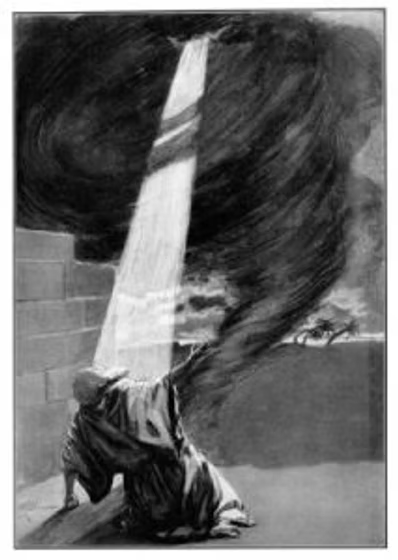
To select ten verses here makes one focus on the magnitude of the Creation, which only God could achieve. One human being then becomes infinitesimally small in comparison. Still, for God to speak to Job from a storm of high winds, one knows that God had not forsaken Job, and Job had never once turned away from God. The love of God never waned as God was one with Job, throughout all his misery.

As an option to be chosen from two readings from 1 Samuel 17, where David and Saul are the characters of focus, Job shows how little faith Saul had in God, and how David was a model of Job. In a Sunday schedule after Pentecost, where the Gospel reading from Mark focus on a storm that threatened the disciples of Jesus, while he slept on the boat, the disciples moaned and groaned like Job, while Jesus responded like God, asking, “Why are you afraid? Have you still no faith?” The lessons all center on the patience of faith, which is why the lesson of Job is the patience he had, always maintaining deep faith and love of God, despite the storm that came upon his flesh.

In this Pentecost season (Ordinary Time), when one’s personal ministry should be underway, it becomes important to see just how small and insignificant oneself is, in the grand scheme of God’s plan. This is why one must die of self-ego and sacrifice all concept of “I,” because “I” will always begin to tremble and shake at the first sign of enormous troubles. When the “I” is removed and God sits upon the throne of one’s heart, there is nothing to fear but that of losing the love of God. Without the “I” limitations, one becomes as great as God.

This means the lesson here is to realize that power is within one’s being, so no matter how hard one’s time on earth might become, it is always a test of one’s patience, knowing Satan is the cause and even if death occurs, the soul will have gained eternal life in Heaven with God. Thus, one can only do what God leads one to do, knowing that if persecution or hardships are along that path, then it is for making one better for the experience.

In ministry to the LORD, Satan will set traps in all the places one least expects to find trouble.

He does that as a test of one’s faith. If Satan will test Jesus, he most certainly will test one who is working towards gaining the love of God and baptism by the Holy Spirit. We are always tested before we gain the right to be in the name of Jesus Christ. The span of forty days demands patience. Becoming a most righteous man or woman is not a sprint, but an endurance race, with twists and turns and hurdles. Faith is what always wins that race and gains one marriage to God.

If God can create the universe and set the earth’s foundation among the morning stars, then God can transform a disciple into an Apostle. God has the ability to change a mortal being’s soul into everlasting happiness, by joining the spirit of Jesus Christ with one’s soul. It will not happen when “I” thinks it should. It will only happen through a test of one’s faith.

#Job38111 #PatienceofJob #trapsofSatan

Job 38:1-7, [34-41] – Gird up your loins like a man

The Lord answered Job out of the whirlwind:

“Who is this that darkens counsel by words without knowledge?

Gird up your loins like a man,

I will question you, and you shall declare to me.

“Where were you when I laid the foundation of the earth?

Tell me, if you have understanding.

Who determined its measurements—surely you know!

Or who stretched the line upon it?

On what were its bases sunk,

or who laid its cornerstone

when the morning stars sang together

and all the heavenly beings shouted for joy?

[“Can you lift up your voice to the clouds,

so that a flood of waters may cover you?

Can you send forth lightnings, so that they may go

and say to you, ‘Here we are’?

Who has put wisdom in the inward parts,

or given understanding to the mind?

Who has the wisdom to number the clouds?

Or who can tilt the waterskins of the heavens,

when the dust runs into a mass

and the clods cling together?

“Can you hunt the prey for the lion,

or satisfy the appetite of the young lions,

when they crouch in their dens,

or lie in wait in their covert?

Who provides for the raven its prey,

when its young ones cry to God,

and wander about for lack of food?”]

———————————————————————————————————-

This is an optional Old Testament selection from the Episcopal Lectionary for the Twenty-second Sunday after Pentecost, Year B 2018. In the numbering system that lists each Sunday in an ordinal fashion, this Sunday is referred to as Proper 24. If chosen, it will next be read aloud in an Episcopal church by a reader on Sunday October 21, 2018. It is important because God finally responds to Job, not only showing that patience is indeed a virtue but showing why Job was a righteous man that God knew would pass Satan’s test.

The last we read from the Book of Job (the previous Sunday, Proper 23), it was from chapter 23. Now, we have moved ahead to chapter 38. In between three friends came to counsel Job, basically saying no true God would punish the righteous. Then, from out of nowhere, comes this person named Elihu, who rebukes those three, saying there is good reason for the righteous to be punished, because it can prevent sin.

When Elihu spoke, everyone listened.

The character named Elihu is questioned by modern scholars, as possibly a late addition to the book, because Elihu was not mentioned early in Job and he is not mentioned after his monologues cease. Elihu spoke in the last part of chapter 34 and all of chapters 35-37. Here, in chapter 38, is God finally responding to Job … not Elihu.

The name Elihu means “He Is My God.” This means Elihu is not a physical character, but the Holy Spirit within Job. It is the Holy Spirit within Job that has made him a righteous man, as no man alone it capable of withstanding the sufferings of a physical life without the presence and assistance of the Holy Spirit. Elihu is, therefore, the reason God accepted the challenge by Satan, because Satan was right that no ordinary man punished unjustly will remain faithful to God.

In the Gospel reading that this Old Testament reading is associated with, Jesus told James and John of Zebedee that no one can be allowed to sit at the right hand or the left hand of Jesus, to sit in his glory, because Jesus was not the one who could grant such a request. That had to come from God, and then it was only for those who had been prepared to receive His glory – the Holy Spirit. The Holy Spirit does not sit beside one, like Job’s three friends did, but within one, as Elihu did in Job.

Imagine yourself as the Temple-Tabernacle, with the Law written inside the ark in your heart, with the high priest being the Christ Mind that makes offerings at this holy altar inside you.

The Epistle reading that associates with this Old Testament reading is from Paul’s letter to the Hebrew-speaking Jews of Rome, when he told all Apostles there to have Jesus Christ as their high priest. Jesus Christ is not a high priest that is to the right or the left, or above in Heaven. Jesus Christ is one’s high priest when he has been resurrected within one’s being. As such, Elihu was the Christ Spirit within Job, meaning Job was a high priest according to the order of Melchizedek also.

When one sees Elihu as within Job, one can then see how chapter 38 is God’s response to Job, after Elihu had spoken through Job. When one sees how Elihu equates to Jesus Christ, Elihu is then relative to what John wrote at the beginning of his Gospel:

“In the beginning was the Word, and the Word was with God, and the Word was God. He was with God in the beginning. Through him all things were made; without him nothing was made that has been made.” (John 1:1-3)

When one reads this response by God, realizing that Job had “the Word” within him, a whole new light shines. The Hebrew word translated as “darkens” (“maḥ·šîḵ,” rooted in “chashak”) also means “hides, conceals, or obscures.” As such, the first question asked by God is, “Who is this that conceals counsel by words without knowledge?”

The answer is now understood to be:

“The high priest Elihu speaks the Word within thy servant Job, who has no opinion of his own to voice.”

The question that follows, “Where were you when I laid the foundation of the earth?” is now answered by Elihu, who strengthened the man he was within, so the answer would be, “I was with you Father, in the beginning.”

The whole of this reading changes complexion. It ceases to sound like Angry God, who was perturbed that the mortal He knew [God is omniscient] would not succumb to the sores of Satan, unjustly.  Job would not lose faith because of Elihu being with Job.  God knew that because God sent Elihu to be in Job.  The whole of this chapter now sounds like Loving God having a nice chat with His Son, the High Priest in Job.

Hey Son. Finger bump!

As an optional Old Testament reading selection for the twenty-second Sunday after Pentecost, when one’s own personal ministry for the LORD should be underway – one has the high priest Jesus Christ within one, bringing with him all the knowledge of God – the message here is to gird up your loins (regardless of one’s human gender) and find the strength of Christ within you.

As I write these interpretations week in and week out, I am able to churn them out regularly because I spend little time looking up what someone thought about this reading or that reading. If I had to depend on what someone else had to say, I would just let someone else say it and save myself a lot of time trying to duplicate what comes from the brains of others. Sometimes I recall a reading and bits of pieces of things I have written before, but I always approach a reading like it is the first time.

In this process (which is not some grand plan or checklist of intelligent things to do), I find myself going back in time, as though I lived the events of the reading. By feeling a part of the past, I am able to understand the past just like I understand the present. Insight whispers to me, saying “Look this up” or “Go over there.” I follow those leads and astonishing revelations come forth. The timing of the Age of Information helps a lot; but … without the Interlinear assistance of Greek translations (Greek is Greek to me), the ability to search ideas and concepts, people, places and thing I previously knew nothing about, God could certainly ask me, “Who is this that conceals counsel by words without knowledge?”

“Not I, Lord,” I would say. “You know that.”

“Lord, you know.”

What I find every time is amazing to me. I write these for my own benefit. It is a joy and a passion. I thank God for letting me use my computer to voice His Word.